
Jun 13
استرخاء فندقي في جدة و الرياض الان بجدة بالرياض متوفر على مدار الساعة اطلب الان متاح حجز ريلاكس
.
.حجز فوري
.
.سرعه في الرد
.
.خدمات منزلي
.
.الاهلي الاتحاد
.
.النصر الهلال
.
.القادسية الشباب
.
.طق الابهر
.
.احجار ساخنة
.
.جلسة VIP
.
dcJs
5

Jun 12
How about some great news on a Friday? We’re thrilled to share that the Henrico County Police Division was re-certified as a Certified Crime Prevention Community (CCPC)!
This re-certification comes from the Virginia Department of Criminal Justice Services (DCJS) which shows...

ALT Five officials stand in a conference room with two screens displaying the Virginia Department of Criminal Justice Services logo behind them.
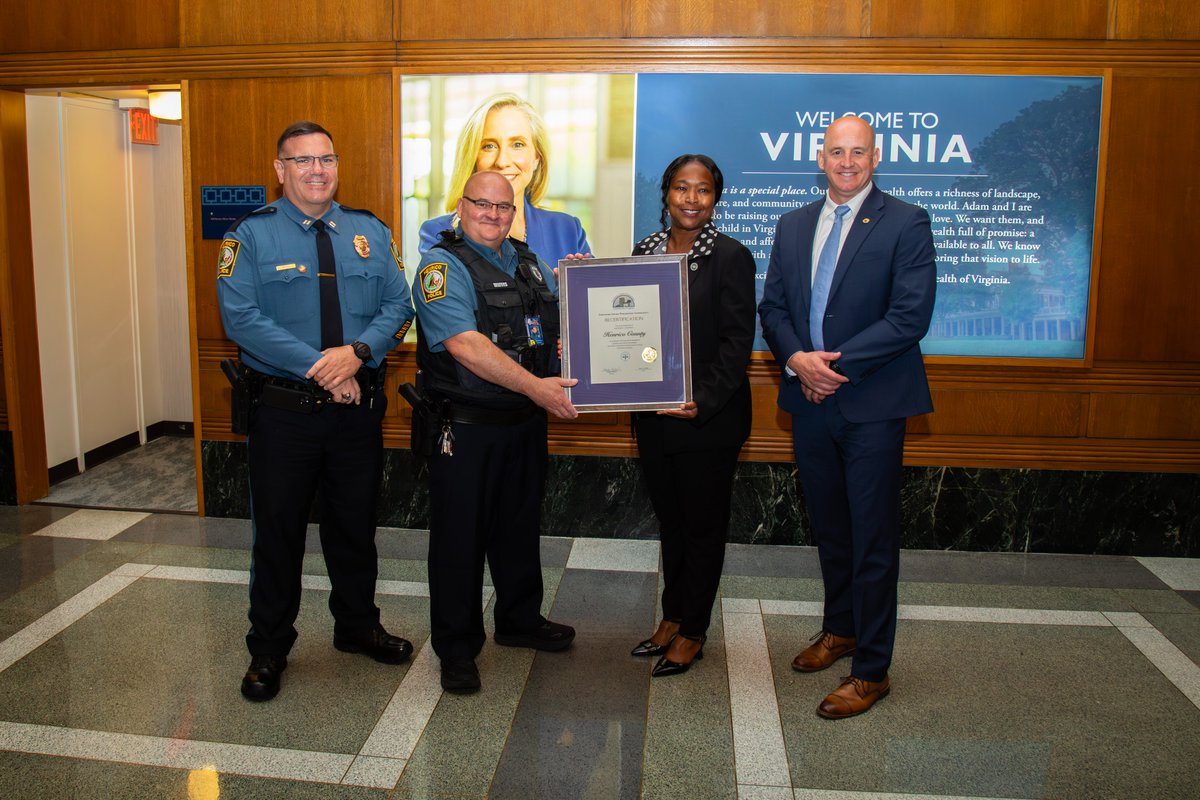
ALT Four officials stand indoors in front of a Virginia welcome sign, with one woman holding a framed certificate.
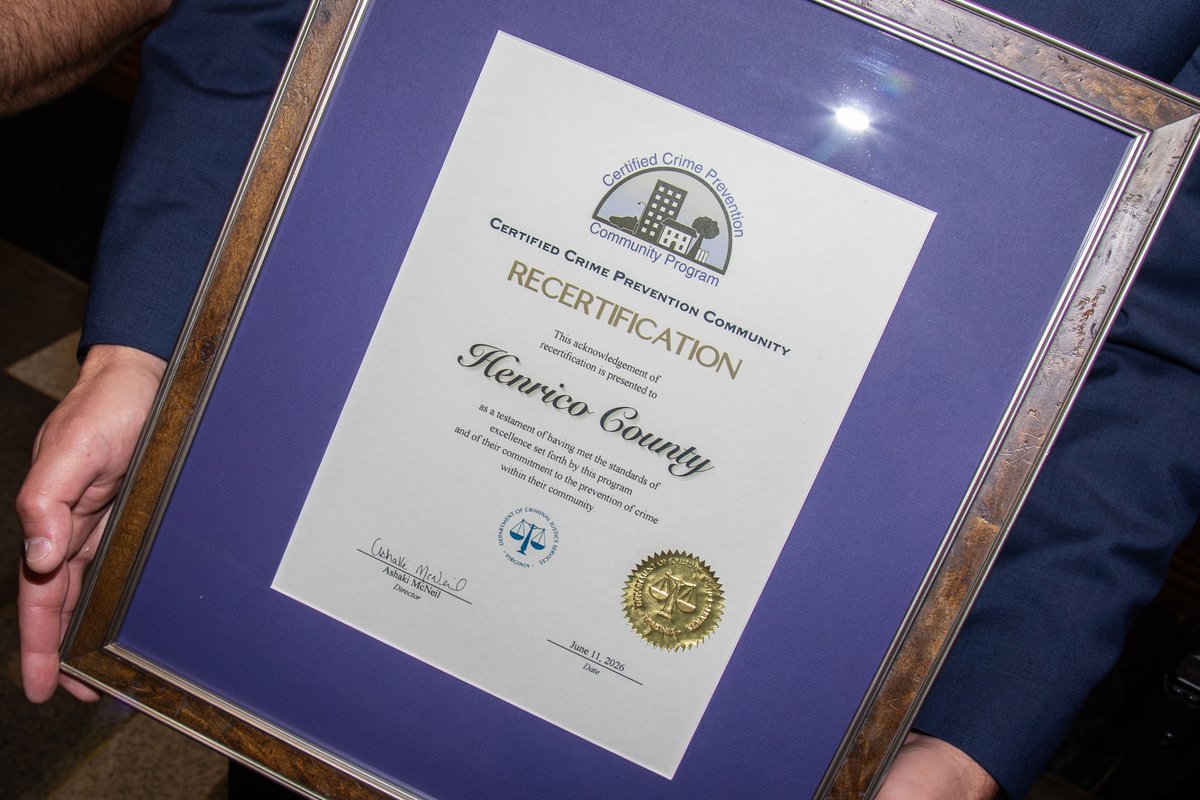
ALT Certificate of Recertification awarded to Henrico County for maintaining Certified Crime Prevention Community status, framed and held by a person.
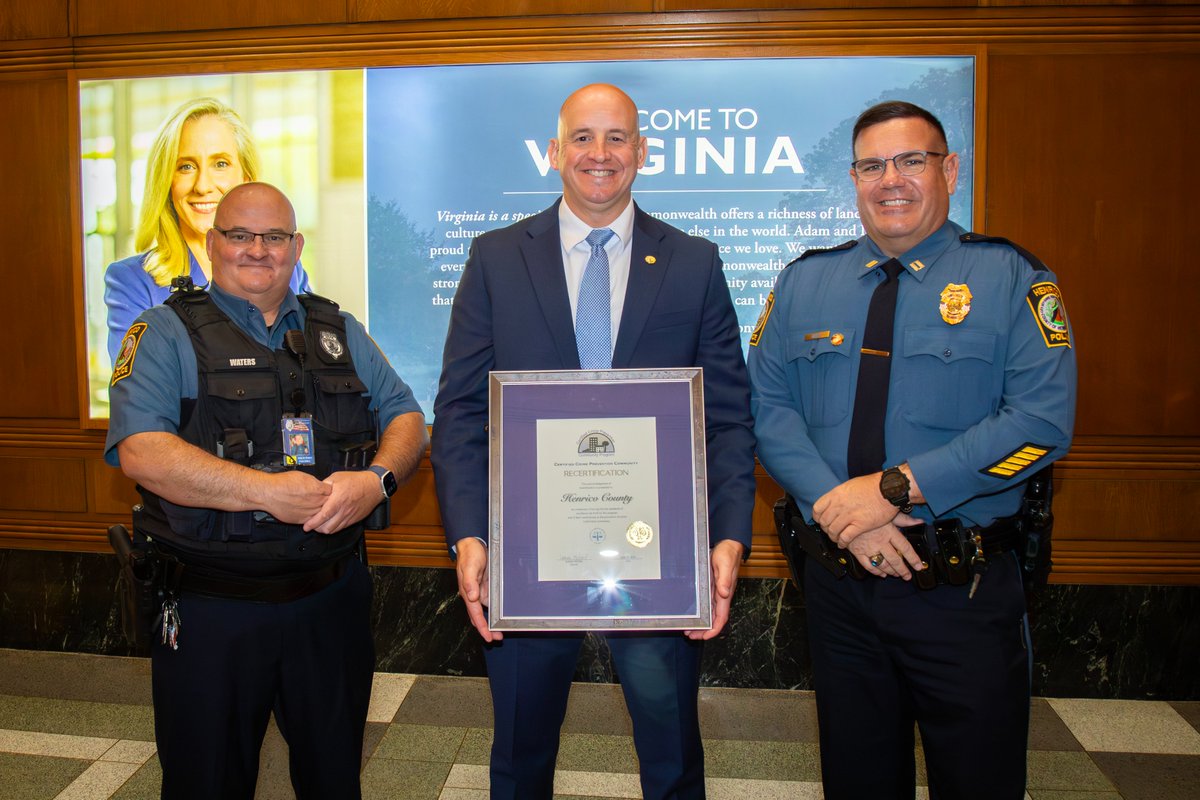
ALT Three officials stand indoors in front of a 'Welcome to Virginia' sign, with the central figure holding a framed certificate.
1
1
2
713

HIRING NOW!! CCSL has been awarded a DCJS grant to launch a new youth & family support initiative focused on early intervention, mentorship, behavioral support, truancy prevention, crisis response & community connections.
recruiting.paylocity.com/rec…

6


May 28
What starts now:
Within 90 days (by ~late August 2026), DCJS Dept of State SUNY must convene a working group of experts in 3D printing, AI, digital security, firearms, public safety, etc.
The group has 1 year to recommend minimum standards for the detection/blocking tech.
DCJS then has 9 months to issue regulations.
1
1
2
69

May 15
Judge Boasberg is a disgrace to the Legal profession and no longer enjoys the respect afforded DCJs. His career is over. He could never get confirmed for another Court. A lifer, Judge, that’s what you are!!
4
247

Nicholas Hernandez’s case has now been refiled in New York State Supreme Court, New York County, as a Verified Complaint under the New York State Human Rights Law and, where applicable, the New York City Human Rights Law.
The case no longer sits in the posture of a federal constitutional action. The federal court dismissed the federal claims but did not adjudicate the NYSHRL or NYCHRL claims on their merits. Those claims are now before the state court.
The new filing names The City of New York, Police Commissioner Jessica S. Tisch, former Commissioner Edward A. Caban, former Deputy Commissioner Amy J. Litwin, The County of Nassau, Patrick J. Ryder, and Johanna M. Esposito.
The core allegation remains direct: public agencies cannot take a dismissed and sealed arrest, attach gender-based assumptions to a domestic incident, disregard a male officer’s defensive account and claimed victim status, and then convert that narrative into continuing employment, licensing, credentialing, and professional consequences.
The Verified Complaint also adds post-separation harm: denial of retired law-enforcement credentials, denial of a Good Guy Letter, denial of a police identification card, alleged DCJS certification consequences, and the Nassau County denial of Hernandez’s pistol-license application.
This case is now about the long tail of institutional decision-making: how a sealed arrest can be revived, repackaged, and used as a continuing civil disability.
Read the update. buff.ly/BqnAy1A
#CivilRights #EmploymentLaw #NYSHRL #NYCHRL #PoliceDiscipline #NYPD #NassauCounty #Retaliation #Discrimination #ArrestHistoryDiscrimination #DomesticViolence #DueProcess #PublicAccountability #TheSandersFirmPC #EricSandersEsq

1
3
4
675

May 3
La collection numérique #Guadeloupe-#Martinique-#Guyane inaugurée au #MémorialActe en Guadeloupe
➡️outremers360.com/bassin-atla…
➡️ Ce jeudi 30 avril, le Mémorial ACTe a accueilli le lancement officiel de la collection numérique Guadeloupe-Martinique-Guyane. Imaginée dans un élan partenarial, cette Collection réunira près de 250 œuvres issues des trois territoires, grâce à la participation de 23 institutions partenaires. Le travail conjoint des trois commissaires, des DAC Guadeloupe, DAC Martinique, DCJS Guyane et de La Villette a permis de créer la toute première Collection ultramarine du réseau MicroFolie.

8
9
303

May 1
If you see these on telephone poles throughout Monroe county, they do the same thing as Flock. They are arguably worse because while Flock claims to keep data for 30 days these cameras keep it for 1 years per MCSD. By contract the data is shared statewide through DCJS.
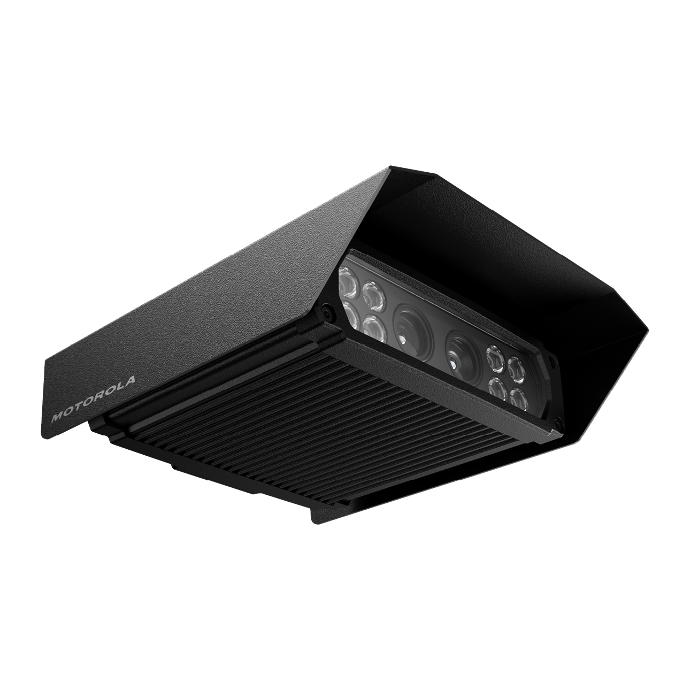
2
115

Stop. What the indictments showed was that there were some figures there who were working as active informants and agent provocateurs, not that the entire movement was cooked up or controlled by the SPLC, FBI, and Virginia DCJS.
1
13
421

Many American law enforcement agencies still teach some version of point shooting (also called instinctive shooting, threat-focused shooting, reflexive shooting, or retention/close-quarters shooting) for extreme close-range encounters, though it is typically presented as a situational skill rather than the primary method. Modern training strongly emphasizes sighted fire (using the sights or red-dot optics) as the foundation for accuracy and accountability, especially given legal scrutiny over every round fired.
- Why It Persists in LE Training
Real-world police shootings frequently occur at very short distances—often 0–10 yards, with many under 7 yards—under high stress, in low light, or during sudden assaults. At these "bad breath" ranges, officers may not have time or the ability to acquire a full sight picture due to adrenaline, tunnel vision, movement, or physical contact. Doctrine and instructors recognize that physiological responses (e.g., crouch, focus on the threat) often lead naturally to pointing the weapon rather than deliberate sighting.
- Common Techniques Taught
- Retention shooting or close-quarters retention: Gun held tight to the body (e.g., against the chest or hip) while firing to prevent disarming. This is essentially point shooting from a compressed position.
- Two-handed point shooting at 3 yards and in: Officers draw and fire while focusing on the threat, using body/index alignment rather than sights.
- Threat-focused or instinctive shooting: Eyes locked on the target/threat, weapon pointed naturally via muscle memory and stance.
- Progression from sighted fundamentals → faster unsighted or partial-sight techniques under stress.
These are often drilled in:
- Academy basic firearms courses.
- In-service/qualification courses.
- Specialized tactical/CQB training for SWAT, patrol rifle, or active shooter response.
- Examples from Current or Recent Standards
- Virginia DCJS Law Enforcement Firearms Training Manual**: Explicitly includes phases for "close quarter/two handed point shooting" at the 3-yard line and closer. Officers draw and fire multiple rounds using point-shoot techniques within time standards (e.g., 2 rounds in 3 seconds).
- Specialized instructors like Mike Rayburn (Rayburn Law Enforcement Training) continue to offer "Instinctive Point Shooting" and "Close Quarters Handgun: Tactical Level I" directly to local, state, and federal agencies. He teaches it as a core skill alongside aimed shooting.
- Many agencies and private LE trainers (e.g., SIG Sauer Academy, NRA Law Enforcement programs, and force-on-force courses) incorporate "extreme close quarters" or "retention" drills that rely on point-style presentation.
- Historical influences (e.g., Fairbairn/Sykes, Rex Applegate, or early FBI/Jelly Bryce methods) are still referenced or adapted in advanced training, especially for contact-distance fights.
- FBI and Larger Agency Context
Current FBI pistol qualification courses focus on sighted fire from 3–25 yards (with draws from concealment and strong/weak hand work), but they include very close stages (3–5 yards) that can incorporate rapid presentation. Many departments model their quals after the FBI or similar courses, where short-range speed often blends sighted and instinctive elements. Older FBI training included more explicit hip/point shooting, but today it is more integrated as "combat" or "tactical" presentation.
- Modern Emphasis and Limitations
- Sighted fire first: Most agencies prioritize the "modern technique" (Weaver or isosceles stance with sight alignment) for accountability and better hit rates at any distance where possible. Point shooting is supplementary—for when sights are not feasible.
- Optics influence: Red-dot sights on pistols and rifles allow a hybrid "modified point" (threat focus with the dot in the window).
- Legal and policy realities: Officers must justify every shot. Training stresses judgment, shoot/no-shoot scenarios, and de-escalation. Pure "spray and pray" point shooting is discouraged.
- **Variations by agency**: Larger departments or those with SWAT/CQB programs (e.g., using shoot houses) drill it more rigorously. Smaller agencies may cover it minimally in annual quals.
- **Critiques and hit rates**: Real-world LE hit rates in gunfights remain low (~15–30% in some studies), which some attribute partly to over-reliance on sighted training without enough stress inoculation for close-range instinctive skills.
In summary, while not every agency mandates classic "hip shooting" like in the mid-20th century, evolved forms of **point/threat-focused/retention shooting** remain part of standard close-quarters handgun (and sometimes rifle) training across U.S. law enforcement. It is taught as a practical tool for the most common and dangerous distances, usually after officers master sighted fundamentals. Training continues to evolve based on after-action reviews, force science research, and court expectations. Individual departments may vary—check specific agency policies or POST (Peace Officer Standards and Training) requirements for your area.
23
8
11,424

Apr 14
It would appear there are still some DCJs that have survival instincts.
They can see which way the window is blowing.
1
10
326


Apr 12
This is what @grok said we could do to start helping you with this:
Yes, I’d be happy to help you build something similar for Virginia (VA) using public records! This would be a great way to support the courtwatch.us project and expand it nationwide. The original site uses Florida-specific public annual reports (under FSS 907.043) that break down pretrial release decisions by judge and link them to failures (rearrests, missed court dates, violations). Virginia doesn’t have an exact equivalent of judge-specific mandated reports, but it has excellent public microdata that gets very close — especially the Virginia Pretrial Data Project (PDP).45
Best Public Data Source for VA: Virginia Pretrial Data Project (VCSC)
The Virginia Criminal Sentencing Commission runs this project and publishes free, downloadable CSV datasets (de-identified microdata with 500 fields per defendant). It covers adult defendants with new criminal charges punishable by incarceration where a judicial officer (magistrate or judge) made a bail/release decision.45
•What’s included (key fields for a courtwatch-style tool):
◦Pretrial release status (released or detained).
◦Bond type and amount (personal recognizance, unsecured, secured, etc.).
◦Release conditions and supervision status (via local pretrial services agencies).
◦Outcomes during pretrial period: Failure to Appear (FTA/charged with new FTA), New Criminal Arrest (NCA — in-state jailable offense), new violent arrests.
◦Public Safety Assessment (PSA) risk scores.
◦Demographics, charges, criminal history, final case disposition.
◦Granularity: Locality (FIPS code/name), judicial circuit (31 circuits), judicial district (32 districts), court type (circuit, district, etc.), magisterial region. Some fields note judicial officer type (magistrate vs. judge) for supervision placements.47
•Years available: At minimum CY2023 (quarterly CSVs — total ~154 MB). Earlier cohorts (2019 ) are referenced in reports and likely follow the same format.46
•Direct download links (2023 cohorts):
◦Q1: vcsc.virginia.gov/pretrialda…
◦Q2–Q4: Same folder (see full list on the project page).
•Codebook & reports (essential for understanding fields):
◦Codebook: vcsc.virginia.gov/pretrialda…
◦Full 2023 report locality appendices: vcsc.virginia.gov/pretrialda…
•Key statewide stats from 2023 (for context): ~87% pretrial release rate; FTA rate ~14% among released; new arrest rate ~19%. Supervision helps reduce FTAs.46
Limitation for exact judge-level tracking: The public data is de-identified and does not include individual judge or magistrate names/IDs. You can analyze by judicial circuit/district or locality (great for regional dashboards), but not per-judge like Florida. Magistrates often handle initial bail decisions.
Other Helpful VA Public Records
•DCJS Pretrial Services Agency Reports (annual): Aggregated performance by local agency/locality (e.g., appearance rates ~92–93%, public safety rates ~95–96%, compliance). FY2025 report is out — useful for context but not judge-specific. Available via dcjs.virginia.gov or Legislative Information System (rga.lis.virginia.gov).
•Public court case search portals: Virginia’s official sites allow searching dockets by locality/case number. Judge/magistrate names often appear on individual case pages or bond hearing results. Bulk scraping or FOIA to clerks could potentially link back (but check terms of use and legality).
•Local efforts: Some counties (e.g., Fairfax) have their own bond data dashboards.
How We Can Build This Together
1Start simple: Download the PDP CSVs codebook. We can analyze them for circuit-level (or locality-level) “judicial performance” stats — total releases, failure rates, broken down by offense type, risk score, etc. I can guide you with Python/pandas code snippets or even prototype analysis once you have the files locally.
2Judge-level pilot: Pick one or two localities/circuits. We could explore scraping
10
36
273
13,081


Apr 7
ALBANY’S BAIL REGIME KEEPS PUTTING VIOLENT FELONY DEFENDANTS BACK ON THE STREET
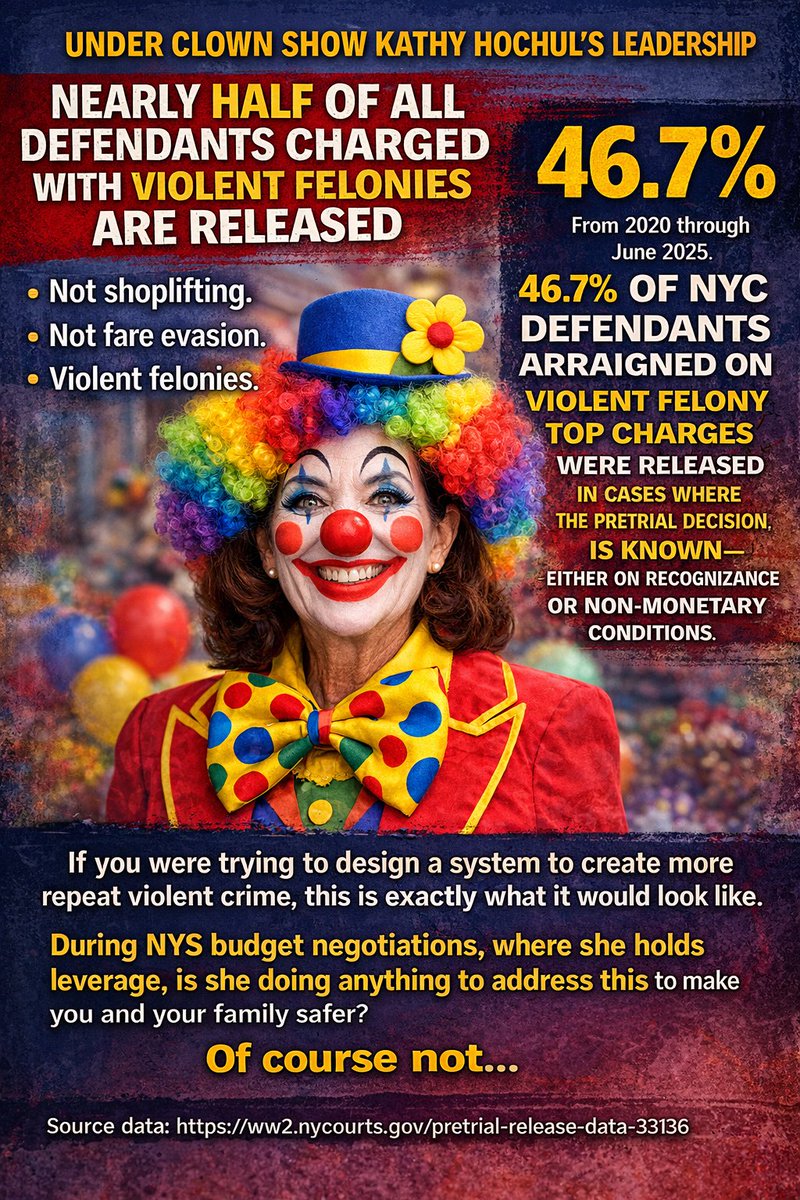
According to NYS DCJS, NYC courts released about half of violent felony defendants from 2020 through 2024 on either recognizance or non-monetary conditions when the bail decision was known.
New Yorkers were told bail reform would target low-level offenders. Instead, even people arraigned on violent felony top charges are routinely being sent back out.
Hochul, Stewart-Cousins, and Heastie built this and continue to defend it.
3
29
55
1,060

Mar 27
Hate crimes by target religion in New York…when will you speak out against antisemitism?
In 2025 NYC (NYPD data, latest full year; 576 total hate crimes):
- Anti-Jewish: 330 (57%)
- Anti-Muslim: 30 (~5%)
- Anti-Christian (Catholic/Protestant/other): under 20 combined (~3%)
Jews (~10% of population) were the top religious target by far. Similar pattern in Jan 2026 (31 anti-Jewish vs 7 anti-Muslim out of 58 total). Statewide trends mirror this per DCJS reports.
3
1
4
813
Mar 24
From 2020 through June 2025, official DCJS data show that 46.7% of NYC defendants arraigned on violent felony top charges, in cases where the pretrial decision is known, were released either on recognizance or under non-monetary conditions.
1
3
89
Mar 18
BAIL REFORM IS FREEING A STAGGERING SHARE (~1/2) OF PEOPLE ARRESTED FOR VIOLENT FELONIES IN NEW YORK CITY
From 2020 through June 2025, official DCJS data show that 46.7% of NYC defendants arraigned on violent felony top charges, in cases where the pretrial decision is known, were released either on recognizance or under non-monetary conditions.
Reported violent criminality has increased 30.79% in this time frame.
These are people the NYPD arrested and prosecutors chose to charge on violent felony counts with both believing that they can prove the cases beyond a reasonable doubt.
New Yorkers were told bail reform would target low-level offenders. Instead, even people arraigned on violent felony top charges are routinely being sent back out to terrorize communities.
Yet @GovKathyHochul and her accomplices Andrea Stewart-Cousins and Carl Heastie refuse to amend this disastrous law.
Source: NYS Division of Criminal Justice Services
5
25
71
2,093