

From romance scams to grandparent scams, fraudsters are devising tactics to defraud senior citizens. Find out how to start a conversation that could protect your loved one's sensitive information and assets in this article. livesocial.seismic.com/4y51f livesocial.seismic.com/tLw_1…


Understanding metastasis by devising poorly defined concepts?
Nobody knows what is EMT, incl. specific markers, reg. nets, cellular properties, etc.
How about MTM? specific markers, reg.nets, cellular properties, etc.
If unknown, what it can help, like EMT? @CellCellPress

In the latest issue! A 3D morphogenetic blueprint for metastatic outgrowth in breast cancer dlvr.it/TT3Tw6
1
12

>”real organizing is usually one guy..”
No, it’s not. That’s working, not organizing.
>”and when everyone shows up…”
This is fantasy talk. It’s like saying “when I have a billion dollars.” People, like money, don’t just show up on their own, out of the ether. Someone, usually a group of men, have to go get them.
You do so by forming a group with trusted associates, devising a plan, delegating tasks, building a product, constantly adjusting to the market, and continuing to expand your group at a rate that doesn’t require you to compromise on quality, while balancing against the scale of your competitors.
Michael Collins is useful, when he has the IRA. Otherwise, he’s just a guy playing pretend.
5
262
Larry G Warner lost in a world I don't even know s retweeted

Jun 14
x.com/historyrock_/status/20…
Thanks to Allen Collins for devising that amazing guitar solo!!!
Jun 14

Free Bird is probably Lynyrd Skynyrd’s best song. The guitar solo is simply legendary, it’s impossible to stay still while listening to it!! 🤘🏻

3
19
80

Minjae devising his prankster plan since he wasnt scared at all during their horror school ep 🤣


71

Because Ghost and Price were devising methods to get rid of the colonel without arousing suspicion, Horangi was devising plans to mark his personal territory.
39
279

That is exactly what he said!
You are focusing on Islam instead of devising means of growing your religion.
Muslims are growing their religion with system they devised. You are growing yours by complaining about Muslims system.
😂😂😂😂😂😂😂😂😂😂😂

3

How Jimmy Carter Betrayed the Shah, by John Rees
The Review of the News (a John Birch Society publication), February 21, 1979
Iran was for 20 years the keystone of America’s strategy in the Middle East and a major factor in the economic stability of the Free World. But, in the two years and two months of the Carter Administration, it has ceased to be an ally and is now immersed in anarchy and chaos for which the U.S. President bears the major responsibility. Not since the fall of the Nationalist Government in China has an American Administration committed so damaging a betrayal of a major ally.
What has happened in Iran threatens the entire world balance of power and the economies of the West, and it has come about only because the Carter Administration allowed itself to be used in a program crafted by the Kremlin to destabilize Iran. In the words of a senior Iranian diplomat in Washington, “President Carter betrayed the Shah and helped create the vacuum that will soon be filled by Soviet-trained agents and religious fanatics who hate America.”
The vital importance of Iran to the Free World is the result of a number of factors including:
· Its geographic location on the southern border of the U.S.S.R. where it is the eastern gateway to the Middle East;
· Its oil fields which are the source of between 70 to 90 percent of the oil imported by the countries of Western Europe, Japan, Israel, South Africa (and Rhodesia); and which were growing in significance as a source for U.S. oil imports.
In terms of the Free World’s defense strategy, Iran has long been of critical importance. Iran and Turkey are the Middle Eastern members of the C.E.N.T.O. alliance for regional security. From Iran, highly sophisticated electronic-intelligence listening posts, equipped and manned by the National Security Agency, have monitored military activities in the Soviet Union. These have grown to critical importance since the U.S. decided to take the Greek side after the Cyprus invasion and, in retaliation, Turkey shut down all U.S. bases and electronic posts on her territory and moved so far toward an accommodation with Moscow as to sign a friendship and cooperation agreement with the Soviets.
Even more important, the Shah’s well-trained and American-equipped Armed Forces were available to serve as the regional protector of the small, sparsely populated, but oil-rich countries along the Persian Gulf and Arabian peninsula which have been targets for both courtship and subversion by Moscow. Indeed, although there was some tension between Iran and Saudi Arabia (based in part on the fact that they epitomize the two divisions of Islam), the Iranian military had already proved its effectiveness in Oman where at the invitation of Sultan Qabus the Shah’s troops wiped out a Marxist terrorist organization and drove its stragglers back to sanctuary in the neighboring People’s Democratic Republic of Yemen (P.D.R.Y.).
The P.D.R.Y. has been intimately collaborating with the U.S.S.R. since the British abandoned Aden. Its revolutionary Marxist Government has been on excellent terms with Libya, that other revolutionary socialist Islamic republic, and with the Marxist regimes in Algeria and Iraq. These countries have worked to assist Soviet maneuvers in the Middle East, providing training bases, arms, passports, and other logistical support for terrorist groups ranging from Africa and the Middle East to Europe. The West German Baader-Meinhof gang, “Carlos the Jackal,” and factions of the Palestine Liberation Organization (P.L.O.) have all had the use of Libyan and P.D.R.Y. facilities. Members of the two chief Iranian terrorist groups, one Marxist-Leninist and the other “Islamic-Marxist,” have received training in the P.D.R.Y., Libya, Iraq, and Cuba.
Mere collaboration with the Communists does not make a regime immune from a coup to install a totally controlled gang of Soviet agents. The P.D.R.Y.’s collaborationist Government was overthrown by a Soviet-controlled regime last summer, opening Aden to the Warsaw Pact and Cuban forces as a staging area for operations in Ethiopia. The recent coup in Afghanistan, the attempted coup in Iraq, the civil war in Lebanon, the growing disorders in Turkey, and what is happening in Iran show that an all-out Soviet offensive is underway to capture the entire Middle East for the Communist camp.
With a hostile, anti-Western regime in Iran, the pressure against Saudi Arabia, Jordan, the Arab Gulf countries, and Egypt will increase dangerously.
That this was allowed to happen is from a strategic point of view unthinkable. From a political point of view it is even worse. Under the direction of its able monarch Iran had been transformed in a single generation from a near-feudal agricultural society to an urbanized, burgeoning, industrialized, and modem country with an increasingly Western character. This program of industrialization was carried out under the personal direction of the Shah. His plan was to make Iran a technologically advanced, economically diversified, and self-sustaining nation so that in the next century when the oil ran low Iran would not go into an economic decline and return to the dark ages.
There can be no question that the Shah took his position as a ruling monarch very seriously, shouldering moral and economic responsibility for the emerging Iranian people. Clearly he tried to bring to Iran the best of what Western societies had to offer. And not merely in the material sense. Among the Western concepts and developments he had written into law in Iran were the principles of religious toleration, separation of church and state, and expanded legal and political rights for women. Education was pro-vided for both women and men, and an advisory parliament was set up to which, over the years, additional powers were granted.
These programs were anathema to the fanatical elements of the Shi’ite Moslem clergy who had come to exercise vast power over the peasants because of their enormous land holdings. As in Western Europe during the 13th and 14th Centuries, persons attempting to ensure their salvation had bequeathed land, houses, jewels, and money to the Shi’ite mosques, monasteries, and religious centers. With richness and temporal possessions came temporal authority. But the heart of the Shi’ite clergy’s power was control of land in an agricultural society where their economic strength enforced “piety” and obedience to their religious orders. All of the Shah’s efforts at industrialization and modernization were therefore viewed as a direct threat to the Shi’ite mullahs - who easily rationalized this as an attempt by the Christian countries to subvert Islam by technology. The resulting hatred of the West led the Shi’ite clergy to collaborate with the Soviet Union and the Communists in Iran.
The Shah particularly cut into the power of the Shi’ite clergy with a land-reform program in which large estates (including those of the Shah and his family) were broken up and given to landless tenants. The compensation paid to both the secular and clerical landowners never made up in their view for loss of the power they once held over their former tenants. Thus the Shah was seen as a man to be destroyed by the West-bating Shi’ite Moslem clergy, their fanatical followers, and the Marxists and Communists organizing among the Iranian intellectuals, students, and industrial workers.
The Soviets realized that by destroying the Shah they might gain unhindered access to their client states of Syria and Iraq; access to the warm-water ports of the Persian Gulf; control of the Strait of Hormuz between the Persian Gulf and the Gulf of Oman, through which move the tankers carrying oil from Saudi Arabia, the United Arab Emirates, and Iran; and, control of Iran’s own vast energy resources of oil and natural gas. And, of course, such a coup would also bring benefits to the radical Arab states which have aligned themselves with the Soviet Union - Libya, Syria, Algeria, P.D.R.Y., and Iraq. In addition, a militant anti-Western regime in Iran would immediately cut off oil shipments to Israel and South Africa.
As the Shah moved to control these groups who have perennially plotted revolution against him, and to maintain his long-established friendship with the Free World, Jimmy Carter entered the White House and global politics underwent a drastic change.
Soon after President Carter took office in January 1977, reports began to circulate of major domestic political concessions being made by the Shah in response to demands by the Carter Administration. In effect, radicals around President Carter were seeking to impose the “anything goes” political system of the United States in the late 1970s on a country that had been partially occupied by the Red Army during World War II; which had to put down a Communist Government in its Azerbaijan province set up by Stalin’s minions; which had a long border with the U.S.S.R.; which barely escaped a Communist takeover in the early 1950s; which had no tradition of Western political freedoms; and, which was in the throes of a drastic social and economic transformation from feudalism.
In the name of “human rights” the Carter radicals were out to destroy the most progressive ruler in Iran’s history and turn his throne over to a gang of fanatics out of the dark ages as a prelude to Communist takeover.
By linking various demands to the sale to Iran of sophisticated military hardware and the training of Iranian military technicians and pilots, the radical Carter team began a campaign to “destabilize” the Shah’s Government. In chronological sequence, the successful betrayal went like this: First, pressure was applied to release from prison many of those who had plotted to overthrow the Shah, including members of terrorist groups. After all, the Carter State Department, Amnesty International, and Moscow Radio all agreed that these were “political” prisoners. Next, pressure was applied to alter the Iranian judicial code so that terrorists and subversives were no longer tried by military courts but in civil jurisdictions. Defendants and their supporters quickly commenced the sort of propaganda activities seen in Western countries when the authorities attempt to prosecute revolutionaries. Third, pressure was applied to institute guarantees of American-style “free assembly,” that would allow organization of open meetings calling for the overthrow of the Shah’s Government. And, fourth, “opposition tendencies” in the ruling Rastakhiz (Renaissance.) party were encouraged by the United States.
The Shah’s concessions to U.S. “human rights” pressure in order to obtain vital military equipment were, of course, perceived as weakness not only by his enemies among the Communists and the mullahs, but also among his own supporters in the Rastakhiz party. The perception of weakness brought about quick escalation of challenges which the Shah and his Government were unable effectively to check be-cause of increasing “human rights” pressure from President Carter and his team of radicals. By the end of the summer of 1977, university students and followers of the Shi’ite clergy had begun staging street demonstrations on the campuses and in several Iranian cities. These were unchecked and escalated in violence. Some Iranians believe that this opposition to the Shah was actually organized by the Central Intelligence Agency at the order of President Carter. The Iranian magazine Khandaniha, for example, carried an article in its issue for December 16, 1978, which said that “Imam Husa Sadr was approached to take up the leadership of a new government, but, because of the vigilance of the Eastern bloc, this plan crumbled and the Imam vanished.”
In November 1977, the Shah and his Empress had made a state visit to Washington, D.C. They and all Iranians were given a clear message of the Carter Administration’s deep hostility when the Shah was “greeted” by President Carter as some 4,000 Marxist-led Iranian students brandishing clubs and the banners of Iranian terrorist organizations were allowed to mass within a hundred feet of the White House. Wearing masks to’ conceal their identities, these revolutionaries attacked both American and Iranian residents of this country who had peacefully assembled to welcome the Shah. Many people were injured, but only 15 of the rioters were arrested - and were then quickly released.
The failure to interfere with these violent demonstrations, virtually on the White House lawn, was seen as the clearest of signals that the Carter Administration was willing to see the Shah and his Empress insulted, even directly assaulted by tear-gas, in the streets of the American capital. Obviously Carter was not committed to the survival of the Shah and his pro-American Government. Again quoting from the Khandaniha:
“Before that latest trip, the Shah had traveled several times to the U.S.A. without encountering any demonstrations of Iranian students residing in the U.S.A.... By contrast, during the Shah’s most recent trip such demonstrations (which included Iranians re-siding in Canada and Europe) were not only permitted, but perhaps even encouraged by CIA officials.”
As The Review Of The News reported November 30, 1977, White House media czar Jody Powell had instructed the police “that strict enforcement might make America look like a ‘police state.’ “ In short, the riot against the Shah was a calculated insult designed to reinforce Carter’s radical demands. And, while President Carter and his advisors were urging the Shah toward still more radical and revolutionary changes and concessions in the fabric of Iranian society, the Soviet Union was moving every bit as rapidly to mobilize its long-constructed networks of subversion, sabotage, espionage, and terrorism in Iran.
Viewing revolution in the whole region as an interrelated drama, Moscow now held the dress rehearsal. In April 1978, the Free World suffered a major defeat when the leader of the Communist party. of Afghanistan, the Khalq or “Masses” party, seized control of Iran’s eastern neighbor in a bloody coup and established a Marxist-Moslem dictatorship. Just as Soviet agents long planted among the Shi’ite Moslems of Iran would soon do, the Afghan Communist despot Nur Mo-hammed Taraki called for a “jihad” (holy war) against those he designated as false Moslems or “Ikhwanu Shaya-teen.’’ The latter means “brothers of devils” and is a phrase from the Koran applied by the Afghan Reds to all who oppose the transformation of Afghanistan into a Soviet satellite. It became plain that the Communists had been busy devising a Marxist “liberation theology” for Islam, just as they had done for Christianity and other religions targeted for subversion.
But the capture of Afghanistan provoked no reaction from the Carter Administration and Washington continued to pump dollars to the new Communist regime. This confirmed to the Kremlin that it was in sufficient control of U.S. foreign policy to prevent a response to Soviet aggression in the Middle East, just as it had prevented resistance to Soviet aggression in Africa. A de facto U.S. policy of non-intervention against Communist aggression, even to defend the source of oil and natural gas on which the countries of the Trilateral Commission - North America, Western Europe, and Japan - depend for their economic and military strength, made clear to Moscow that it was free to act at will in Iran.
With the Kremlin’s puppet Taraki in control of Kabul, a flood of Soviet-trained agents moved across the border into Iran to infiltrate the mosques, the schools, the Shi’ite monasteries, the bazaars, and the oil fields. By November 1978, there were an estimated 500,000 illegal Afghan immigrants in Iran, in most cases virtually indistinguishable from Iranians living in the eastern provinces. The K.G.B., which had taken control of Afghanistan’s secret police, set up large training camps for Iranian terrorists.
Of course the subversion of Iran by Communist agents had been going on for some time. Over the past decade a large number of Soviet intelligence officers from both the K.G.B. and the G.R.U. have been caught and expelled from the country by the Iranian security authorities. Reports show that there have been as many as 4,000 Soviet technicians in various jobs in Iran and another 1,000 from other Communist countries in Eastern Europe. How many of these also had K.G.B. or G.R.U. duties in the subversion of Iran we do not know precisely; but it is a matter of record that the K.G.B. has used as “cover” such organizations as the Irano-Soviet Cultural Society, the local offices of the Soviet news agency Novosti, the Soviet trade mission in Teheran, Soviet consulates in large Iranian cities, a Soviet-owned trans-port company, and the Soviet hospital in Teheran.
With these resources, assisted by indigenous agents and Iranians in high military and administrative positions whom the K.G.B. had either black-mailed or bought, the Soviet Union commenced a sophisticated political-warfare operation against the Shah in late 1977. A new publication of the Iranian Tudeh Communists, called Nauid (Good News), began to appear weekly in Teheran. A high-quality pro-duction in contrast to the sleazy mimeograph tracts put out by the other Leftist and terrorist groups, Nauid has been able to respond to the swiftly moving political events in Iran, often bringing out special editions on the eve of major strikes and demonstrations. Its pages reflect the line of the clandestine National Voice of Iran (N. V1.) broadcasts from Baku on the Caspian in calling upon the Iranian military to mutiny against the Government and for general strikes. Nauid has frequently used forgeries intended to inflame its targets and began carrying fake proclamations by spurious “rank-and-file” Iranian military groups urging desertion and mutiny. It carried phony accounts of mutinies for months before the recent outbreak of dissension in the Iranian Air Force.
This Communist publication has been publishing the Tudeh party’s call for formation of an “anti-dictatorial broad front,” the same sort of maneuver the Communists are using in Nicaragua, The Philippines, and other countries. In an effort to win over the Shi’ite clergy, the Tudeh Communists have said that the ayatollahs and mullahs must play the “vanguard role” in this movement. In a June 1978 edition of Nauid, the Communists offered to place all of their very considerable propaganda, political, and technical resources at the service of this front. Nauid pointed to the “benefits” that have accrued to the fundamentalist Islamic and socialist Government of Libya and to the terrorist “freedom fighters” of the P.L.O. as a result of their cooperation with the Soviet Union, suggesting that similar “benefits” could come to Iranians who joined the ranks of Communist collaborators. Not surprisingly, all available evidence points to the fact that Nauid is produced in the Soviet Embassy in Teheran on its modern printing press, and that it is the voice of the K.G.B.’s covert political action agents when these can be distinguished from the voice of the Tudeh party puppets.
The alliance of “Islamic-Marxists” or “black and red revolutionaries” is not new in Iran. The largest Iranian terrorist organization, the Organization of Mujaheddin of the People of Iran (O.M.P.I.), originated in a 1963 at-tempt to overthrow the Shah in which Ayatollah Ruhollah Khomeini played a leading role. It has spoken of its members as Islamic-Marxists for the past nine years. Thus this unlikely union is not, as several U.S. commentators have claimed, an “invention of the Shah’s propagandists.” In fact the 4,000-member O.M.P.I. announced in 1976 that it had “joined the Marxist-Leninist revolution” in Iran and was hailed in welcome by its rival terrorist group, the somewhat smaller Organization of Iranian People’s Fedayeen Guerrillas. As violence in Iran continued to in-crease along with the evidence of Soviet involvement in destabilization and subversion, there was no response by the Carter Administration. In a recently released staff study by the House Select Committee on Intelligence, we find the following statement: “The attention of top policy makers was not brought forcefully on Iran until October 1978.” The House Intelligence Committee study contains a wealth of “evidence” to support this statement, but it makes no mention whatever of President Carter’s meeting with the Shah in November 1977 when it was already apparent that the Communists had targeted Iran for takeover and the violence had literally spilled onto the steps of the White House.
What, we may ask, does it take to obtain “the attention of top policy makers”? The fact is, alas, that those policy makers were well aware that the Reds were out to destroy the Shah and were trying to help them! The Washington Post of February 13, 1979, carries a column which reports that the Shah has told President Sadat of Egypt that C.I.A. set him up on orders of President Carter, and that the Shah had proof of this last spring.
As the Moslem-Marxist alliance gained momentum, a new forbidding figure became central to Iran’s tragedy, the 78-year-old Shi’ite religious leader Ruhollah Khomeini, who uses the honorific title “ayatollah” or “reflection of God” reserved for a handful of the most respected Shi’ite mullahs or “masters” of the Koran and Islamic precepts.
This month Khomeini, whose brother had been imprisoned as a member of the Communist party in Iran, returned from 14 years of political exile, all but the last few months in Communist Iraq, having maintained an implacable opposition not merely to the Shah but to the entire Iranian royal family, to the military which supports the Shah, and to the Constitution and the Government. During his exile, Khomeini issued repeated calls for revolution and the violent overthrow of the Shah. Khomeini says his goal is the creation of a revolutionary Islamic republic that will be anti-Western, socialist, and with the ultimate power in the hands of the chief ayatollahs.
In the words of Michael Ledeen, an expert on Iran at Georgetown University in Washington, D.C., there is ample evidence that Ruhollah Khomeini is “a clerical fascist, a violent anti-Semite and an intensely chauvinistic anti-American.” This evidence is not taken from any secret intelligence files, but from Khomeini’s own writings, lectures, and press interviews. As long ago as December 1968, in The Middle East magazine, Khomeini affirmed that the purpose of his Islamic republic would be completely to eliminate all Western influence from Iran. Apparently Communism is not considered a “Western influence” since Khomeini has repeatedly said during the past year that in his Islamic theocracy the Communists will participate as a legitimate political force.
Khomeini’s Islamic republic will seek to bring back to Iran the punishments established by Muhammad in the early 7th Century. These include 80 lashes for drinking alcohol; the public stoning of adulterers; cutting off a thief’s hand and so on. According to Newsweek, one of Khomeini’s close aides told their reporter, “you don’t cut off the whole hand - just the finger-tips.” The aide wanted to make clear that this is much more respectful of “human rights” than the Saudi and Libyan practice of hacking off the entire hand at the wrist.
So much for President Carter’s effort to destroy the Shah in the name of “human rights.” Clearly there is much more involved here.
In December of 1978 the Communist Tudeh party, which had been run from East Berlin by Iranian exile Iraj Eskandari, gave its tentative support to the Islamic revolutionary movement headed by Khomeini. The support was far too tentative for Moscow’s liking and it promptly sacked Eskandari. The new boss of Tudeh, one Nureddin Klanuri, immediately issued a statement which read, “The Tudeh Party approves Ayatollah Khomeini’s initiative in creating the Islamic revolutionary council. The ayatollah’s program coincides with that of the Tudeh Party.” The alliance was now a matter of public record.
Which came as no surprise to anyone, although the Carter Administration continued to pretend not to realize that Khomeini’s closest advisor, Sadegh Ghothzadeh, alias Asfahani, was well-known to the European intelligence community as a master revolutionary with tight links to the leaders of the French and Italian Communist parties. Asfahani, it develops, also works closely with the Libyan secret service, one of the K.G.B.’s most helpful collaborating agencies in the Middle East.
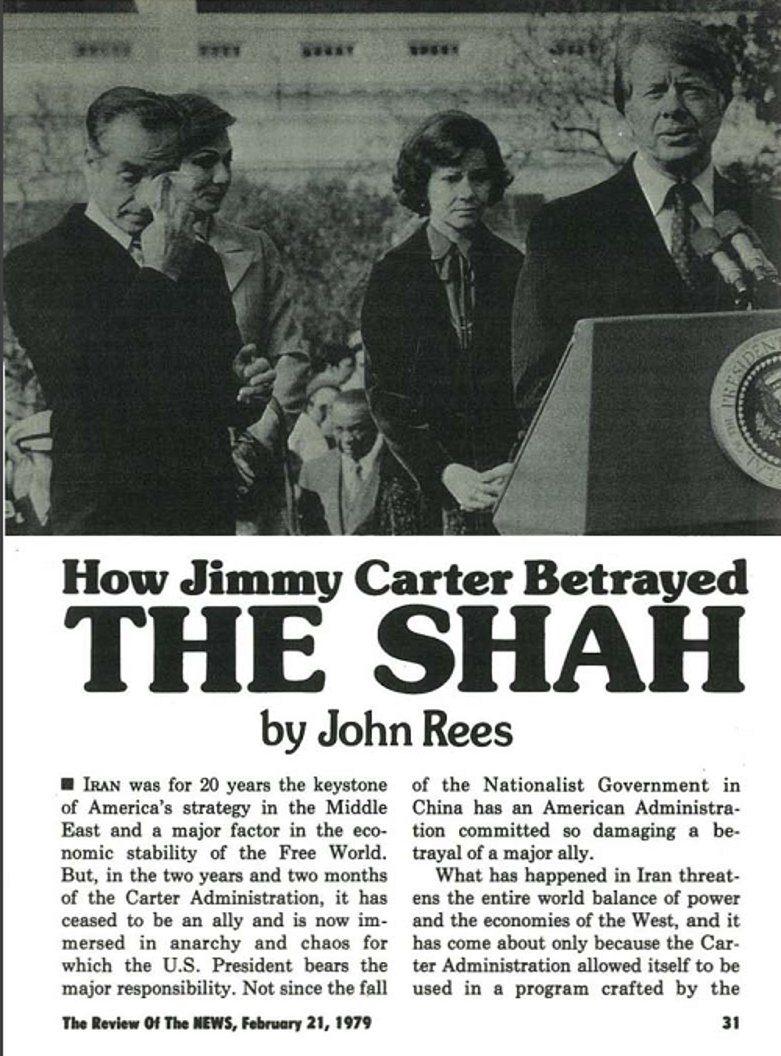
1
341
The complete article by John Rees in The Review of the News, February 21, 1979, "How Jimmy Carter Betrayed the Shah"
How Jimmy Carter Betrayed the Shah, by John Rees
The Review of the News, February 21, 1979
IRAN was for 20 years the keystone of America’s strategy in the Middle East and a major factor in the economic stability of the Free World. But, in the two years and two months of the Carter Administration, it has ceased to be an ally and is now immersed in anarchy and chaos for which the U.S. President bears the major responsibility. Not since the fall of the Nationalist Government in China has an American Administration committed so damaging a betrayal of a major ally.
What has happened in Iran threatens the entire world balance of power and the economies of the West, and it has come about only because the Carter Administration allowed itself to be used in a program crafted by the Kremlin to destabilize Iran. In the words of a senior Iranian diplomat in Washington, “President Carter betrayed the Shah and helped create the vacuum that will soon be filled by Soviet-trained agents and religious fanatics who hate America.”
The vital importance of Iran to the Free World is the result of a number of factors including:
· Its geographic location on the southern border of the U.S.S.R. where it is the eastern gateway to the Middle East;
· Its oil fields which are the source of between 70 to 90 percent of the oil imported by the countries of Western Europe, Japan, Israel, South Africa (and Rhodesia); and which were growing in significance as a source for U.S. oil imports.
In terms of the Free World’s defense strategy, Iran has long been of critical importance. Iran and Turkey are the Middle Eastern members of the C.E.N.T.O. alliance for regional security. From Iran, highly sophisticated electronic-intelligence listening posts, equipped and manned by the National Security Agency, have monitored military activities in the Soviet Union. These have grown to critical importance since the U.S. decided to take the Greek side after the Cyprus invasion and, in retaliation, Turkey shut down all U.S. bases and electronic posts on her territory and moved so far toward an accommodation with Moscow as to sign a friendship and cooperation agreement with the Soviets.
Even more important, the Shah’s well-trained and American-equipped Armed Forces were available to serve as the regional protector of the small, sparsely populated, but oil-rich countries along the Persian Gulf and Arabian peninsula which have been targets for both courtship and subversion by Moscow. Indeed, although there was some tension between Iran and Saudi Arabia (based in part on the fact that they epitomize the two divisions of Islam), the Iranian military had already proved its effectiveness in Oman where at the invitation of Sultan Qabus the Shah’s troops wiped out a Marxist terrorist organization and drove its stragglers back to sanctuary in the neighboring People’s Democratic Republic of Yemen (P.D.R.Y.).
The P.D.R.Y. has been intimately collaborating with the U.S.S.R. since the British abandoned Aden. Its revolutionary Marxist Government has been on excellent terms with Libya, that other revolutionary socialist Islamic republic, and with the Marxist regimes in Algeria and Iraq. These countries have worked to assist Soviet maneuvers in the Middle East, providing training bases, arms, passports, and other logistical support for terrorist groups ranging from Africa and the Middle East to Europe. The West German Baader-Meinhof gang, “Carlos the Jackal,” and factions of the Palestine Liberation Organization (P.L.O.) have all had the use of Libyan and P.D.R.Y. facilities. Members of the two chief Iranian terrorist groups, one Marxist-Leninist and the other “Islamic-Marxist,” have received training in the P.D.R.Y., Libya, Iraq, and Cuba.
Mere collaboration with the Communists does not make a regime immune from a coup to install a totally controlled gang of Soviet agents. The P.D.R.Y.’s collaborationist Government was overthrown by a Soviet-controlled regime last summer, opening Aden to the Warsaw Pact and Cuban forces as a staging area for operations in Ethiopia. The recent coup in Afghanistan, the attempted coup in Iraq, the civil war in Lebanon, the growing disorders in Turkey, and what is happening in Iran show that an all-out Soviet offensive is underway to capture the entire Middle East for the Communist camp.
With a hostile, anti-Western regime in Iran, the pressure against Saudi Arabia, Jordan, the Arab Gulf countries, and Egypt will increase dangerously.
That this was allowed to happen is from a strategic point of view unthinkable. From a political point of view it is even worse. Under the direction of its able monarch Iran had been transformed in a single generation from a near-feudal agricultural society to an urbanized, burgeoning, industrialized, and modem country with an increasingly Western character. This program of industrialization was carried out under the personal direction of the Shah. His plan was to make Iran a technologically advanced, economically diversified, and self-sustaining nation so that in the next century when the oil ran low Iran would not go into an economic decline and return to the dark ages.
There can be no question that the Shah took his position as a ruling monarch very seriously, shouldering moral and economic responsibility for the emerging Iranian people. Clearly he tried to bring to Iran the best of what Western societies had to offer. And not merely in the material sense. Among the Western concepts and developments he had written into law in Iran were the principles of religious toleration, separation of church and state, and expanded legal and political rights for women. Education was pro-vided for both women and men, and an advisory parliament was set up to which, over the years, additional powers were granted.
These programs were anathema to the fanatical elements of the Shi’ite Moslem clergy who had come to exercise vast power over the peasants because of their enormous land holdings. As in Western Europe during the 13th and 14th Centuries, persons attempting to ensure their salvation had bequeathed land, houses, jewels, and money to the Shi’ite mosques, monasteries, and religious centers. With richness and temporal possessions came temporal authority. But the heart of the Shi’ite clergy’s power was control of land in an agricultural society where their economic strength enforced “piety” and obedience to their religious orders. All of the Shah’s efforts at industrialization and modernization were therefore viewed as a direct threat to the Shi’ite mullahs - who easily rationalized this as an attempt by the Christian countries to subvert Islam by technology. The resulting hatred of the West led the Shi’ite clergy to collaborate with the Soviet Union and the Communists in Iran.
The Shah particularly cut into the power of the Shi’ite clergy with a land-reform program in which large estates (including those of the Shah and his family) were broken up and given to landless tenants. The compensation paid to both the secular and clerical landowners never made up in their view for loss of the power they once held over their former tenants. Thus the Shah was seen as a man to be destroyed by the West-bating Shi’ite Moslem clergy, their fanatical followers, and the Marxists and Communists organizing among the Iranian intellectuals, students, and industrial workers.
The Soviets realized that by destroying the Shah they might gain unhindered access to their client states of Syria and Iraq; access to the warm-water ports of the Persian Gulf; control of the Strait of Hormuz between the Persian Gulf and the Gulf of Oman, through which move the tankers carrying oil from Saudi Arabia, the United Arab Emirates, and Iran; and, control of Iran’s own vast energy resources of oil and natural gas. And, of course, such a coup would also bring benefits to the radical Arab states which have aligned themselves with the Soviet Union - Libya, Syria, Algeria, P.D.R.Y., and Iraq. In addition, a militant anti-Western regime in Iran would immediately cut off oil shipments to Israel and South Africa.
As the Shah moved to control these groups who have perennially plotted revolution against him, and to maintain his long-established friendship with the Free World, Jimmy Carter entered the White House and global politics underwent a drastic change.
Soon after President Carter took office in January 1977, reports began to circulate of major domestic political concessions being made by the Shah in response to demands by the Carter Administration. In effect, radicals around President Carter were seeking to impose the “anything goes” political system of the United States in the late 1970s on a country that had been partially occupied by the Red Army during World War II; which had to put down a Communist Government in its Azerbaijan province set up by Stalin’s minions; which had a long border with the U.S.S.R.; which barely escaped a Communist takeover in the early 1950s; which had no tradition of Western political freedoms; and, which was in the throes of a drastic social and economic transformation from feudalism.
In the name of “human rights” the Carter radicals were out to destroy the most progressive ruler in Iran’s history and turn his throne over to a gang of fanatics out of the dark ages as a prelude to Communist takeover.
By linking various demands to the sale to Iran of sophisticated military hardware and the training of Iranian military technicians and pilots, the radical Carter team began a campaign to “destabilize” the Shah’s Government. In chronological sequence, the successful betrayal went like this: First, pressure was applied to release from prison many of those who had plotted to overthrow the Shah, including members of terrorist groups. After all, the Carter State Department, Amnesty International, and Moscow Radio all agreed that these were “political” prisoners. Next, pressure was applied to alter the Iranian judicial code so that terrorists and subversives were no longer tried by military courts but in civil jurisdictions. Defendants and their supporters quickly commenced the sort of propaganda activities seen in Western countries when the authorities attempt to prosecute revolutionaries. Third, pressure was applied to institute guarantees of American-style “free assembly,” that would allow organization of open meetings calling for the overthrow of the Shah’s Government. And, fourth, “opposition tendencies” in the ruling Rastakhiz (Renaissance.) party were encouraged by the United States.
The Shah’s concessions to U.S. “human rights” pressure in order to obtain vital military equipment were, of course, perceived as weakness not only by his enemies among the Communists and the mullahs, but also among his own supporters in the Rastakhiz party. The perception of weakness brought about quick escalation of challenges which the Shah and his Government were unable effectively to check be-cause of increasing “human rights” pressure from President Carter and his team of radicals. By the end of the summer of 1977, university students and followers of the Shi’ite clergy had begun staging street demonstrations on the campuses and in several Iranian cities. These were unchecked and escalated in violence. Some Iranians believe that this opposition to the Shah was actually organized by the Central Intelligence Agency at the order of President Carter. The Iranian magazine Khandaniha, for example, carried an article in its issue for December 16, 1978, which said that “Imam Husa Sadr was approached to take up the leadership of a new government, but, because of the vigilance of the Eastern bloc, this plan crumbled and the Imam vanished.”
In November 1977, the Shah and his Empress had made a state visit to Washington, D.C. They and all Iranians were given a clear message of the Carter Administration’s deep hostility when the Shah was “greeted” by President Carter as some 4,000 Marxist-led Iranian students brandishing clubs and the banners of Iranian terrorist organizations were allowed to mass within a hundred feet of the White House. Wearing masks to’ conceal their identities, these revolutionaries attacked both American and Iranian residents of this country who had peacefully assembled to welcome the Shah. Many people were injured, but only 15 of the rioters were arrested - and were then quickly released.
The failure to interfere with these violent demonstrations, virtually on the White House lawn, was seen as the clearest of signals that the Carter Administration was willing to see the Shah and his Empress insulted, even directly assaulted by tear-gas, in the streets of the American capital. Obviously Carter was not committed to the survival of the Shah and his pro-American Government. Again quoting from the Khandaniha:
“Before that latest trip, the Shah had traveled several times to the U.S.A. without encountering any demonstrations of Iranian students residing in the U.S.A.... By contrast, during the Shah’s most recent trip such demonstrations (which included Iranians re-siding in Canada and Europe) were not only permitted, but perhaps even encouraged by CIA officials.”
As The Review Of The News reported November 30, 1977, White House media czar Jody Powell had instructed the police “that strict enforcement might make America look like a ‘police state.’ “ In short, the riot against the Shah was a calculated insult designed to reinforce Carter’s radical demands. And, while President Carter and his advisors were urging the Shah toward still more radical and revolutionary changes and concessions in the fabric of Iranian society, the Soviet Union was moving every bit as rapidly to mobilize its long-constructed networks of subversion, sabotage, espionage, and terrorism in Iran.
Viewing revolution in the whole region as an interrelated drama, Moscow now held the dress rehearsal. In April 1978, the Free World suffered a major defeat when the leader of the Communist party. of Afghanistan, the Khalq or “Masses” party, seized control of Iran’s eastern neighbor in a bloody coup and established a Marxist-Moslem dictatorship. Just as Soviet agents long planted among the Shi’ite Moslems of Iran would soon do, the Afghan Communist despot Nur Mo-hammed Taraki called for a “jihad” (holy war) against those he designated as false Moslems or “Ikhwanu Shaya-teen.’’ The latter means “brothers of devils” and is a phrase from the Koran applied by the Afghan Reds to all who oppose the transformation of Afghanistan into a Soviet satellite. It became plain that the Communists had been busy devising a Marxist “liberation theology” for Islam, just as they had done for Christianity and other religions targeted for subversion.
But the capture of Afghanistan provoked no reaction from the Carter Administration and Washington continued to pump dollars to the new Communist regime. This confirmed to the Kremlin that it was in sufficient control of U.S. foreign policy to prevent a response to Soviet aggression in the Middle East, just as it had prevented resistance to Soviet aggression in Africa. A de facto U.S. policy of non-intervention against Communist aggression, even to defend the source of oil and natural gas on which the countries of the Trilateral Commission - North America, Western Europe, and Japan - depend for their economic and military strength, made clear to Moscow that it was free to act at will in Iran.
With the Kremlin’s puppet Taraki in control of Kabul, a flood of Soviet-trained agents moved across the border into Iran to infiltrate the mosques, the schools, the Shi’ite monasteries, the bazaars, and the oil fields. By November 1978, there were an estimated 500,000 illegal Afghan immigrants in Iran, in most cases virtually indistinguishable from Iranians living in the eastern provinces. The K.G.B., which had taken control of Afghanistan’s secret police, set up large training camps for Iranian terrorists.
Of course the subversion of Iran by Communist agents had been going on for some time. Over the past decade a large number of Soviet intelligence officers from both the K.G.B. and the G.R.U. have been caught and expelled from the country by the Iranian security authorities. Reports show that there have been as many as 4,000 Soviet technicians in various jobs in Iran and another 1,000 from other Communist countries in Eastern Europe. How many of these also had K.G.B. or G.R.U. duties in the subversion of Iran we do not know precisely; but it is a matter of record that the K.G.B. has used as “cover” such organizations as the Irano-Soviet Cultural Society, the local offices of the Soviet news agency Novosti, the Soviet trade mission in Teheran, Soviet consulates in large Iranian cities, a Soviet-owned trans-port company, and the Soviet hospital in Teheran.
With these resources, assisted by indigenous agents and Iranians in high military and administrative positions whom the K.G.B. had either black-mailed or bought, the Soviet Union commenced a sophisticated political-warfare operation against the Shah in late 1977. A new publication of the Iranian Tudeh Communists, called Nauid (Good News), began to appear weekly in Teheran. A high-quality pro-duction in contrast to the sleazy mimeograph tracts put out by the other Leftist and terrorist groups, Nauid has been able to respond to the swiftly moving political events in Iran, often bringing out special editions on the eve of major strikes and demonstrations. Its pages reflect the line of the clandestine National Voice of Iran (N. V1.) broadcasts from Baku on the Caspian in calling upon the Iranian military to mutiny against the Government and for general strikes. Nauid has frequently used forgeries intended to inflame its targets and began carrying fake proclamations by spurious “rank-and-file” Iranian military groups urging desertion and mutiny. It carried phony accounts of mutinies for months before the recent outbreak of dissension in the Iranian Air Force.
This Communist publication has been publishing the Tudeh party’s call for formation of an “anti-dictatorial broad front,” the same sort of maneuver the Communists are using in Nicaragua, The Philippines, and other countries. In an effort to win over the Shi’ite clergy, the Tudeh Communists have said that the ayatollahs and mullahs must play the “vanguard role” in this movement. In a June 1978 edition of Nauid, the Communists offered to place all of their very considerable propaganda, political, and technical resources at the service of this front. Nauid pointed to the “benefits” that have accrued to the fundamentalist Islamic and socialist Government of Libya and to the terrorist “freedom fighters” of the P.L.O. as a result of their cooperation with the Soviet Union, suggesting that similar “benefits” could come to Iranians who joined the ranks of Communist collaborators. Not surprisingly, all available evidence points to the fact that Nauid is produced in the Soviet Embassy in Teheran on its modern printing press, and that it is the voice of the K.G.B.’s covert political action agents when these can be distinguished from the voice of the Tudeh party puppets.
The alliance of “Islamic-Marxists” or “black and red revolutionaries” is not new in Iran. The largest Iranian terrorist organization, the Organization of Mujaheddin of the People of Iran (O.M.P.I.), originated in a 1963 at-tempt to overthrow the Shah in which Ayatollah Ruhollah Khomeini played a leading role. It has spoken of its members as Islamic-Marxists for the past nine years. Thus this unlikely union is not, as several U.S. commentators have claimed, an “invention of the Shah’s propagandists.” In fact the 4,000-member O.M.P.I. announced in 1976 that it had “joined the Marxist-Leninist revolution” in Iran and was hailed in welcome by its rival terrorist group, the somewhat smaller Organization of Iranian People’s Fedayeen Guerrillas. As violence in Iran continued to in-crease along with the evidence of Soviet involvement in destabilization and subversion, there was no response by the Carter Administration. In a recently released staff study by the House Select Committee on Intelligence, we find the following statement: “The attention of top policy makers was not brought forcefully on Iran until October 1978.” The House Intelligence Committee study contains a wealth of “evidence” to support this statement, but it makes no mention whatever of President Carter’s meeting with the Shah in November 1977 when it was already apparent that the Communists had targeted Iran for takeover and the violence had literally spilled onto the steps of the White House.
What, we may ask, does it take to obtain “the attention of top policy makers”? The fact is, alas, that those policy makers were well aware that the Reds were out to destroy the Shah and were trying to help them! The Washington Post of February 13, 1979, carries a column which reports that the Shah has told President Sadat of Egypt that C.I.A. set him up on orders of President Carter, and that the Shah had proof of this last spring.
As the Moslem-Marxist alliance gained momentum, a new forbidding figure became central to Iran’s tragedy, the 78-year-old Shi’ite religious leader Ruhollah Khomeini, who uses the honorific title “ayatollah” or “reflection of God” reserved for a handful of the most respected Shi’ite mullahs or “masters” of the Koran and Islamic precepts.
This month Khomeini, whose brother had been imprisoned as a member of the Communist party in Iran, returned from 14 years of political exile, all but the last few months in Communist Iraq, having maintained an implacable opposition not merely to the Shah but to the entire Iranian royal family, to the military which supports the Shah, and to the Constitution and the Government. During his exile, Khomeini issued repeated calls for revolution and the violent overthrow of the Shah. Khomeini says his goal is the creation of a revolutionary Islamic republic that will be anti-Western, socialist, and with the ultimate power in the hands of the chief ayatollahs.
In the words of Michael Ledeen, an expert on Iran at Georgetown University in Washington, D.C., there is ample evidence that Ruhollah Khomeini is “a clerical fascist, a violent anti-Semite and an intensely chauvinistic anti-American.” This evidence is not taken from any secret intelligence files, but from Khomeini’s own writings, lectures, and press interviews. As long ago as December 1968, in The Middle East magazine, Khomeini affirmed that the purpose of his Islamic republic would be completely to eliminate all Western influence from Iran. Apparently Communism is not considered a “Western influence” since Khomeini has repeatedly said during the past year that in his Islamic theocracy the Communists will participate as a legitimate political force.
Khomeini’s Islamic republic will seek to bring back to Iran the punishments established by Muhammad in the early 7th Century. These include 80 lashes for drinking alcohol; the public stoning of adulterers; cutting off a thief’s hand and so on. According to Newsweek, one of Khomeini’s close aides told their reporter, “you don’t cut off the whole hand - just the finger-tips.” The aide wanted to make clear that this is much more respectful of “human rights” than the Saudi and Libyan practice of hacking off the entire hand at the wrist.
So much for President Carter’s effort to destroy the Shah in the name of “human rights.” Clearly there is much more involved here.
In December of 1978 the Communist Tudeh party, which had been run from East Berlin by Iranian exile Iraj Eskandari, gave its tentative support to the Islamic revolutionary movement headed by Khomeini. The support was far too tentative for Moscow’s liking and it promptly sacked Eskandari. The new boss of Tudeh, one Nureddin Klanuri, immediately issued a statement which read, “The Tudeh Party approves Ayatollah Khomeini’s initiative in creating the Islamic revolutionary council. The ayatollah’s program coincides with that of the Tudeh Party.” The alliance was now a matter of public record.
Which came as no surprise to anyone, although the Carter Administration continued to pretend not to realize that Khomeini’s closest advisor, Sadegh Ghothzadeh, alias Asfahani, was well-known to the European intelligence community as a master revolutionary with tight links to the leaders of the French and Italian Communist parties. Asfahani, it develops, also works closely with the Libyan secret service, one of the K.G.B.’s most helpful collaborating agencies in the Middle East.
(continued)
1
4
281


Recently there were leaks where the Chinese were seen devising plans to defame India. One such plan falsely attributed a video to India and got millions and millions of impressions. The wumao army apparently prevented any community notes too.
So Chinese propaganda needs busting.
1
185

 ⋆
⋆
Yup. They always label it as safety. They must sit in a room somewhere, cackling and snorting, devising how to frame these surveillance traps. The people at the top are the worst abusers of kids. They don't care about their safety.
4

10h
policing and threaten the targets of economic consequences.
u use ur might to expand the leftist institutions by devising grading systems that give u higher ranking for higher diversity and treason in ur institutions.
these leftist prey upon natural grievances of people to
1
11
103

iow: they're going to discuss devising a format in which to discuss those things they will subsequently at some point in time agree to discuss.....?
56

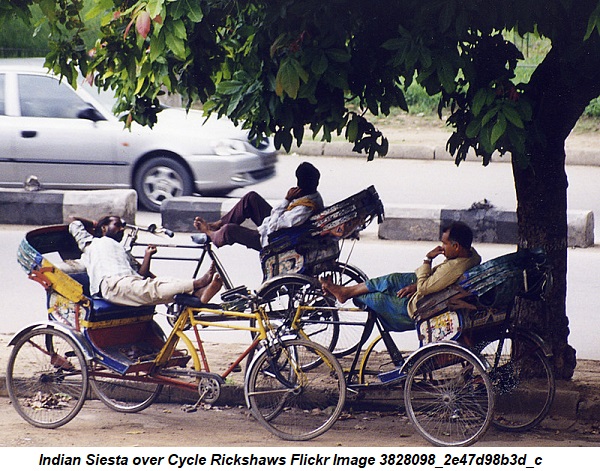
COMFORT in a SPACE (815 SEPT 2025 Gautam Shah)
interiordesignassist.wordpre… Space use scheduling and tailoring our lifestyles are most important passive methods of devising comfort in a space. We use the same spaces for different functions at different times.
2
Darth Ridiculous retweeted

“A major part of the financial expertise of the government consists of devising ways to conceal how much they are taking from the public. Those who complain that the government is not supporting the creative arts have just never looked at federal bookkeeping.”
— Thomas Sowell
1
11
72
9,454