Reets retweeted

18 Feb 2025
Zoveel goed betaald personeel op het NIP-hoofdkantoor. En niemand die het medisch schandaal in wording #DutchProtocol, heeft bestudeerd. Of de #CassReview & #WPATHFiles.
Teleurstellend.
Btw, @Ponds_rudolf is voorzitter NIP èn werkzaam bij Amsterdam UMC. Interessante combinatie.
1
1
4
55
Reets retweeted
17 Sep 2025
Het #DutchProtocol is het experiment dat uit het laboratorium ontsnapte. De eerste studies waren problematisch: bijna iedereen was homoseksueel en er was die nietvermelde jongen die stierf door de behandeling.
De followup-studies zijn schaars, zwak & kennen extreem veel uitval🚩
2
3
40

Heleen Dupuis stelde goede vragen en had reële bedenkingen. Nederland had dit medisch schandaal, #puberteitsblokkering en #jeugdtransitie eind vorige eeuw kunnen voorkómen ipv te exporteren als #DutchProtocol.
Die eerste patiënt is nu een alleenstaande met een mannelijk uiterlijk, die zich herinnert dat haar beste schoolvriendin, die erg op haar leek, nu een butch lesbian is (the Protocol NYT podcast).
Jun 17

NOS Journaal 08-01-1999:
De behandeling met puberteitsremmers is geintroduceerd in Nederland bij 7 kinderen, en deze oogst veel kritiek, van oa. Heleen Dupuis. Louis Gooren geeft uitleg.
2
10
24
529
@EersteKamer. #vvd @progressiefned @CDAvandaag @christenunie @D66 @DenkNL @AWJAvanHattem @fvdemocratie @SPnl @JuisteAntwoord @SGPnieuws @PartijvdDieren @BoerBurgerB
Die kinderen, die denken dat ze een verkeerd lichaam hebben en die niet tegengesproken mogen worden vanwege de #anticonversiewet, die komen in de fuik van de #transgenderklinieken.
Het zijn meestal homoseksuele, autistische, getraumatiseerde kinderen / jongeren. Ze worden niet beschermd. Ze krijgen onnodige operaties die hen niet alleen onvruchtbaar maken, hun #orgasmevermogen aantasten en hun partnerkeuze decimeren, het is ook zeker dat velen levenslang ernstige #gezondheidsklachten zullen hebben.
De wet belemmert vrije gesprekken met hen - alsof zelfdiagnose / vurige wens als kind of tiener boven alles gaat. Homoconversie ìs al verboden - deze wet is vooral gericht op tieners die problemen hebben met hun lichaam of met hun maatschappelijke (toekomstige) rol.
Stel die wet uit, verdiep u in de 'zorg' en weet dat Nederland hopeloos achter loopt bij de aanbevelingen uit #systematische_reviews. De Amsterdamse genderkliniek startte jeugdtransitie (#DutchProtocol) maar kan of wil na ruim 30 jaar niet eens laten zien wie van de duizenden patiënten nog in leven is. Hoevelen decennia later nog blij is met hun onomkeerbare keuze als tiener, welk deel werk heeft, een partner heeft, een goede fysieke en mentale gezondheid heeft.
Een medisch schandaal.
Jun 14

Here is an overview of what the literature currently reports on complication rates for transgender surgery:
🔼 Top Surgery (Chest Masculinization / Mastectomy)
Top surgery is generally considered the safer and less complex of the two categories.
Overall complication rates vary considerably by study and technique:
•In one institutional series of 73 subcutaneous mastectomies, the rate of major complications was just 2.7%, with revision surgery required in 5.4% of cases. 
•In another retrospective study of 81 patients, complications occurred in 25% of patients, though only two required reoperation within 30 days. 
Hematoma is the most frequently reported early complication:
•Hematomas are the most common immediate complication in gender-affirming mastectomy, with rates in the literature ranging from 0% to 31.2% — substantially higher than in other types of breast surgery. The use of more limited, nipple-sparing incisions is associated with a higher hematoma rate.  
Hormones: A meta-analysis of 15 studies (3,036 patients on testosterone vs. 726 not on testosterone) found that overall complication rates were similar between the two groups (11.08% vs. 9.80%), meaning testosterone therapy does not appear to significantly increase complication risk. 
Patient-reported outcomes are generally positive, with studies consistently reporting improvements in chest dysphoria, gender congruence, and body image after surgery.
🔽 Bottom Surgery
Bottom surgery encompasses multiple complex procedures and carries significantly higher complication rates than top surgery.
Vaginoplasty (transfeminine)
The complication rate after gender-affirming vaginoplasty is approximately 25.3%, with roughly half of these requiring surgical intervention. 
Transfeminine vaginoplasty frequently leads to urethral stricture (10–18%), meatal stenosis (5–10%), neovaginal stenosis (up to 30%), and dyspareunia (20–40%). 
Overall, vaginoplasty carries a complication rate ranging from 20–70%, with granulation tissue occurring in approximately 26% of cases. 
In a small number of cases (roughly 0–5%), rectal injury can occur as an intraoperative complication. Other common complications include meatal stenosis, urinary retention, and haemorrhage. 
Phalloplasty (transmasculine)
Phalloplasty is among the most technically complex procedures in reconstructive surgery and carries the highest complication rates:
•Gender-affirming phalloplasty has a reported complication rate as high as 76.5%.  
•In a detailed retrospective study of 280 patients at a dedicated transgender surgery center, patients experienced an average of 3.6 complications requiring surgery (range 0–18). Total phallus loss due to vascular insufficiency occurred in 0.7% of cases. 
•Even with the radial forearm free flap method, considered by many as the gold standard, urethroplasty-related complications occur in up to 64% of cases. 
Phalloplasty is associated with urethral fistulas (15–60%), urethral strictures (25–58%), and urinary retention (25–58%). Pelvic floor dysfunction affects up to 94.1% of transgender men post-surgery. 
Metoidioplasty (smaller-scale transmasculine procedure)
Metoidioplasty carries somewhat lower rates than phalloplasty: urethral fistulas in 10–25% of cases, strictures in around 20%, and urinary retention in 15–25%. 


3
4
232
Het #DutchProtocol (jongeren die #gendertransitie starten met #puberteitsblokkers) heeft zijn basis in teleurgestelde #transidentificerende mannen. Die vonden dat je beter 'eerder kunt beginnen'.
Kinderen en jongeren die zich 'anders' voelen werden doelwit: homoseksueel, autistisch, getraumatiseerd.
Lees de artikelen van oa Bram Kuiper.
Apr 14

Never forget how the puberty suppression experiment began.
In 1988, the Dutch published a follow-up study of the first wave of adult men to embark on the “sex reassignment” experiment.
The men said they had no regrets, but were unhappy with the cosmetic outcome due to a “never disappearing masculine appearance.”
That’s where the idea to block puberty came from.
Adult men were unhappy because they didn’t look like women, so the Dutch decided to intervene earlier, before the irreversible surge of testosterone at male puberty.
It's also safe to assume that the majority of those men were autogynephilic, meaning their desire to become women had an erotic motivation.
In other words, the experiment to turn adult men into the object of their own sexual desire failed, but instead of hanging up their lab coats and ending the mad endeavour, the Dutch turned their attention to innocent children — most of whom would have just grown up to be gay if given the time to mature and develop.
6
14
291
Interesting that there isn't a comparable Dutch study from #genderkliniek Amsterdam on the long term effects on mental health of #GenderAffirmingCare.
They invented the #DutchProtocol.

This is the type of data collection and statistical analysis that Australian 🇦🇺 ‘gender’ clinics like the one at the Royal Children’s Hospital should have been doing for many years. No doubt the results would be as equally alarming as this Finnish longitudinal research study.
2
9
41
830
Ronald Plasterks column berust op feiten. De bespreking ervan door @debroervanroos op 'informatie' van #genderkliniek Amsterdam. Dezelfde die het #DutchProtocol uitvond.
#WijVanWCeend...
Alle systematische reviews hebben dezelfde uitkomst: geen verbetering, wel veel schade.
Apr 2

we belden Ronald Plasterk over een ongenuanceerde column over transzorg in de Telegraaf.
hele gesprek in de nieuwe RADIO BOOS👇
🎧: bit.ly/RADIOBOOS62
🖥️: bit.ly/RADIOBOOS62yt
5
25
98
2,764
Het #Dutchprotocol: de #puberteitsontwikkeling volledig blokkeren om #headspace te creëren, schrijven Nederlandse onderzoekers.
Maar verwarring over wie je bent hóórt gewoon bij #puberteit. Je groeit er vanzelf uit.

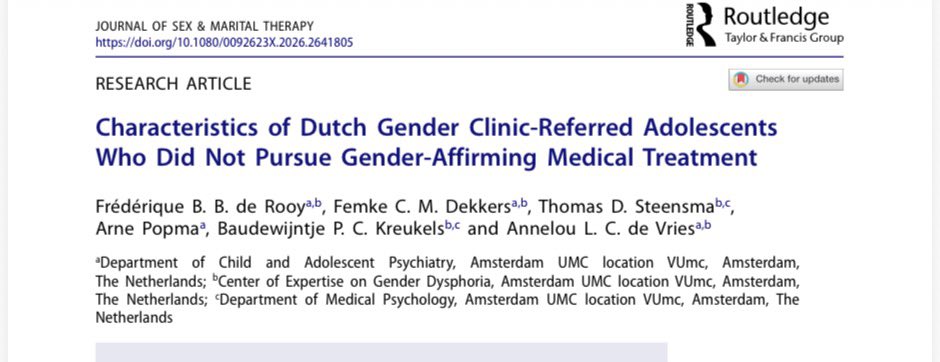
A scientific paper sites, “creating headspace” as justification for starting pediatric gender interventions.
Quote: “gender affirming medical treatment was started in six adolescents, who had not yet received a gender dysphoria diagnosis with the purpose of creating HEADSPACE for further exploration in their diagnostic trajectory.”
5
11
322

Feb 27
Steeds meer artsen spreken zich uit. Nu Nederland nog!
Eind van #Dutchprotocol nadert…

ANOTHER Colorado doctor speaks out—
Cardiologist—who worked with Democrats on public health issues—says parents wouldn’t support “gender-affirming care” if they realized the increased risk of stroke 🧠 and cardiovascular 🫀problems.
1
1
6
73

"I was just following woke consensus" should not keep doctors and ideologues out of jail.
#DutchProtocol
youtu.be/yyB2bnxe9WM?si=ELFX…
2
7
20
1,514
They should also ask for the Dutch data @amsterdamumc #genderkliniek which include more than 2000 young people treated cf the #DutchProtocol: #pubertyblockers and a choice of surgical and hormonal interventions to look like the other sex.
Feb 22

Enough. 9k children were referred to the Tavistock. 2k received puberty blockers. The first thing you do is track that cohort. You determine how many are alive and living productive lives. How many went on to cross sex hormones. How many are employed and in long term relationships. How many died and why.
The research team explicitly rejected this way forward saying the information would not help them. I don’t understand this. It’s a rich mine of information that will certainly indicate what areas require further research.
The only reason I can think that they do not wish to follow up with this cohort is that they know the outcomes of medicalising autistic and vulnerable children are going to be catastrophically bad and this scandal will finally be revealed in its true colours and horror.
1
2
113
@bartdrenth zegt het heel helder in @HPdeTijdNL:
“Pas als iets duidelijk meer baat dan schaadt, kun je de toepassing opschalen. Die stap hebben de #genderklinieken overgeslagen. Ik viel helemaal van mijn stoel van de reactie van de Nederlandse klinieken: ze wilden niet terug naar een experimentele fase, want dan konden ze ‘niet genoeg jongeren helpen’. Inmiddels zijn vrijwel alle landen met het #DutchProtocol gestopt, maar Nederland niet.”
‘hpdetijd.nl/nieuws/leven/477…
2
9
100
In Frankrijk bericht Le Figaro over de rechtszaak waarbij Amerikaanse detransitioner Fox Varian twee miljoen dollar kreeg toegewezen ivm haar dubbele mastectomie op 16-jarige leeftijd.
In Nederland is er nog geen enkel artikel in de reguliere media over verschenen: waarom niet, @nrc @volkskrant @trouw @telegraaf @ADnl @NUnl @refdag @nosnl ?
De 'genderbevestigende zorg' voor kinderen en jongeren is nb in Nederland uitgevonden: het #DutchProtocol.
Nu het steeds duidelijker wordt dat dit een groot medisch schandaal aan het worden is, waar is de Nederlandse berichtgeving hierover?
Feb 7

French newspaper Figaro reports the landmark US damages award to detransitioner Fox Varian, who underwent a double mastectomy at age 16. lefigaro.fr/actualite-france…
1
8
28
1,206
The same goes for the Dutch #trans teens studies before intruding of the #DutchProtocol. 90% stopped transitioning after finding out that they were gay/lesbian.
After that, 90% continued and 'transitioned' (except you never can).
#DutchProtocol interrupts the natural remedy: #puberty.
@OlafDekkers
Jan 24

80-90% of the Tavistock cohort were same sex attracted according to the 2012 patient survey. You are actively supporting gay conversion therapy you grotesque bunch of mostly heterosexual loons.
1
1
6
338
The Amsterdam #Genderteam in (which invented the #DutchProtocol) finally wants to do a
longitudinal multidisc outcome study.
But not on the 1000s of kids that were #transed, but on children with genital abnormalities (DSDs).
academic.oup.com/jsm/article…
Why not on your enormous ... /1
1
3
11
852
Ongelofelijk! Die 100.000 handtekeningen, die nodig zijn om het Lagerhuis te laten spreken over het Pathways onderzoek (een onderzoek waarbij honderden jongeren puberteitsblokkers (PB) zouden krijgen), waren er in no time.
Bij ons zijn PB gewoon nog 'zorg'.
#DutchProtocol. En kent het publiek de gevaren niet.
petition.parliament.uk/petit…
5
52

27 Nov 2025
Artsen die aan het zg. #DutchProtocol meewerken zouden hun licentie moeten verliezen.
Het is wel iets erger dan bv Ivermectine voorschrijven, hè?
6
347

27 Nov 2025
Wereldwijd groeit de kritiek op puberteitsblokkers voor 'transkinderen'.
#DutchProtocol
Maar in Nederland?
@HKouwenberg78: "Bij geen enkel ander ziektebeeld dat we toeschrijven aan de psyche wordt medisch-chirurgisch ingegrepen met onomkeerbare gevolgen."
telegraaf.nl/binnenland/twij…
4
29
85
1,578

27 Nov 2025
"Bij geen enkel ander ziektebeeld dat we toeschrijven aan de psyche wordt medisch-chirurgisch ingegrepen met onomkeerbare gevolgen. We creëren de illusie dat je een ander geslacht kunt aannemen, maar dat is biologisch onmogelijk. Deze kinderen zijn voor het leven verminkt,” zegt medisch specialist @HKouwenberg78.
Als je als volwassene zeker weet dat je jouw lichaam onomkeerbaar wilt laten veranderen, prima.
Echter, zo'n 70 tot 90 procent van de kinderen met #genderdysforie groeit hier overheen.
In het buitenland is er veel discussie over de effectiviteit, de risico’s en de ethische aspecten van dit zogeheten #DutchProtocol en is er in sommige landen mee gestopt. Waarom bijven wij in NL dit kinderen aandoen? Waarom is dit voor überhaupt iemand acceptabel?
#transkinderen
telegraaf.nl/binnenland/twij…
33
262
878
20,684
19 Nov 2025
Nieuw Zeeland kiest ervoor om geen nieuwe puberteitsblokkers meer voor te schrijven bij "genderdysforie". In het VK gebeurde dat al eerder. In Scandinavische landen lag dit voorschrijven al sinds 2020 aan banden.
#DutchProtocol - wanneer stopt Nederland ermee?
Er is geen bewijs dat het werkt, wel veel bewijs van negatieve effecten. En de premisse is fout: niemand gaat door de 'verkeerde puberteit'. Er worden ook geen 'levens gered' (van zelfmoord) door 'genderbevestigende behandeling'. Sterker: sommige onderzoeken laten een hoger sterftecijfer zien.
2
6
60