

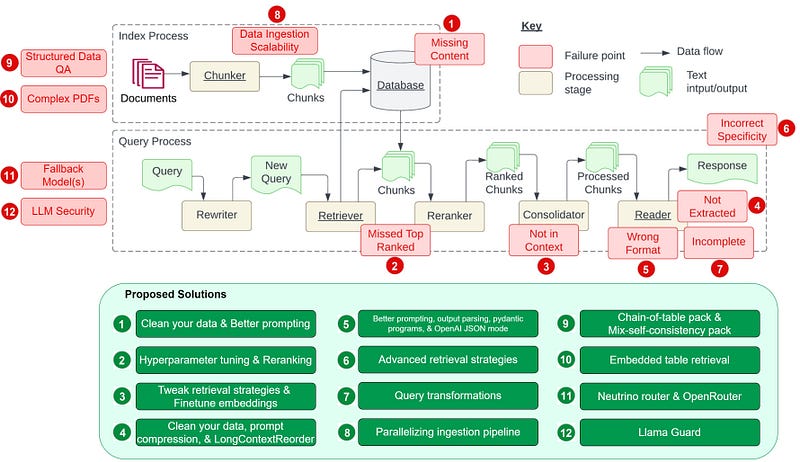
1. Data quality is crucial 📊: Whether addressing missing content issues or handling context problems, clean data is essential for the proper functioning of the RAG pipeline.
2. Prompt engineering and hyperparameter tuning are vital for performance ⚙️: Improving prompts and adjusting hyperparameters like chunk_size and similarity_top_k can significantly enhance the performance of RAG systems.
3. Advanced retrieval strategies and query transformation can improve the accuracy and completeness of answers 🎯: Techniques such as “small-to-large” retrieval, chain table packing, and hybrid self-consistency query engines can boost RAG systems' performance in handling complex queries and structured data.
4. Security and scalability are key considerations in RAG system design 🔒: As RAG systems become more widespread, preventing prompt injection, handling unsafe outputs, and preventing sensitive information leaks are critical. Llama guard offers a mechanism to secure LLM inputs and outputs by classifying content.
5. Using fallback models and routers can improve system stability and efficiency 🌐: Employing fallback models like neutrino routers and open routers ensures continuous operation when the primary model encounters issues.
6. Developing and deploying RAG systems is a multifaceted challenge 🚀: Developers need to consider system design, data processing, model selection, and performance optimization to ensure the effectiveness and robustness of RAG systems in practical applications.
#AI #Coding #FutureTech #AIResearch #CodeGeneration #Tech #MachineLearning #TechInnovation #DataQuality #PromptEngineering #HyperparameterTuning #AdvancedRetrieval #QueryTransformation #Security #Scalability #FallbackModels #SystemDesign #PerformanceOptimization
1
2
67