Filter
Exclude
Time range
-
Near
When I am building automation workflows in Make, I am making the same decisions a data scientist makes when tuning hyperparameters. Small settings. Enormous outcomes. Hyperparameters are the configuration decisions made before machine learning training begins, they control how the learning process itself works, not what the model learns. The key ones every AI practitioner needs to understand: Learning rate: how much the model's weights are adjusted per training step. The single most important hyperparameter. Too high: unstable, diverges. Too low: extremely slow, may not converge. Finding the right learning rate is the first step in any successful training run. Batch size: how many training examples are processed per weight update. Small batches: noisy but often generalise better. Large batches: stable but may overfit to training distribution. Epochs: how many complete passes through the training data. Too few: underfitting. Too many: overfitting (use early stopping). Grid search vs random search: two strategies for exploring the hyperparameter space. Grid search is exhaustive but scales poorly. Random search is probabilistic but often finds good solutions faster. The automation parallel I keep coming back to: every Make workflow I build has equivalent settings, batch processing limits, scheduling frequency, error handling strategies. Change them and the whole pipeline performs differently. The principle is universal: small configuration decisions upstream determine outcomes downstream. Getting them right requires systematic experimentation, not guesswork. Love and Light, Motunrayo Akinsete #HyperparameterTuning #MachineLearning #Automation #MotunBizAcademy #AIinAfrica
8
The difference between a good model… and a great one? 👉 Tuning & validation 📢 Chapter 01 | Lecture 15 ⚙️ Hyperparameters, Validation & Model Selection Good models don’t happen by chance. Learn how to: ✔ Tune hyperparameters ✔ Use validation & cross-validation ✔ Prevent overfitting (early stopping) ✔ Choose the right model 🎥 Watch now: [youtu.be/ZyPvDupEeFQ?si=iC-B…] #MachineLearning #AI #DataScience #ModelSelection #HyperparameterTuning
61
What's the biggest mistake you see with parameter optimization techniques? ⚡ The fastest path to mastering parameter optimization techniques Full guide 👇 🔗 kubaik.github.io/tune-up/ #HyperparameterTuning #DeepLearning #EdgeComputing #MachineLearning #developer

4
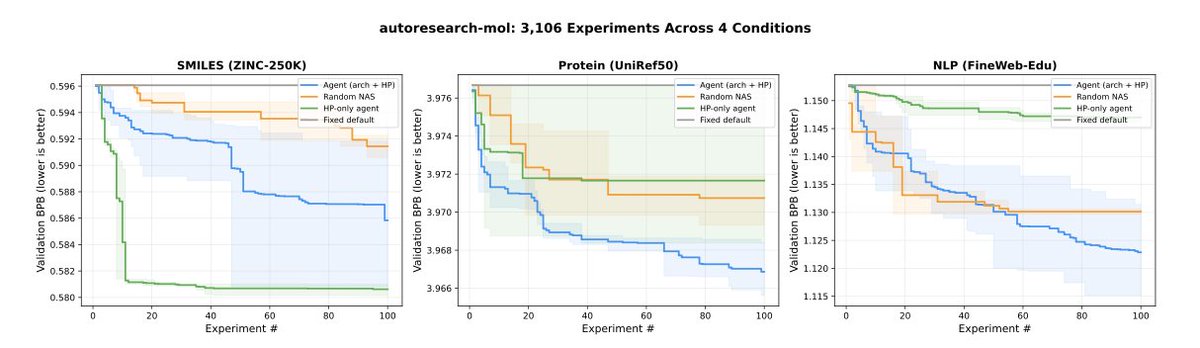
What an Autonomous Agent Discovers About Molecular Transformer Design: Does It Transfer? 1. The paper runs a controlled, large-scale test of whether “molecular Transformers should be different from NLP Transformers” using an autonomous LLM agent that edits training code. Across SMILES, proteins, and English (control), it executes 3,106 GPU-bounded experiments and explicitly separates architecture changes from hyperparameter (HP) tuning. 2. Core result: the value of architecture search is strongly domain-dependent. In NLP (FineWeb-Edu, long context, large vocab), architecture search accounts for 81% of the total improvement over baseline (padj = 0.009), while HP tuning contributes 19% (padj = 0.022). 3. In SMILES (ZINC-250K, short sequences, 37-char vocab), architecture search is counterproductive: HP tuning alone achieves 151% of the total improvement (padj = 0.001), meaning the HP-only agent beats the full “architecture HP” agent on average (best bpb 0.581 vs 0.586). The architecture contribution is negative (−51%, not significant). 4. Proteins (UniRef50) land in between: total gains exist but are small, and neither HP nor architecture contributions reach significance. The study interprets this as “architecture-insensitive” behavior at ~10M parameters for this setup. 5. Methodological innovation: a 4-condition design that cleanly decomposes gains: (a) full LLM agent (architecture HP), (b) random NAS (architecture sampled uniformly; default HPs), (c) HP-only LLM agent (architecture frozen by prompt), (d) fixed default baseline. This enables direct attribution of improvements to HP tuning vs architecture search. 6. Search-efficiency metric: besides final validation bits-per-byte (bpb), it reports AUC-OC (area under the best-so-far curve across 100 trials). On SMILES, HP-only converges fastest and lowest; on NLP, the full agent separates early (~20 trials) and keeps improving; on proteins, all curves cluster tightly. 7. Apparent specialization vs real universality: agent-discovered “best architectures” cluster by domain (permutation test on mixed-feature Gower distances, p = 0.004), suggesting the agent finds different designs for SMILES vs NLP vs proteins. 8. But transfer tests overturn the usual expectation: every discovered innovation transfers across domains with <1% degradation (41/41 universal; binomial p = 2×10⁻¹⁹ against a predicted 35% universal rate). The paper argues the clustering reflects search-path dependence (what the agent tries first given early signals), not fundamental biological requirements—at least at this ~8.6M parameter, short-training regime. 9. Practical takeaway framed as a decision rule: small vocab short sequences (e.g., SMILES-like: <100 tokens, <500 length) → prioritize HP tuning; large vocab long context (NLP-like: >1K tokens, >1K length) → full architecture search is worth it; proteins may show thin margins at this scale. 10. The agent repeatedly rediscovers broadly useful Transformer tweaks that are also known in NLP, including grouped query attention (KV head compression), gated MLPs (e.g., SwiGLU/GeGLU), learned per-layer residual scaling, and using value embeddings every layer (vs alternating). Downstream sanity checks show SMILES pretraining improvements can translate to MoleculeNet linear-probe ROC-AUC ~0.74–0.76 and high-validity generation. 💻Code: github.com/ewijaya/autoresea… 📜Paper: arxiv.org/abs/2603.28015 #ComputationalBiology #Bioinformatics #DrugDiscovery #Proteins #Transformers #NeuralArchitectureSearch #HyperparameterTuning #LLMAgents #MachineLearning
1
10
1,420
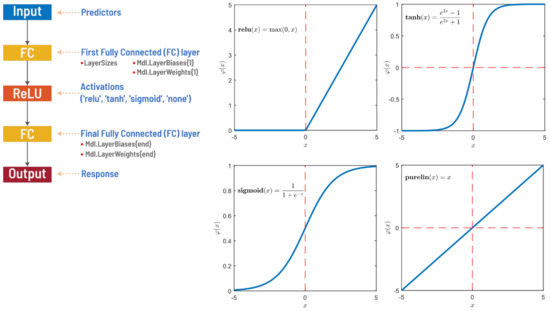
📢 #highlycited paper 📚 Improving #HardenabilityModeling: A Bayesian Optimization Approach to Tuning Hyperparameters for #NeuralNetworkRegression 🔗 mdpi.com/2076-3417/14/6/2554 👨‍🔬 by Wendimu Fanta Gemechu et al. 🏫 Silesian University of Technology #Bayesianoptimization #hyperparametertuning
1
2
25
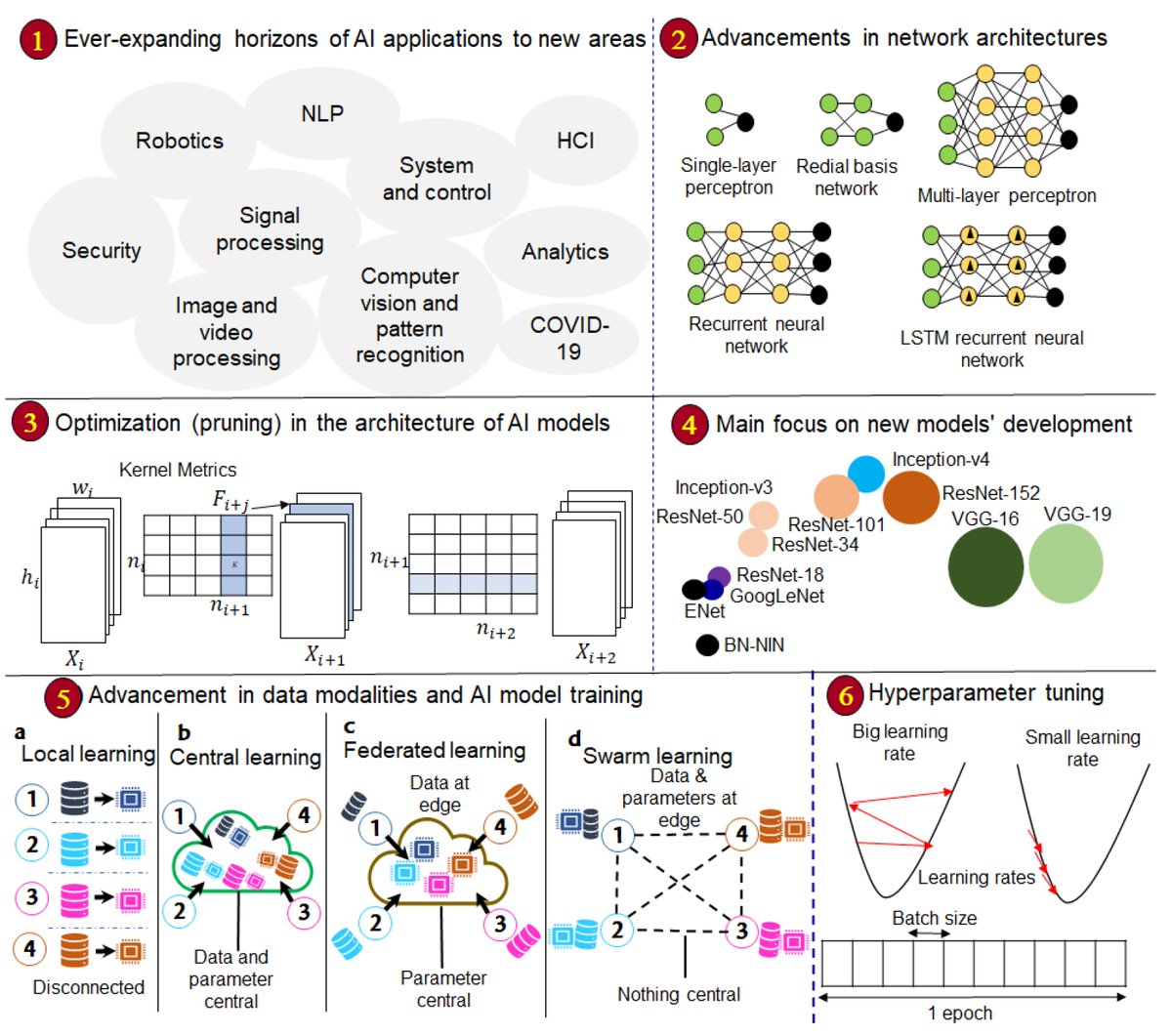
🚀#HighlyCitedPaper! 🖥️A Data-Centric #AI Paradigm for Socio-Industrial and Global Challenges 🔗Read at: mdpi.com/2079-9292/13/11/215… Authors from Gachon University #DataCentricAI #DataQuality #ModelCentricAI #ScarceTrainingData #ArtificialIIntelligence #HyperParameterTuning
1
27
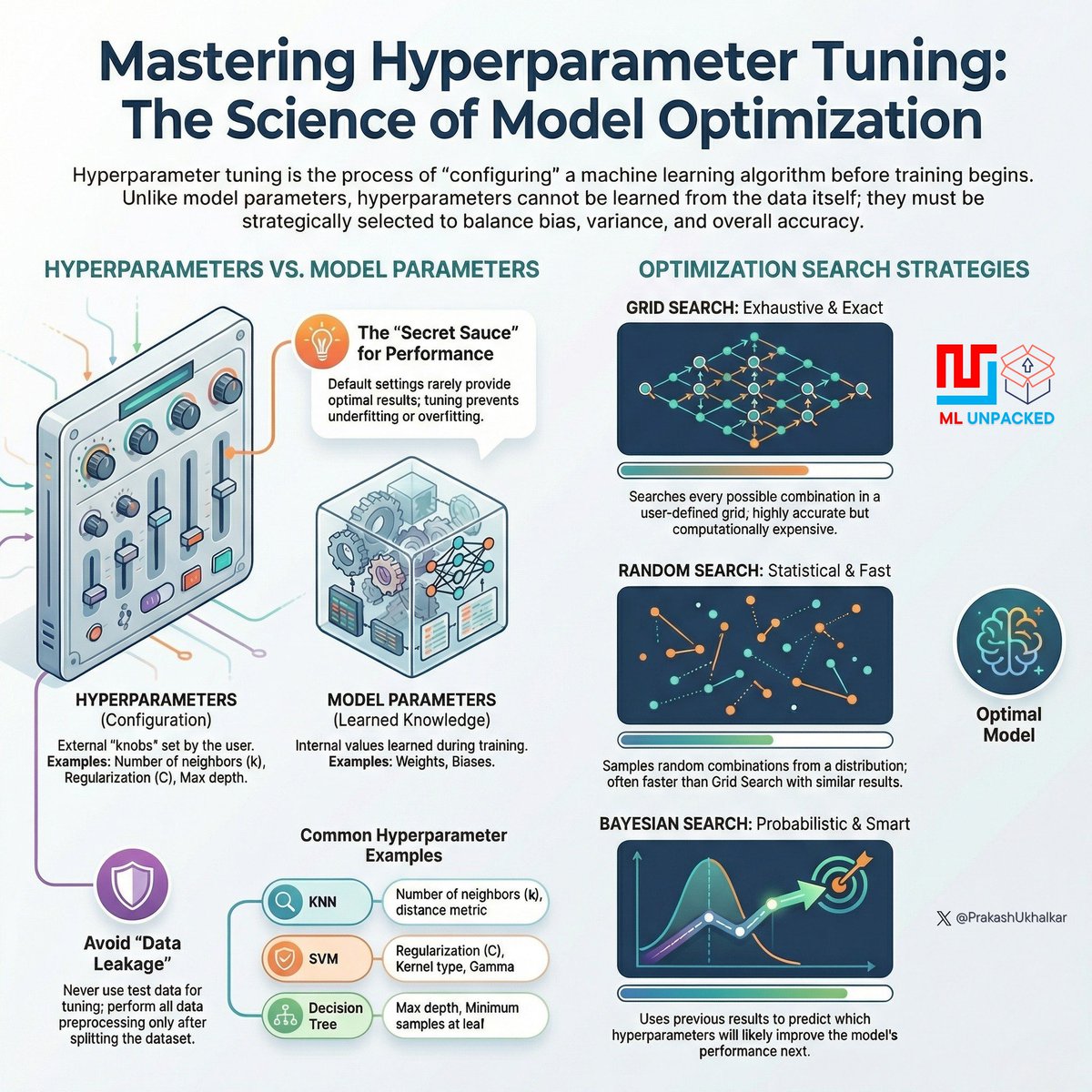
Default settings rarely give optimal results. Hyperparameter tuning helps models learn better and generalize well. Algorithm choice matters, configuration matters more. ML Unpacked. (^_^) #MachineLearning #HyperparameterTuning #ModelOptimization #DataScience #MLUnpacked
11
7 Scikit-Learn-Tricks, die dein Hyperparameter-Tuning auf das nächste Level heben. Weniger Trial-and-Error, bessere Modelle. #ML #ScikitLearn #HyperparameterTuning #DataScience
1
🚀 New Post: Tune In Optimize model performance with expert hyperparameter tuning methods.... 🔗 Read more: kubaik.github.io/tune-in #coding #Go #DataScience #React #HyperparameterTuning

4
grid search is brute force and inefficient—random search, bayesian optimization, and hyperband offer smarter ways to tune hyperparameters faster with better results. practical for real ml workflows. kdnuggets.com/3-hyperparamet… MachineLearning, HyperparameterTuning, DataScience, AI
2
GenAI4UQ Leverages Ray Tune for Efficient Hyperparameter Optimization (Source: Huggingface) GenAI4UQ employs Ray Tune to optimize machine learning model hyperparameters, balancing exploration and computational efficiency. #MachineLearning #HyperparameterTuning #RayTune #GenAI4UQ #Optimization 🤔 How can automated hyperparameter tuning frameworks be further improved to handle increasingly complex scientific models? dailyaiwire.news/article/gen…
20
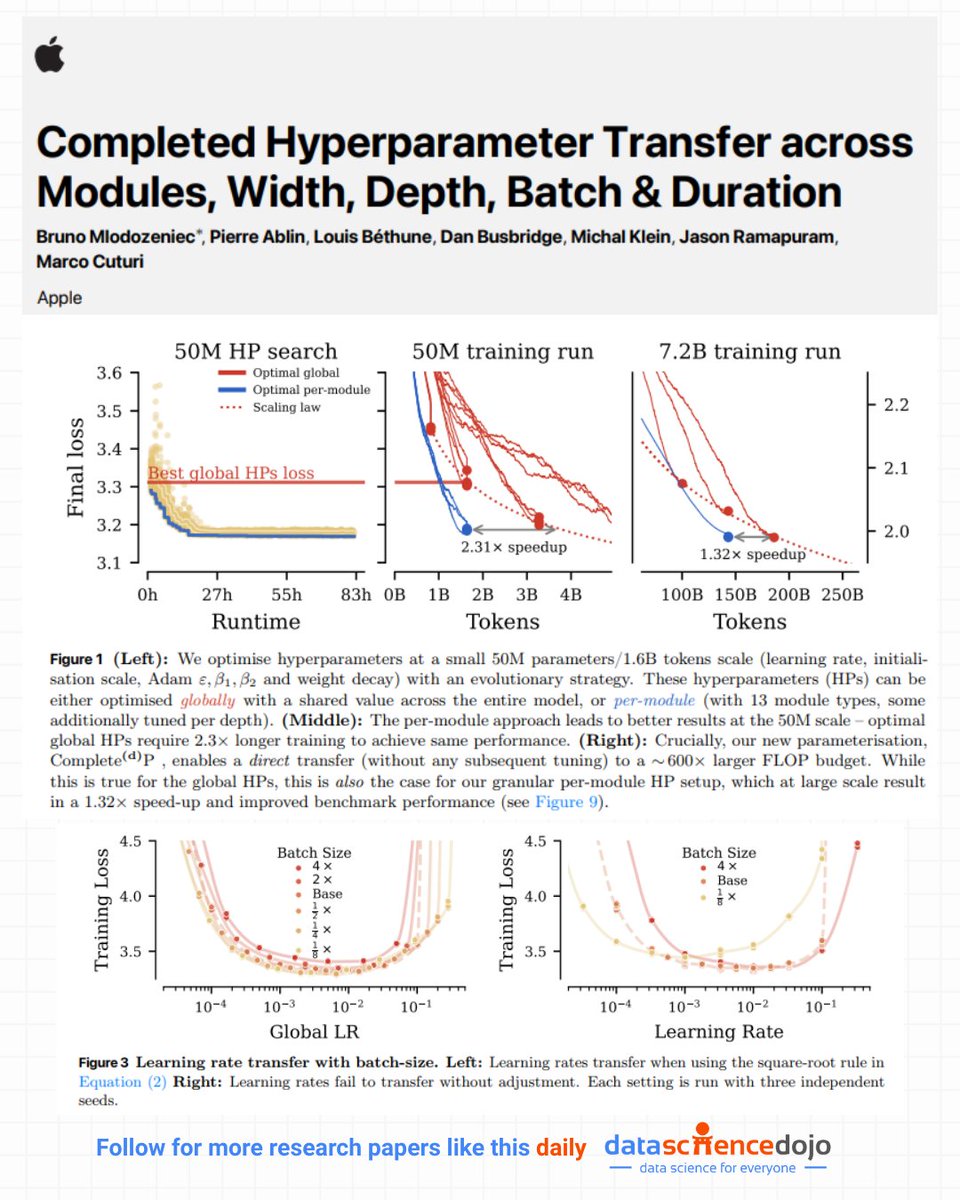
📢 Apple just released a paper that tackles one of the most persistent practical challenges in training large models: hyperparameter tuning at scale. While many advances in deep learning focus on bigger architectures or more data, this work dives deep into a deceptively difficult problem: how do you find good hyperparameters — like learning rates, weight decay, and optimizer settings — once you scale models up by orders of magnitude? The authors build on recent ideas in hyperparameter parameterizations and extend them with a new framework called Complete(d)P, which unifies scaling across model width, depth, batch size, and training duration. Instead of treating each scaling axis separately, their approach lets you search for optimal hyperparameters on a small model and then transfer them reliably to much larger models — even when you change batch size or the number of training tokens. A key insight from this paper is that tuning hyperparameters at scale doesn’t have to mean expensive grid searches or manual trial-and-error on every new configuration. With the right parameterization, the structure of the optimization landscape can be understood well enough at small scale that the same settings still work when everything grows — reducing training cost and improving stability across scales. The authors also show that this per-module hyperparameter transfer works better than global tuning alone, and that it can yield real speedups and more reliable training behavior as models get larger. In short, this paper is a thoughtful reminder that scaling ML systems isn’t just about bigger models — it’s about smarter training design. And that optimizing how we train at scale can unlock efficiency gains that are just as important as any architectural breakthrough. #MachineLearning #HyperparameterTuning #ModelScaling #AITraining #DeepLearning #Optimization #Research #LLMs #EfficientAI
1
4
928
20 Dec 2025
🚀 New Post: Tune Smarter Optimize model performance with expert Hyperparameter Tuning Methods.... 🔗 Read more: kubaik.github.io/tune-smarte… #HyperparameterTuning #MachineLearning #NextJS #Vercel #DevOps

9
🚀 New Post: Tune In Optimize model performance with expert hyperparameter tuning methods.... 🔗 Read more: kubaik.github.io/tune-in #MachineLearningOptimization #Kubernetes #GreenTech #innovation #HyperparameterTuning

10
11 Nov 2025
8️⃣ Model Tuning & Optimization Process ⚙️ Good model? Make it GREAT. Steps: - Define goals: Faster? More accurate? - Try methods: Grid/Random Search, Bayesian Opt - Ensemble: Combine models (VotingClassifier) - Advanced: Learn from tools like Optuna Output: Optimized params that squeeze every % point. Time saver: AutoML like Auto-sklearn for newbies. Tuned a model lately? What changed? #HyperparameterTuning #Optimization
1
15
24 Oct 2025
Boost your ML model's performance with hyperparameter tuning! Explore techniques like Grid Search, Random Search, and Bayesian Optimization. Read more info : nomidl.com/machine-learning/… #MachineLearning #HyperparameterTuning #AI #DataScience #MLTips
1
13
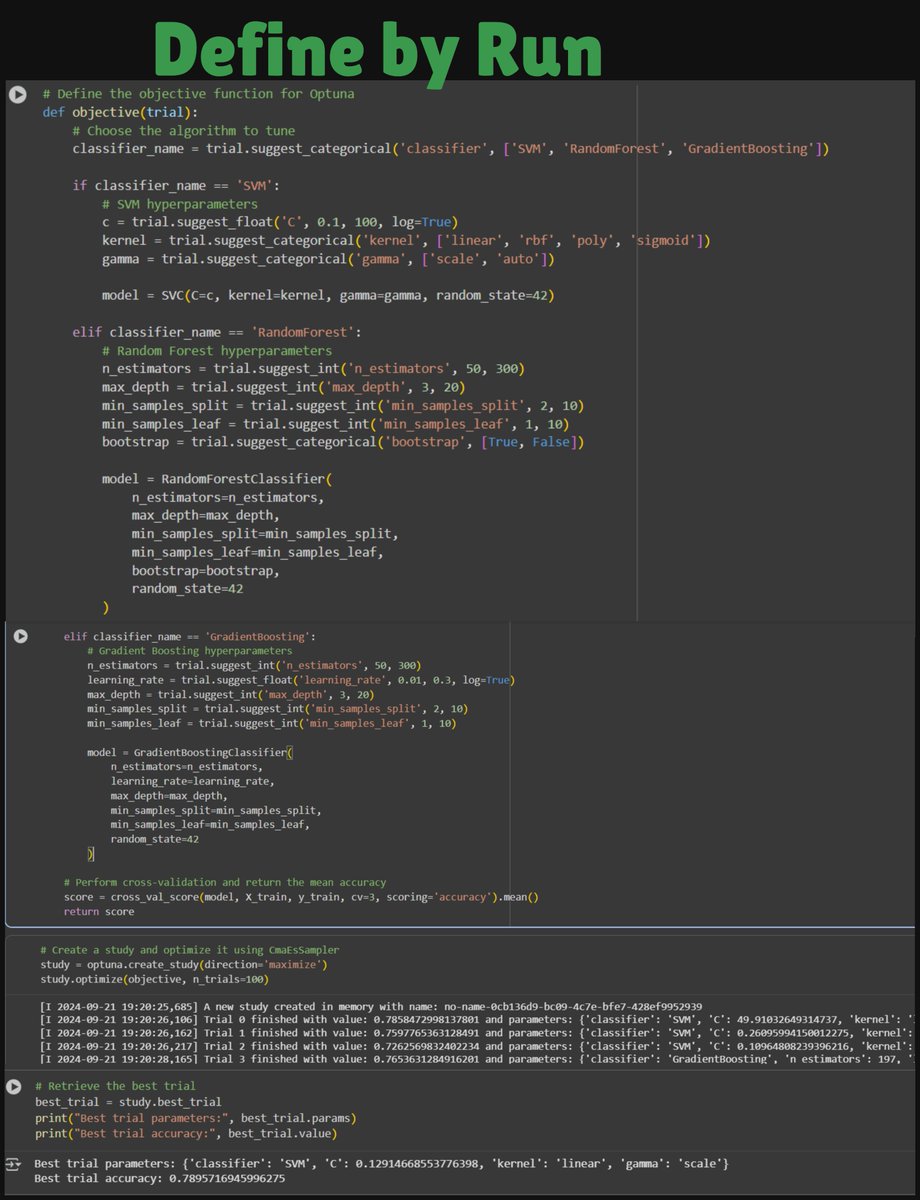
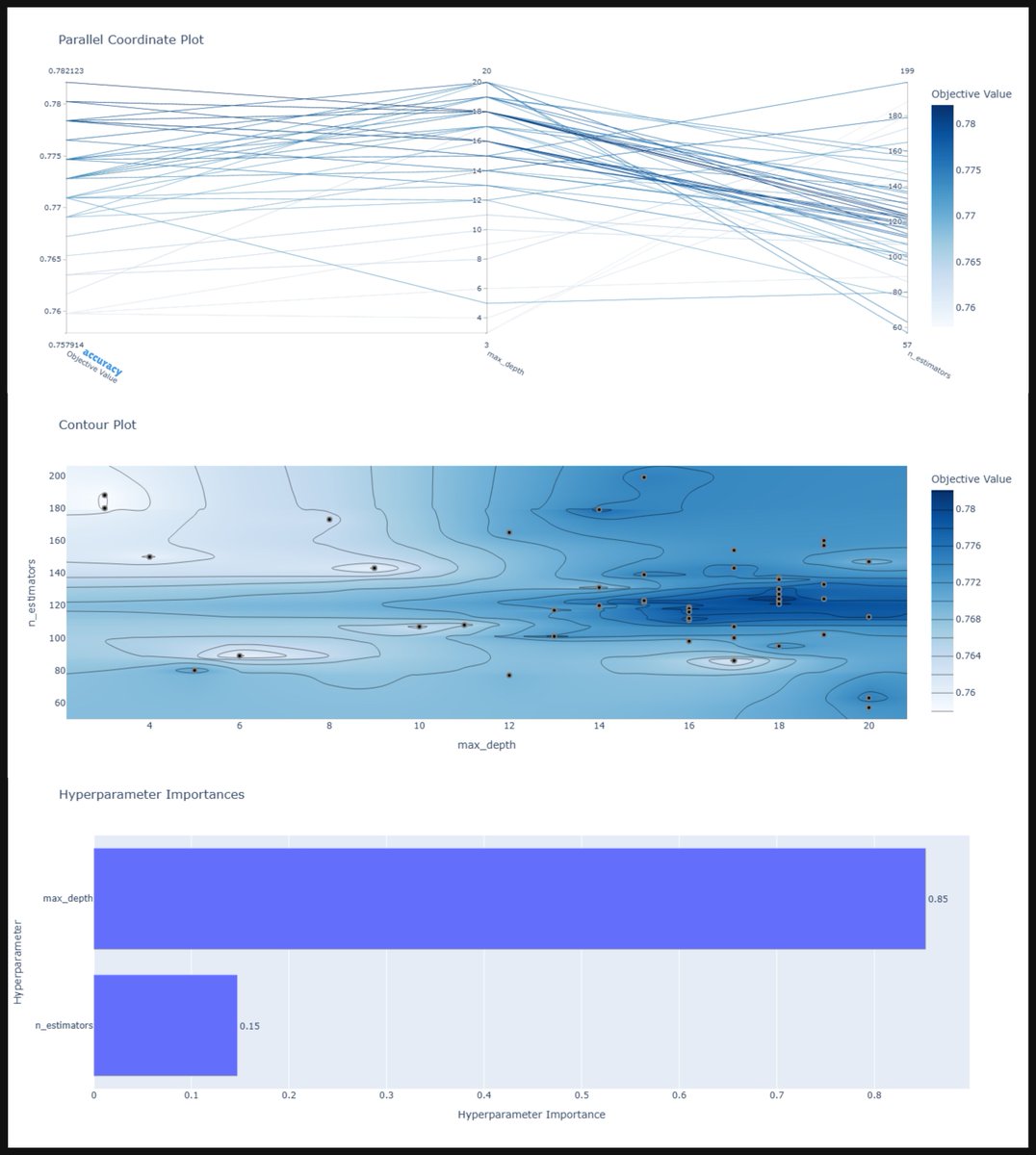
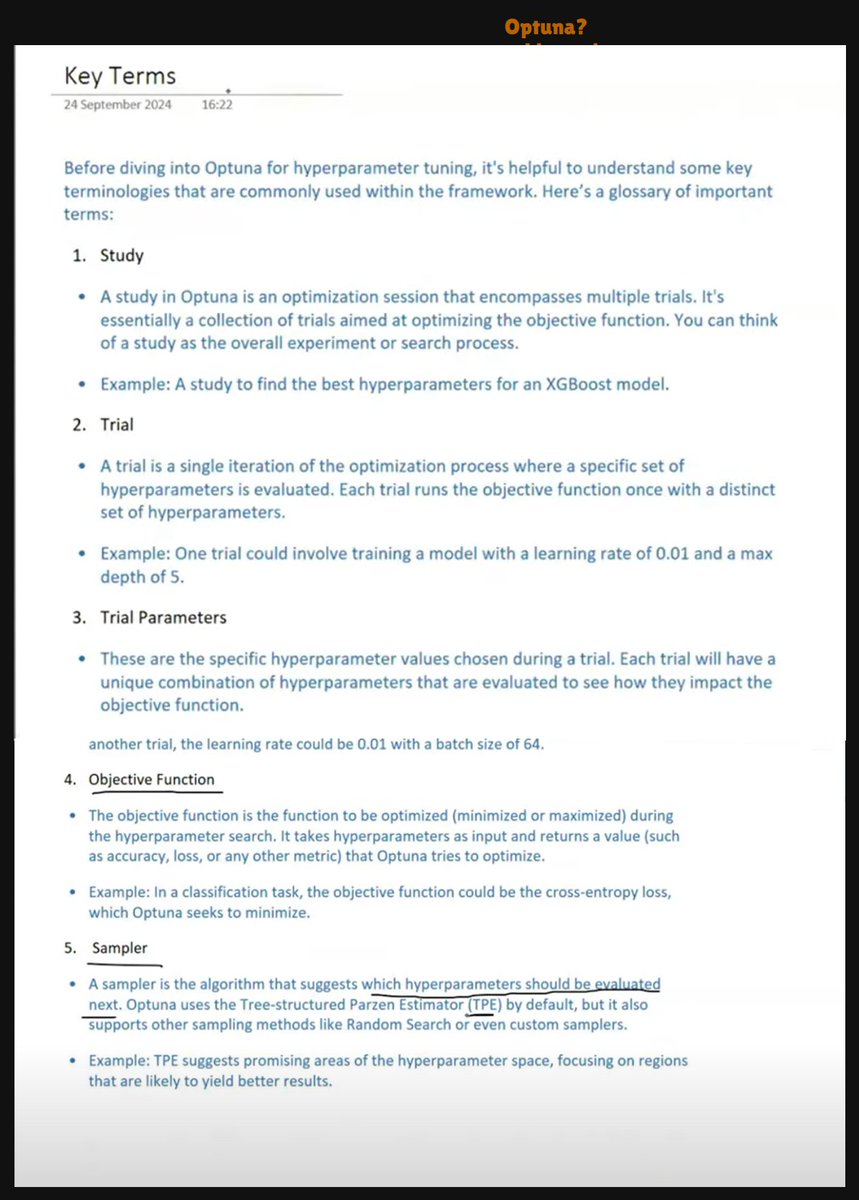
🎯 Hyperparameter Optimization with Optuna — Completed! ✅ Implemented Bayesian Optimization (TPE) ✅ Applied dynamic & conditional search spaces Visualized parameter importance 🚀 #MachineLearning #Optuna #HyperparameterTuning #AI #DataScience #BayesianOptimization
142
15 Oct 2025
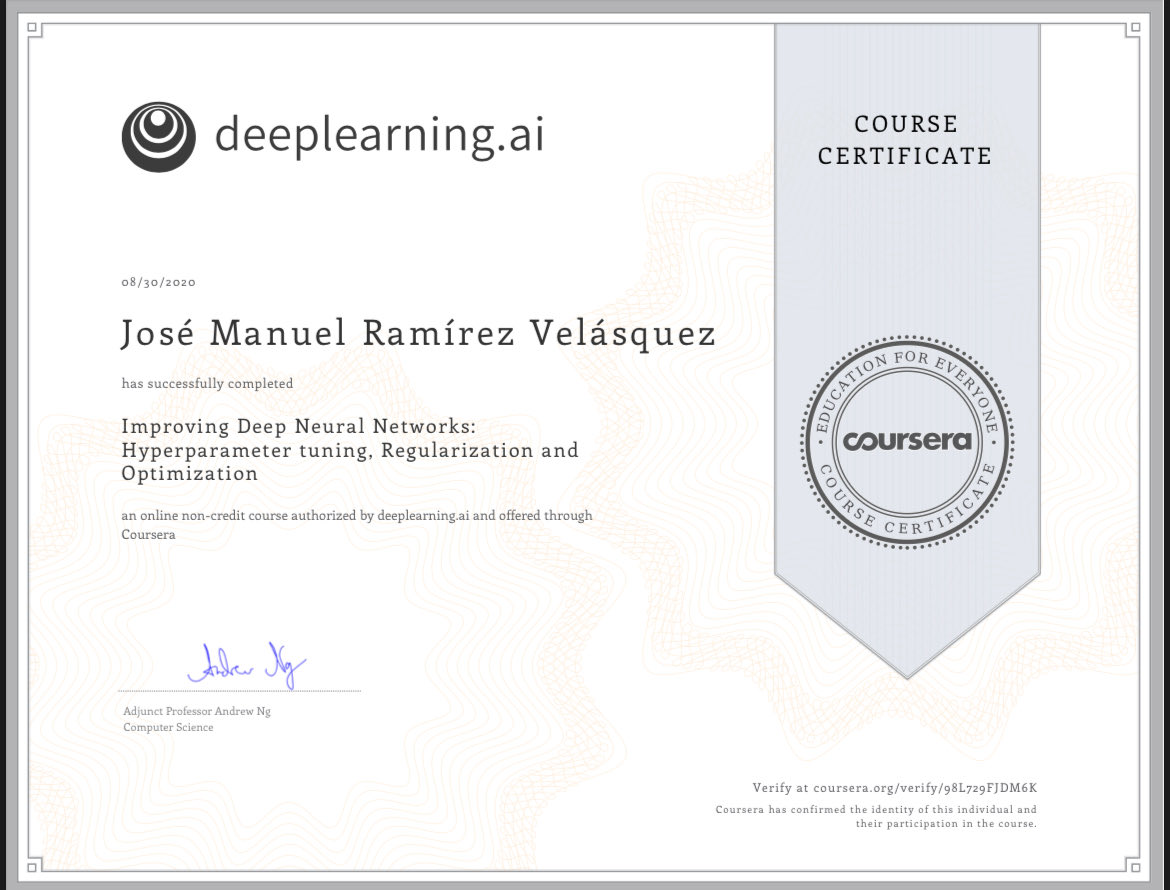
Improving Deep Neural Networks: más allá del entrenamiento básico. Con este curso de DeepLearning.AI dirigido por Andrew Ng, profundicé en técnicas avanzadas para ajustar hiperparámetros, aplicar regularización y optimizar redes neuronales profundas. Aprendizajes clave para mejorar precisión y eficiencia en modelos reales de IA. #deeplearning #ai #machinelearning #neuralnetworks #andrewng #deeplearningai #optimization #hyperparametertuning
70