💔🇿🇦Sjoe! Human Rights Day 2026: A Nation Still Waiting 🇿🇦 30 Years Later… Where Did the Dignity Go? 💧🚫 ~ A Country That Promised More Than It Delivered 📉🇿🇦
Sjoe, you remember that feeling when the postman finally arrives with the letter you’ve been waiting thirty years for, only to find the envelope is empty? That’s South Africa on March 21, 2026. Three decades ago we wrote the most beautiful constitution the world has ever seen—ink still wet with hope, dignity declared non-negotiable, water promised as a right, education as a door, safety as a baseline. We signed it in Pretoria while the world watched and applauded.
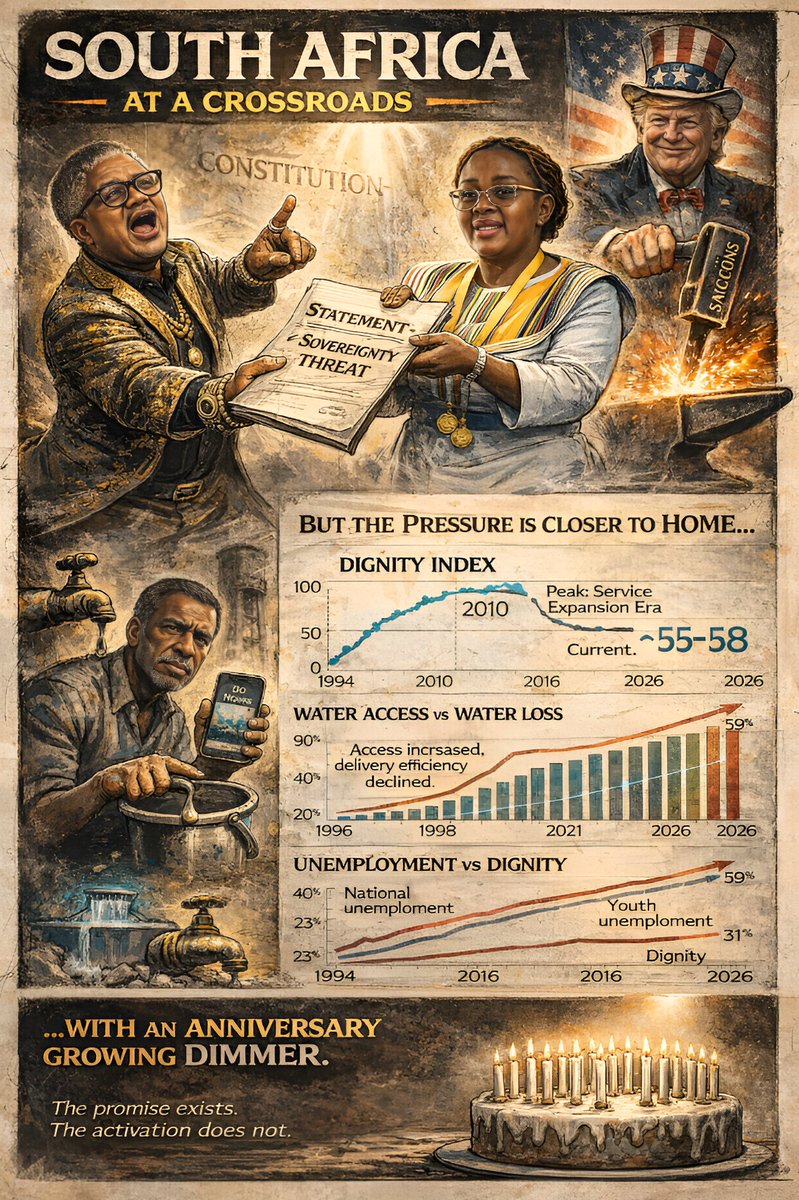
Today, in the same city where the ink dried, residents queue at tankers and communal standpipes with 25-litre buckets because their municipal taps have been dry for days, even though the Vaal Dam is sitting at 92% capacity (Department of Water and Sanitation, March 2026 weekly bulletin).
A learner in a rural Eastern Cape school tries to join an online maths lesson but the signal dies after thirty seconds. A woman in KwaZulu-Natal waits two years for a forensic report on an assault that never arrives. Unemployment sits at 31.4% nationally, 59.6% for those aged 15–24 (Stats SA QLFS Q4 2025). And on the very day meant to celebrate this constitutional miracle, the African National Congress invites the nation to a “People’s March in Defence of Our Sovereignty and Democratic Gains” under the hashtag
#SAWillNotBeBullied. The route: Mary Fitzgerald Square to the Constitutional Court.
The message: external forces are threatening us.
The claim is simple and brutal: the Constitution is not defective. It is dormant. Dignity—clean water from the tap, safety in the street, opportunity through a functioning economy, inclusion in the digital age—has been deferred not by foreign enemies at the gate, but by choices made inside the house we built.
The evidence network is overwhelming and convergent. This is not opinion; it is pattern.
Stirring Questions:
If the Constitution promised dignity as non-negotiable, why is it still negotiable for millions?
How can a day dedicated to human rights feature a march that appears to look outward while so much is broken inside?
And if sovereignty is under threat, whose sovereignty is actually being defended when taps run dry in the richest province?
Context
The Constitution adopted on 8 May 1996 and signed into law by Nelson Mandela on 10 December 1996 was deliberately designed to be transformative. It did not merely end apartheid; it sought to reverse its material and psychological legacy. Section 10 declares that everyone has inherent dignity. Section 27 guarantees the right to sufficient food and water. Section 29 promises basic education. Section 16 protects freedom of expression. Section 9 demands equality before the law and prohibits unfair discrimination.
These were not aspirational slogans; they were enforceable obligations on the state to “take reasonable legislative and other measures, within its available resources, to achieve the progressive realisation” of socio-economic rights.
The early years delivered visible proof that realisation was possible.
Household electricity access climbed from roughly 58% in 1996 to over 90% by the mid-2010s (Stats SA General Household Survey series). Water infrastructure expanded rapidly in many areas. Social grants grew into the largest poverty-alleviation programme on the continent, lifting millions above the food poverty line.
The narrative was linear progress: liberation politics would deliver material liberation.
Common views split predictably. Defenders of the ruling party emphasise the inherited structural inequalities—no constitution can erase four centuries of dispossession overnight—and point to policies like Broad-Based Black Economic Empowerment (B-BBEE) and employment equity as necessary redress. Critics counter that thirty years is long enough to expect measurable improvement in quality of life, not just quantity of access. Service delivery protests have become an annual calendar event. Corruption inquiries have become routine.
The lived experience of many South Africans increasingly diverges from the constitutional text.
The issue is no longer whether the framework is sound. The courts have repeatedly affirmed it is. The question is why implementation has stalled so profoundly. Johannesburg, the economic engine room, faces intermittent water supply in multiple systems despite adequate bulk storage (Rand Water reports, early 2026). Gender-based violence and femicide rates place South Africa among the highest globally (SAPS crime statistics 2024/25). The UN measure between rich and poor the Gini coefficient hovers around 0.63—still the world’s highest (World Bank, 2025). Unemployment remains structural at 31.4% (Stats SA, Q4 2025).
These are not isolated failures.
They are symptoms.
Stirring Questions:
If the early years proved delivery was possible, what changed after 2010?
Is transformation policy protecting dignity or inadvertently gatekeeping it?
When service delivery protests become a permanent feature of democracy, does that mean democracy is working—or that it is failing its own citizens?
Evidence Network
1. The Broken Signal – Digital Exclusion as the New Pass Law
Picture a learner in a rural Eastern Cape school trying to join an online mathematics lesson. The video buffers, then freezes. The phone returns to “SOS only”. That screen is not a technical failure; it is policy made visible. Sentech, the state-owned common carrier, maintains near-perfect analogue and digital terrestrial television coverage through more than 340 transmission sites. Yet its broadband ambitions under the SA Connect programme have repeatedly faltered.
MyWireless was launched in the early 2000s as a wireless broadband solution but discontinued due to poor coverage and uptake. BizNet followed a similar path—quietly shelved. Annual integrated reports show persistent net losses, accumulated deficits exceeding R661 million over five years to 2024, and reliance on government grants and bailouts that total billions over three decades (Sentech Integrated Annual Reports 2020–2025; Parliamentary Portfolio Committee briefings).
SA Connect Phase 2 aimed to connect government facilities and provide community Wi-Fi hotspots. By late 2025, approximately 6 343 sites and 32 055 hotspots had been installed, theoretically covering an estimated 5.6 million households (Department of Communications and Digital Technologies progress reports).
Yet independent assessments describe the rollout as “severely delayed” and “well behind” original targets (Parliamentary Monitoring Group minutes, 2025). Rural communities remain cut off from online education platforms, telemedicine, government e-services, job portals, and civic participation.
Meanwhile, low-Earth-orbit satellite providers such as Starlink operate legally in more than 20 African countries, including neighbouring Botswana and Zimbabwe, delivering 100–200 Mbps with latency of 20–50 ms. Starlink has offered subsidised or free school connectivity packages in several jurisdictions. In South Africa, the company remains unlicensed—primarily due to the 30% local black ownership requirement under B-BBEE policy—despite recent government signals that Equity Equivalent Investment Programmes may be accepted as alternatives (Ministerial policy directive, December 2025).
The irony is quiet but lethal: a state that once built transmission towers to reach every household with propaganda now struggles to reach the same households with the tools of participation.
Stirring Questions:
If connectivity is now the infrastructure of rights, why do regulatory choices keep advanced technology out of reach?
When a state provider excels at analogue but fails at digital, is the problem technical or structural?
And if rural learners miss online education because of licensing rules intended to advance redress, whose redress is being advanced?
2. The Invisible Right – When Silence Becomes a Violation
The learner in the Eastern Cape is not merely offline; she is systematically excluded from the modern infrastructure of rights. Section 16 of the Constitution protects freedom of expression and access to information. Without connectivity, public discourse shrinks to those who can afford mobile data or live near a working hotspot.
Section 29 guarantees the right to basic education; online platforms are now essential tools for curriculum delivery, especially in under-resourced schools. Section 27 covers health care services and sufficient food and water; telemedicine and health information portals collapse without bandwidth. Section 9 demands equality; digital exclusion disproportionately affects poor, rural, and female-headed households.
Article 19 of the Universal Declaration of Human Rights reinforces access to information as foundational. UN resolutions and statements from 2011 onward (UN Special Rapporteur Frank La Rue, 2011; UN Human Rights Council, 2016; UN Secretary-General, 2021) have repeatedly framed reliable internet as a prerequisite for exercising existing rights in the information age. In South Africa, the constitutional obligation to progressively realise these rights is clear.
Yet regulatory barriers—most notably the 30% black ownership requirement under B-BBEE—have kept providers like Starlink from legal operation, even as the same policy framework allows equity equivalent programmes in other sectors (Ministerial directive, December 2025).
The state’s commitment to historical redress is legitimate. But when it blocks tools that could connect schools and clinics faster and cheaper than ground-based infrastructure, the protective intent produces a new form of latency-based inequality.
Dignity is deferred one megabit at a time.
Stirring Questions:
If rights already protected by the Constitution require connectivity to be meaningful, are regulatory barriers protecting redress or creating new exclusion?
When a policy meant to correct historical injustice delays modern inclusion, where is the balance?
And if silence from a rural village is now a rights violation, who is responsible for turning the volume up?
3. The Quiet Coup – Cadre Deployment as the New Architecture of Exclusion
The root cause is no longer hidden. The Judicial Commission of Inquiry into Allegations of State Capture, Corruption and Fraud (Zondo Commission, 2018–2022) documented in exhaustive detail how cadre deployment—prioritising party loyalty over competence in public appointments—has corroded institutional capacity across state-owned enterprises, municipalities, water boards, and law enforcement agencies.
The commission found that this practice contributed directly to operational failures, financial mismanagement, and service delivery collapse in multiple entities.
The consequences are measurable and consistent. Non-revenue water losses average 40–55% in many municipal systems due to poor maintenance, illegal connections, and lack of technical oversight (Department of Water and Sanitation Blue Drop reports, 2023–2025). Forensic laboratory backlogs leave thousands of gender-based violence cases unresolved for years (National Prosecuting Authority annual reports, 2024–2025). Municipal service delivery protests have become so frequent they are no longer newsworthy.
The liberation movement that dismantled racial engineering now presides over a subtler form of stratification: competence is rationed according to political allegiance.
Apartheid built separate entrances. Cadre deployment built separate standards of governance—one for the cadre class, one for everyone else. The result is not overt oppression but a slow, grinding erosion of capacity that makes constitutional rights progressively unrealisable.
Stirring Questoins:
If cadre deployment corrodes the very institutions meant to deliver rights, how can we rebuild merit without dismantling legitimate redress?
When loyalty trumps competence, who pays the price?
And if the same movement that fought for equality now rations competence, is the revolution eating its own children?
4. The March of Distraction – Sovereignty Abroad, Silence at Home
On Human Rights Day 2026—the precise 30th anniversary of the Constitution’s adoption—the African National Congress announces a People’s March in Defence of Our Sovereignty and Democratic Gains. The route runs from Mary Fitzgerald Square to the Constitutional Court. The messaging targets perceived external interference (
#SAWillNotBeBullied).
Yet in the same city, residents of Johannesburg continue to collect water in buckets and bottles because large parts of the economic capital experience intermittent supply despite national dam levels remaining adequate (Rand Water system status reports, March 2026).
Gender-based violence and femicide persist at rates that place South Africa among the highest in the world (SAPS crime statistics 2024/25). Inequality remains the highest on the planet (Gini coefficient approximately 0.63, World Bank 2025 estimates).
The march is not a celebration of constitutional achievement. It is a procession that turns its back on the dignity the day exists to honour. A government that cannot keep taps running in its richest province marches to defend sovereignty from threats that do not carry buckets.
The juxtaposition is not accidental; it is the clearest possible signal that the narrative has shifted from delivery to deflection.
Stirring Questions:
If a march on Human Rights Day focuses on external threats while domestic crises remain unaddressed, whose rights are being defended?
When sovereignty is invoked to rally support, but taps run dry at home, what is actually being protected? And if the day of dignity becomes a day of distraction, what does that say about the stewards of that dignity?
5. The Inverted Curve – Dignity’s Rise and Quiet Fall
The trajectory is quantifiable and damning. A composite dignity index—weighting Human Development Index (30%), inverse Gini coefficient (25%), basic services access (20%), safety/inverse violent crime rates (15%), and inverse unemployment (10%)—shows a clear inverted-U curve.
From roughly 48–58/100 in the late 1990s, the score climbed steadily to a peak near 68/100 around 2010, driven by rapid expansion of electricity (from ~58% to over 90% household access), water and sanitation coverage, and early poverty alleviation through social grants (UNDP Human Development Reports series; Stats SA historical surveys).
After 2010 the line flattens, then bends downward, settling at approximately 55–58/100 by 2025–2026 (UNDP 2025; Stats SA QLFS Q4 2025; World Bank inequality data). Unemployment hovers at 31.4% nationally and exceeds 59% for youth (Stats SA, Q4 2025). The Gini coefficient remains the world’s highest. Service quality erodes even where quantity improved—non-revenue water losses, intermittent supply, forensic backlogs.
The constitutional promise was partially realised, then quietly abandoned.
Stirring Questions:
If dignity peaked then declined, what specific policy choices caused the curve to bend downward?
If early gains proved realisation was possible, why did we stop?
When the numbers show regression while rhetoric celebrates progress, how do we bridge the gap between data and narrative?
And if dignity is now trapped in the low fifties, how much lower can it go before the social contract itself begins to fracture?
Synthesis
These five strands—digital exclusion, rights denied through silence, institutional corrosion via cadre deployment, the distracting march, and the quantifiable decline of dignity—do not stand alone.
They form a network of cumulative evidence. Independent sources converge on the same pattern: Stats SA on unemployment and services, the Zondo Commission on governance failures, World Bank on persistent inequality, UNDP on human development stagnation, Amnesty International and Human Rights Watch on impunity and repression, government reports on water and broadband rollout.
The explanatory coherence is striking. Theoretical integration is clear: a constitution that demands progressive realisation cannot be fulfilled when capacity is corroded by patronage, when regulatory choices gatekeep essential tools, and when political energy is directed outward rather than inward.
The argument is falsifiable. Measure water pressure in Johannesburg suburbs. Test broadband speeds in rural schools. Track forensic backlog clearance rates. Audit appointment processes against merit criteria.
The evidence network withstands scrutiny because it is not built on single sources or isolated incidents; it is built on decades of convergent data across economics, law, governance, and human development.
The early gains prove delivery was possible.
The subsequent stagnation and decline prove the problem is not inherent incapacity but deliberate priority.
The solution emerges not as radical innovation but as simple restoration: renew merit-based appointments, prioritise maintenance over patronage, enforce rights realisation over rhetoric, remove unnecessary regulatory barriers to connectivity.
The child’s frozen screen, the bucket queue in Sandton, the march route past dry taps, the dignity index bending downward—the facts themselves reveal all.
The Constitution is not broken. It is waiting to be used.
Objections
BBEE and transformation policies remain essential redress for historical injustice. The concern is valid—centuries of dispossession cannot be undone overnight. But when those policies block tools that could connect schools and clinics faster and more affordably than ground-based infrastructure, the cost-benefit equation tilts. Equity equivalent programmes already exist in other sectors; extending them to digital inclusion would advance redress without sacrificing access.
Others insist external threats to sovereignty are real and require unified response. Undeniably true—geopolitics is not imaginary. But sovereignty begins at home. A state that cannot guarantee running water in its richest province has little standing to lecture the world on independence. Defending sovereignty abroad while neglecting it domestically weakens the claim, not strengthens it.
Finally, some say progress is gradual and thirty years is not enough to judge. Granted—structural change takes generations. Yet the dignity index peaked around 2010 and has declined since. Unemployment has trended upward for fifteen years. Water losses and service interruptions have worsened. Gradual progress does not explain regression. The evidence points to choices, not time.
Conclusion
The Constitution is not defective; it is dormant. Thirty years after its adoption, the document that promised to heal a wounded nation gathers dust while its stewards point fingers outward. Human Rights Day 2026 should not be a rally against the world. It should be a reckoning in the mirror. The taps remain dry in Johannesburg despite full dams. Signals remain weak in rural villages. The dignity score is trapped in the low fifties. The planet continues to move forward.
South Africans still possess the collective will to enforce the promise. The early post-1994 gains prove it was possible.
convergent evidence from statistics, commissions, international reports, and lived experience—shows the reversal was not inevitable. It was chosen. Reversing it requires no constitutional amendment; it requires political courage.
Renew merit-based appointments.
Prioritise maintenance over patronage.
Remove unnecessary regulatory barriers to connectivity.
Direct energy inward rather than outward.
The question is no longer whether the promise was genuine. The promise was genuine. The question is whether we still have the collective will to demand its realisation. Until we answer yes, the taps will stay dry, the signals weak, the dignity deferred, and the birthday cake will sit on the table with thirty candles but no one to light them.
The evidence network proves dignity has been deferred through internal choices this Human Rights Day 2026, with undeniable evidence. Sjoe.
#SjoeSA 😱🇿🇦
#DryTa
psDrama 🚱💧
#BufferingDemocracy 📶⏳
#RightsOnMute 🔇📜
#FullDamNoWater 🤯💦
#DignityDeferred 😤⏰
#SARealityCheck 🪞🇿🇦
#30YearsLater ⏳🎂
#FixTheBasics 🔧🚰
#NotBrokenJustIgnored 📜👀
#WakeUpMzansi 😴⚡
#DataMustFall 📶🔥
#WaterIsLife 🚱❤️
#MarchOrFix 🚶♂️❓
#SignalLostSA 📡❌
#BucketsNotPromises 🪣😑
#ServeThePeople 🍽️🇿🇦
#NoMoreExcuses 🚫🧠
#SAWillBeHeard 📢🇿🇦
#TurnTheTapOn 🚰🔥
#EnoughIsEnough 😡✊
References:
Amnesty International. (2025). Amnesty International Report 2025/26: The state of the world’s human rights.
amnesty.org/en/documents/pol…
Human Rights Watch. (2026). World Report 2026: Events of 2025.
hrw.org/world-report/2026
Statistics South Africa. (2025). General Household Survey 2024.
statssa.gov.za/publications/…
Statistics South Africa. (2026). Quarterly Labour Force Survey Q4 2025.
statssa.gov.za/publications/…
United Nations Development Programme. (2025). Human Development Report 2025.
hdr.undp.org/content/human-d…
World Bank. (2025). World Development Indicators: Gini index (World Bank estimate) – South Africa.
data.worldbank.org/indicator…
Judicial Commission of Inquiry into Allegations of State Capture (Zondo Commission). (2022). Report of the Judicial Commission of Inquiry into Allegations of State Capture, Corruption and Fraud in the Public Sector. Department of Justice and Constitutional Development.
statecapture.org.za/
South African Government. (2026, March). Human Rights Month 2026 theme announcement. Government Communication and Information System.
gcis.gov.za/
Department of Water and Sanitation. (2026). Weekly dam levels and water supply status reports – March 2026.
dws.gov.za/Hydrology/Weekly/
Rand Water. (2026). System status reports – March 2026.
randwater.co.za/