
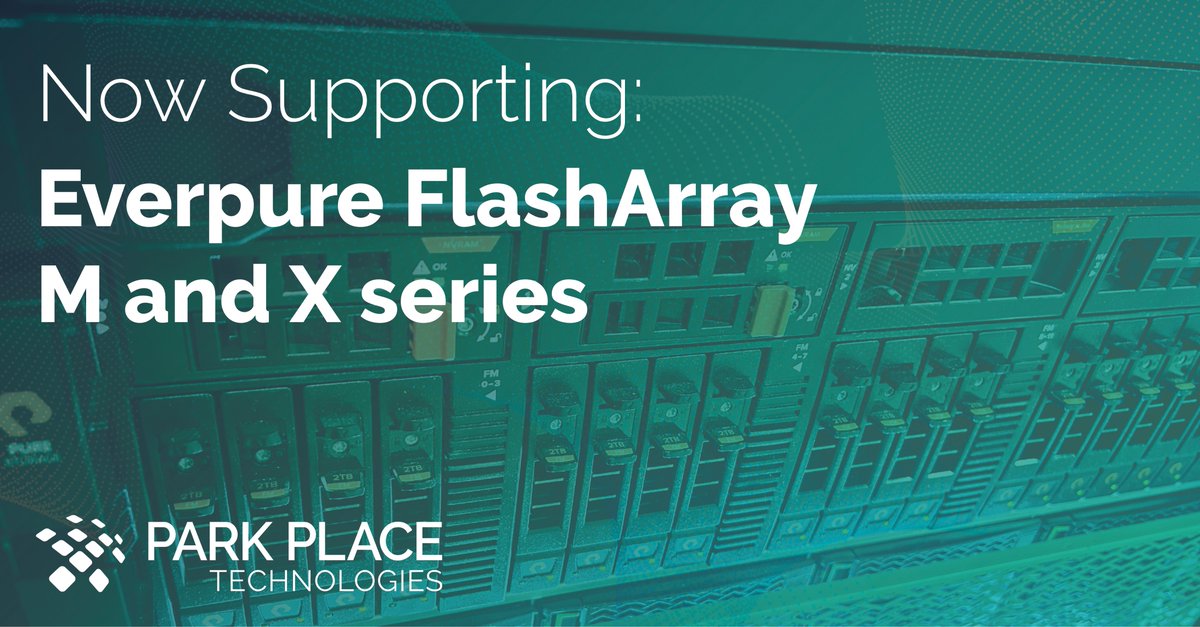
Park Place Technologies now offers full FlashArray support for M and X series arrays at 30-40% less than Everpure renewal pricing, with direct-to-engineer support from Level 3 engineers with deep Everpure expertise. Let's talk: parkplacetechnologies.com/th…
21

Jun 11
Where is AI's real long-term memory stored?
Large language models keep their parameters in GPU memory. But in enterprise AI, "company-specific knowledge" is something different: vector databases.
In RAG (Retrieval Augmented Generation) architecture, models query company-specific data in real time. These queries come from a vector store. The vector store loads from ultra-fast storage.
$PSTG is a natural player in this layer. Positioning itself as a vector store backend with FlashArray.
As enterprise AI adoption accelerates, this thesis becomes clearer. Companies will want to feed their own data to LLMs. The speed of that feed will determine everything.
An early and quiet position.
Not investment advice.
14
Jun 11
If you see $PSTG as "just a storage company," you're reading it wrong.
Pure Storage holds a strategic position in the memory layer of AI infrastructure.
AI inference is highly sensitive to latency. Model weights and vector databases must load from ultra-fast storage. Pure Storage's FlashArray system fills this gap.
Why Pure Storage instead of HDD or traditional storage?
Latency. Pure Storage is NVMe-based, sub-millisecond access time.
$NVDA, $AMZN, and major hyperscalers use Pure Storage systems.
The transition to subscription model continues (Evergreen//One). Recurring revenue is growing.
A small company. But positioned in the right place for AI infrastructure.
Not investment advice.
31
Jun 11
#PSTG'yi "sadece depolama şirketi" olarak görüyorsanız yanlış okuyorsunuz.
Pure Storage, AI altyapısının bellek katmanında stratejik bir pozisyonda duruyor.
AI inference gecikmeye çok duyarlı. Model ağırlıkları ve vektör veritabanları ultra hızlı depolamadan yüklenmeli. Pure Storage'ın FlashArray sistemi bu boşluğu dolduruyor.
Neden Pure Storage, HDD ya da geleneksel depolama değil?
Gecikme. Pure Storage NVMe tabanlı, milisaniyenin altında erişim süresi.
$NVDA, $AMZN ve büyük hyperscaler'lar Pure Storage sistemleri kullanıyor.
Abonelik modeline geçiş devam ediyor (Evergreen//One). Recurring revenue büyüyor.
Küçük bir şirket. Ama AI altyapısında doğru yerde duruyor.
Yatırım tavsiyesi değildir.
18

Jun 11
Slow storage is holding your business back.
@EverpureData FlashArray//XL. Extreme performance, zero downtime, built for the AI era.
marketing@techfirstgulf.com
#PureStorage #FlashArray #TechFirstGulf
6

Jun 7
Storage admins, what's your primary tool in 2026?
→ Primary: NetApp BlueXP
→ Performance arrays: Pure FlashArray
→ HCI: VMware vSAN
→ Software-defined: Ceph / Rook
→ Cloud: AWS FSx S3
→ Monitoring: Prometheus Grafana
→ Backup: Rubrik / Veeam
26

$PSTG — Valye Company Analysis
In its most recent quarterly filing dated June 5, 2026, Everpure, Inc. reported the commencement of shipments tied to a major hyperscaler design win, marking a significant milestone in its fiscal 2026 performance. Despite supply chain chall
Key points:
• Everpure began fiscal 2026 shipments for a large hyperscaler customer following an industry-first Flash design win, with further volume expected in fiscal 2027 [S1], [S2].
• The company’s subscription service mix continues growing, reflecting accelerated adoption of its Evergreen//One outcome-based SLA offering [S2], [S22].
• Everpure’s product suite integrates proprietary Purity OS software with DirectFlash hardware modules across FlashArray and FlashBlade//EXA platforms, targeting AI/HPC and traditional workloads [S1], [S22].
• Evergreen architecture enables continuous non-disruptive hardware and software upgrades, reducing customer switching costs and differentiating from competitors reliant on disruptive hardware refresh cycles [S1], [S16].
• Industry trends such as all-flash data center modernization, AI-driven storage demands, containerized workloads supported by Portworx software, and hybrid/multi-cloud complexity underpin long-term growth opportunities [S1], [S22].
Read: valye.com/news/pstg-company-…
#ValyeAI #Stocks #StockAnalysis #StocksInFocus #PSTG #StockMarket #FlashStorage #Hyperscaler #AI #TechInnovation
146

Jun 5
Your fastest workloads have always been your least protected.
Rubrik for Volumes changes that. Everpure FlashArray block volumes are now in Rubrik Security Cloud: same SLA automation, same 3-2-1-1-0 architecture as your VMs and databases. One platform, no carve-outs.
Beta is open now, check it out 👉 rbrk.co/4g03HmP
9
678

May 29
#VM Migrations to #Azure Local on Everpure FlashArray Made Easy with Azure Migrate
@purestorage
blog.everpuredata.com/produc…
3
3
204

May 27
Everpure $P
2027年度Q1決算を発表‼️
AI需要追い風に売上高・利益ともに過去最高水準、通期ガイダンスも引き上げ📈
株価は時間外で7.4%下落📉
🔸FY27 Q1業績
⭕️EPS: 0.47ドル(予想0.40ドル)
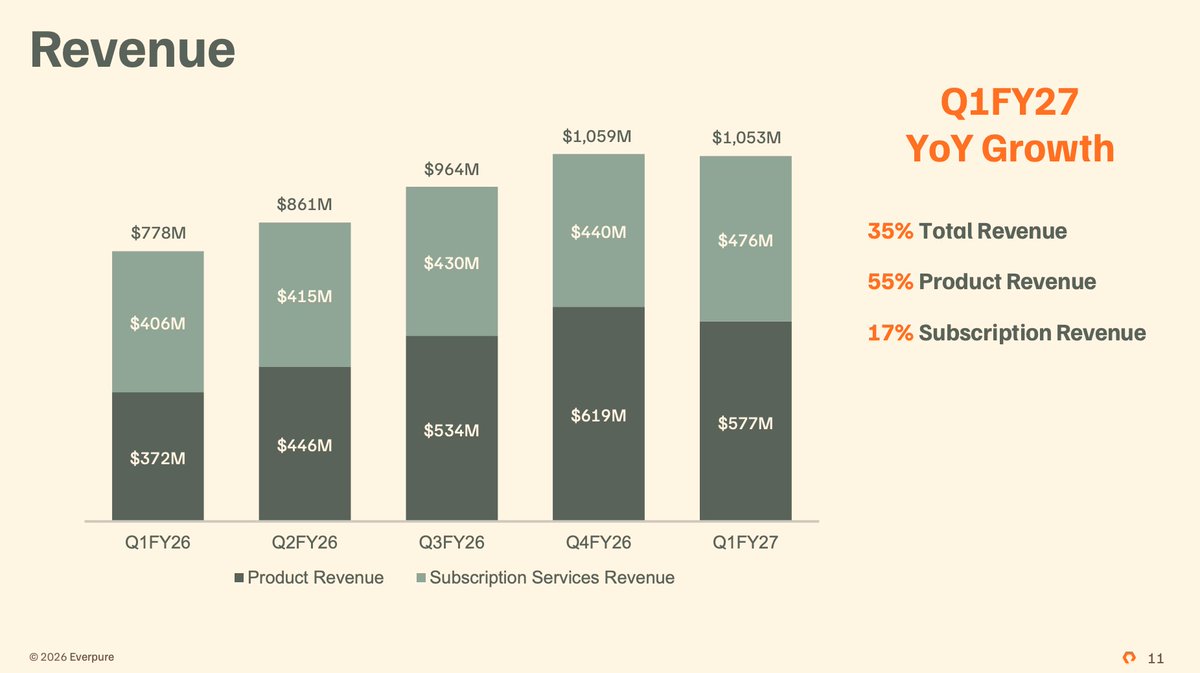
⭕️売上高: 10.53億ドル(予想10.03億ドル)
📈売上高成長率: 35% Y/Y
✔️製品売上高: 5.77億ドル( 55% Y/Y)
✔️サブスクリプション売上高: 4.76億ドル( 17% Y/Y)
🔸FY27 Q2ガイダンス
⭕️売上高: 10.95〜11.05億ドル(予想10.5億ドル)
📈売上高成長率: 27〜28% Y/Y
📈Non-GAAP営業利益: 1.95〜2.05億ドル(前年比 50〜58%)
🔸FY27 通期ガイダンス(上方修正)
⭕️売上高: 44.1〜45.1億ドル(予想43.9億ドル、従来43〜44億ドル)
📈売上高成長率: 20〜23% Y/Y
⭕️Non-GAAP営業利益: 8.20〜8.60億ドル億ドル(従来7.80〜8.20億ドル、 29〜36% Y/Y)
🔸サブスクリプション・ARR指標
📈サブスクリプションARR: 20.4億ドル( 19% Y/Y)
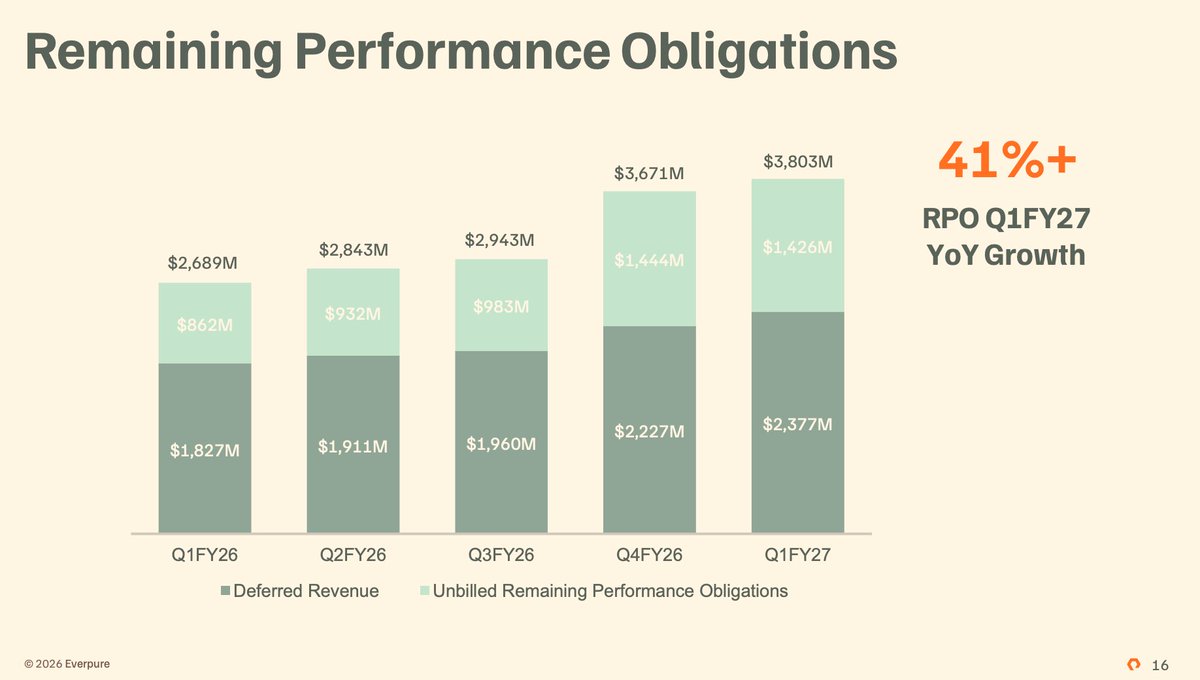
📈残存履行義務(RPO): 38億ドル( 41% Y/Y)
📈Storage as a Service(TCV売上): 1.65億ドル( 73% Y/Y)
🔸ハイパースケーラー戦略
✔️Q1のハイパースケーラーからの製品売上貢献は軽微
✔️Q3・Q4にかけてハイパースケーラー向け製品売上が大幅増加する見込み(顧客発注コミットメントに基づく)
✔️ハイパースケーラー向け製品の粗利益率は75〜85%を想定
✔️複数の見込み顧客とシステム認定作業に多大なリソースを投入中
🔸地域別売上構成(Q1)
✔️米国売上: 7.39億ドル( 39% Y/Y)
✔️海外売上: 3.14億ドル( 27% Y/Y、全体の30%)
🔸株主還元
📈自社株買い: Q1に130万株・約8,400万ドルを実施
✔️既存の4億ドル自社株買い枠の残額: 約2.45億ドル
🔸CEOコメント(Charlie Giancarlo氏)
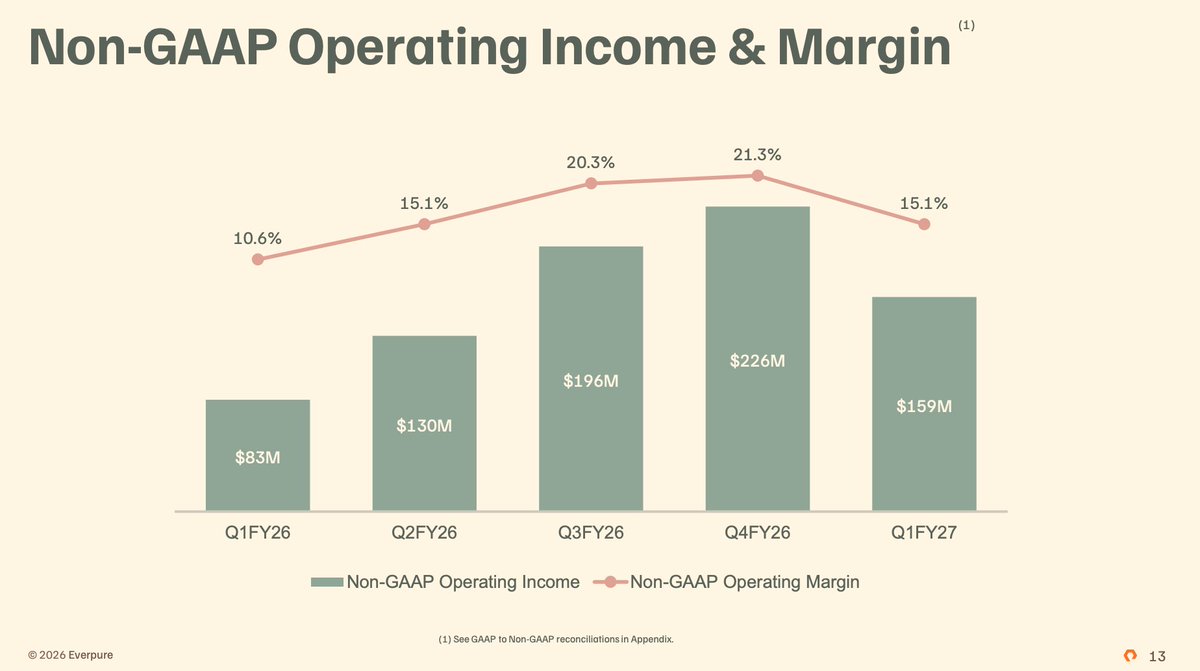
「Q1はまた素晴らしい四半期となりました。売上高は前年比35%増、営業利益はほぼ倍増し1.59億ドルとなり、いずれもガイダンス上限を超えました。1touchの統合を通じてEnterprise Data Cloudビジョンを拡大し、企業がインフラの摩擦をなくしAI時代に向けてデータを活用できる唯一無二のポジションを確立しています。」
🔸会社概要
Everpure(NYSE: P)は、旧Pure Storageが2026年にブランドを刷新した企業で、業界をリードするストレージ・データ管理プラットフォームを提供しています。FlashArray・FlashBlade・Evergreen//Oneなどの製品群を通じて、データのセキュリティ・アクセス性・インテリジェンスを確保し、AI時代に対応したデータ管理を実現。
Fortune 500の約64%を含む世界14,500社以上の顧客を持ち、10年以上にわたりNPS 80以上を維持する高い顧客満足度を誇ります。
1
2
38
4,967

May 27
$P (Everpure, 旧Pure Storage) Q1'27 決算
⭕EPS: 0.47 vs 予0.40
( 62.1% YoY / Beat 17.5%)
⭕売上: 1.05B vs 予1.00B
( 35.3% YoY / Beat 5.3%)
✅Product売上:576.5M( 55.0% YoY)、急加速
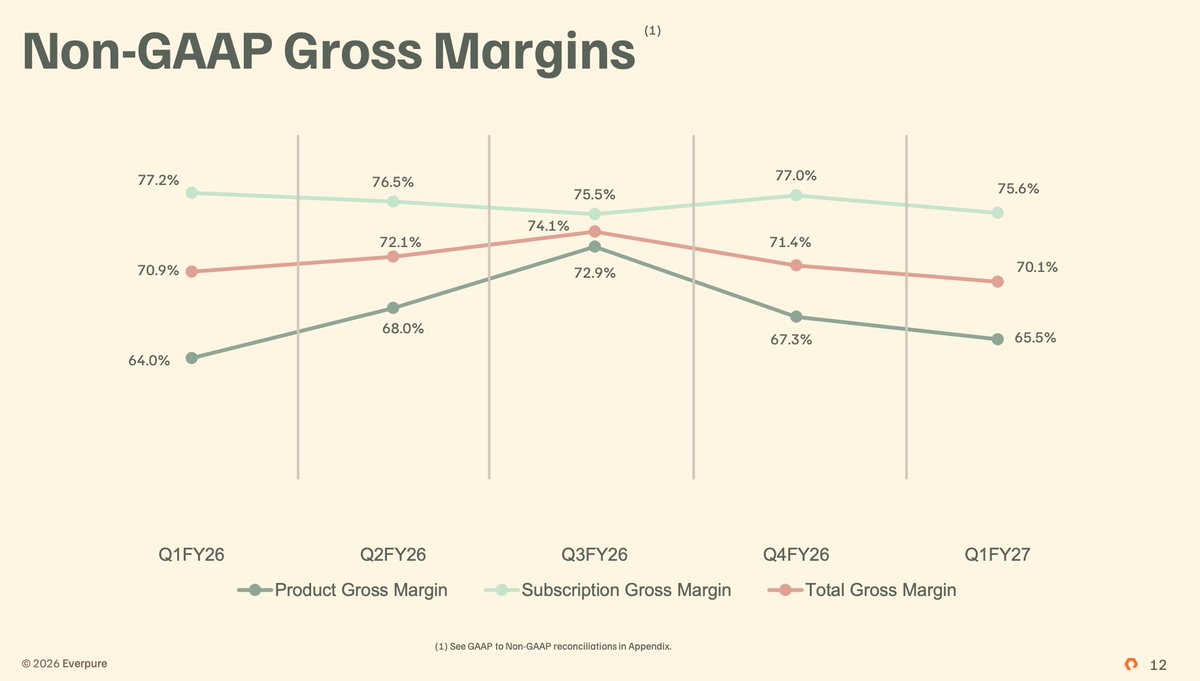
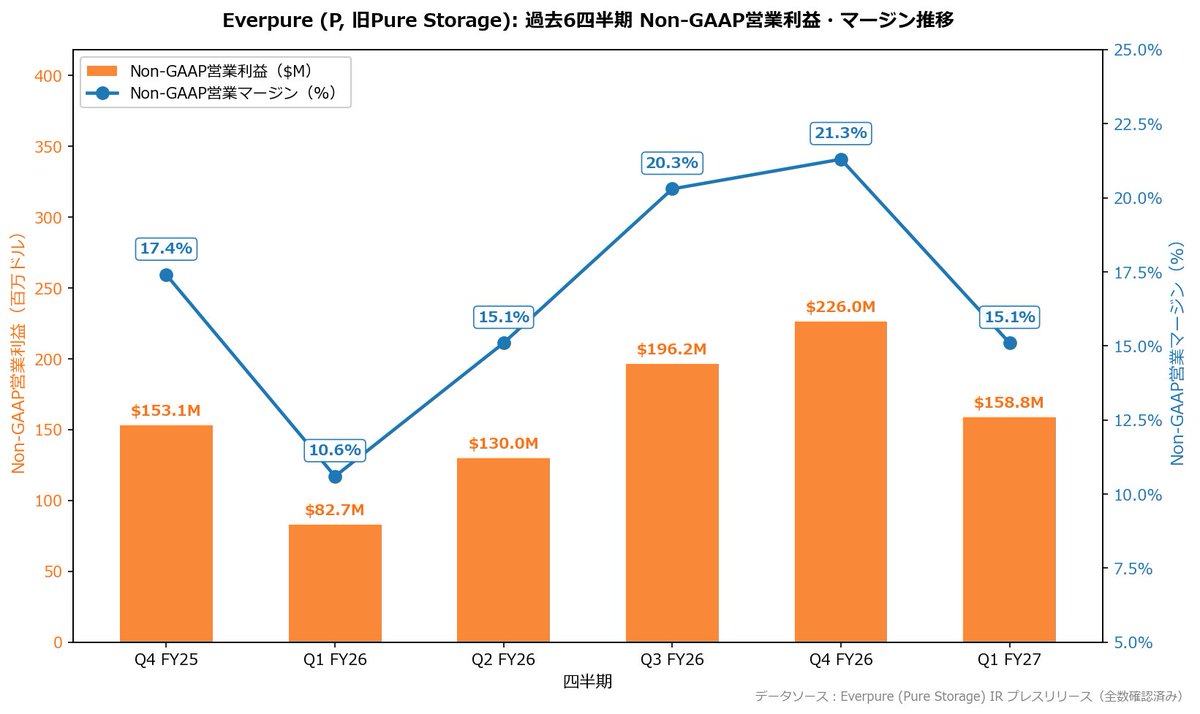
✅Non-GAAP 営業利益:158.8M( 91.9% YoY)
✅営業マージン:15.1%( 450bps)
✅Subscription ARR:2.0B( 19.0% YoY)
✅RPO:3.8B( 41.0% YoY)
✅GAAP営業利益が黒字転換(前年-31M→ 20M)
✅Pure Storage→Everpureへブランド変更、データ管理プラットフォーム企業へ転換
✅1touch買収完了(DSPM・データ発見/分類)
✅FlashBlade//EXAがSPECstorage AI_Imageで過去最高スコア
⚠️ 営業CF -36.5% YoY、FCF -47.2% YoY(運転資本変動による一時要因)
⚠️ Non-GAAP粗利率:70.1%(-80bps YoY)
FY27 Q2ガイダンス
⭕売上:1.095-1.105B(予1.05B)
(中間値1.10B: 27.5% YoY / Beat 4.8%)
✅Non-GAAP 営業利益:195-205M(中間値200M: 54% YoY)
FY27通期ガイダンス(大幅上方修正)
⭕売上:4.41-4.51B(予4.39B)
(中間値4.46B: 21.5% YoY / Beat 1.6%、前回4.3-4.4B/ 17-20%から上方修正)
✅Non-GAAP 営業利益:820-860M(中間値840M: 32.5% YoY、前回780-820Mから上方修正)
🏷️ ストレージ/データ管理プラットフォーム
📝 全フラッシュストレージで業界をリードするデータ管理プラットフォーム企業。Evergreen//One(STaaS)・FlashArray・FlashBladeを中核に、AI/HPC・ハイパースケーラー向けに展開。Net Promoter Scoreが10年以上業界最高水準。2026年5月にブランドをPure Storage→Everpureへ刷新し、DSPM企業1touchを買収してAI時代の「データインフラ摩擦の解消」を新ビジョンに掲げる。
2
857

May 18
$P and $META have collaborated since 2017 to help design $META’s initial AI infrastructure. Since then, $META has continued to deepen the relationship by using $P’s FlashArray and FlashBlade systems for scalable storage to support $META’s AI workloads.
More recently, $P has been providing $META with DirectFlash and architectural software solutions via its Purity platform.
With various bottlenecks surfacing in the AI race, $P creates value by:
- Reducing energy consumption by 85% or more compared to competitors. $P’s DirectFlash solution bypasses traditional SSD layers for lower latency and power at scale. This makes $P’s solution ideal for AI (training pipelines, inference).
- Removing the need for frequent hardware/software upgrades across multiple generations of SSD renewal. SSDs degrade and need replacement over time. Physical replacement is not tough; it is the downtime during replacements/swaps and the process of securing replacements that makes it cumbersome and costly. Moreover, data security is an issue. SSD controllers cannot be easily demagnetized like hard drives, so failing drives containing sensitive AI model data or user data must be physically shredded or cryptographically erased (via block-level cryptographic erasure) before disposal to comply with security standards.
$P makes storage reliable and non-disruptive for the customer. In turn, this creates customer loyalty and predictable costs.
1
1
3
146


May 6
The post is a cryptic, but now very clear flex from @SIN3R6Y. What the tweet says on the surface:
"Why did DeBank pull #PulseChain support from their platform and Rabby? Oh... It's solvable tho."
DeBank (a popular on-chain portfolio tracker) and Rabby (a popular crypto wallet) both quietly dropped support for PulseChain recently.
A lot of people in the PulseChain community were annoyed and speculating why.
What the attached image actually shows (and why it's the punchline):
It's a real-time server performance dashboard (labeled "Array Performance" from what looks like a high-end storage system - probably Pure Storage FlashArray, based on replies).
The graph has three panels from ~12:46 to 12:51 on May 6, 2026:Latency - very low and stable (good).
IOPS (Input/Output Operations Per Second) - Read IOPS spiking up to ~70K at times (very high activity).
Bandwidth - This is the smoking gun.
The blue line (Read) is absolutely hammering ~700–900 MB/s for minutes straight. Then, right around the vertical marker line (~12:48:30), it drops sharply to roughly half that level and stays lower.
In plain English:
PulseChain users (or the PulseChain RPC nodes that DeBank/Rabby were querying) were absolutely pounding their servers with massive data requests - basically using a ridiculous amount of bandwidth and IOPS.
That translates directly into huge monthly cloud/server costs for DeBank and Rabby.
The post is saying:
"Yeah… they didn’t pull support because they hate PulseChain. They pulled it because we were using so much bandwidth, it was costing them a fortune."
The "Oh..." is the sarcastic reveal moment when you see the graph.
The "It's solvable tho." means the excessive load isn't an unsolvable problem - it can be fixed with better indexing, caching, optimized queries, or dedicated infrastructure on the PulseChain side (and some replies even suggest Alex already has a fix or is working on one).
TL;DR: The post is proudly (and slightly trollishly) showing proof that PulseChain users are extremely active on these platforms — so active that it became expensive for DeBank/Rabby to keep supporting the chain. They pulled support to cut costs, but Alex is hinting that the real issue (bandwidth/IOPS abuse) is fixable.
Classic PulseChain "we're so based it broke your servers" energy.
Thank you Alex for being so clear and for educating us...
😏
❤️💛🧡💚💙🩵💜🩷🤍❤️
4
7
44
461

🟢شخصياً
أراهن عليها $P Everpure
شركة متخصصة في تقنية الـ Flash Storage (تخزين فلاش فائق السرعة)
توفر أجهزة FlashArray اللي تخزن بيانات الشركات العملاقة بسرعة فائقه وأمان عالي و
ودعم قوي للـ Ai 🤖 👌
🔹مثال مختصر:
متجر مثل أمازون يتعامل مع ملايين الطلبات يومياً $P تعطيه FlashArray يخزن كل شيء بسرعة خيالية واستقرار عالي جداً.

11
8
162
34,318

Apr 14
At scale, database consolidation fails when storage becomes the bottleneck.
The Nutanix and Everpure integration enables you to consolidate SQL Server and Oracle databases while keeping the applications that depend on them fast. ⚡
👉 Learn how to scale without compromise: purefla.sh/4820YEP
#Everpure #EnterpriseDataCloud #StoragePlatform #StorageAndDataManagement #SQLServer #Oracle #Databases #FlashArray #Nutanix #Virtualization #DatabaseConsolidation
1
4
537
Apr 8
Exploring new possibilities for your virtualization stack?
Discover 7 insights from integrating Nutanix Cloud Platform with Everpure FlashArray—and see how you can boost performance, simplify operations, and scale with confidence.
In Chicago? Join us at Nutanix .NEXT today and tomorrow to connect, learn, and see it in action.
🚀 : purefla.sh/47NsplG
#FlashArray #Nutanix #Virtualization #NutanixNEXT #Everpure #EnterpriseDataCloud #StoragePlatform #StorageAndDataManagement
1
3
341
Apr 8
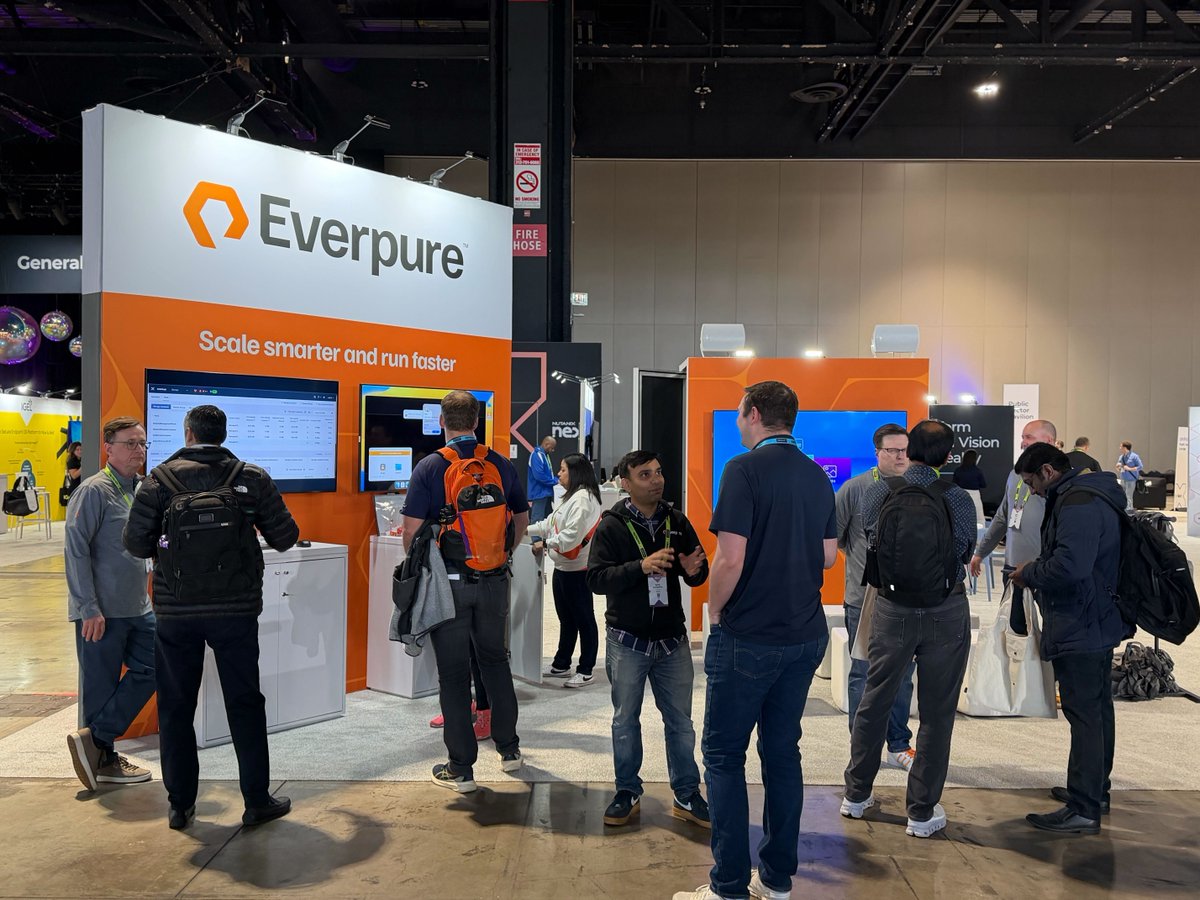
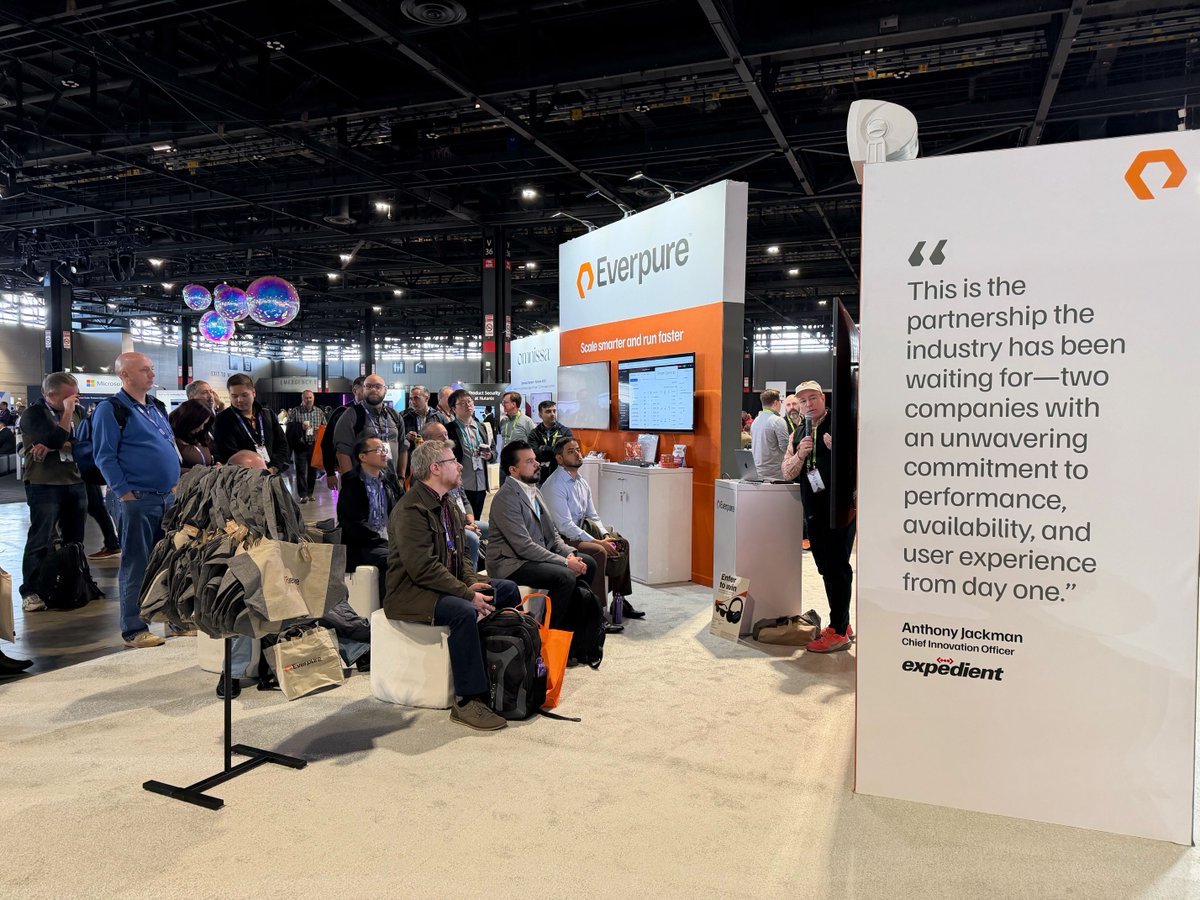
We’re live at Nutanix .NEXT 🚀
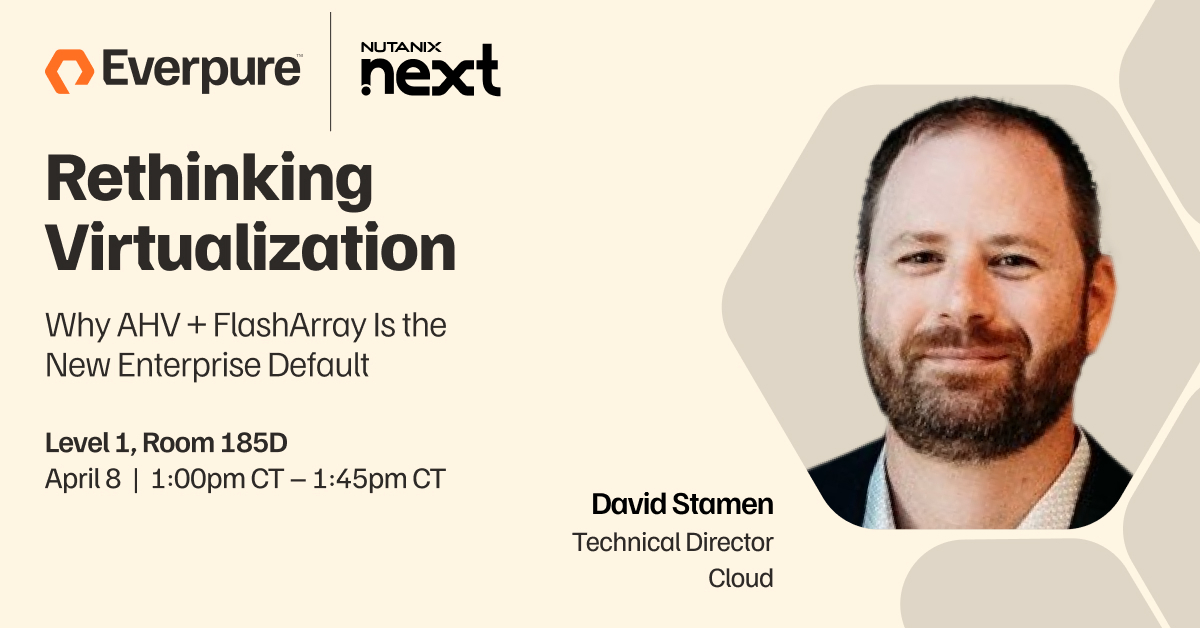
If you’re here today, don't miss our session:
Rethinking Virtualization: Why AHV FlashArray Is the New Enterprise Default
🗓 April 8, 2026
⏰ 1:00–1:45 PM
📍 McCormick Place, Level 1, Room 185D
See how organizations are simplifying operations, reducing costs, and boosting performance with modern virtualization.
✨ Plus, stop by Booth P8 to chat with our team and see it in action: purefla.sh/4rox6t4
#Everpure #NutanixNEXT #EnterpriseDataCloud #StoragePlatform #StorageAndDataManagement #Virtualization
1
5
312

Apr 7
Headline: Nutanix declares the AI control plane era at .NEXT, positioning for the enterprise replatforming wave
At this year’s Nutanix .NEXT conference, the message wasn’t subtle—and it wasn’t incremental.
This wasn’t about product updates or incremental hybrid cloud improvements. It was a clear signal that the market is moving into a new phase: one where artificial intelligence isn’t just another workload, but the driving force behind a full-scale re-architecture of enterprise IT.
The headline shift is this: Nutanix is positioning itself not just as a cloud platform vendor, but as a control plane for what it calls “AI factories.”
And that framing matters.
From hybrid cloud to AI operating model
For the past decade, the enterprise conversation centered on hybrid and multicloud—where workloads run and how infrastructure is distributed.
At .NEXT, that conversation evolved.
Nutanix executives outlined a transition from a cloud operating model to an AI operating model, where enterprises must manage not just applications and infrastructure, but pipelines of data, models, and increasingly autonomous agents.
In this world, AI is not experimental. It’s operational.
That shift introduces new requirements:
- Governance across distributed environments
- Lifecycle management for models and agents
- Cost control at scale
- Security embedded into the platform
The implication is clear: running AI at scale requires a system, not just tools.
Shadow AI emerges as the next enterprise risk
One of the more important themes coming out of the keynote is the rise of “shadow AI.”
Much like shadow IT in the early cloud era, organizations are now seeing teams adopt external AI services outside of centralized control. The difference is that AI introduces significantly higher stakes, particularly around data exposure, compliance and cost visibility.
Nutanix is leaning directly into that problem, positioning its platform as a centralized governance layer for AI workloads—designed to bring visibility and control back to the enterprise.
This is more than a security story. It’s an operational one.
If AI becomes embedded in every business process, then uncontrolled AI usage becomes a systemic risk.
Partnerships signal platform ambition
Another clear signal from the keynote is the breadth of Nutanix’s ecosystem strategy.
Deepening alignment with NVIDIA and AMD underscores the importance of silicon flexibility in AI infrastructure. At the same time, partnerships spanning Cisco, Dell Technologies, AWS, Microsoft, Accenture, HPE, Lenovo and Tata Consultancy Services reflect a broader reality: no single vendor owns the AI stack.
Instead, platforms are emerging through ecosystems.
Nutanix’s approach is to position itself as the layer that integrates across that ecosystem—spanning infrastructure, data, and AI services—while maintaining a degree of neutrality that enterprises increasingly demand.
A full-stack play with an emphasis on control
Nutanix also made the case that its platform is now “complete,” spanning core infrastructure, Kubernetes-based cloud-native architecture, data services and AI capabilities.
At the foundation is a cloud-native stack built on containers and Kubernetes, reinforcing a message to enterprises that modernization is no longer optional. Without it, AI at scale becomes difficult—if not impossible—to operationalize.
Support for external storage platforms such as Dell PowerFlex and Pure Storage FlashArray further signals a pragmatic approach to adoption, allowing customers to integrate with existing environments rather than forcing wholesale replacement.
Customer stories highlight operational realities
Customer examples across industries reinforced a consistent theme: simplicity and control are becoming more important than raw performance.
From retail to healthcare, organizations are grappling with:
-Cost pressures
-Talent shortages
-Increasing cyber risk
-The need to modernize without disruption
In healthcare in particular, where regulatory pressure and resilience requirements are high, infrastructure decisions are increasingly evaluated through the lens of operational continuity and security rather than just technical capability.
A comment from a Wynn Resorts CIO during the keynote captured this shift succinctly: success is not just about technology, but about trust in the platform and the people behind it.
The bigger picture: a market in transition
Taken together, the announcements and messaging at .NEXT point to a broader industry transition already underway.
The disruption in the virtualization market has opened the door for a wider replatforming effort. At the same time, AI is accelerating the urgency of that shift by exposing the limitations of existing infrastructure models.
What’s emerging is a new battleground:
-Not just cloud vs. on-premises
-Not just one vendor vs. another
But a competition to define the enterprise operating model for AI.
The bottom line
Nutanix is making a calculated bet that enterprises don’t just need better infrastructure—they need a way to run AI as a core part of their business.
That means:
-Controlling where AI runs
-Governing how it’s used
-Managing its cost and risk
-Integrating it across hybrid environments
If the last decade was about virtualizing infrastructure, the next one will be about operationalizing AI.
And the company that owns the control plane for that shift stands to define the next era of enterprise IT.
4
274