
RISC-V is making waves in the world of floating-point operations! 🌊 Its open architecture is setting new standards for performance and flexibility. Discover how it’s revolutionizing computing and paving the way for innovative applications. #RISC #FloatingPoint #TechInnovation
12

#FloatingPoint entrega los detalles de su nuevo disco “Mere Mortals”. Partitura que compuso para el Ballet de San Francisco I @floatingpoints; @rockaxisoficial
rockaxis.com/vanguardia/noti…


21

Jun 4
everyone @ycombinator is right when they say the friends you make during the batch are friends for life
the floatingpoint team are the real homies, some of our friendship highlights:
- during the batch, they were building "lumina" which was an ai powered research platform for papers. we stayed up until 3am with them one day ingesting over 1B vectors to power it
- later on, when they made their first pivot to chunkr, they actually built the POC as part of a "hackathon" with us at the trieve office. few weeks later they launched it and raised a seed round 💚
- today they are building the data layer for vision. this is a huge problem. i can't think of a better team to solve it
if you want to work at a breakout data and research company, there's no better spot
join my friends 🥹

ALT team photo with fed and the lumabros

ALT denzell and ishaan hanging

ALT playing carrom with the lads
Jun 4

Today we’re launching floatingpoint.
An effort to build the data layer for pixels.
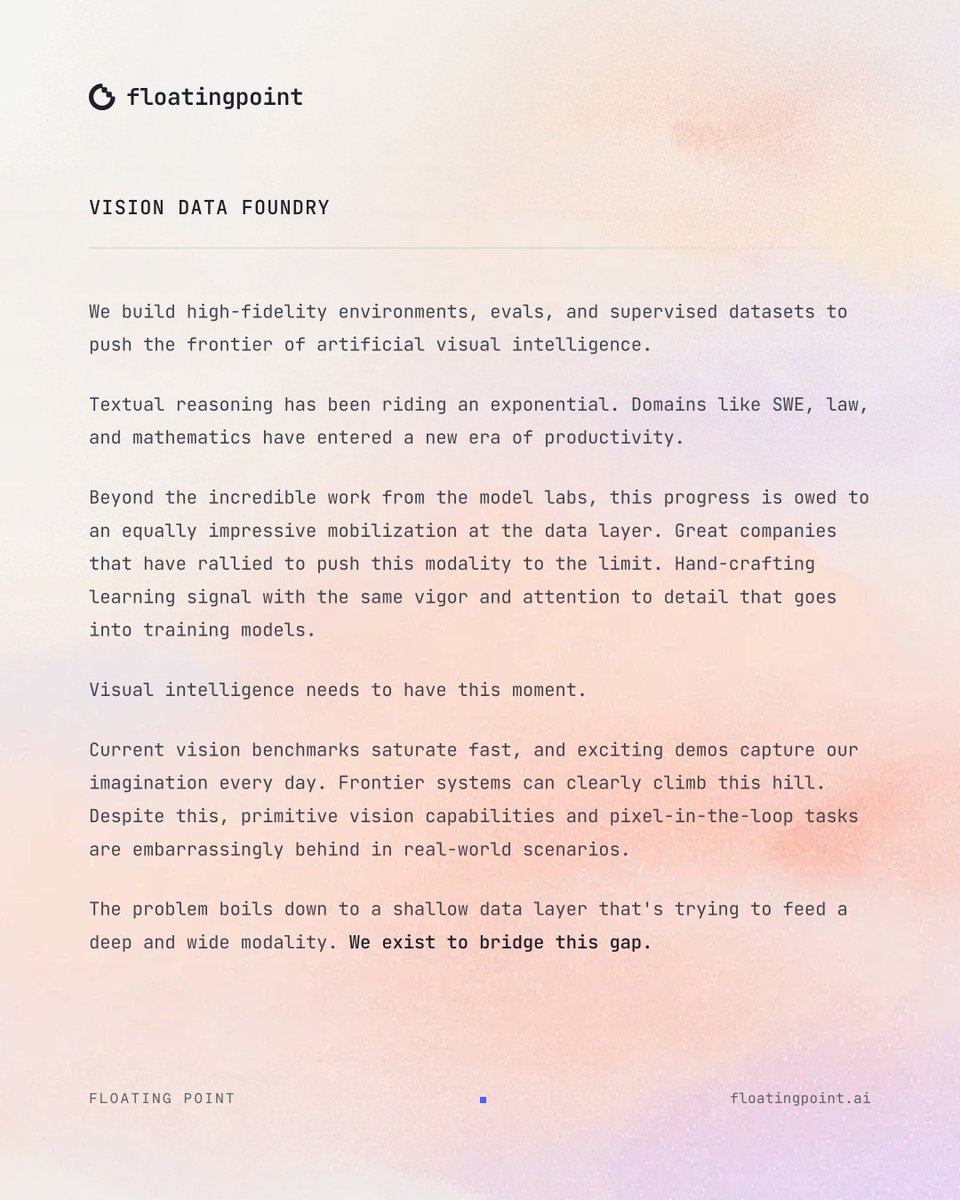
ALT floatingpoint.ai
3
55
5,678

We are pushing the frontier to unlock new capabilities that were never possible with just text.
Launching floatingpoint a vision data foundry!
Jun 4
Today we’re launching floatingpoint.
An effort to build the data layer for pixels.
ALT floatingpoint.ai
3
731

Jun 4
Text is only one interface to intelligence.
Vision is messier and closer to the world, but it also unlocks so many new use cases for AI. Which makes it both hard and important to get right.
I’m excited to announce floatingpoint, a data foundry for vision.
Jun 4
Today we’re launching floatingpoint.
An effort to build the data layer for pixels.
ALT floatingpoint.ai
1
1
12
1,187








Apr 14
New blog post! I really hope I'll get a decent amount of people mad with this one 😈😈😈
#programming #computing #floatingpoint #geometry
lisyarus.github.io/blog/post…
10
24
237
34,403

Apr 10
Common Floatingpoint Gemerald


1
4
140

🚀 New on Johnny’s Software Lab: Handling floating-point errors in C without killing performance!
NaNs, infinities, sticky bits, and traps — what works and what’s a trap🪤.
Read more: johnnysswlab.com/floating-po…
#Cpp #Performance #FloatingPoint #NaN #Infinity
6
15
1,230

Feb 17
MultiFloats.jl v3.0 released: MultiFloats.jl is the world's fastest library for extended-precision floating-point arithmetic with 128–256 bits (30–60 decimal digits).MultiFloats.jl v3.0 introduces new arithmetic algorithms that are simultaneously faster and more accurate than MultiFloats.jl v2.0. github.com/dzhang314/MultiFl…
#JuliaLang #MultiFloats #HighPrecision #NumericalComputing #ScientificComputing #HighPerformanceComputing #HPC #OpenSource #FloatingPoint #Mathematics #ComputationalScience #JuliaCommunity
6
15
1,616


Jan 6
The Rubin GPU It features the new NVFP4 tensor core. This is a dynamic processing engine that adjusts its mathematical precision in real time. It knows exactly when it needs high precision floatingpoint math and when it can speed up with lower precision.
1
3
88

25 Nov 2025
My version numbers would be:
0.5
0.75
0.875
0.9375...
Continuing until I run out of mantissa bits and have to promote it to 1.0.
#Dyadic #FloatingPoint
4
434

24 Nov 2025
The problem of ensuring the same results of machine learning when trained on different hardware is solved by Reproducible Operators (RepOps), a framework by Gensyn that offers deterministic algorithms of popular machine learning tasks, making sure that they provide the same output.
Although both models are the same, differences in the architecture of the gpu and the driver versions may result in differences in the bits generated when carrying out machine learning functions.
Output errors are caused by driver changes, concurrent engineering, and floatingpoint roundoff error.
This is not a problem with centralized training, but with decentralized networks, where you must ensure work is done by anonymous machines, it becomes a severe problem.
Repops eliminates this problem by applying deterministic execution. In Brazil, when a matrix is multiplied using a GPU it produces the same result as it would using a CPU in Korea. Results.ge means that distributed workloads do not deviate or change inconsistently because it can predict its results with accuracy on a bit.
The calculation is correct when the results of two nodes are identical. Otherwise, Gensyn will be able to spot the problem step immediately.
RepOps provides a basis of trust; in contrast to traditional decentralized computing which can experience inconsistencies, RepOps has deterministic operations and can, on the fly, punish dishonest nodes and check the accuracy of its operation cheaply.
It is a small aspect, which allows the possibility of converting global hardware into a reliable and integrated engine that can train serious AI models with ease, without a necessity of any single machine, just math. @gensynai

21
21
138

15 Aug 2025
念願の夜フェス!混雑具合がちょうど良くとても快適✨Perfume→電気グルーヴ→きゃりー→floatingpoint(宇多田ヒカルゲスト)で帰宅~🐾

3
322


1 Apr 2025
Grungy analog photo from a war in Milano, Italy, flash photography, unedited.
by floatingpoint

1
3
216