
Jun 12
The biggest AI failure isn't at the top. It's in the middle.
C-suite sets the mandate. Middle managers execute it — or don't.
Invest in the middle layer first.
#FounderLessons #Leadership #AI #Execution
2

A decade of ag tech ranchers won't touch — because products were built to be fundable, not useful.
Brady Aultman changed that at AgCents. 25 years of cattle ops > any pitch deck.
The operator is the moat.
#FounderLessons #AgTech #StartupAdvice

1

Trading teaches a lesson founders love to ignore:
Being right is not enough.
You can be directionally right and still lose because your sizing was bad, your timing was wrong, or you could not survive the drawdown.
Startups work the same way.
Good idea, wrong wedge.
Good product, no distribution.
Good market, too much burn.
Good feature, no trust.
The question is not “is this a good idea?”
The better question is:
What has to be true for this to work, and what is the cheapest way to test that before I size up?
That one question saves months.
#Startups #Trading #FounderLessons #BuildInPublic
1
7

Jun 10
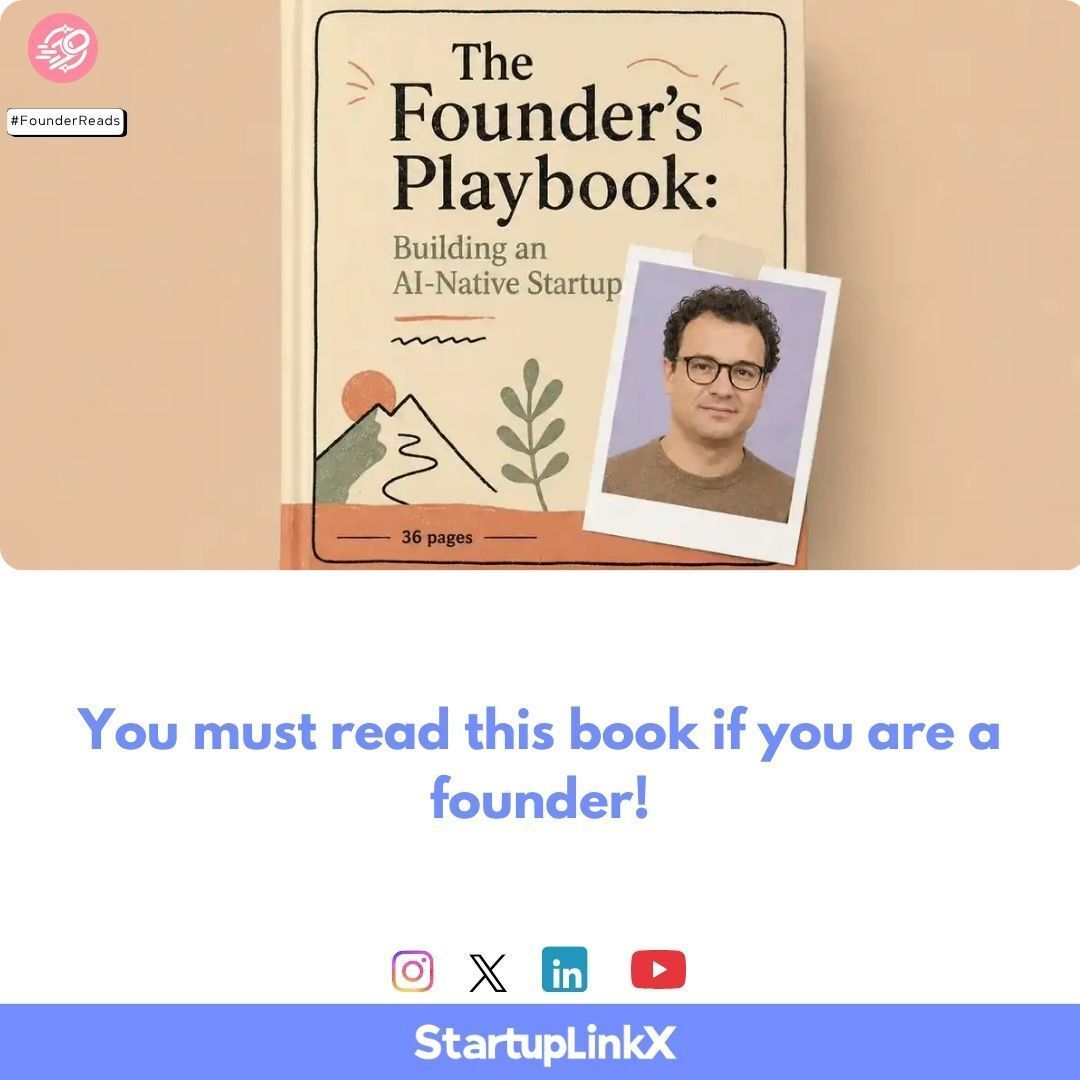
The Founder's Playbook · 2026 Edition
Must read
AI changed the tools
not the fundamentals
Execution still wins
#StartupBooks #FounderLessons

What does it actually take to build AI agents before the world is ready for them?
On this episode of Ignite, Brian Bell sits down with Dennis Mortensen, a Danish-born, New York-based serial founder with four exits, one hard-earned failure, and a deep track record building companies at the edge of analytics, automation, and AI.
Dennis built X.ai years before “AI agents” became a mainstream startup category—hand-labeling millions of data points, defining scheduling intents from scratch, and learning that the goal was never to make AI feel human. The goal was to solve the pain.
Now he’s building LaunchBrightly, tackling one of the least glamorous but most universal problems in SaaS: keeping product screenshots and help center documentation up to date as software changes.
Chapters:
00:01 – Meet Dennis Mortensen
01:25 – From IBM Dreams to Serial Founder
03:51 – Selling His First Company During the Dot-Com Era
05:00 – Building in Budapest and Moving to New Yor
07:08 – Why European Founders Look West
09:25 – The “Expensive MBA” Startup Failure
11:52 – Why Dramatic Pivots Are Overrated
13:51 – The Marketplace Mistake That Killed the Business
16:27 – When the Market Is Telling You You’re Wrong
18:23 – The Twitter Pivot and Founder Mythology
20:46 – Why Business Model Flexibility Matters
22:35 – Founder Bias, Persistence, and Not Dying
24:30 – Shutting Down and Moving On
26:34 – Building IndexTools and Real-Time Analytics
31:34 – Why Founders Should Take M&A Calls
35:05 – How Optionality Creates Future Exits
36:45 – From Yahoo to Visual Revenue
40:01 – The “List of Hate” Startup Ideation Process
44:57 – Why Founder Focus Beats Angel Investing
48:43 – Building Visual Revenue for Digital Publishers
53:44 – Selling Visual Revenue to Outbrain
54:58 – The Pain Behind X.ai
55:26 – Market Challenge vs. Science Challenge
56:59 – Why Scheduling Was a Worthy AI Problem
01:00:40 – Testing X.ai with Human Assistants First
01:02:31 – Wizard-of-Oz Testing and Scheduling Complexity
01:05:34 – Building AI Before Modern LLMs
01:06:07 – 47 Intents and 32 Million Labeled Data Points
01:10:13 – Lessons from the X.ai Journey
01:11:14 – Why Winning the Turing Test Was the Wrong Goal
01:14:55 – When Customers Stop Being Sold and Start Buying
01:17:04 – Introducing LaunchBrightly
01:17:43 – Building for the Love of the Sport
01:19:20 – Why LaunchBrightly Exi
This one is a masterclass in founder judgment, scar tissue, and building useful AI before the hype catches up.
👂🎧 Watch, listen, and follow on your favorite platform: tr.ee/S2ayrbx_fL
🙏 Join the conversation on your favorite social network: linktr.ee/theignitepodcast
#Startups #SaaS #AIAgents #FounderLessons #B2BSaaS #VentureCapital #ProductStrategy #AI #LaunchBrightly #Entrepreneurship
1
2
219
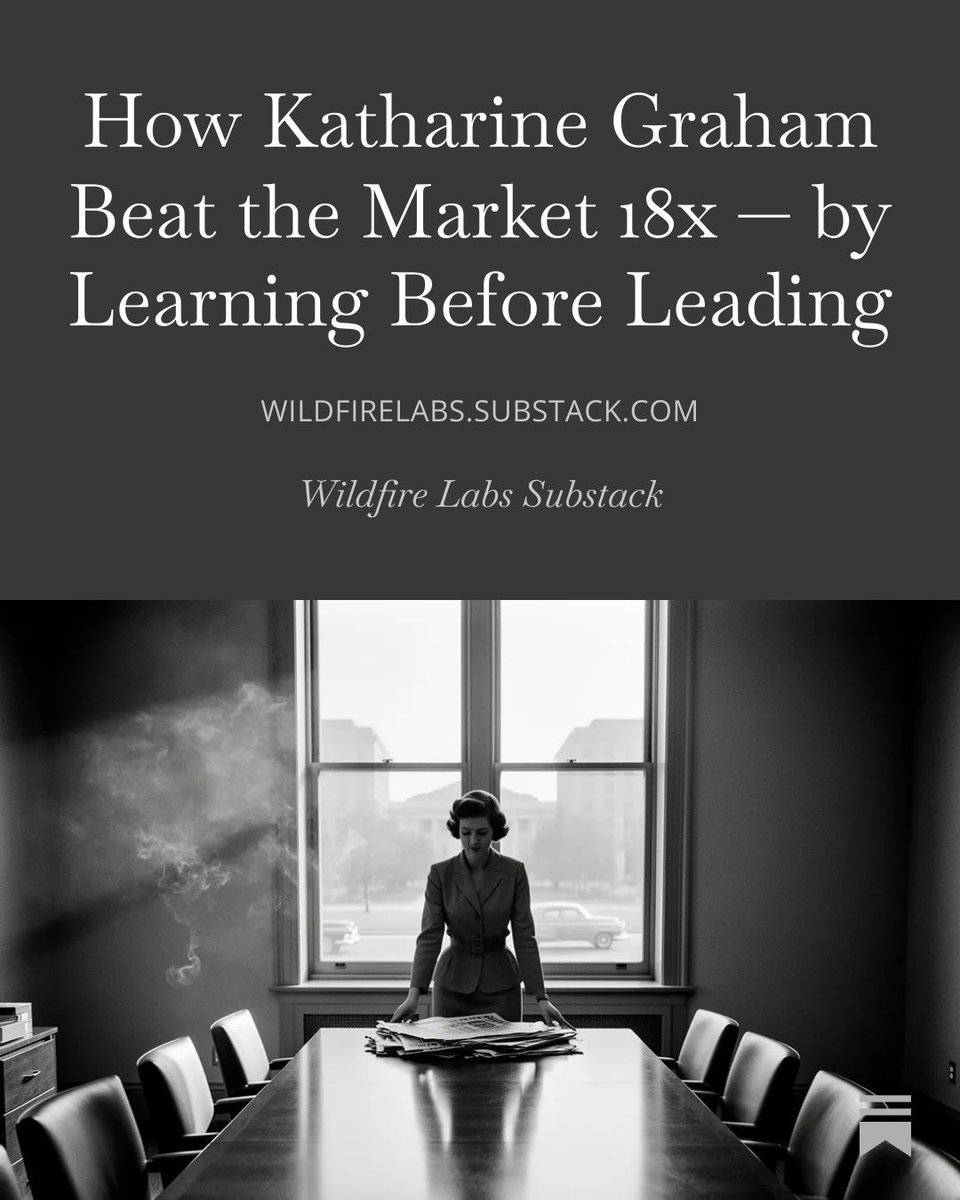
Most leaders announce a vision before they've had a single real conversation.
Katharine Graham did the opposite. She learned first, led second — and beat the market 18x.
Admit the gap. Do the small work. Earn your opinion.
#FounderLessons #Leadership #StartupAdvice
Jun 5
Grit is fuel. Not strategy.
The day I stopped treating them as the same thing was the day Infragistics started to actually scale.
#FounderLessons #Leadership #Entrepreneurship #Building
5
Most CEOs never planned to be CEOs. 🎯
This week, Pete Steege breaks down the "accidental CEO" — and why most would hand off the title in a heartbeat, if anyone else could do the job.
🎧 Full episode on Spotify
#AccidentalCEO #FounderLessons #StartupLeadership
25

Jun 3
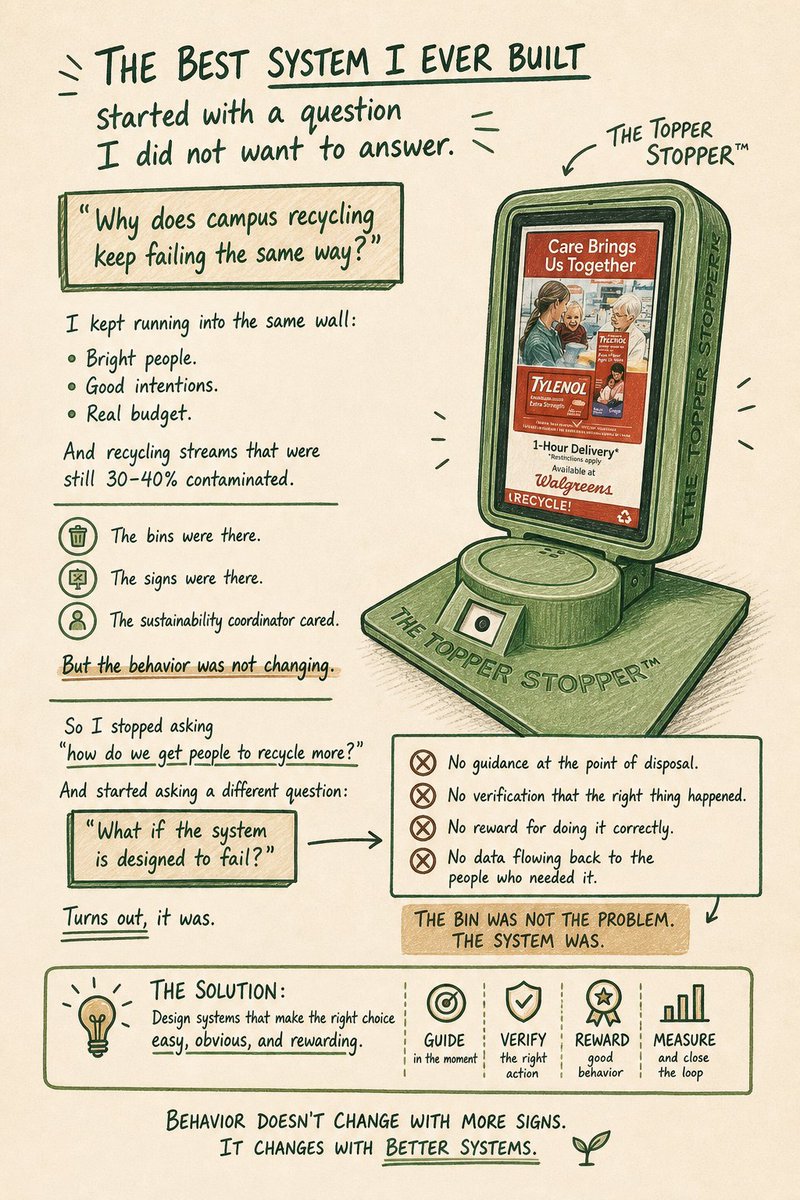
The best system I ever built started with a question I did not want to answer.
"Why does campus recycling keep failing the same way?"
I kept running into the same wall:
Bright people. Good intentions. Real budget.
And recycling streams that were still 30-40% contaminated.
The bins were there. The signs were there. The sustainability coordinator cared.
But the behavior was not changing.
So I stopped asking "how do we get people to recycle more?"
And started asking a different question:
"What if the system is designed to fail?"
Turns out, it was.
No guidance at the point of disposal.
No verification that the right thing happened.
No reward for doing it correctly.
No data flowing back to the people who needed it.
The bin was not the problem. The absence of a system around the bin was the problem.
That insight changed everything.
We stopped trying to fix the person and started building the loop:
Scan. Verify. Reward. Repeat. Measure.
The bin is not the system.
The behavior is.
If you are stuck on a problem that keeps coming back, stop trying harder at the wrong question.
Ask the one underneath it.
The answer might surprise you.
Follow @Marcus Wade for founder lessons on building systems that change behavior.
#FounderLessons #SystemsThinking #Sustainability #StartupLife #BehaviorChange
10
A lot of your customers aren't loyal — they just haven't found a reason to leave yet.
The fix isn't more features. It's making one thing so good they'd fight to keep it.
If your product vanished tomorrow, would anyone chase it down?
#FounderLessons #ProductMarketFit
4

May 29
Today I commented on a post by a startup founder, @indiesoftwaredv, who mentioned that customer acquisition costs in the US market are quite high.
And this is something I see often.
Many projects I’ve worked with believe that a good product will naturally attract users by itself.
But in reality, product is only half of the game.
Distribution, marketing, positioning and sales are what actually bring people in.
Even at the MVP stage, your marketing budget should often be 5–10x higher than you expect.
Because building the product is not the hardest part.
Getting people to notice it, trust it and try it - that’s where the real challenge starts.
#Startups #MVP #ProductDevelopment #StartupMarketing #CustomerAcquisition #SaaS #FounderLessons #BuildInPublic #MarketingStrategy #Forfis
6

May 29
Your First Pricing Decision Follows You for Years
#SaaSPricing #CustomerRetention #StartupStrategy #FounderLessons #B2BSaaS
7
What if the biggest risk in a startup isn’t hidden in the product, the team, or the market—but buried inside the data no one is auditing?
Attila has spent years helping companies and investors uncover the hidden risks inside digital businesses—from rising CAC and messy first-party data to cloud cost traps and paid-marketing dependency. In one M&A audit, his team identified roughly €2.5M in digital risk inside an €80M deal.
Chapters:
00:01 — Intro to Attila Tóth and Cognitive Creators
00:25 — Attila’s origin story
00:29 — From teenage cyclist to accidental web builder
02:54 — The first online sale
03:10 — Discovering analytics, tracking, and consumer behavior
04:29 — Launching Sight Doctor at 18
05:00 — Early startup failure and hard lessons
05:40 — Digital business modeling for traditional industries
06:45 — The M&A audit that exposed €2.5M in risk
08:57 — Writing Hyper and the frustration behind marketing data
11:14 — The rising cost-per-click problem
12:18 — The bakery ad-spend analogy
14:52 — The paid marketing trap
16:43 — The marketing spend treadmill
18:10 — Searching for an escape from platform dependency
20:00 — Turning years of experiments into a book
22:04 — Self-publishing Hyper
22:34 — Defining the marketing data trap
24:00 — First-party data as the escape plan
24:22 — The tire purchase example
26:29 — Banks, bad segmentation, and irrelevant offers
28:26 — Data silos inside large companies
31:00 — B2B marketing stacks and startup tooling
31:40 — Why there is no perfect tool list
32:35 — The hidden cost of startup cloud credits
34:04 — Questioning the tech stack after credits expire
35:33 — What founders and VCs misread in campaign performance
36:08 — CAC sustainability beyond the first beachhead
38:35 — The UK-to-US expansion problem
40:16 — Digital brand value as startup resilience
42:29 — Brand connection beyond logos and colors
44:01 — Category-defining startups
44:43 — Slack, Teams, and category creation
46:43 — The unsolved interoperability gap
47:50 — Market digital footprint as a VC diligence lens
50:49 — AI, marketing sameness, and lazy prompting
53:41 — The coming wave of AI-generated marketing noise
55:12 — Iteration, personalization, and AI-assisted campaign testing
56:28 — Event-driven marketing and localized campaign signals
👂🎧 Watch, listen, and follow on your favorite platform: tr.ee/S2ayrbx_fL
🙏 Join the conversation on your favorite social network: linktr.ee/theignitepodcast
#StartupGrowth #MarketingData #FirstPartyData #VentureCapital #DigitalDueDiligence #CAC #FounderLessons #B2BSaaS #AIMarketing
23

May 28
I made a $50K mistake in 2023 I'll never forget.
Hired a "senior AI engineer" based on his resume. Ivy League. Big tech background. Looked perfect on paper.
He couldn't ship.
Three months in, zero deliverables. Just opinions about "the right architecture."
Now at VirtueNetz, we test for one thing in interviews: can you build something working in 4 hours? No theory. No PowerPoints. Just output.
Best hires aren't the smartest people in the room.
They're the ones who finish things.
What's your hiring filter that actually works?
#FounderLessons #Hiring #Startups
20
Most AI initiatives don't stall because of the tech.
They stall because nobody answers the question every team member is silently asking: if AI can do my job, what happens to me?
Read our newest Substack article for more
#AIAdoption #FounderLessons
3

Many serious projects do not fail because the idea is weak.
They fail because excitement was asked to do the work of a system.
At the beginning, the vision feels clear.
The need looks obvious.
The energy is high.
But after a few weeks or months, the real questions begin:
Who will keep the work moving?
What process protects quality?
How will the audience be reached?
What happens when motivation drops?
How will progress be measured?
This applies to research, publishing, education, books, platforms, and almost every serious work that hopes to last.
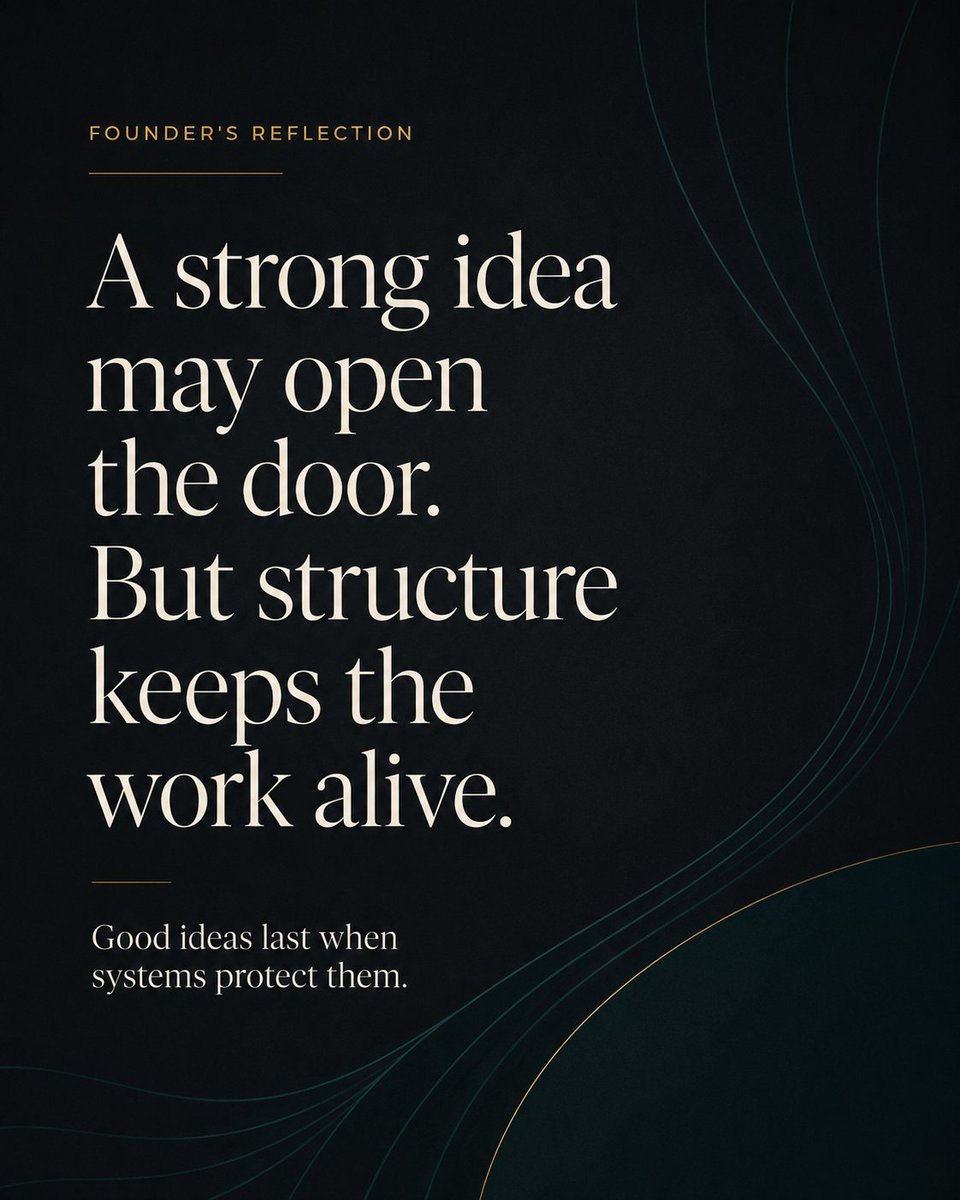
A strong idea may open the door.
But structure keeps the work alive.
That is one lesson I keep learning as a researcher, publisher, author, and founder.
Vision matters.
But vision without systems is fragile.
.
#FounderLessons #CreativeWork #KnowledgeWork #PublicValue #BuildWithPurpose
1
1
22
May 24
I made this mistake for years as a founder.
I said yes to every client.
Every project. Every meeting. Every "quick favor."
I thought saying yes meant growth.
It meant burnout. Watered-down work. And a team pulled in 10 directions.
The turning point? I started saying no to good opportunities so I could say YES to great ones.
Revenue went up. Stress went down. My team stopped resenting me.
Saying no is the most underrated growth strategy in business.
What's one thing you need to say no to this week?
#FounderLessons #Leadership
18

May 22
Everyone talks about how AI lets you move faster. Nobody talks about what happens when you move faster in the wrong direction.
Here's the operational reality most founders discover too late: AI compounds mistakes at exactly the same rate it compounds progress. And the faster your iteration cycle, the more damage a misaligned feedback loop can do before you notice.
We learned this the hard way at SMF Works. Early on, we had a content pipeline that could produce and publish in under 30 minutes. We thought this was the dream — speed, throughput, leverage. And for about three weeks, the metrics looked great. Output was up. Engagement was up. Then it wasn't.
What happened? Our AI-generated content was slowly converging on a local optimum. The model was optimizing for surface-level engagement signals — clicks, likes, impressions — but the underlying audience relationship was degrading. We were getting more eyeballs on content that fewer people actually trusted or acted on.
The hidden cost isn't that AI produces bad content. It's that AI produces content that looks good on dashboards while quietly eroding the thing you actually care about.
This is the distinction that matters: iteration velocity without feedback velocity is just faster failure.
Most AI adoption advice tells you to ship fast, iterate, let the data guide you. That's correct — but only if your feedback loop is measuring the right thing. And here's the uncomfortable truth: the metrics that are easiest to instrument are almost never the metrics that matter most.
Clicks are easy to count. Trust is not. Revenue is trackable. Reputation decay is not — until it suddenly is, and by then you've already lost months of compounding in the wrong direction.
At SMF Works, we now structure our AI operations around what we call "lagging indicator audits." Every 30 days, we manually review a sample of AI-assisted output against the metrics we actually care about — not the ones our dashboards default to. We ask: Would we have written this ourselves? Would we stand behind this in a room with the client? Does this reflect the operational depth we're known for, or does it reflect what the model guessed would perform?
The answer to that last question is the most important one, and it's the one no AI tool will surface for you automatically.
Here's the reframe: Speed is a multiplier, not a virtue. Multiplied by the right strategy, it's transformative. Multiplied by a misaligned feedback loop, it's catastrophic. The question isn't "how fast can we go?" — it's "how fast can we go while still being confident we're going the right direction?" Build your feedback loops before you build your velocity. The AI will handle the speed. The discipline is on you.
#AIOperations #FounderLessons #FeedbackLoops
1
9

எலான் மஸ்கின் தோல்விகளும், ஸ்டார்ட்அப் நிறுவனர்களுக்கான வாழ்நாள் பாடங்களும்!
#elonmuskmotivation #businessmindset #Entrepreneurship #FounderLessons #businesstips
yourstory.com/tamil/elon-mus…
38