
Bah c'est injuste de critiquer le gameplay d'un jeu et dire qu'il est guezz uniquement car on arrive pas à le prendre correctement en main ou à l'apprivoiser correctement, le gamedesign par contre je peux rien dire c'est pas dinguo et ça baisse drastiquement la qualité du jeu
1
4

Designing worlds at Good Life! These super-achiever kids are doing college-level work!
tulsaartsacademy.com/request…
#tulsakids #tulsamoms #momsoftulsa #iwantthebestformykids #musickids #musiclessons #musiceducation #coding #gamedesign #vr #robotics #stem #animation #photography #dj
1
1

How Pragmata works with goal setting from the level design perspective
patreon.com/GameDesignerNote…
#GameDesign #LevelDesign #Pragmata #Capcom
1

🎓✨ Don't miss your chance to secure your future!
📢 15th June is the last date to avail the current scholarship benefits. Take advantage of this opportunity and begin your creative journey with the Department of Multimedia, Lovely Professional University.
🚀 Shape your passion into a profession with industry-oriented programs and endless possibilities.
📅 Last Date: 15th June
✅ Apply now and unlock your scholarship benefits!
#LPU #LPUMultimedia #Scholarship2026 #LastDateAlert #CreativeCareers #Animation #VFX #GameDesign #UIUXDesign #GraphicDesign #FilmMaking #MultimediaEducation #StudyAtLPU #FutureCreators #AdmissionsOpen
a

Me neither. It is one thing to not like it. But to say it is bad is somethign completely different. And the game legit did every single aspect better than BOTW.
In my eyes, if I try to be as bjective as possible TOTK ist one of - if not the - bets game. in terms of Gamedesign
38

How does the Noisemaker role change player psychology in Among Us?
Noisemakers instantly reveal where someones died
Everyone rushes towards the body, blaming anyone they see
Leading to false positives and throwing off everyones deductions
#amongus #gaming #gamedesign
30

Magafin retweeted

14
108
1,567
33,242

FOCUS ON
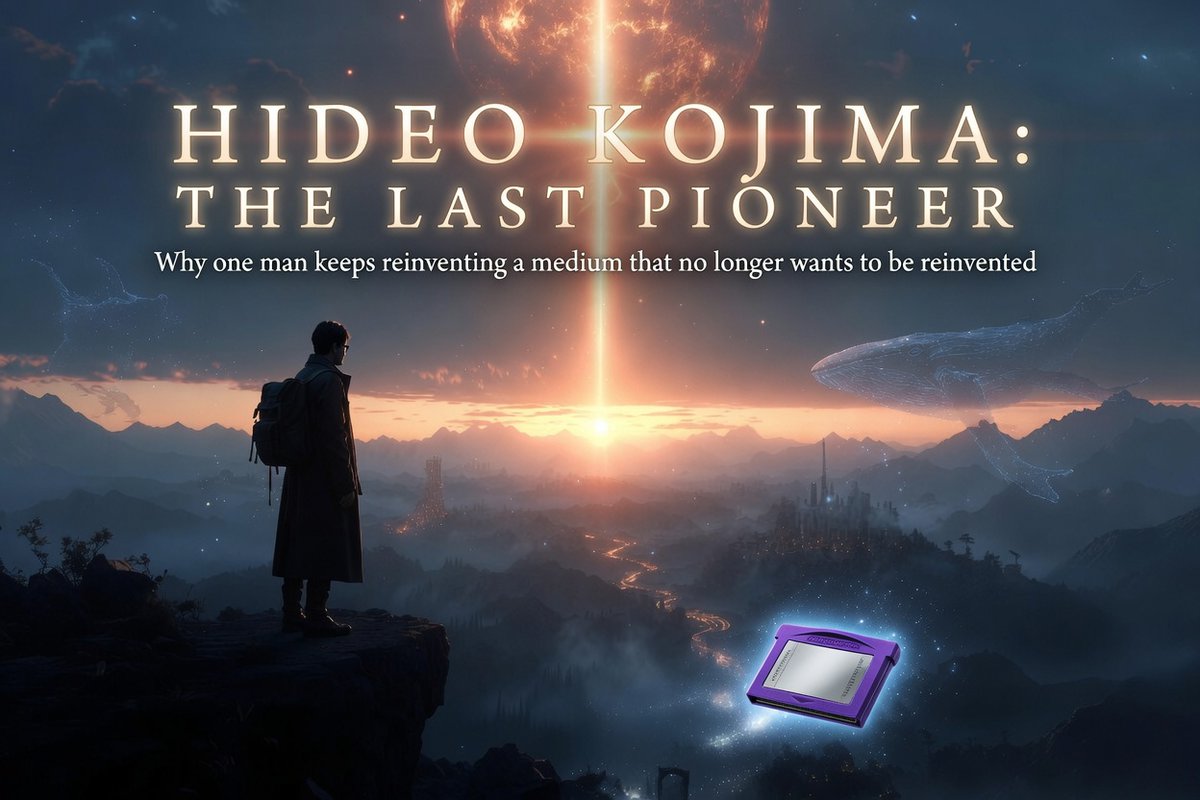
Hideo Kojima: The Last Pioneer (Article 1/X?)
Why one man keeps reinventing a medium that no longer wants to be reinvented
There are game designers.
There are auteurs.
And then there’s Hideo Kojima — a category of one.
Not because he’s flawless.
Not because every game is a masterpiece.
But because he is the last major creator in AAA who still treats the medium as if it were young, fragile, and full of unexplored doors.
Most studios innovate only when the market permits it.
Kojima innovates because he can’t help himself.
Innovation as Instinct
Boktai is the perfect example.
A Game Boy Advance cartridge with a real solar sensor.
A weapon that only recharges under actual sunlight.
Gameplay that changes based on real-world weather, daylight, and your willingness to step outside.
Today, that idea wouldn’t survive five seconds in a pitch meeting.
For Kojima, it was simply obvious.
Because for him, innovation isn’t a marketing strategy.
It’s a reflex.
He doesn’t ask, “Will this sell?”
He asks, “Can a video game even do this?”
The Auteur Who Refuses to Stay in One Box
Kojima doesn’t repeat himself.
He mutates.
From military stealth to post-apocalyptic hiking simulators.
From political realism to supernatural absurdism.
From cinematic blockbusters to vast, silent landscapes that dare to trust the player’s isolation.
From solar-powered Game Boy cartridges to horror teasers that scarred an entire generation.
He doesn’t have a single “style.”
He has obsessions:
Technology.
Connection.
Isolation.
Identity.
Control.
The body.
The machine.
The player.
Every game is a new angle on the same constellation of ideas.
The Courage to Be Ridiculous
This might be his greatest lesson.
Kojima understands that to reach the sublime, you must first risk the ridiculous — and he never blinks.
Cyborg ninjas.
Psychic soldiers reading your memory card.
Invisible ghost rain.
A delivery man saving the world by walking.
It should all collapse under its own weight.
It should all feel stupid.
Instead, it becomes meaningful — because Kojima commits completely.
He never winks at the camera.
He never apologizes.
He never tones it down.
Where modern Western writing often hides behind cheap, self-protective irony, Kojima offers absolute sincerity.
The Last Man in AAA Who Still Takes Real Risks
The modern industry is terrified of risk.
Budgets are enormous.
Margins razor-thin.
Players impatient.
Publishers cautious.
Kojima remains the exception.
He makes games that, on paper, should not exist:
A stealth game where the most important boss fight requires you to unplug your controller.
A horror demo more influential than most full releases.
A walking simulator disguised as a blockbuster.
A Game Boy game that forces you to go outside.
He is the last pioneer because he still behaves like the medium is unexplored territory.
This Is Only the Beginning
You can’t explain Kojima in one article.
You can barely explain him in seven.
Talking about Kojima means talking about authorship, technology, cinema, philosophy, failure, obsession, loneliness, connection, and the future of the medium itself.
To truly understand the pioneer, we must return to his overlooked cyberpunk roots, decode the structural revolution of his tactical espionage, and dissect the viral, terrifying mystery of his unfinished masterpieces.
We must examine the thin line between raw vision and unchecked hubris.
Above all, it means believing — stubbornly, defiantly — that video games can still be something greater than products.
Kojima isn’t just a game director.
He is one of the last remaining proofs that this medium is still alive — and still worth fighting for.
#HideoKojima #GameDesign #TheLastPioneer #VideoGameAuteur #DeathStranding #GameDev
ALT Grok Imagine
32
The World They Don’t Tell You
Why Mystery Is the Last True Form of Respect for the Player
There’s a moment in every great video game when you stop and think:
“I don’t know what I’m looking at… but I want to know more.”
It’s a rare spark.
It’s wonder.
And it doesn’t come from dialogue, codex entries, or an NPC dumping lore like a tired tour guide.
It comes from the unknown.
The classics understood this.
In Shadow of the Colossus, no one explains who the giants really are.
In Myst, no one holds your hand.
In pre-Breath of the Wild Zelda, the map wasn’t a GPS — it was an invitation to get lost.
Today, many games are terrified of mystery.
Afraid you won’t understand.
Afraid you’ll get lost.
Afraid of low engagement metrics.
So they flood you with maps, icons, tutorials, audiologs, and chatty companions explaining the obvious.
They explain everything.
And in doing so, they steal the one thing no budget can buy:
the desire to discover.
Wonder as an Active Process
Wonder isn’t a special effect.
It’s mental work — the moment a game trusts you to interpret, connect, imagine.
The old pact was simple:
“Here. Look. Listen. Figure it out yourself.”
Today’s pact is different:
“Follow the arrow. Listen to the monologue. Don’t think too hard.”
And when you stop thinking, you stop discovering.
When you stop discovering, you stop remembering.
The Unsaid as a Form of Respect
Mystery isn’t a flaw — it’s a language.
It’s the space a game leaves for your imagination to fill.
FromSoftware mastered this: fragmented lore, items that hint more than they reveal, worlds that feel alive precisely because they’re not fully explained.
They don’t tell you everything because they respect you enough not to.
When a game leaves space, you fill it.
And that space becomes yours.
Crimson Desert: Gorgeous Freedom, Empty Soul
In an industry obsessed with hand‑holding, Crimson Desert dares to do the opposite.
No excessive markers.
No constant guidance.
Bosses teach you by fighting like you do — forcing you to observe, die, adapt.
It’s a brutal, invisible tutorial that respects your intelligence.
The world is alive, unpredictable, often hostile.
For the first 40 hours, the freedom feels genuinely exhilarating.
Then reality hits.
I dropped it after 40 hours.
Not because it was too hard or repetitive, but because mystery without substance isn’t enough.
Narratively, Crimson Desert is shockingly weak: flat characters, disjointed events, a story that constantly hints but never commits.
The “unsaid” becomes simply “unwritten,” and the intended ambiguity collapses into frustration and indifference.
It remains a valuable — if flawed — example of design that respects the player’s ability to explore and learn.
But it also proves a hard truth:
beautiful mystery without a compelling reason to care is ultimately just expensive empty space.
What We Lose When We Lose Mystery
Memories that don’t stick.
Worlds that feel vast but leave no mark.
Players turned from explorers into tourists — consuming instead of interpreting, executing instead of discovering.
Mystery demands patience, attention, and the willingness to fail.
In the age of instant dopamine, these are treated as design flaws.
Yet those who pay the price leave the game changed.
Why We Lost It
It’s not nostalgia — it’s the industry.
Playtests that treat any confusion as a UX failure.
Metrics that reward instant engagement over curiosity.
Hollywood‑style storytelling terrified of ambiguity.
A growing Western fear of “wrong interpretations.”
Games That Still Dare
Tunic — a manual you decipher like a spellbook.
Sable — pure atmospheric exploration.
Death Stranding — where the land itself is the riddle.
Outer Wilds — the gold standard of respectful mystery.
These are worlds that don’t talk at you —
they listen.
How to Bring Wonder Back
Trust the player.
Let writers and level designers collaborate from day one.
Have the courage to leave things unsaid.
Leave questions unanswered.
Leave silence.
Conclusion: Mystery as an Act of Freedom
Video games are the only medium where mystery can be lived, not just observed.
Not watched. Not told. Crossed.
When a game lets you discover, imagine, and interpret, it isn’t taking anything away from you.
It’s giving you everything.
Wonder doesn’t come from what the game shows you.
It comes from what the game has the courage not to say.
And as long as there are worlds brave enough to stay silent,
games will remain one of the last places where the unknown isn’t a bug —
but an invitation to enter.
#GameAnalysis #Gaming #GameCritique #MysteryInGames #GameDesign #WonderInGaming
ALT Image genereted by Grok Imagine
41

Après je suis iencli de Pokemon donc peut être biaisé mdrrr
Mais niveau gamedesign je maintiens que c’est fort
1
2
16

L'ère de la modélisation 3D automatisée 🤖
Combien d'heures avez-vous déjà perdues sur des polygones récalcitrants au lieu de vous concentrer sur la vision créative de vos projets ?
#KingLand #IA #3DDesign #Meshy #Innovation #Créativité #TechTrends #Automatisation #DesignDigital #FuturDuTravail #Independants #GameDesign #Architecture #DigitalArt
▫️ Fiche Impact : kingland.fr/article/meshy-3d…
Parce qu’avec la vitesse de l'IA, le temps libéré vaut bien mieux que le labeur technique répétitif.
La modélisation #3D a longtemps été une barrière à l'entrée, réservée aux experts maniant des logiciels complexes pendant des nuits entières. Avec l'arrivée de @MeshyAI 3D Agent, le paradigme bascule. Nous ne sommes plus dans l'exécution laborieuse, mais dans la direction artistique pure. L'outil transforme vos prompts en assets tangibles, réduisant drastiquement le cycle de production pour les freelances et les studios agiles.
🔹 Génération instantanée d'objets texturés à partir d'un simple texte ou d'une image de référence.
🔹 Optimisation automatique du maillage pour une intégration fluide dans les moteurs de rendu.
🔹 Personnalisation avancée des paramètres pour conserver une direction artistique cohérente.
🔹 Gain de productivité massif permettant de démultiplier le volume de livrables sans sacrifier la qualité.
✨ Explorer Tool : kingland.fr/tool/meshy-gener…
La technologie ne remplace pas l'œil du créateur, elle devient le pinceau le plus rapide qu'il n'ait jamais possédé pour sculpter ses visions les plus audacieuses.
— C. Pestel
Je me souviens de mes premières modélisations où chaque sommet déplacé était une victoire. Voir aujourd'hui une machine comprendre l'intention derrière une forme me rend humble. Ce n'est pas la fin du talent, c'est le début d'une ère où seule votre capacité à imaginer définira vos limites, et non plus votre maîtrise technique des outils de création.
Quel aspect de votre processus créatif aimeriez-vous voir automatisé en priorité cette année ?
1
8