Artus Krohn-Grimberghe retweeted

A few points that make me think this is a dick swinging contest. I'm a govcon myself, I know the inner workings, I'm totally aware of the NSA model situation. Just because the NSA is using the models, or whoever, does not mean pete and others in the admin are happy with it or want it to happen. The tech is so good that they have every employee up their ass telling them they need to use it. Government is very fragmented, and other leaders may have convinced the DoW to allow this to happen, and they probably agreed with reluctance. They were originally flagged as a supply chain risk when OAI models have, let's be honest, close to similar cyber capabilities. Yes, mythos is better for now. Dario didn't want to help the DoW and pete got pissed. Just today he posted that this is why they kicked Anthropic out of the pentagon. They have beef and were probably looking for an issue or want to keep this model in house for now. Has this cyber risk existed for other models? Definitely, probably for over a year for the big 3. Some would argue even longer than that. Anyone in the AI world knows this. Why was OAI not flagged a supply risk and why was 5.5 released with no issue? We'll see what happens with 5.6, that will be telling. Anyways, the above makes me think it was politicslly motivated but I think there's a ton of other issues as well. Darios ridiculous fear mongering, major lack of understanding of genai on the gov's side and so on.
2
1
9
383


14h
if you run or advise a small govcon business especially in manufacturing, infrastructure, or industrial services there is a shift i’m seeing on the ground.
ai isn’t about smarter models.
it’s about fixing the exact bottlenecks that keep small businesses from growing: proposal volume, compliance, pricing discipline, and delivery.
and here’s the part i have noticed most business owners miss - yeah, you do not need expensive frontier models to solve 80% of those problems. we really don’t.
let me make it concrete.
use case 1: proposal volume (the #1 govcon choke point)
a 12‑person hubzone business i worked with was drowning in rfps. they weren’t losing - they just couldn’t respond fast enough. i know someone i respect that grinds relentlessly on sam.gov however it’s easier said than done quite frankly.
we routed their proposal drafting through a cheaper model for the first 80% (bid/no bid selections, outline, compliance matrix, past performance mapping, even a self‑updating opportunity dashboard). frontier only touched the final narrative polish.
result:
• 3× more proposals submitted
• same staff
• ai spend stayed flat
that’s the difference between “we can’t keep up” and “we’re finally competing.”
use case 2: compliance & documentation
another small contractor was spending 10–15 hours a week on repetitive compliance tasks - qc logs, safety reports, equipment checklists, subcontractor documentation.
we moved those workflows to an efficient model that generates the first draft automatically from their existing data. we also collected, compared, and refined competitor workflows and workflows from adjacent industries and created a hybrid.
result:
• 70% reduction in admin time
• pms got hours back for actual delivery
• no expensive model needed
this is the stuff that actually moves margins.
here is a playbook that in my opinion works for small #govcon businesses:
• route routine tasks (compliance, qc, draft proposals, pricing prep etc) to cheaper models
• save frontier intelligence for engineering problems, negotiations, or final proposal polish
• pilot one painful area and measure the before/after
• tie it into your existing systems so it becomes part of the workflow, not another tool to manage
when you do this right, you unlock things like:
• submitting more bids without hiring
• protecting margins on fixed‑price work
• reducing admin drag on pms
• becoming more competitive on opportunities
this is what i think ai economics actually means for small govcon business - not hype, just better margins and more capacity.
if you want to talk through how this applies to your operation whether you’re trying to win more work, prep for an acquisition, or just get your team out of admin quicksand hit me in the DMs.
where do you feel the biggest bottleneck right now: proposals, compliance, pricing, or delivery?
1
12
How many firms are positioned for USMC's $26.5M engineering support recompete? SBA set-aside just awarded — who's already tracking M67854-26-R-3001? #GovCon
recompeteiq.com/opportunitie…
2
Cape Fox Federal has held the 30th Rescue Squadron ISR planning contract for years. $38.8M recompete incoming—and Air Force ISR support is increasingly competitive. New entrant window is open. #GovCon
Heads up: NIST just dropped an $8.0M IDIQ for mechanical construction services in Maryland. SBA set-aside — solid play for small businesses with HVAC expertise. Opportunity score 71/100. #GovCon
recompeteiq.com/opportunitie…
1

Jun 13
The SBA has introduced substantial revisions to the 8(a) program’s social disadvantage criteria, which may influence eligibility and affect current and prospective program participants. Aron Beezley & Gabby Sprio provide analysis on our GovCon Source blog.
govconsourceblog.com/2026/06…
28

Jun 13
Enterprises don't like supply chain risks. ITAR is not sexy or appealing and doesn't connote "capable" to most CIOs/CISOs, it connotes "enormous pain in your ass and liability you want to avoid at all costs".
So, maybe with some segments, but not the biggest ones. Even if it gets rolled back, once you become risky...and this is their 2nd strike on that regard.
We had to yank them out of everything the first time for all our govcon customers...and they didn't really come back. 2nd time? No way.
268


Jun 12
6/6 The full brief, every deadline, every action item, and every strategic angle is inside GovCon Ready in 30.
Join here: skool.com/govcon-ready-in-30…
#govcon #federalcontracting #ndaa #defensecontracting #smallbusiness #governmentcontracting #acquisitionpolicy
7
Most people think certifications unlock federal contracts. They don't. Past performance does. You can have every cert on the list and still lose to a firm with a clean CPARS record. The cert gets you in the room. The record gets you the contract. #GovCon #SmallBusiness
4

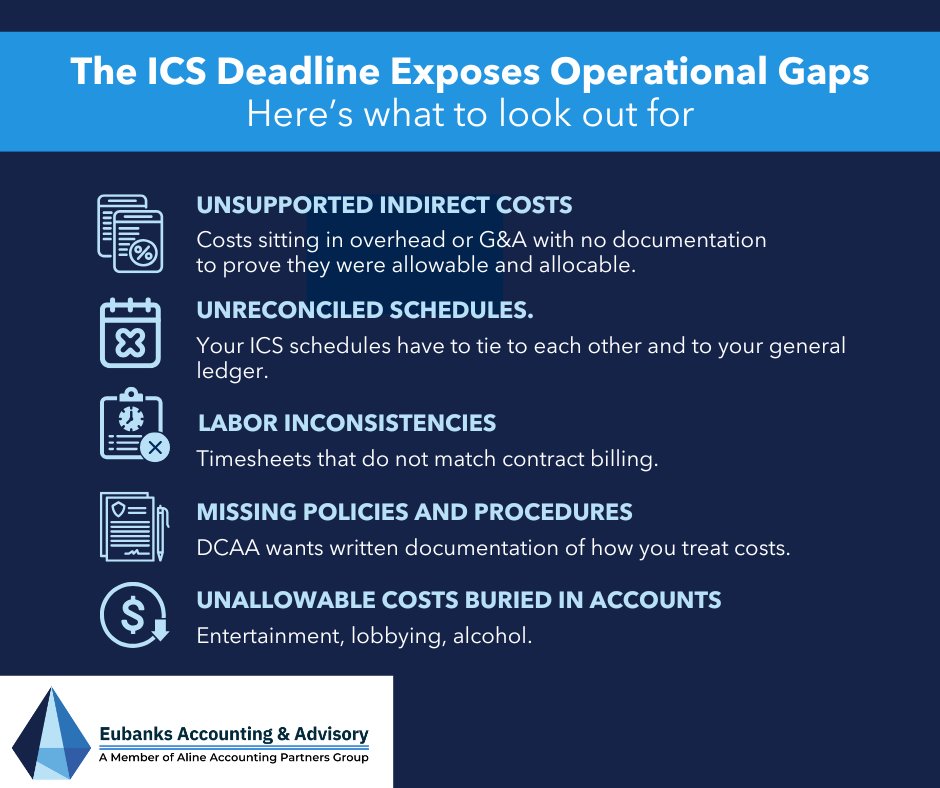
Most ICS problems are not filing errors. They are accounting mistakes that built up all year and surfaced the moment someone tried to pull the submission together.
#GovCon #DCAA #EubanksAccounting #IncurredCostSubmission #GovernmentContracting
2
Cleared IT staffing shouldn't come with a 40% agency markup baked in. We place vetted, credentialed tech talent directly for gov contracts. NYC MBE certified, SAM registered. #GovCon
4


Jun 12
In the most recent episode of the GovCon HR Round-Up, Declan Leonard, Joe Young, and I discussed several breaking federal and Virginia legal developments that government contractors should have on their radar.
We covered DOJ signaling potential False Claims Act liability for DEI violations, and proposed changes greatly impacting SBA 8(a) and women-owned small business programs. We also discussed significant Virginia employment law developments, including updates to non-compete enforcement, expanded Wage Payment Act protections, and new pay transparency requirements that fundamentally change the rules of the road for employment law in Virginia.
If you work in government contracting, HR, or employment law, this episode provides important insights.
Watch the episode here: youtu.be/yoVFeIvJIGY?si=Db99…
8

Jun 12
OMB proposes major changes to federal grant rules, expanding termination authority and adding new compliance requirements. bit.ly/49VF0Eq
#GovCon #FederalGrants
21

Jun 12
How many firms are bidding the USMC PdM IW Engineering recompete? $26.5M SBA set-aside just awarded — and it's a services refresh in a tight market. #GovCon
recompeteiq.com/opportunitie…
6