
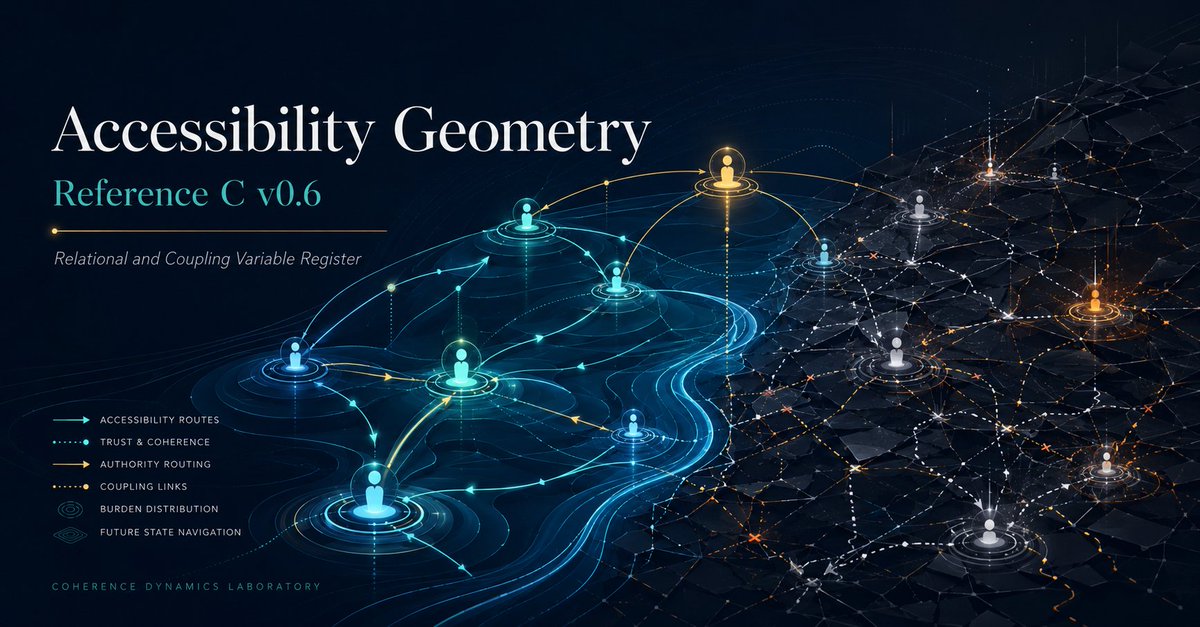
Accessibility Geometry Reference Stack — Reference C: Accessibility Relational and Coupling Variable Register v0.6
DOI: doi.org/10.5281/zenodo.20709…
Reference C defines the relational and coupling layer of the Accessibility Geometry framework.
Where Reference A defines primary observer-state variables, and Reference B defines derivative behavior, warning trajectories, and preliminary Human TAWS logic, Reference C asks a different question:
How do observer-systems relate, couple, recognize, distort, coordinate, authorize, burden, exclude, repair, orient, and shape one another’s accessible futures?
Version v0.6 is a major expansion.
It develops the relational register beyond Shared Geometry, Trust, Observer Coupling, Relational Impedance, Stewardship Responsibility, Power Gradient, Authority Routing Geometry, Composite Observer Fields, and Verification Homeostasis.
New additions include:
Practice Ecology
Lived Accessibility Orientation
Affective Accessibility
Corrective Dissent Integration
Meso-Scale Governability
Governance Load
Moral Accessibility
Universal Reciprocity Constraint
Burden Externalization
Coordination Capture
Persecution Coordination
Extraction Gradient
Identity Compression Load
Public-Good Accessibility
Delegated Action Envelope
Authority Assumption Event
Integrated First-Person Field
Symbolic Orientation Geometry / Waypoints
The central clarification is:
Relational strength is not relational health.
Strong trust, strong coupling, strong authority, strong coordination, strong identity, or strong symbolic orientation may expand accessibility — but they may also suppress dissent, externalize burden, compress identity, collapse moral accessibility, or narrow the future-space of less-protected observer-nodes.
That distinction matters.
Coherence is not inherently good.
Coordination is not automatically good.
A shared map does not guarantee a shared world.
A shared world does not guarantee shared moral accessibility.
A symbolic waypoint may preserve orientation, but it must remain corrigible.
Reference C v0.6 remains exploratory, bounded, and non-diagnostic.
It does not provide clinical, legal, moral, political, theological, commercial, institutional, or operational authority.
Its purpose is to provide controlled vocabulary for future simulation, calibration, case analysis, symbolic-orientation work, Human TAWS refinement, Multi-Scale Observer Dynamics research, and responsible applied use under Reference D/E/F/G discipline.
The governing principle is:
Relational variables describe structure and movement. They do not authorize judgment without declaration, evidence, proxy discipline, external anchoring, and validation class.
Final summary:
Observer accessibility is shaped not only by trust, coupling, power, authority, practice, verification, and shared geometry, but also by whether the relational field preserves moral accessibility, distributes burden without externalizing harm, coordinates without capture, and orients observers through symbolic waypoints without mistaking symbolic orientation for validation.
#AccessibilityGeometry #CoherenceDynamics #ObserverSystems #SystemsTheory #Cybernetics #RelationalGeometry #Governance #HumanTAWS #LogicalAliveness #SymbolicOrientation #Waypoints #Falsifiability #CalibrationDiscipline #HumanCompatibleAI #MultiScaleSystems
2
32

23 Sep 2025
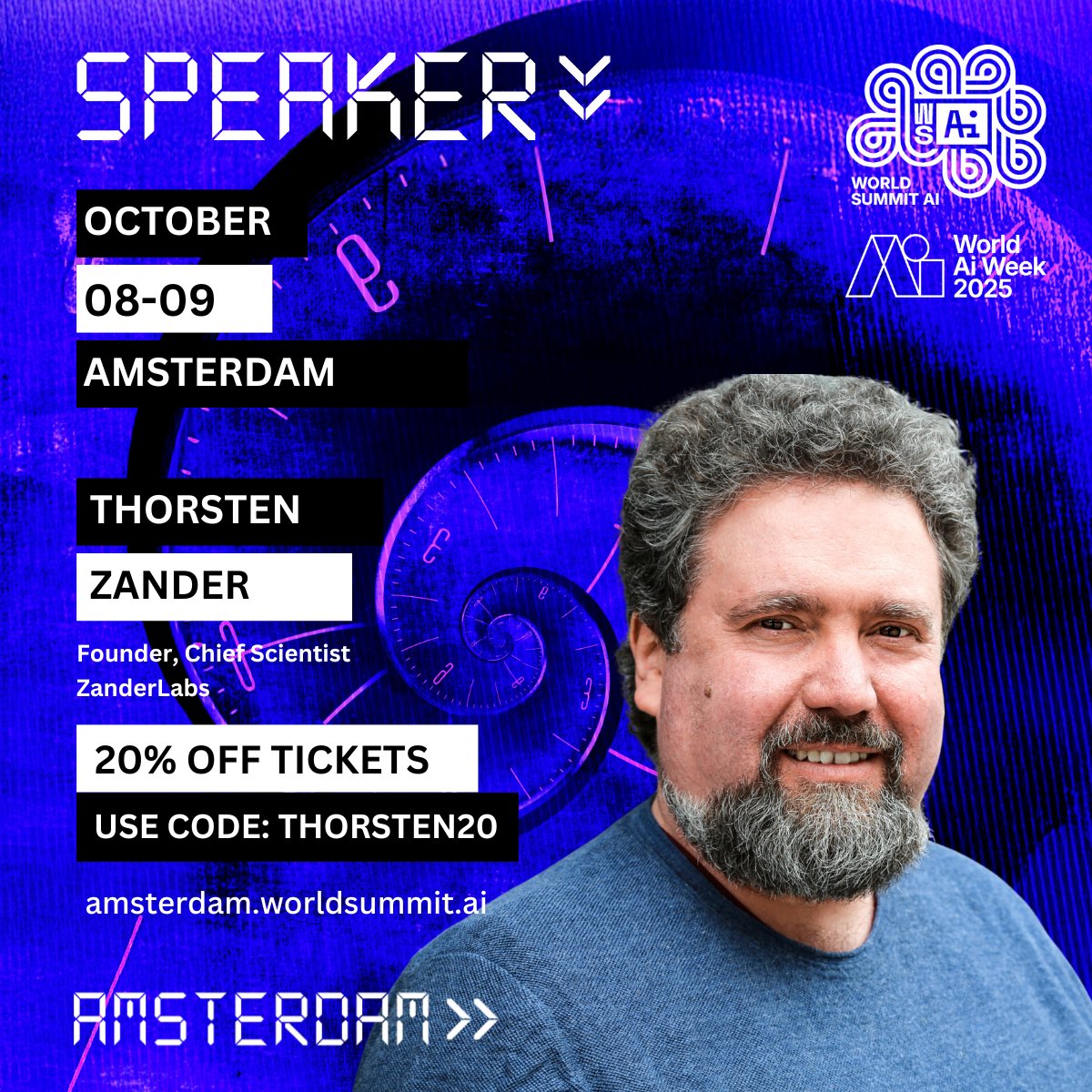
AI That Understands You: Prof. Dr. Thorsten O. Zander Shows us the Future.
In just 15 days time Prof. Dr. Thorsten O. Zander Professor for Neuroadaptive Human-Computer Interaction at BTU Cottbus and Chief Scientist at Zander Labs, is bringing a groundbreaking session to WorldSummitAI. The future is now, and Zander will share his knowledge on building systems that sense, understand, and adapt to our thoughts, emotions, and values in real time ⏰
➡️ What Thorsten will cover:
- Neuroadaptive technology that uses real-time brain data to create AI aligned with human inner worlds.
- The launch of the brAIn network and the €30M NAFAS project - next level initiatives shaping AI that’s truly human compatible.
- Practical breakthroughs already transforming mental health, education, and human robot collaboration 🤖 🤝
📈 Thorsten’s track record:
- Pioneer of passive brain-computer interfaces and leader in neuroadaptive AI.
- Trusted advisor to top leaders navigating the AI alignment problem.
- Driving projects that bring neuroscience insights directly into AI design for real-world impact.
🎤 Why this talk matters: Because AI isn’t just about completing tasks anymore. It’s about resonating with what makes us human. This session reveals how neuroadaptive AI is redefining the relationship between humans and machines today, not tomorrow.
Will you be there in just 15 days time to join us when Thorsten takes the stage?
#WorldSummitAI #NeuroadaptiveAI #HumanCompatibleAI #AIAlignment #TechLeadership
3
1
190

7 Oct 2019
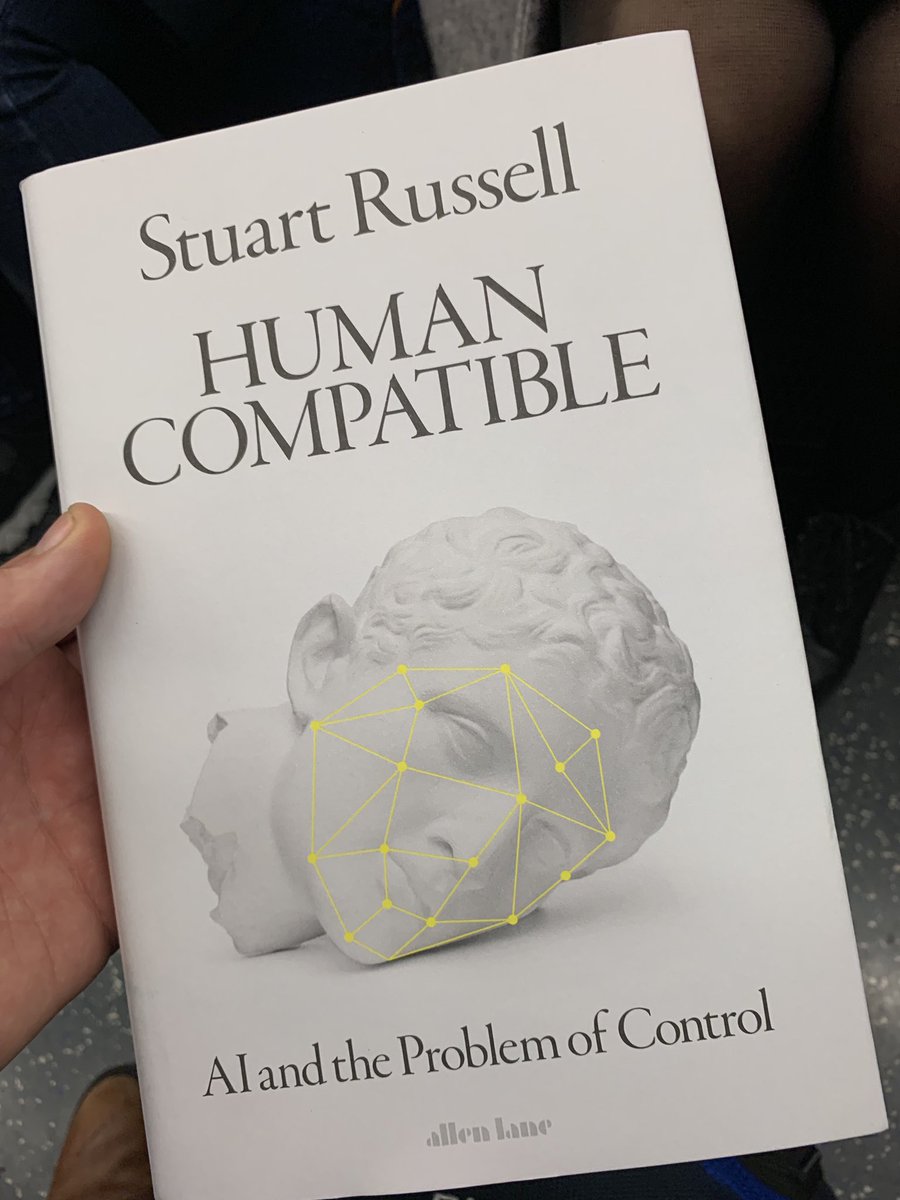
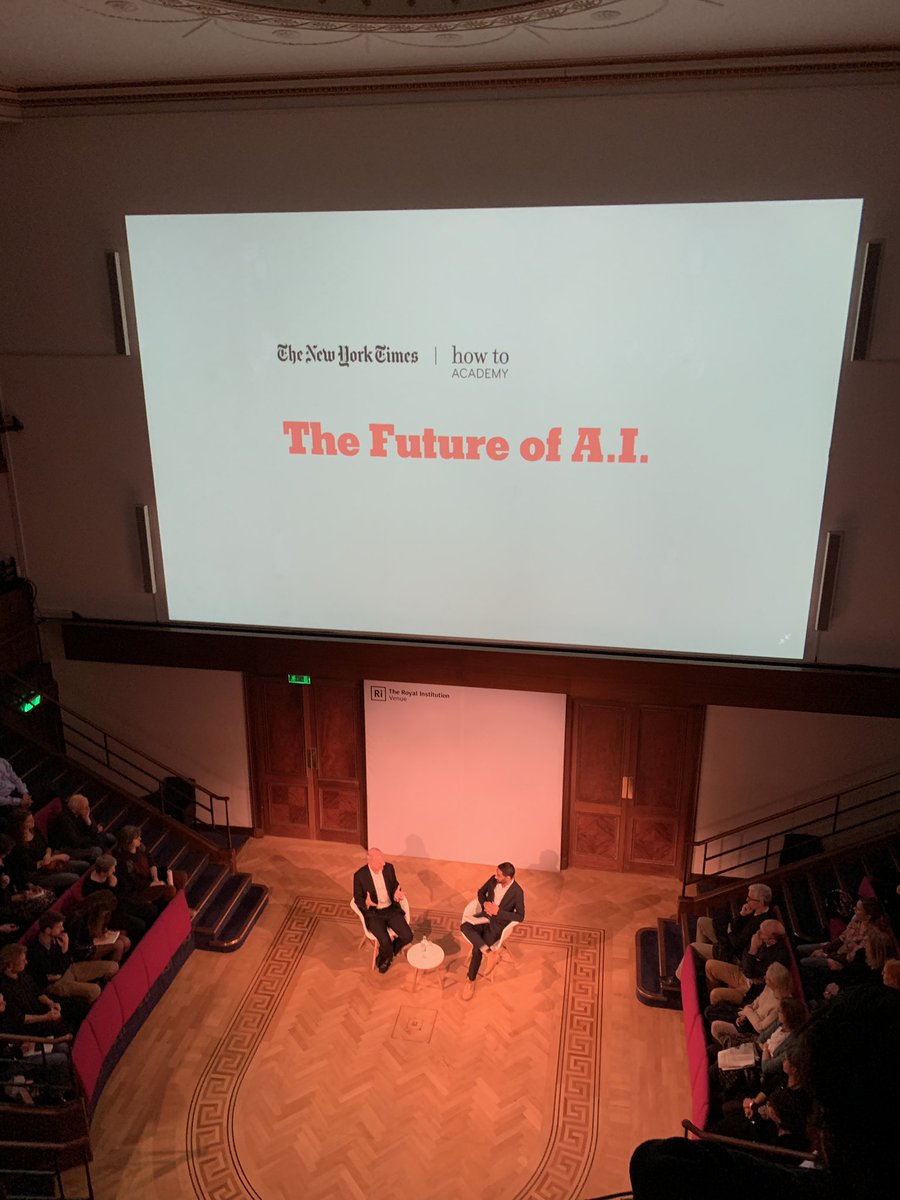
#HumanCompatibleAI. insightful talk this evening at the Royal Institution with Professor Stuart Russell from @CHAI_Berkeley. Favourite quote: „certainty is a specialised model of uncertainty“ #wisetothenew #AIDichotomies #Skynet vs #AIforGood and #AItopia

2
2
7