
I am pleased to announce the publication of:
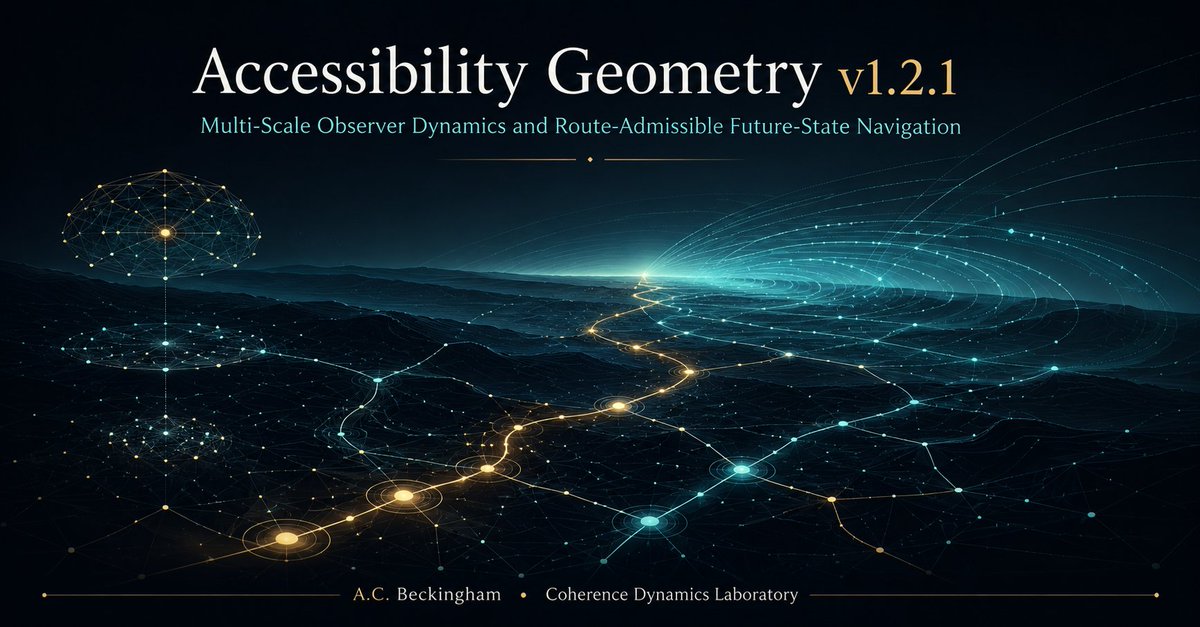
Accessibility Geometry v1.2.1: A Framework for Multi-Scale Observer Dynamics, Integrated Observer Fields, and Route-Admissible Future-State Navigation
DOI: doi.org/10.5281/zenodo.20718…
This release represents the current parent-framework synthesis for the Accessibility Geometry research sequence.
The central claim remains simple:
Observers navigate accessible futures, not all possible futures.
A future may be possible in abstract state-space while remaining invisible, unreachable, meaningless, inadmissible, unsafe, unauthorized, or non-repairable from a given observer coordinate.
Version v1.2.1 refines the framework around a stronger route-based formulation:
Accessible futures are those that an integrated observer-system can still reach through viable, admissible, and constraint-preserving routes from the present coordinate.
This update synchronizes the parent paper with the matured Accessibility Geometry Reference Stack and introduces several important synthesis concepts, including:
Integrated First-Person Field;
Future-Coordinate Backcasting;
Route-Status Discipline;
Verification Homeostasis;
Reconstructive Saturation Trap;
Generator-Compatible Robustness;
Moral Accessibility;
Universal Reciprocity Constraint;
Sovereign Dissent and Consequence Governance;
Layer I–IV Discipline.
One of the most important distinctions in this version is:
Reconstructability is not Integration.
A system may know more, see more, report more, audit more, forecast more, and model more while becoming less able to move.
The map may improve.
The movement may not.
This paper does not claim empirical validation, operational readiness, clinical authority, legal authority, policy authority, military authority, commercial authorization, Human TAWS deployment, moral scoring capacity, proof of consciousness, proof of personhood, or metaphysical closure.
It is a parent-framework synthesis — a disciplined research language for asking how observer-systems preserve, lose, expand, recompute, and govern accessible future-state space across scale.
Its purpose is not to close inquiry.
Its purpose is to provide a structured language through which inquiry may continue.
#AccessibilityGeometry #MultiScaleObserverDynamics #ObserverSystems #AccessibleFutures #FutureStateNavigation #LogicalAliveness #Reconstructability #Integration #VerificationHomeostasis #ZenoConditions #SharedGeometry #GeometricCohesion #CompositeObserverFields #PowerGradient #AuthorityRouting #CorrectiveDissent #SafeRouteControl #MoralAccessibility #SystemsTheory #Cybernetics #AIGovernance #CoherenceDynamicsLaboratory
1
6
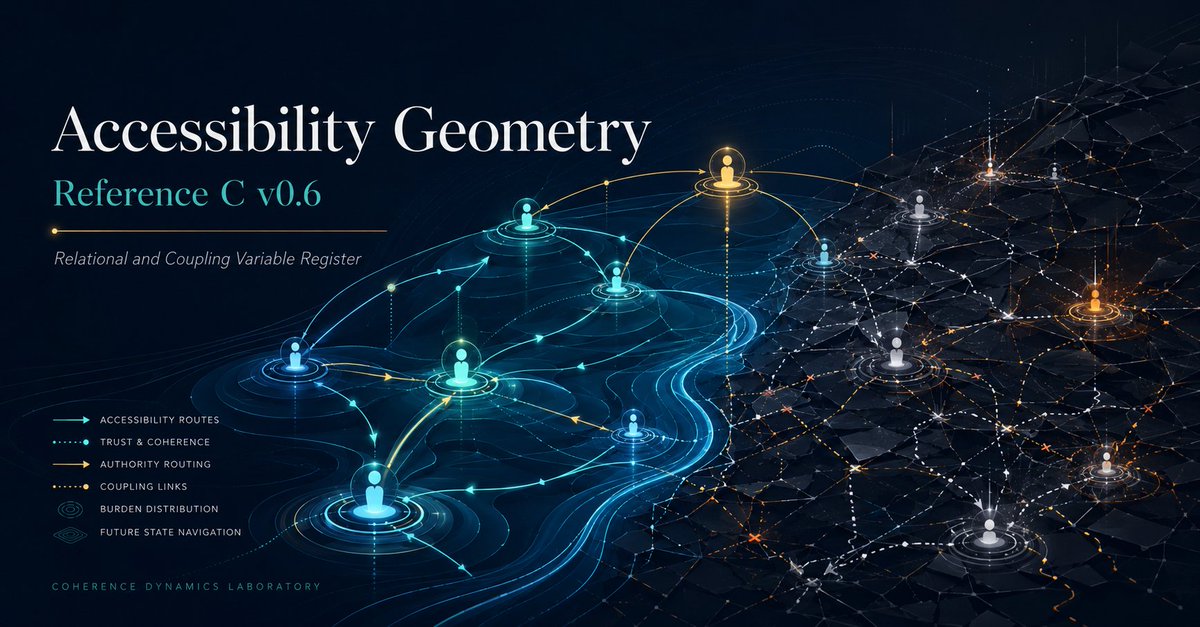
Accessibility Geometry Reference Stack — Reference C: Accessibility Relational and Coupling Variable Register v0.6
DOI: doi.org/10.5281/zenodo.20709…
Reference C defines the relational and coupling layer of the Accessibility Geometry framework.
Where Reference A defines primary observer-state variables, and Reference B defines derivative behavior, warning trajectories, and preliminary Human TAWS logic, Reference C asks a different question:
How do observer-systems relate, couple, recognize, distort, coordinate, authorize, burden, exclude, repair, orient, and shape one another’s accessible futures?
Version v0.6 is a major expansion.
It develops the relational register beyond Shared Geometry, Trust, Observer Coupling, Relational Impedance, Stewardship Responsibility, Power Gradient, Authority Routing Geometry, Composite Observer Fields, and Verification Homeostasis.
New additions include:
Practice Ecology
Lived Accessibility Orientation
Affective Accessibility
Corrective Dissent Integration
Meso-Scale Governability
Governance Load
Moral Accessibility
Universal Reciprocity Constraint
Burden Externalization
Coordination Capture
Persecution Coordination
Extraction Gradient
Identity Compression Load
Public-Good Accessibility
Delegated Action Envelope
Authority Assumption Event
Integrated First-Person Field
Symbolic Orientation Geometry / Waypoints
The central clarification is:
Relational strength is not relational health.
Strong trust, strong coupling, strong authority, strong coordination, strong identity, or strong symbolic orientation may expand accessibility — but they may also suppress dissent, externalize burden, compress identity, collapse moral accessibility, or narrow the future-space of less-protected observer-nodes.
That distinction matters.
Coherence is not inherently good.
Coordination is not automatically good.
A shared map does not guarantee a shared world.
A shared world does not guarantee shared moral accessibility.
A symbolic waypoint may preserve orientation, but it must remain corrigible.
Reference C v0.6 remains exploratory, bounded, and non-diagnostic.
It does not provide clinical, legal, moral, political, theological, commercial, institutional, or operational authority.
Its purpose is to provide controlled vocabulary for future simulation, calibration, case analysis, symbolic-orientation work, Human TAWS refinement, Multi-Scale Observer Dynamics research, and responsible applied use under Reference D/E/F/G discipline.
The governing principle is:
Relational variables describe structure and movement. They do not authorize judgment without declaration, evidence, proxy discipline, external anchoring, and validation class.
Final summary:
Observer accessibility is shaped not only by trust, coupling, power, authority, practice, verification, and shared geometry, but also by whether the relational field preserves moral accessibility, distributes burden without externalizing harm, coordinates without capture, and orients observers through symbolic waypoints without mistaking symbolic orientation for validation.
#AccessibilityGeometry #CoherenceDynamics #ObserverSystems #SystemsTheory #Cybernetics #RelationalGeometry #Governance #HumanTAWS #LogicalAliveness #SymbolicOrientation #Waypoints #Falsifiability #CalibrationDiscipline #HumanCompatibleAI #MultiScaleSystems
2
29