
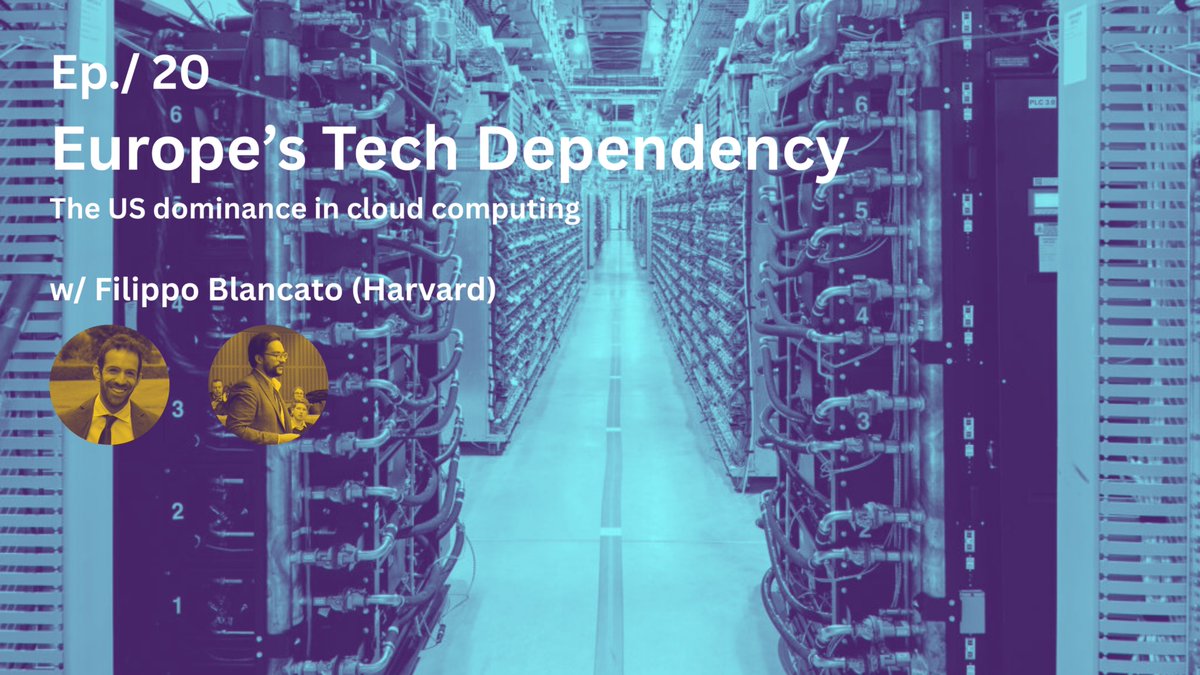
This is a thoughtful addition to my post by Harvard Fellow in Technology & Geopolitics,@FilippoBlancato, riffing on the Economist article by @DadaJudith.
Filippo and I agree on the whole, but he thinks that European data centre built out isn't what it is chalked up to be:
"I think we both agree that the point about building our own tech stack or having a bigger share of the tech pie is more about national security than boosting productivity.
Still, I'm not sure that paving Europe with data centres will be a good idea. A lot of the things [proposed in the Economist article] are already in the Cloud and AI Development Act. It proposes acceleration zones for data centres, fast-permits etc.
The point is, even if we concede that having these data centres is necessary, who is going to benefit from these fast permits? The US hyperscalers that already invest hundreds of billions in this stuff. So really we are going to end up with more US infrastructure in Europe––how is that good?
Because you have them in your territory and have leverage over the firms? Maybe you have more leverage over Microsoft, but not with the US government that can switch you off, so I don't see the strategic advantage.
Even if we grant permits only to European companies to build this infrastructure: do they have the capital? And if they have and receive subsidies for it, we still have a bunch of data centres that pollute and raise electricity prices which are already high in Europe.
And data centres are not green, not now at least. How's this compatible with our climate goals? And what if the future of AI is not hyperscalable compute? What do we do with all this stuff that we built in the meantime? It's not going to be useless, but it's not going to be a game changer for our competitiveness either."
Basically, much of the buildout could well turn out to be a huge misallocation based on a risky bet on the future, one that doesn't even solve (and may even worsen) our dependency on US tech services. These big speculative capital investment cycles are what the US political economy is good at. If Europe can free-ride on the US compute buildout for now, why not?
If you're interested, we spoke about this at length a couple of months ago. Here's a link to the transcript: patreon.com/eurotrash/posts/…
Jun 16

For years, the entire conversation about the relevance tech sector has become ever more unmoored from reality, and AI is just the most severe manifestation of this trend.
The supposed economic gains from creating large tech sector oligopolies are minimal and ambiguous in terms of trend productivity and trade competition. They show up in market capitalisation, which is a whole other story.
The ICT capital deepening story only fits the 1995-2005 period, when European firm were genuinely investing less. To the extent there has been any divergence since, it's been due to hours and demography, distortionary US non-tradeable prices, higher US rent extraction capitalised as productivity gains. Nothing we can or want to replicate. Meanwhile, the embodied gains from the tech have diffused to European users too and we've pocketed the consumer surplus. If US firms gain a TFP boost premium it's really about industrial organisation, labour markets, and market size and we should be honest about this.
The case for building a European tech stack and boosting compute capacity is political point about dependency. And that's the case we should make. But it's deeply dishonest not to mention things like Art. 11 and 17 of the European copyright directive, because, as it happens, even though this is key to creating independent capabilities, it would threaten the rents of US tech firms.
2
13
1,318



🌸Now they call it infrastructure.
Hyperscalable data centers. AI. Neural processing. Brain-computer interfaces. Implants. Cloud. Low latency. Security. Privacy.
Clean words. Technical. Carefully placed.
Then you read more slowly and something else appears.
The idea appears of connecting human brains to massive data centers to process neural signals in real time. The possibility appears that thousands, then millions, will depend on external infrastructure to interpret, expand, or modulate brain activity. The promise appears of “upgrading” neurons. Upgrading the brain. Upgrading the human being.
As if the human being were an old phone.
From the information I work with, this cannot be read only as a technological issue. The brain is not an isolated biological computer. It is a translator. A receiver of the signal of consciousness. The soul, or the point of attention of the Source, works through the body. The brain, the nervous system, DNA, and every cell function as translation interfaces between the etheric field and physical experience.
You touch that interface and you are not touching just any machine.
You are touching the way a person perceives, remembers, decides, feels, interprets, and identifies themselves.
That is where the gravity of the matter begins.
A brain-computer interface is not simply a medical advance to move a cursor with the mind. That is the friendly doorway. The acceptable image. The case shown to the public. A paralyzed person regaining control. Fine. No one disputes that. The problem appears when that same architecture stops being therapeutic and becomes structural. When the human brain becomes linked to an external network for processing, storage, and analysis.
And even more so if that network depends on gigantic data centers.
Hyperscale.
That word already says everything.
They are not thinking about a few patients. They are thinking about population. About volume. About neural data as raw material. About brain activity translated, stored, compared, modeled, predicted, and eventually influenced.
This connects directly with what was explained in the Taygetan laboratory report on nanotechnology, graphene, artificial neuro-modulation, and frequency-based control. It spoke of particles capable of lodging between neurons and dendrites, reading depolarizations, interfering with neurotransmitters, altering the bioelectrical frequency of neural networks, and transmitting or receiving information through electromagnetic fields.
That, scaled to society, requires infrastructure.
It requires a network.
It requires processing.
It requires data centers.
The comment speaks of BCI as a desired future. I read it as a possible open phase of something that has been in preparation for a long time. First the concept is introduced. Then it is normalized. Then it is presented as medicine. Then as enhancement. Finally as necessity.
If you don’t upgrade, you fall behind.
The phrase sounds modern. It sounds innocent. It is not.
From this perspective, upgrading the brain does not mean expanding consciousness. It may mean the exact opposite: replacing the natural connection with the Source with a technological intermediary. An artificial layer between soul and body. An external translator placed on top of the biological translator.
And here we must be careful with a confusion. Advanced technology does not mean spiritual expansion. A civilization can have extremely powerful machines and still operate with a regressive mindset. It can have AI, implants, data centers, neural interfaces, and use all of it to reduce the human being to a biological terminal of a network.
That would not be evolution.
It would be assimilation.
In Taygetan information it is explained that the body must maintain a frequency compatible with the signal of the soul. Alcohol, drugs, certain chemicals, sustained fear, stress, electromagnetic interference all of this can de tune the body. If the brain stops translating correctly, the person changes. Their emotional state, reasoning, access to intuition, memory, identity all change.
Now imagine that de tuning managed by a network.
Not as an accident. As architecture.
A high density neural implant generating data at a thousand megabits per second is not a minor technical detail. It is a constant extraction of brain activity. They say it is needed to decode intention, movement, communication. Fine. The same pathway can also be used to analyze emotional patterns, thought tendencies, impulses, reactions, fear states, resistance, obedience.
If you can read enough activity, you can predict.
If you can predict, you can intervene before.
If you can intervene before, the decision no longer arises cleanly. You don’t even need to prevent it. You can tilt it.
A little.
Just a little.
Until the individual believes they made the decision themselves.
That is the darkest point of all this.
Perfect control does not feel like control. It feels like one’s own thought.
In immersion related contexts it was explained that advanced technology can read the electrochemical and electromagnetic dynamics of a brain and retransmit them, divert them, connect them to another body, another experience. Artificial telepathy was discussed, direct brain stimulation, images, sounds, sensations imposed without external stimulus. Computers capable of interacting with the mind as if invisible cables were connected to the head.
That already exists in advanced societies, according to that information. There it can be used ethically for medicine, education, immersion, translation between species, repair. In regressive hands, the same logic becomes a prison.
No need for science fiction.
Just follow the direction.
Gigantic data centers. AI. Biometrics. Behavioral data. Surveillance. Then neural data. Then implants. Then updates. Then brains connected to hyperscalable infrastructure.
They call it progress.
I see dependency.
A human being connected to a brain cloud loses full sovereignty over their own mental process. Even if they are promised security. Even if they are told about privacy. Neural privacy is a contradiction if your brain signals must pass through external data centers to be processed.
Once thought becomes data, someone will want to own it.
Someone will want to train models with it.
Someone will want to modify it.
And I am not talking only about companies. I am talking about a much deeper logic of control. The same one that turns everything into a network, everything into surveillance, everything into prediction, everything into permission. What was external now wants to enter the body. And then the brain.
Then there is the mention of biological data centers, wetware, human neurons in chips. That takes it one step lower.
We are no longer only talking about machines processing human data. We are talking about biology used as a computational component. Neurons as hardware. Living cells integrated into processing systems.
From my framework, that is extremely serious.
A neuron is not a wet transistor. It is a living cell connected to the signal of consciousness, even if in a way that Earth science neither understands nor wants to understand. Every cell has its own connection. Every neuron acts as part of the soul’s translator. Using neural tissue as a computational component without understanding the etheric dimension of life opens up problems that will not appear in a technical specification sheet.
Problems of consciousness.
Problems of interference.
Problems of entities, egregores, residual signals, frequency compatibility.
Earth science loves dissecting the frog and claiming it understands the frog. It cuts it open, measures it, labels it. Then it wonders why life has slipped through its hands. With human neurons in chips, the same thing would happen. They think they are using tissue. They may be creating reception points. They may be opening micro interfaces without knowing what can enter, what can attach, what can resonate there.
All of this links to transhumanism.
Transhumanism, from this information, is not simply putting technology into the body. It is displacing the sovereignty of the soul over its biological suit. Turning the body into a terminal. Replacing the natural connection with an artificial network. Making the Source signal encounter more and more noise, more filters, more technological layers that claim to improve while reducing access to what you truly are.
Bodies turned into biological robots. Hive mind. Frequency incompatibility causing the original soul to withdraw. Bodies becoming more compatible with other signals, with lower astral entities or regressive intelligences. It sounds extreme to those who do not use this framework. Yes. But if you accept that everything works through frequency, the conclusion follows naturally.
Change the body’s frequency and you change who can inhabit it, influence it, or direct it.
AI data centers would not only be digital surveillance. They could become an infrastructure for managing human frequency at scale. First they observe behavior. Then biometrics. Then brain activity. Later they intervene.
Not suddenly.
Never suddenly.
First medicine. Then convenience. Then enhancement. Then social obligation.
The comment says that by 2026 the industry sees a turning point. Wireless advanced implants, fast AI, broader commercial and medical application. That sentence should chill anyone who understands what the brain is from both a spiritual and technical perspective.
The brain is not a console.
The mind is not an application.
Consciousness does not need to be updated from a server.
It expands through understanding, integration, internal work, its own frequency. Not by connecting it to an infrastructure that can read and modulate neural signals from outside.
And I return to the scale of these data centers. If truly absurdly large facilities are being built, larger than what conventional commercial demand would justify, then we must look at what kind of future they are preparing for. Public AI already consumes enormous resources, yes. But if we add total surveillance, social simulations, digital twins, neural processing, BCI, biometric data, predictive behavior models, storage of brain activity the scale begins to mean something else.
A modern panopticon does not need towers with guards.
It needs data.
It needs computation.
It needs every individual to be readable.
The final step would be for them to also become writable.
Read the brain. Write into the brain. Decode signals. Stimulate networks. Adjust states. Predict response. Correct deviation.
That is no longer surveillance.
It is administration of human experience.
Some will see this as exaggeration. It always happens. First they laugh. Then they get used to the language. Later they buy it as inevitable progress. By the time they react, they have already accepted the main premise: that their body, mind, and consciousness are systems that can be improved by an external infrastructure.
That is where you lose.
Real improvement does not come from handing the brain over to a network. It comes from restoring the natural connection with the Source, clearing noise, raising frequency, breaking programming, and stopping the acceptance of perceived authority as if it were revealed truth. It comes from understanding that the body is a sacred translator, not a cheap peripheral waiting for an upgrade.
AI data centers. Neural implants. Wetware. Brain cloud. All together point in a very clear direction within this framework.
They want the human being to stop being a free point of attention and become a managed node.
The question is blunt: when they offer you a brain upgrade, will you ask who controls the server or will you smile while they install the cage?✨💫#BrainInterfaces #NeuralControl #Transhumanism #TaygetaOfficial

1
1
6
172


Apr 7
The point of campaigns (and news outlets) as content creators is not to win over the terminally online (🙋), but the opposite — to reach people who don't post and don't consume much political news. You know, normal people.
That's the majority of Americans now (per Pew) so it's really hard to reach most persuadable voters with traditional comms. So you flood the zone with interesting stuff aimed at a wide range of audiences with a wide range of non-political interests and hope that some of it breaks through.
It's like drone swarm attacks, but for messaging. Content is cheap and hyperscalable, so it's OK if the vast majority gets filtered, as long as some gets to the target.
4
10
112
40,331

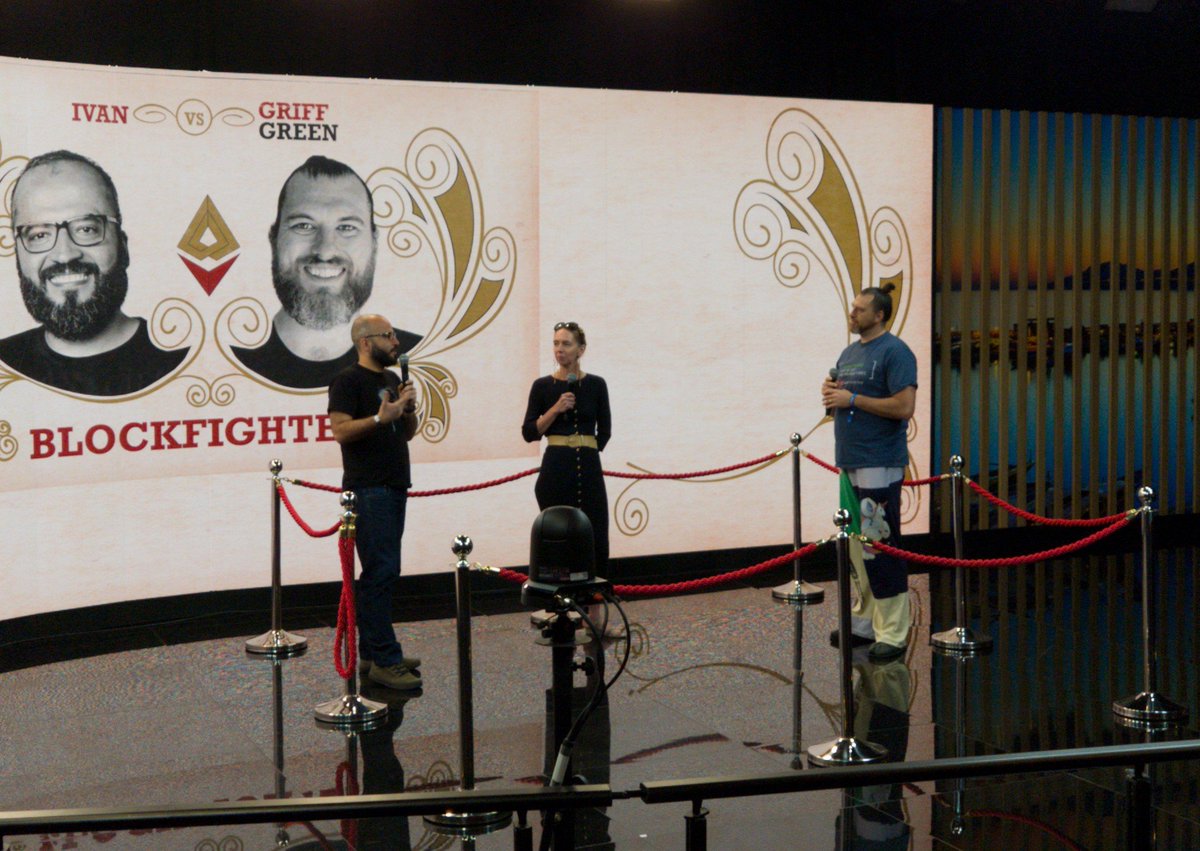
Awesome debate "have DAOs failed" moderated by @nichnachnoch with @griffgreen and @TheTakenUser
DAOs haven't failed, just need a major rebrand to be the definitive, configurable, hyperscalable governance layer for humans, agents, enterprises.
1
3
12
455

🎙BLOCKCHAIN x LUCID-INTERNET OF AI (IOAI) PROJECT VOICE AMA ALERT 🎙
Ready to explore the future of LUCID-INTERNET OF AI (IOAI) project..
🌍 What’s Happening?
Lucid is the Internet of AI (IoAI) — a hyperscalable AI Layer unifying models, agents, datasets, compute, and apps into one collaborative DeAI ecosystem.
It fixes silos, amnesia, opacity, and unfair rewards with shared portable memory, on-chain Thought Epoch proofs, auto-payouts, and <100 ms speed — anchored on Solana for Web3 trust at Web2 performance.
Lucid agents are more secure (enterprise encryption audited trails), more powerful (frontier LLMs, DePin compute, 500 integrations), and deploy with true 1-click ease — vastly simpler than OpenClaw’s hardware setups. One subscription also gives access to more models and tools than Hugging Face’s fragmented library.
Web2 speed · Web3 trust · Web4 intelligence — isolated AIs become interoperable on-chain citizens in a composable digital nation.
🗓Event Breakdown
📆 Date: March 18TH 2026
⏰ Time: 1 : 00 PM UTC
📍 Venue: t.me/TheBlockChainCallss
🎤 Guest: Eli-Lucid CEO
🎙 Host: Federico
🏆 Rewards: USDC
🔗 Official Resources
LUCID-INTERNET OF AI: 📱 Twitter 📱 Website 📱 Discord
#BlockChain #LUCID-INTERNET OF AI (IOAI) #Web3 #AMA

13
6
9
192

Feb 24
Comparison of various StreamrTV @Streamr / @Streamr_App VS competitors. The bar is set high!
Decentralized Architecture: Peer-to-Peer network without servers, avoiding single points of failure and vendor lock-in compared to #Zoom, #Signal, #Microsoft Teams, #Google Meet, and #Jitsi.
Real-Time Data Processing: Low latency through scalable Pub-Sub protocols, hyperscalable, superior to centralized systems with increasing user numbers.
Cryptographic Security: Blockchain integration (Ethereum, Polygon) for robust protection, more secure than centralized services like Zoom or Google Meet.
Data Monetization: Buying/selling of data streams with $DATA token, staking APY, superior to options in Huddle01 or Livepeer.
Broad Applicability: Supports video, AI, IoT, and Metaverse data, more comprehensive than Livepeer (video transcoding) or Huddle01 (video conferencing).

3
9
662

Feb 10
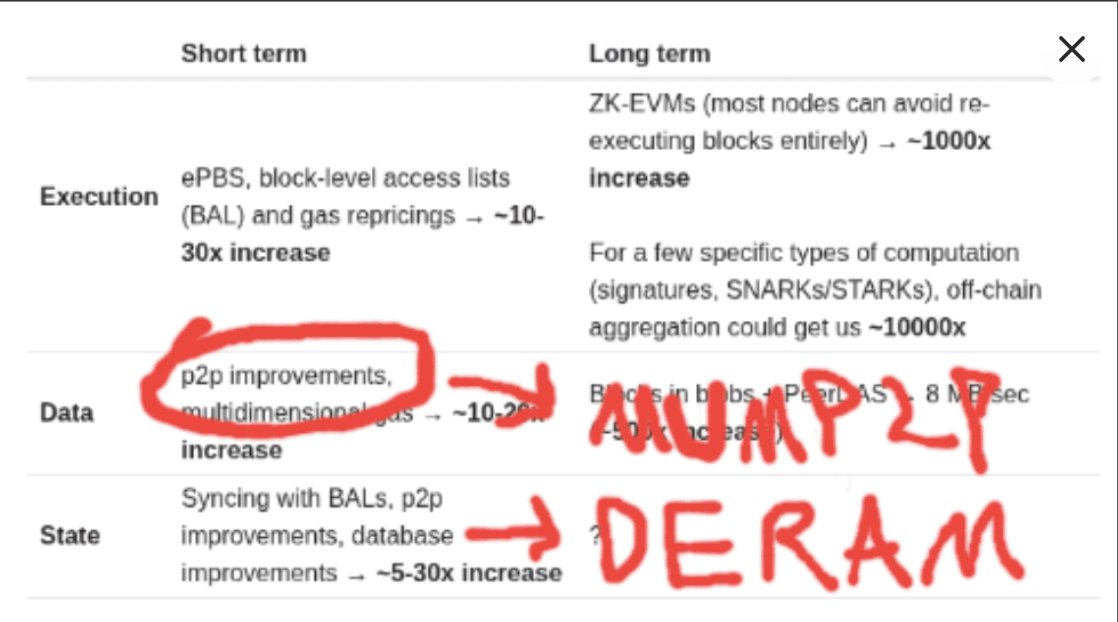
2 years ago most people didn't understand the need for what we're building at Optimum, now the problems we solve are entering mainstream discussion.
We built out mump2p for hyperscalable p2p networking, deRAM is in development for hyperscalable data storage/access.
Skate where the puck is going

Feb 5

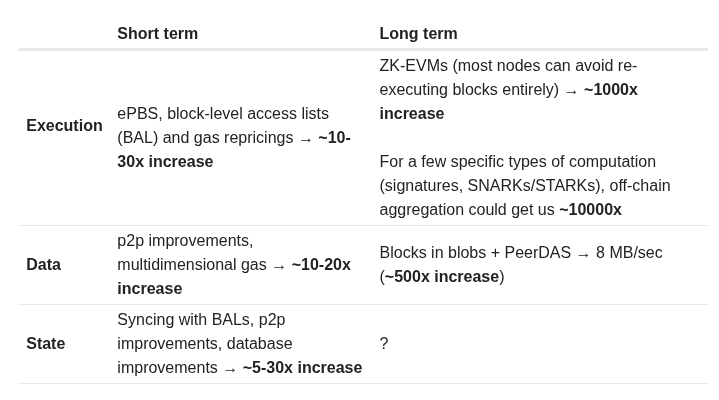
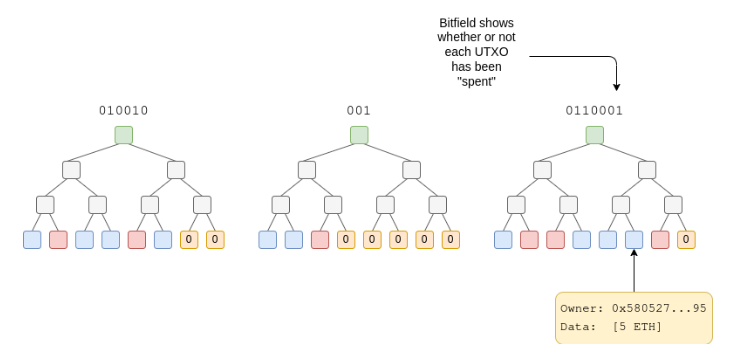
Hyper-scaling Ethereum state by creating new forms of state:
ethresear.ch/t/hyper-scaling…
Summary:
* We want 1000x scale on Ethereum L1. We roughly know how to do this for execution and data. But scaling state is fundamentally harder.
* The most practical path for Ethereum may actually be to scale existing state only a medium amount, and at the same time introduce newer forms of state that would be extremely cheap but also more restrictive in how you can use them.
* In such a design, the present-day state tree would over time become dominated by user accounts, defi hub contracts, code, and other high-value objects, while all kinds of individual per-user state objects (eg. ERC20s balances, NFTs, CDPs) would be handled with cheaper but more restrictive tools. Making the developer abstractions to make this easy to implement for the use cases that make up >90% of state today seems very doable.
10
5
36
1,185


Feb 3
@Streamr_App isn’t just another meeting app.
Privacy-first video conferencing.
Engineered peer-to-peer, hyperscalable with zero middlemen.
Unlike any other💯
Feb 3

We’re live.
The @Streamr_App Alpha is now open.
Video conferencing chat, unlimited meetings, unlimited attendees (10 speakers), end-to-end encrypted, and built serverless, so there are no central servers or middlemen.
No third parties in the room.
Just the people who are supposed to be there.
x.com/Streamr/status/2018665…
1
2
63

Feb 2
Today, Binance announced the delisting of @Streamr's official token, $DATA, from its platform, effective February 13, 2026.
Is this the end for @Streamr?
Absolutely not! It signifies the dawn of even greater innovations in the Web3 landscape.
Streamr is building a decentralized, real-time data network that delivers cryptographically secure, open-source, and serverless streaming solutions for data and media broadcasts.
With the recent launch of Streamr 1.0, the platform now features complete $DATA tokenomics, enabling node operators to secure the network, relay data, and earn yields through staking…
Integrated with blockchains like Ethereum, BNB, and Polygon, Streamr empowers use cases such as AI data delivery, live video streaming via a hyperscalable decentralized CDN, verifiable DePIN data from IoT devices, secure serverless communications, interactive metaverse experiences, and seamless data monetization through subscriptions.
This shift away from centralized exchanges like Binance aligns perfectly with Streamr's vision of a truly decentralized future.
Join the movement today and yap about @Streamr today

Feb 2
We’re disappointed to confirm that Binance will delist $DATA on 13 February 2026.
Binance does not provide advance notice. Once the monitoring tag was applied earlier this year, we took immediate action to defend the listing, including improving order book liquidity and running a trading campaign.
We’ve reviewed Binance guidelines carefully and don’t believe Streamr is in major conflict with them. Despite solid metrics and clear improvements, Binance still chose to delist for reasons unknown to us.
While this is a setback, it’s not the end of the road. $DATA remains listed on top-tier exchanges like KuCoin and is tradable on DEXes such as Uniswap on Ethereum and Polygon. Liquidity is expected to migrate accordingly.
We continue to work closely with KuCoin and other exchanges. More updates soon.
13
7
21
519

"By focusing on onboarding users to intuitive interfaces, backed up by hyperscalable L1s and robust infrastructure, DeFi could build the foundation for mainstream adoption..."
- Dan Hughes, founder of Radix
@Cointelegraph @Raullen

3
6
151


Jan 28
People looking for alternative video conferencing apps…look into @Streamr_App; better, faster, private, hyperscalable and zero dependencies on BigTech companies
1
2
5
155
Jan 25
You’ll like @Streamr_App, fully p2p video conferencing running in browsers.
Not one single server involved. But still hyperscalable by design.
Video quality and latency is even better compared to Zoom, Meet, Teams.
Alpha launching this week.
Powered by @streamr @0xPolygon
3
13
226

Jan 14
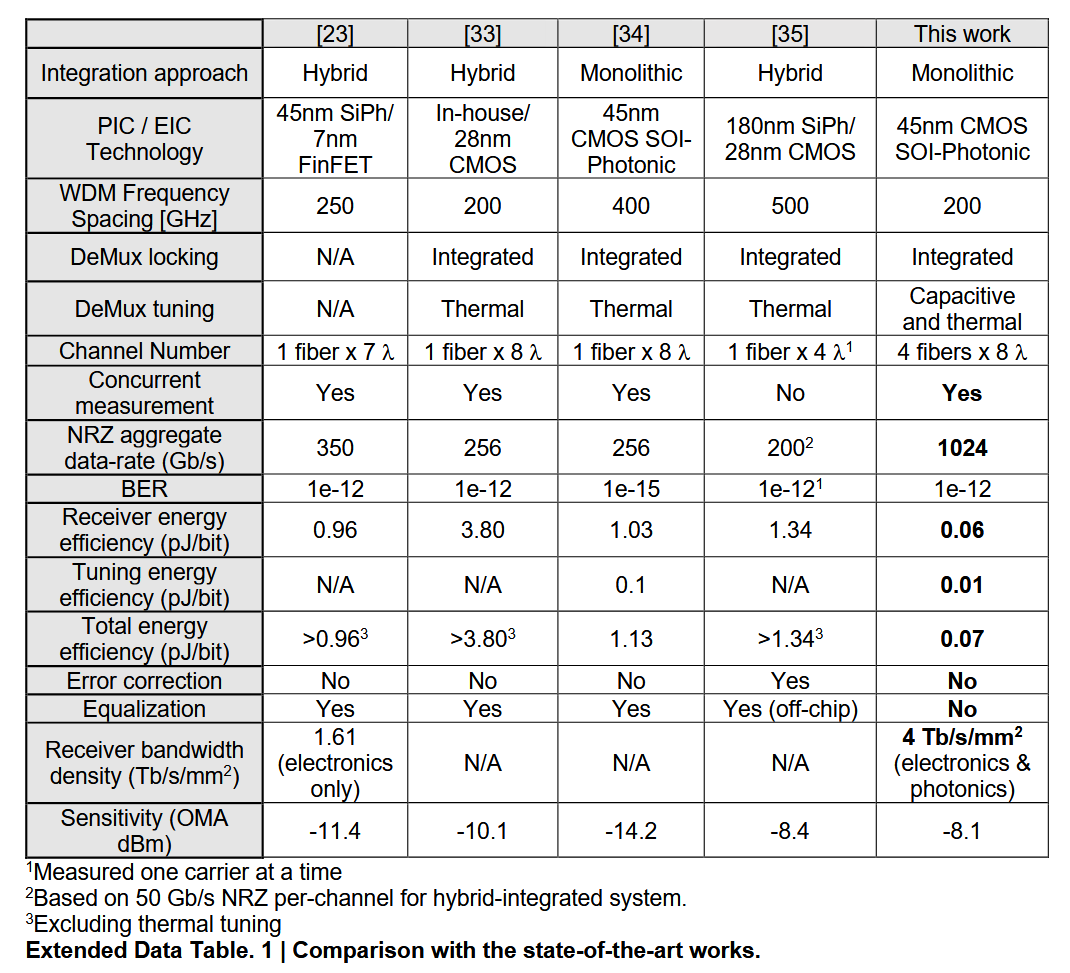
The implemented monolithic receiver offers a scalable, energy-efficient, and reliable solution for optical interconnects beyond Tb/s, suitable for deployment in future hyperscalable data centers and HPC systems.
2
287

Jan 9
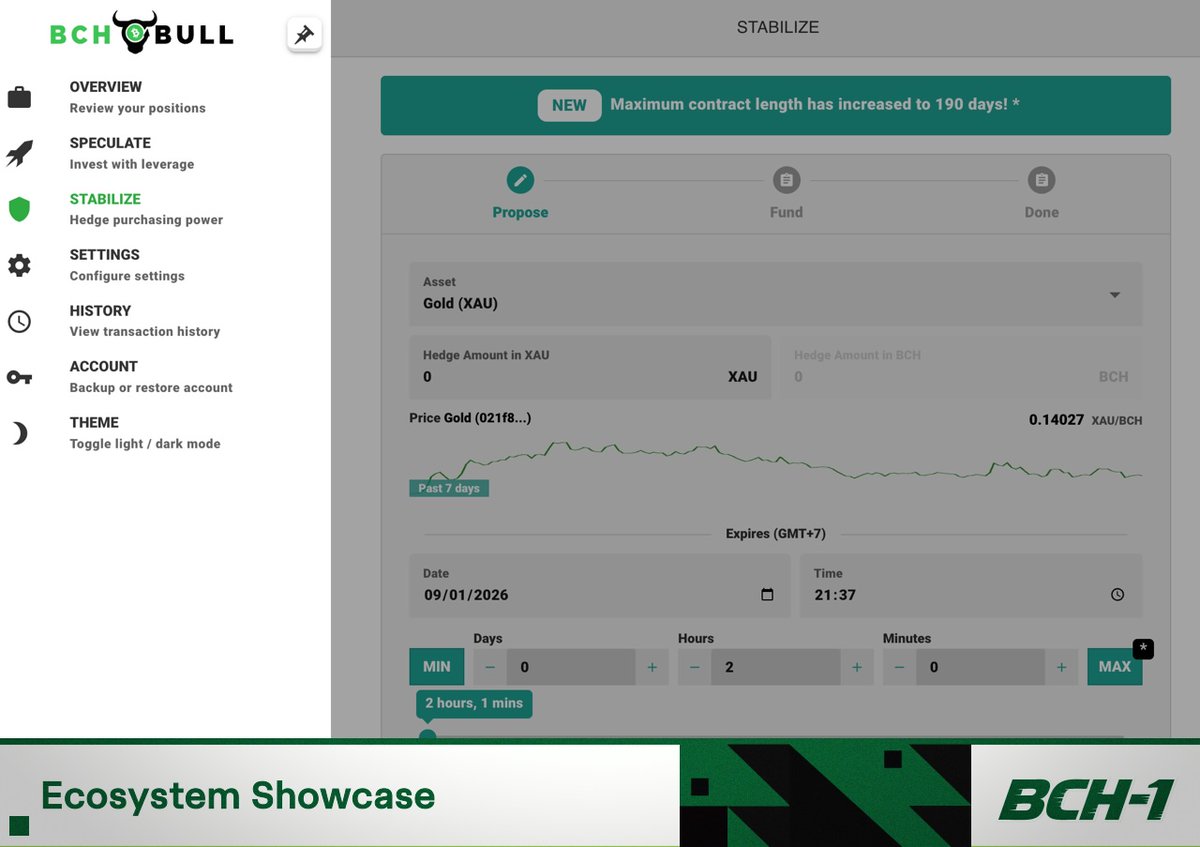
Ecosystem Deep Dive: BCH Bull 🧵
FOMOing on Silver and Gold?
@BCH_BULL is a native derivatives app built directly on the $BCH base layer.
It uses native smart contracts and $BCH as collateral to create fully on-chain, decentralized hedging and speculation.
Anyhedge has a TVL of 4.8 Million USD and and growing according to DefiLamma
The protocol behind BCH BULL is @AnyHedge , with infrastructure designed by @GeneralProtocol
It enables locking up BCH in time-based positions, settled using oracles.cash. There is no reliance on L2s, sidechains, or external custodians.
With BCH Bull, users can gain exposure to BTC, ETH, gold, silver, USD, INR, PHP, EUR, and CNY — using only BCH as the entry and exit asset.
Each position is enforced by BCH-native smart contracts, not wrapped tokens or synthetic middle layers. Oracles provide USD-denominated prices.
Everything is transparent. Contracts are viewable, on-chain, and live. Gas fees remain sub-cent, even for more complex operations.
The app is powered by:
— Bitcoin Cash as the base chain
— CashScript for contract logic
— oracles.cash for price feeds
— AnyHedge as the derivatives protocol
— BCH Bull as the product interface
All on L1, no sidechain or L2 trickery, hyperscalable.
This is what application-layer defi on Bitcoin Cash looks like, interoperable components working together across a cohesive, low-cost (due to low fees) UTXOs.
BCH Bull shows what is possible when developers build directly into the base layer. It adds another lane for BCH adoption and a new kind of utility for its economic layer.
bchbull.com
3
10
32
1,790

Jan 5
🚀 BCH-1 Phase 1 Update:
Just sent to TG group the BCH-1 Developers Handbook for devs joining the "Programmable Bitcoin" for the first time.
We now have 98 registered hackers.
Here are some cool things that have already been hatching for $BCH:
- A Sablier (payment streaming) like platform for Bitcoin Cash
- A Remix like web app, build, test and deploy Cashscript contracts
- A socially viral way to spread BCH tokens, using BCH's unique capabilities.
- Smart Contract Marketplace
- Bundling different tokens together in one tx
- Token Access Control for communities
- Airdrop tools built on BCH's hyperscalable L1 design
DAO systems, payment systems, voting systems and hopefully more coming.
This week, we split teams into 4 groups, depending on their vision stage, and help them start formulating their vision for what they will work on during the actual sprint in Phase 2, as well as identify technical challenges.
We start 2026, like we think it will - 2026 is the year $BCH starts slapping as Bitcoin Cash's programmable era.

5
15
53
2,809