
iPSCs are essentially equivalent to ESCs, capable of unlimited proliferation and differentiation into all cell types. The problem is that differentiated cells derived from either PSCs or ESCs will be eliminated by the immune system, making them impractical for regenerative therapy.
4

Raynaud overlap fascinates me, I’ve been reading up on it, there's similarities between SGFs & iPSCs (Induced Pluripotent Stem Cells) that target endothelial damage. they’re different types of intervention, SGFs signal existing cells repair, iPSCs replace damaged endothelium.👀
1
6
30

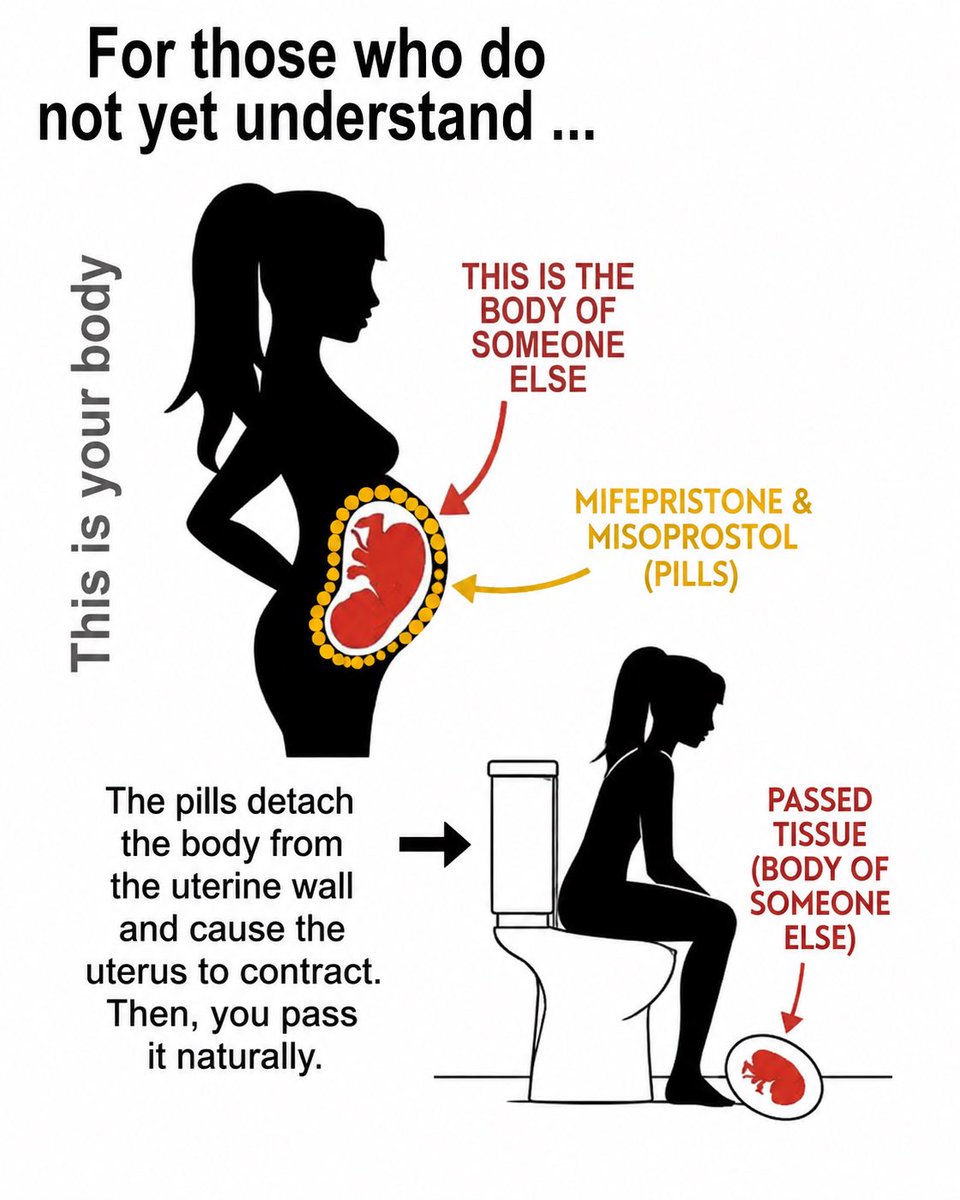
all your infographics, defeated with just one.
if you actually cared, you would make the tech to make artificial wombs possible.
then even if aborted, you could revive the clump of cells using iPSCs / SCNT
12

Japanese researchers in a 2025 PNAS Nexus study used allele-specific CRISPR-Cas9 to excise the surplus chromosome in lab-grown human iPSCs and fibroblasts from patients, restoring typical gene expression and cell function in roughly 30% of treated cells.
55

16h
g: Efficiency reached around 13% chromosome elimination in iPSCs (higher with temporary knockdown of DNA repair genes), with corrected cells showing normalized gene expression and improved cellular phenotypes. It has not been tested on embryos, fetuses, or in any living organism. No clinical application to embryos exists, and extending it to embryos would be a major leap with significant technical, safety, and ethical barriers.
14

Strzelił ze strzelby z jednej ręki! Jak to możliwe!!!
Film ma charakter humorystyczny ;)
#ipscs #ipscshotgun #strzelectwodynamiczne
3
Lili retweeted

Jun 12
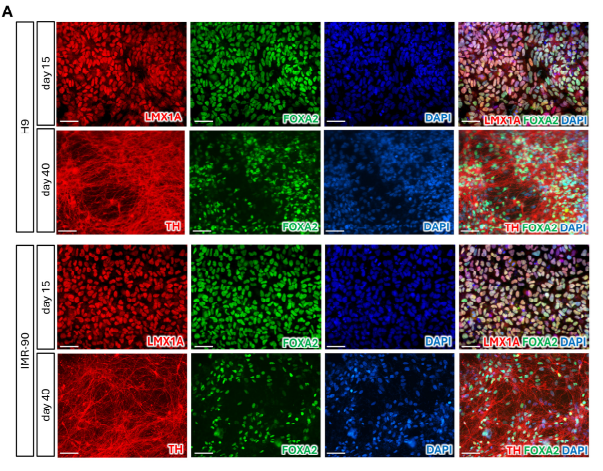
Researchers have developed an improved method to generate transplantable dopamine-producing #neurons from human iPSCs, enhancing differentiation efficiency, safety, and functional recovery in preclinical Parkinson’s disease models. 🧠
Read the study: go.nature.com/4udpcnM
4
9
756

Jun 12
Charles, I agree with several of your points and am uncertain what you mean by a couple. First, where I agree… Yes, there is a stark contrast with the use of genes like OSKM or OSLN to make iPS cells and the concept commonly called “partial reprogramming.” I think you meant that while human iPSCs make benign teratomas if sufficient numbers are injected into animals, the differentiated cells made from them do not make teratomas (but they, of course, can and sometimes do make inappropriate ectopic tissues if not pure). Now on partial reprogramming, I am largely okay with the statement that it can cause the reversal of aging if we affix the adjective “developmental” in front of the word aging. For example, partial reprogramming does not induce telomerase and reset telomere length unless you take the cells to pluripotency (at least in human cells). I also share your concern about off-target effects. Likely 90% of the target cells are sent spiraling into who knows what state? Cancer should be considered a huge risk factor here. We see lots of evidence for this. The use of OSKM or OSLN was initially only considered a proof of concept or a modality of last resort to revert cells to a pre-fetal regenerative state. In the early days we thought if we knew the “regenerative switches” that partial reprogramming hit, these genes would be much more targeted and safer than haphazardly hitting the entire genome with unknown off-target effects. Targeting these “switches” is called “segmental reprogramming.” It is IMO the future.
1
5
202

Jun 12
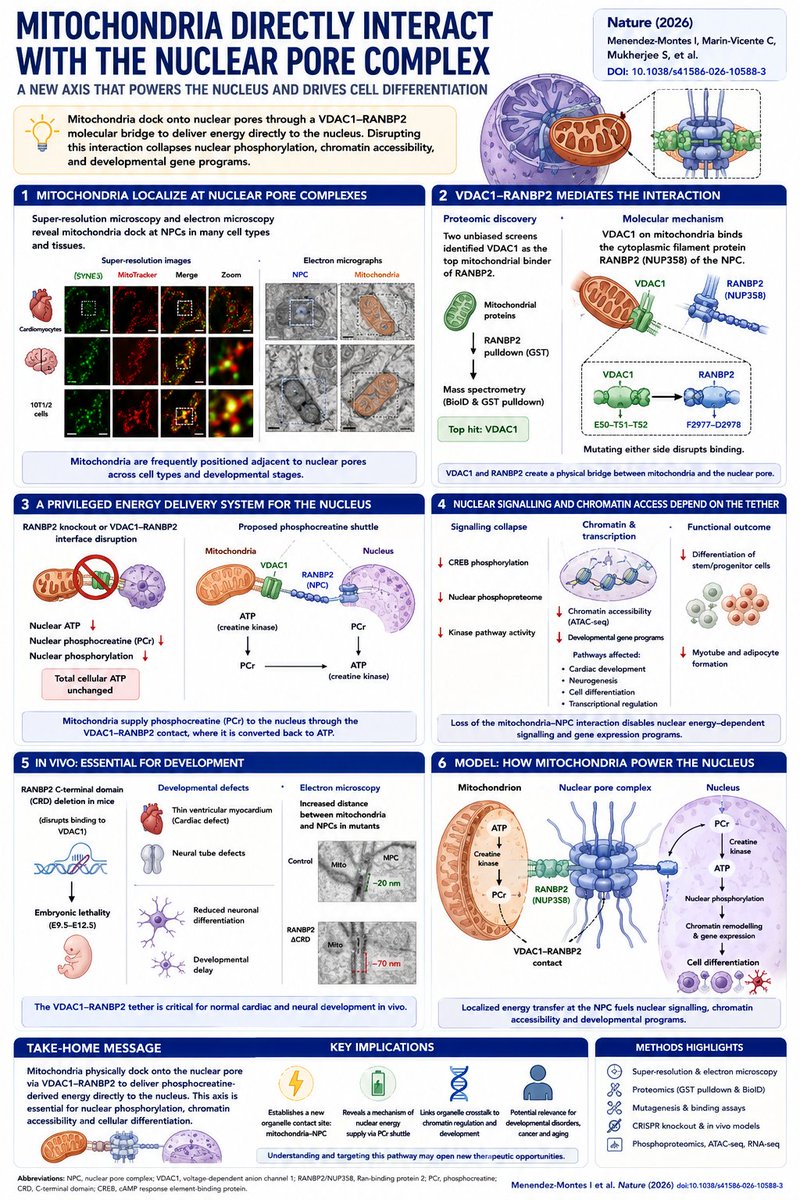
Mitochondria Touch the Nuclear Pore: A New Organelle Communication Axis
For decades, mitochondria and the nucleus were thought to communicate primarily through signaling molecules, metabolites, and transcriptional feedback loops.
A new Nature study reveals something far more direct:
🧬 Mitochondria physically dock onto the nuclear pore complex (NPC).
The work identifies a previously unknown organelle contact site where mitochondria interact directly with the nuclear pore through a molecular tether:
VDAC1 ↔ RANBP2 (NUP358)
This interaction regulates nuclear energy supply, chromatin accessibility, phosphorylation signaling, and ultimately cellular differentiation.
A new mitochondria–nucleus contact site
Using:
🔬 Super-resolution microscopy
🔬 Electron microscopy
🔬 GST pull-down proteomics
🔬 BioID proximity labeling
the authors demonstrated that mitochondria frequently localize adjacent to nuclear pores in multiple tissues including:
❤️ Cardiomyocytes
🧠 Neurons
🫀 Mesenchymal cells
🧫 Cultured fibroblasts.
Electron micrographs on pages 2–3 show mitochondria positioned directly against NPC-associated filament structures, rather than merely near the nuclear envelope.
This architecture appears evolutionarily conserved across tissues and developmental stages.
VDAC1 is the mitochondrial docking protein
Two independent proteomic screens converged on the same target:
🎯 VDAC1
the major mitochondrial outer membrane channel.
The nuclear binding partner was identified as:
🎯 RANBP2/NUP358
the giant cytoplasmic filament nucleoporin of the nuclear pore complex.
Structural modeling identified a direct interaction between:
• VDAC1 E50-T51-T52
and
• RANBP2 F2977-D2978
creating a molecular bridge between mitochondria and the NPC.
Mutating either interface disrupted the interaction.
The surprising function: feeding energy directly to the nucleus
The most important finding is not structural.
It is metabolic.
The authors discovered that NPC-associated mitochondria create a privileged energy delivery system to the nucleus.
When RANBP2 was deleted:
⬇ Nuclear ATP
⬇ Nuclear phosphocreatine (PCr)
⬇ Nuclear phosphorylation
while total cellular ATP remained unchanged.
This indicates a:
nuclear-specific energetic deficiency
rather than global mitochondrial failure.
A phosphocreatine shuttle across the nuclear pore
One of the most novel aspects of the study is the proposed:
⚡ Mitochondria → phosphocreatine → nucleus shuttle.
The model is:
Mitochondrial ATP
→ mitochondrial creatine kinase
→ phosphocreatine (PCr)
→ transport through VDAC1–RANBP2 contact region
→ nuclear creatine kinase
→ ATP regeneration inside the nucleus.
The schematic on Extended Data Fig. 9 (page 34) illustrates this pathway directly.
Nuclear signaling collapses without the tether
Loss of the VDAC1–RANBP2 interaction caused:
⬇ CREB phosphorylation
⬇ Nuclear phosphoproteome
⬇ Chromatin accessibility
⬇ Developmental transcriptional programs.
ATAC-seq revealed widespread chromatin closure.
RNA-seq demonstrated suppression of:
🧬 SMAD
🧬 GATA
🧬 FOX
🧬 TBX developmental networks.
The strongest affected pathways involved:
• differentiation
• organ development
• cardiac development
• neurogenesis.
Stem cells fail to differentiate
Functional consequences were dramatic.
RANBP2-deficient cells showed:
❌ Reduced myotube formation
❌ Reduced adipocyte differentiation
❌ Reduced lineage marker expression.
Similarly, human iPSCs carrying:
🧬 VDAC1 interaction mutations
or
🧬 RANBP2 C-terminal truncations
failed to properly activate cardiomyocyte differentiation programs.
Markers including:
• ISL1
• NKX2.5
• MEF2C
• MYH6
were significantly reduced.
Embryos cannot survive without the tether
The strongest evidence came in vivo.
The investigators generated mice lacking the RANBP2 C-terminal domain responsible for VDAC1 interaction.
Result:
☠ Embryonic lethality.
Affected embryos developed:
❤️ Thin ventricular myocardium
🧠 Neural tube defects
📉 Reduced neuronal differentiation
📉 Developmental delay.
Electron microscopy confirmed increased distance between mitochondria and nuclear pores in mutant embryos.
A new paradigm for organelle biology
Traditionally:
Mitochondria
→ ATP production
→ diffusion
→ nuclear utilization
was considered sufficient.
This study suggests something much more spatially organized:
Energy delivery occurs through dedicated organelle contact sites.
The proposed pathway becomes:
VDAC1–RANBP2 tether
→ mitochondrial docking at NPC
→ local ATP/PCr transfer
→ nuclear phosphorylation
→ chromatin remodeling
→ developmental gene expression
→ differentiation.
Why this matters
This work expands the growing field of inter-organelle communication beyond:
• mitochondria–ER contacts
• mitochondria–lysosome contacts
• mitochondria–lipid droplet contacts
by establishing:
🎯 mitochondria–nuclear pore contacts
as a distinct functional signaling and metabolic hub.
The implications extend well beyond development.
Potential future relevance includes:
🧠 Aging
❤️ Heart failure
🧬 Stem-cell biology
🦠 Cancer metabolism
⚡ Nuclear bioenergetics
🧬 Epigenetic regulation.
The discovery suggests that mitochondrial positioning—not merely mitochondrial activity—can determine nuclear function and cell fate.
Reference
Menendez-Montes I, Marin-Vicente C, Mukherjee S, et al.
Mitochondria directly interact with the nuclear pore complex.
Nature (2026)
DOI: 10.1038/s41586-026-10588-3
#Mitochondria #NuclearPoreComplex #RANBP2 #VDAC1 #CellDifferentiation #StemCells #CardiacDevelopment #Neurodevelopment #ChromatinBiology #NatureJournal
1
98

iPSCs generated using our proprietary mRNA, circRNA, saRNA and RNA-LNP reprogramming kits exhibit robust expression of stemness and pluripotency. integraterna.creative-biogen…
1
20

Researchers have successfully developed methods to convert iPSCs into the three major cell types needed for corneal repair: corneal epithelial cells, stromal keratocyte cells, and corneal endothelial cells.
1
1
40

Jun 11
Researchers have long been exploring the real reasons why and how exactly cells age, with the aim of reversing this process and potentially expanding our liespan. Back in 2006, a Japanese scientist discovered induced pluripotent stem cells (IPSCs)..
verumd.com/2026/06/08/adding…
8

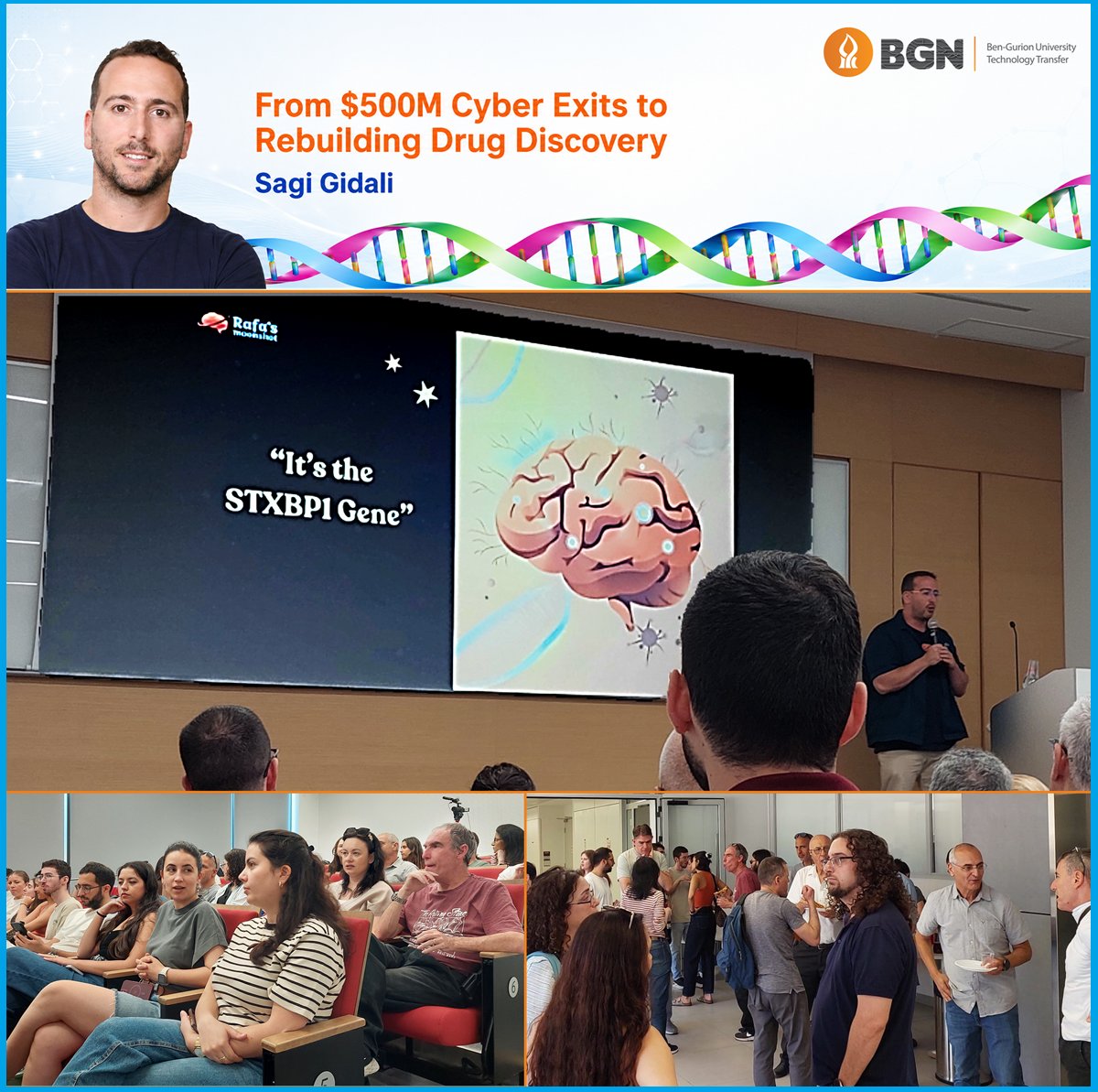
From $500M Cyber Exits to Rebuilding Drug Discovery
What happens when a serial tech entrepreneur turns his focus from cybersecurity to one of the hardest challenges in healthcare: accelerating the discovery of cures for diseases?
In a recent "From Lab to Industry | Lunch & Learn" session hosted by the Bio-Innovation Unit, @SagiGidali shared his remarkable journey from a serial cybersecurity entrepreneur of successful companies such as @Perimeter_81 and @SaferVPN, to harnessing groundbreaking research and cutting-edge technologies, including AI, to accelerate drug discovery for diseases which currently has no cure.
For Sagi, this mission became personal when his son Raphael was diagnosed with STXBP1, a rare genetic disorder.
One of the most inspiring parts of the talk was hearing how his entrepreneurial mindset led him to challenge the doctor’s statement “there is no cure”. Rather than accepting it as a final answer, He chose to take action and build an accelerated program aimed at developing a treatment for his son's disease.
Sagi and his wife founded “Rafas Moonshot”, a patient-driven translational platform advancing real therapeutic programs toward the clinic for rare genetic diseases. In less than two years, the platform has driven millions of dollars into research, built global collaborations, and is progressing toward its first clinical trial for STXBP1.
One of their first interactions with academia in advancing this mission was approaching Prof. @GVatine from @bengurionu, who studies rare neurological disorders, including STXBP1-related disorders, to generate iPSCs for Raphael’s disease as a preclinical model to screen potential drugs.
A recording of the session will be available soon.
This is another example of how personal purpose, deep technology, and academic innovation can come together to open new paths toward future therapeutic strategies.
Learn more about how the Bio-Innovation Unit supports researchers in advancing bio-related discoveries toward real-world solutions.
Link in the comments.
2
23

Jun 11
His research is focused on projects that are system biology-based nationally and internationally, using iPSCs (induced pluripotent stem cells) to model human diseases, especially Alzheimer’s disease
1
6

it's based on real research from Mie University (Japan, 2025).
They used **CRISPR-Cas9** (specifically allele-specific multiple chromosome cleavage) to remove the extra chromosome 21 in lab-grown cells (iPSCs & fibroblasts), achieving "trisomy rescue"
1
266

Dr. Wolfram Zimmermann and team at @yourUMG have engineered heart muscle grafts derived from iPSCs, which increased heart wall thickness and improved cardiac function in patients with heart failure. 💓
Learn more: bit.ly/4edkcJY
Join the discussion: bit.ly/4dYixJs
1
199