
Jun 5
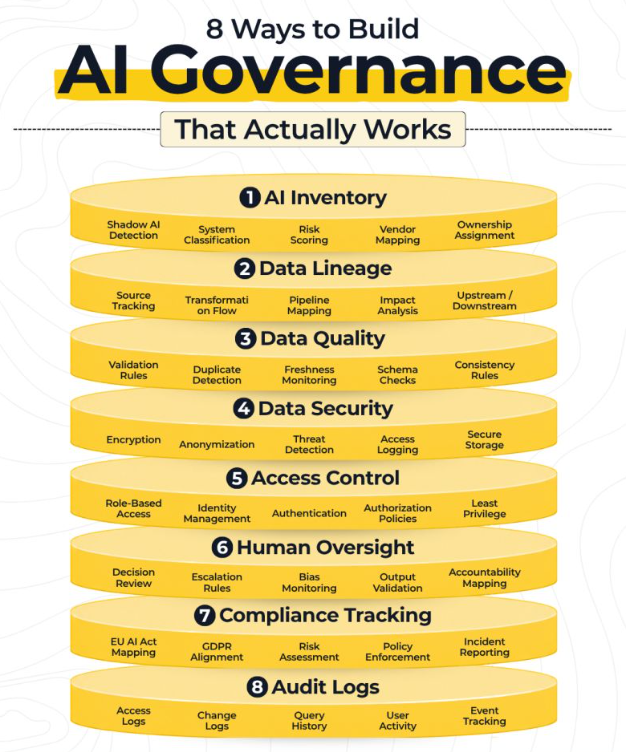
I saw this posted here on LinkedIn and had to check how #InvictusPro & #Realist8Pro stacked up against what most people 'Think' is Real AI Architecture. Here is how we currently stack up against this AI Governance Graphic - What are your thoughts?
The graphic is a generic AI governance stack. Your systems are broader than that because you are not only governing AI models; you are governing business execution systems, telemetry, users, tenants, campaigns, accounting, sender lanes, files, workflows, audits, infrastructure, security, and AI-assisted control planes.
1. What your systems already have that this graphic does not show
A. Master Control Plane / Principal Trust governance
The graphic has “ownership assignment” and “accountability mapping,” but your architecture goes further.
Your systems define a sovereign MCP / Principal Trust layer that governs:
SuperAdmin control
tenant hierarchy
licensing
platform health
usage telemetry
AI diagnostics
risk queues
audit/security
revenue/sales visibility
auto-healing recommendations
cross-tenant platform telemetry without exposing tenant-confidential records
That is materially stronger than the graphic’s simple “ownership assignment.” The image shows governance as a checklist; your design treats governance as an operating command layer.
B. Runtime telemetry hierarchy
The image lists audit logs, event tracking, user activity, query history, and access logs.
Your systems go deeper with runtime telemetry doctrine:
KPI primitive engine
telemetry state doctrine
telemetry bus
executive trust telemetry
role-aware rendering
auth-aware smoke testing
runtime governance tables
campaign telemetry events
financial telemetry placeholders
sender-lane telemetry
validation telemetry
system health telemetry
operational incident doctrine
The graphic does not describe telemetry as a command-and-control fabric. Your systems do.
C. Source-of-truth / markdown governance authority
The graphic does not mention source authority.
Your build process requires:
canonical markdown governance docs
source-of-truth hierarchy
repo/runtime/source map
contract extraction from governing markdown
patch-only governed files
validate with endpoint evidence
commit or stop with named blocker
That is a major missing layer in the graphic. The graphic governs AI/data, but it does not govern software implementation authority.
D. Contract-first implementation governance
The graphic says “policy enforcement,” but your systems require machine-readable contracts and implementation sequencing.
You already framed:
API contract governance
Codex execution sequencing
dev-shell orchestration
additive migrations only
governed backend separation
protected runtime boundaries
validation before publish
endpoint evidence before completion
That is more operational than the graphic.
E. AI trust telemetry
The image says “bias monitoring,” “output validation,” and “human oversight.”
Your systems add a more mature trust layer:
AI confidence state
source lineage
token/cost telemetry
model/report provenance
executive trust score
human review requirement
AI trust/state indicators
AI operational safety
AI fiduciary alignment
compartmentalized AI memory scopes
The graphic speaks to AI governance generally. Your system is closer to AI operational assurance.
F. Auto-healing and escalation
The image has “escalation rules,” but your systems explicitly require AI/system telemetry to detect:
faults
failures
bugs
blockages
operational tension
underlying system friction
healing recommendations
attention routing to the Master User / SuperAdmin
That is beyond static governance. It is self-monitoring operational governance.
G. Business execution governance
The image is centered on AI inventory, data, access, compliance, and logs.
Your systems govern actual business execution:
accounting ledgers
journal posting
balanced entries
trial balance
AR/AP
reconciliation
treasury
tax intelligence
campaign sends
vendor management
field ops
project/work-order telemetry
payment/progress verification
CRM workflows
client/vendor/tenant operations
The graphic does not address governance of real business transactions.
H. Campaigns360 sender-lane and preflight governance
The graphic does not include anything close to your Campaigns360 architecture.
You have locked in:
source list → domain carrier KPI
MX carrier KPI
suppression/duplicate/prior-validation gate
Bulk Email Checker preflight
deliverable-only promotion
scrubbed derivative lists
sender-lane allocation
throttled validation checks
shared IP / lane / carrier / MX / host telemetry
Preflight Confirmed To Send
campaign throttling controls
original list preservation
That is a specialized governance layer the graphic does not even contemplate.
I. Security redaction and supply-chain governance
The graphic says encryption, anonymization, threat detection, access logging, secure storage.
Your system adds:
redaction-first scripts
never print secrets
credential rotation assumption
least privilege handling
scoped/in-memory credential handling
backup-before-change
package/framework/repo inspection
no unvetted open-source dependencies
SAST/DAST readiness
container scanning
dependency scanning
vulnerability remediation
incident evidence packages
The graphic is high-level security. Your requirements are build-operational security governance.
J. Multi-tenant fiduciary/accounting isolation
The graphic mentions access control and data security, but not fiduciary separation.
Your Accounting360 / InvictusPro model includes:
tenant-confidential operational data separation
tenant accounting record isolation
tenant AI memory scopes
fiduciary telemetry
entity scope
fiduciary scope
encryption boundaries
RBAC
audit lineage
platform telemetry separation from tenant data
That is stronger than generic “role-based access.”
2. What the graphic notes that I do not yet know is fully implemented in your live systems
Some of these are probably in your governance markdown, but I would not claim they are already live unless we inspect the current repo/runtime.
A. Shadow AI detection
The image explicitly calls out Shadow AI Detection.
I know your architecture governs AI deployment policy, AI orchestration, AI telemetry, AI safety, and AI workflow boundaries. I do not yet know that you have a live detector that identifies unauthorized AI tools, rogue model calls, unapproved API keys, browser-based AI usage, or unsanctioned AI agents inside tenant workflows.
This should become an explicit control:
shadow_ai_detected, unapproved_model_endpoint, unregistered_ai_tool, external_ai_data_exposure_risk
B. Formal AI inventory registry
The image starts with AI Inventory.
You have AI governance concepts, model/version references, AI telemetry, and orchestration policy. I do not yet know that you have a live canonical table or registry for every AI component.
A mature version would inventory:
model name
model provider
version
endpoint
tenant scope
permitted workflows
data classes allowed
human-review requirement
risk tier
owner
approval status
last evaluation
retirement status
C. Vendor AI mapping
The image includes Vendor Mapping.
Your systems include vendor management in the business sense and open-source/package governance, but I do not know whether you have a formal AI vendor map that distinguishes:
OpenAI / Anthropic / local LLM / OCR vendors
Twilio, Stripe, Google, Microsoft, AWS, etc.
data processors vs subprocessors
AI-enabled vendors vs normal vendors
vendor risk tier
DPA/SOC2/ISO status
tenant exposure scope
This is likely needed for Fortune 500 positioning.
D. Data lineage at field-level depth
You already have audit/event lineage and source lineage concepts. The image specifically calls out:
source tracking
transformation flow
pipeline mapping
impact analysis
upstream/downstream mapping
I know you have this conceptually in Accounting360, Campaigns360, and iCore Event Bridge, but I do not know whether every material data object has full lineage implemented.
For example:
uploaded invoice → OCR extraction → AI classification → journal batch → ledger entry → trial balance → executive KPI
campaign source list → validation → scrubbed list → sender allocation → campaign send → bounce/suppression → telemetry rollup
work order → estimate → approval → vendor assignment → photo/progress → invoice → payment
That lineage should be formalized as a first-class system object.
E. Schema consistency checks
The image lists schema checks and consistency rules.
You have migration discipline, endpoint validation, audit events, and additive migration rules. But I do not know whether there is a live schema consistency engine that automatically checks:
expected columns
missing fields
enum drift
null policy violations
tenant scope leakage
foreign-key mismatches
event payload schema drift
API contract mismatch
frontend/backend response mismatch
This is highly relevant because you have already seen schema mismatch issues, such as login/auth problems and missing expected columns.
F. Bias monitoring
The image calls out Bias Monitoring.
Your systems have AI trust, human review, confidence, and fiduciary alignment. I do not know if bias monitoring is explicitly implemented as a measurable control.
For construction/accounting/campaign systems, bias monitoring may not mean demographic bias only. It can mean:
vendor selection bias
estimate approval bias
lead scoring bias
campaign suppression bias
AI recommendation skew
tenant/account prioritization bias
payment/dispute recommendation bias
G. Output validation rules
You have human oversight and audit telemetry, but I do not know whether every AI output has structured validation.
Examples:
AI-generated journal recommendation must balance before posting
AI-generated campaign recommendation must pass suppression/preflight rules
AI-generated estimate must preserve approved pricing logic
AI-generated executive report must cite source telemetry
AI-generated compliance summary must identify evidence sources
This is one of the most important items in the image.
H. Incident reporting specifically for AI
You have operational incident doctrine and security governance. I do not know whether you have a distinct AI incident reporting workflow.
That would include:
hallucinated output incident
unauthorized AI action
privacy/data exposure event
unapproved model call
failed confidence threshold
human override
model drift
unsafe recommendation
tenant complaint tied to AI output
3. Direct comparison table
Governance AreaImageYour SystemsAI inventoryBasic checklistLikely partially defined; needs explicit AI registry if not already builtData lineageGeneric lineageStronger conceptually; should be formalized per workflow/objectData qualityGeneric validationStrong in campaigns/accounting; schema consistency engine may need hardeningData securityEncryption/access/storageStronger due to redaction-first, credential, supply-chain, tenant isolationAccess controlRBAC/least privilegeStronger: RBAC SuperAdmin/MCP tenant/entity/fiduciary scopesHuman oversightReview/escalationStronger: trust telemetry, confidence state, executive attention routingCompliance trackingGDPR/EU AI Act/RiskStronger roadmap: SOC2/ISO/GDPR dashboards, evidence packages, gap trackingAudit logsBasic logsStronger: forensic audit chain, telemetry events, runtime evidenceBusiness governanceNot coveredYour systems cover accounting, campaigns, field ops, vendors, projectsAuto-healingNot coveredYour systems explicitly require auto-healing and fault escalationSource authorityNot coveredYour systems have markdown/source-of-truth governanceCampaign validationNot coveredYour Campaigns360 preflight/sender-lane telemetry is far more advanced4. The biggest thing your systems have that this image misses
Your systems are not just “AI governance.”
They are closer to:
Enterprise Operational Governance AI Trust Governance Runtime Telemetry Business Execution Control Source-of-Truth Software Governance.
That is the core differentiator.
This image is about governing AI responsibly.
Your system is about governing the entire business machine that AI participates in.
5. The useful items from the image to add or explicitly name in your system
These should be added as named controls if they are not already explicit:
Shadow AI Detection
AI Inventory Registry
AI Vendor/Subprocessor Mapping
AI Risk Scoring
Model Ownership Assignment
Data Transformation Lineage
Upstream/Downstream Impact Mapping
Schema Consistency Checks
AI Output Validation
AI Incident Reporting
Bias/Fairness Monitoring
Policy Enforcement Evidence
Access Review Evidence
Query History for AI and reporting surfaces
The strongest immediate addition would be an AI Governance Registry table/module that ties these together.
Example module name:
iCore AI Governance Registry
Core records:
AI asset
model/provider
owner
tenant scope
data classes
workflow permissions
risk score
human review rule
output validation rule
audit/event lineage
vendor/subprocessor
compliance mapping
incident history
active/retired status
6. Final assessment
Your systems already exceed this graphic in scope, telemetry depth, operational governance, SuperAdmin command visibility, campaign preflight controls, source authority, and runtime audit doctrine.
The image is still useful because it names several controls that should be made explicit in your architecture if they are not already live:
Shadow AI Detection, formal AI Inventory, Vendor AI Mapping, Schema Consistency, Bias Monitoring, Output Validation, and AI Incident Reporting.
The main gap is not vision. Your vision is larger. The gap is making each of those items a named, inspectable, auditable system object inside the MCP / iCore governance layer.
2
425
Jun 1
Construction is no longer just about labor, scheduling, and field execution.
At the enterprise level, it is about verification, documentation, payment control, workflow accountability, risk reduction, and stakeholder visibility.
After 35 years in multifamily, hospitality, and commercial construction — and more than 10 years building software and AI-driven systems — we built InvictusPro / Realist8Pro to solve the operational gaps that slow projects down and create exposure between developers, lenders, GCs, subcontractors, employees, and field technicians.
This platform brings construction teams into one controlled system with:
✅ Role-Based Access Control
✅ Blockchain-layered security
✅ AI-assisted progress assessments
✅ Photo-based progress verification
✅ AIA G702/G703-inspired progress payment certification
✅ RFQs, RFIs, project updates, bids, change orders, invoices, and aging
✅ Client dashboards and workflow-driven project visibility
For C-level executives, developers, lenders, and construction leaders, this is about more than software.
It is about building a better command layer for construction operations — where progress can be verified, payments can be supported, documentation is organized, and every stakeholder has controlled access to the information they need.
Watch the video and see how InvictusPro / Realist8Pro is helping modern construction teams work smarter, verify faster, and manage projects with greater confidence.
For demos, Q&A, and onboarding, contact:
Aaron Jones
Global Sales Director
Sales@Realist8Pro.com
Realist8Pro.com
#InvictusPro #Realist8Pro #ConstructionTechnology #PropTech #ConTech #SaaS #EnterpriseSoftware #ConstructionManagement #ProjectManagement #AI #BlockchainSecurity #ProgressPayments #AIA #Developers #Lenders #GeneralContractors #Subcontractors #DigitalTransformation
1
25
May 8
In construction, the project does not move through one person.
It moves through a control chain.
After 35 years in construction, across hotels, motels, casinos, commercial remodels, condominium projects, apartment complexes, and high-value development work, I built #InvictusPro Platform OS and #Realist8Pro SaaS around one clear reality:
Every role needs better project intelligence.
The #Owner needs capital visibility.
#FinanceManagers, #Banks, and #Lenders need documentation, draw readiness, progress confidence, and risk awareness.
#Architects and #Engineers need coordinated plans, approvals, submittals, documentation, and project alignment.
#ConstructionManagement firms need oversight across schedules, budgets, resources, vendors, change orders, and production movement.
#GeneralContractors need operational control across estimates, invoices, trades, field updates, approvals, and work execution.
#SpecialtyContractors and #Tradesmen need clear work orders, communication, documentation, and mobile field tools that support the actual work being performed.
That is the real construction environment.
Not noise.
Not disorder.
Not disconnected guesswork.
A disciplined execution chain that becomes stronger when every layer has the right intelligence at the right time.
That is what InvictusPro Realist8Pro was built to support.
The PaaS Connects:
• Office UI/UX
• Field tech apps
• Project workflows
• Estimates and invoices
• Draw readiness
• Change orders
• Vendor management
• Approval routing
• Role-based access controls
• Documentation
• Communications
• Executive dashboards
• KPI reporting
• Real-time telemetry
This gives owners, lenders, finance teams, architects, engineers, construction managers, general contractors, and trades a clearer view of what is happening from capital planning to field execution.
Because the best organizations do not wait until conditions become expensive.
They see movement early.
They measure performance clearly.
They communicate through the right channels.
They document decisions properly.
They execute with better information.
1•Directive
One system.
One command layer.
Owner-to-lender visibility.
Office-to-field intelligence.
Executive-grade construction control.
InvictusPro Realist8Pro is built for the people responsible for capital, documentation, approvals, field production, financial confidence, and project accountability.
This is the ‘#InvictusPro’ Platform Operating System • A 5⭐️ Enterprise OS
DM me or request a demo:
lnkd.in/gNi9ej4b
InvictusPro.co 📲⭐️
#InvictusPro #Realist8Pro #ConstructionFinance #ConstructionManagement #ConstructionTechnology #ProjectFinance #OwnerRepresentation #LenderReporting #DrawManagement #ProjectControls #FieldOperations #OfficeOperations #RealEstateDevelopment #CommercialConstruction #GeneralContractors #Architects #Engineers #ConstructionTelemetry #ExecutiveDashboard

1
33
Apr 23
⭐️⭐️⭐️⭐️⭐️ STAR• ‘#Realist8Pro’ X ‘#InvictusPro’
License Or Buy The Software-> ✅Own It Yourself Outright.
1•Year Will Save Contractors Using ‘#ServiceTitan’ Over $90K If You Have 25 Service Techs Tied In!
DM Me or Fill Out Our Form Here 👉🏻 Realist8Pro.com
57
Apr 23
👉🏻Who Creates Your Sales Orders?
📲 This Software Takes 1-Single Sales Orders & Creates A Symphony Of Business Intelligence 6-Ways From Sunday For C-Level Executive Telemetry 👉🏻From Conception To Closing 💫 ‘#Realist8Pro’ X ‘#InvictusPro’
👉🏻 ⭐️⭐️⭐️⭐️⭐️👈🏻 5 STAR SaaS
Realist8Pro.com

43
Apr 22
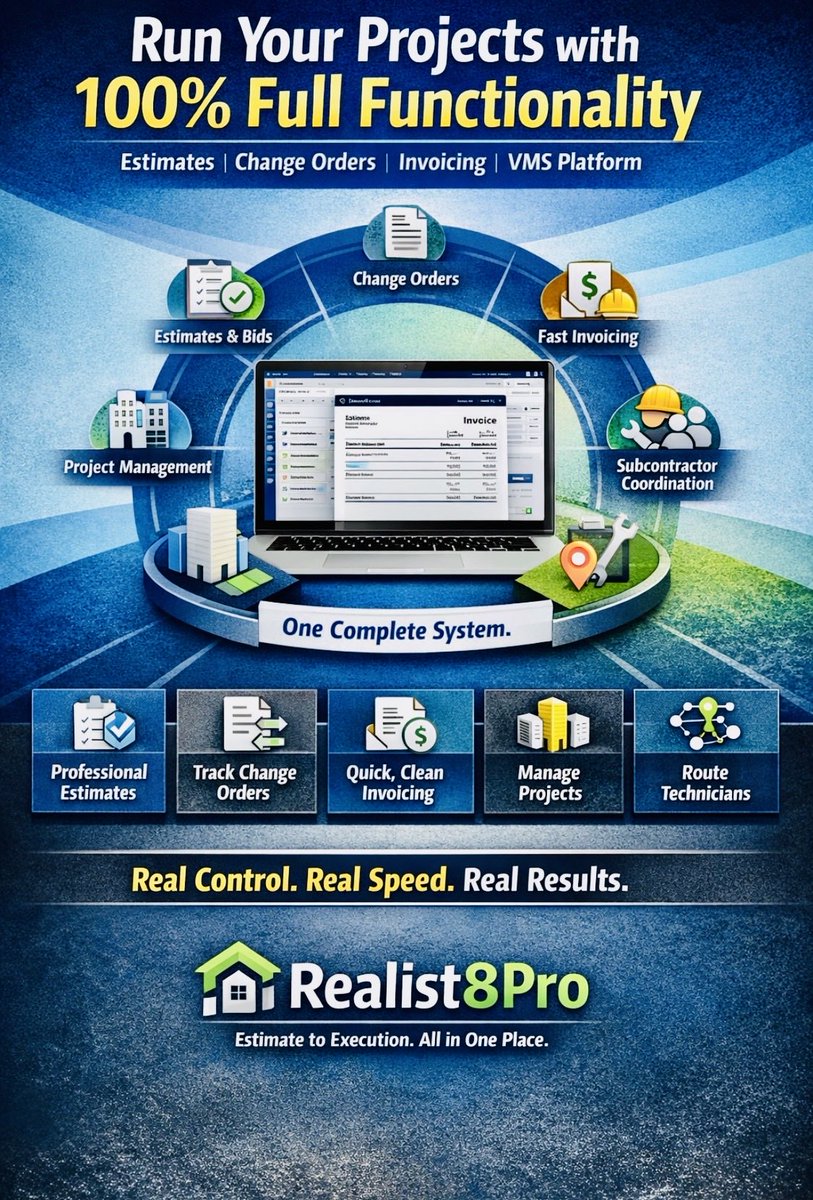
Most software platforms force companies to stitch together estimates, change orders, invoicing, vendor coordination, technician management, project communication, and reporting across multiple disconnected systems.
‘#Realist8Pro’ does it out of the box. ⭐️5 Years Running Field Construction Companies ⭐️
SERIOUSLY: Compare Platforms here Online ->👉🏻 lnkd.in/evjKfJ3u
From the first estimate to the final invoice, ‘#Realist8Pro’ gives your company a fully connected operational environment built to run real work in real time.
👉🏻With Realist8Pro.com
your team can:
✅ Create fast, professional estimates
✅ Generate and track change orders with precision
✅ Push invoicing forward quickly and cleanly
✅ Manage projects from one structured system
✅ Coordinate subcontractors with clarity and accountability
✅ Route technicians effectively in the field
✅ Maintain communications, statuses, files, and progress in one place
✅ Operate with a true VMS framework that supports full project execution
✅Every Project Has Linked-Simulcast From Every Employee-> Every Tech -> Every Subcontractor
✅Total Communications Network LaunchPad For SMS & eMail Instant Messaging
This is not stripped-down software.
This is not partial functionality.
This is not another platform that needs five add-ons just to become usable.
Realist8Pro delivers 100% full operational functionality for companies that need control, speed, accountability, and visibility across the entire service and project lifecycle.
If your current stack is slowing down estimates, creating invoicing bottlenecks, complicating change orders, or making vendor and technician management harder than it should be, it may be time to step into a platform that was built to actually run the business.
Realist8Pro helps companies work faster, communicate better, and manage projects the way professionals should.
#InvictusPro #Realist8Pro #ConstructionSoftware #FieldServiceManagement #ProjectManagement #ChangeOrders #EstimatingSoftware #InvoicingSoftware #VendorManagement #SubcontractorManagement #TechnicianManagement #WorkOrderManagement #OperationsManagement #PropertyOperations #BusinessSystems
15
Apr 21
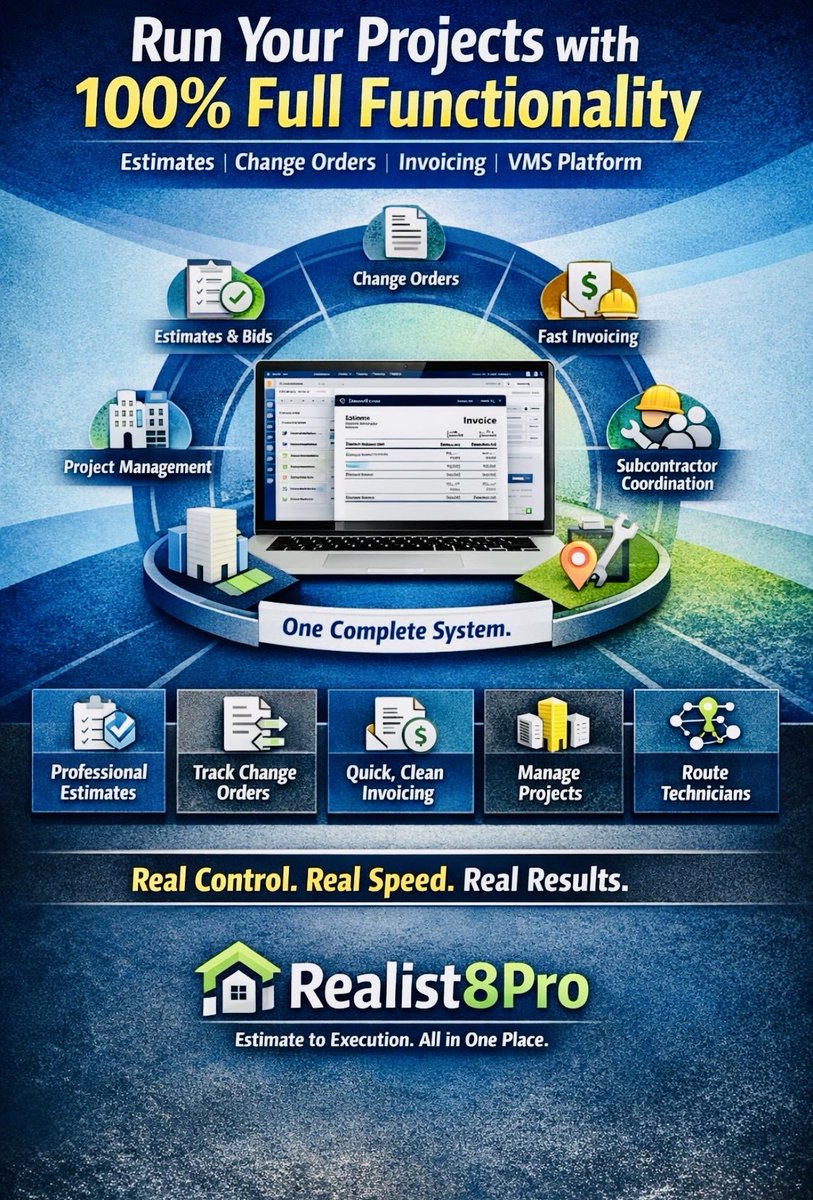
Most software platforms force companies to stitch together estimates, change orders, invoicing, vendor coordination, technician management, project communication, and reporting across multiple disconnected systems.
‘#Realist8Pro’ does it out of the box.
From the first estimate to the final invoice, ‘#Realist8Pro’ gives your company a fully connected operational environment built to run real work in real time.
👉🏻With Realist8Pro.com
your team can:
✅ Create fast, professional estimates
✅ Generate and track change orders with precision
✅ Push invoicing forward quickly and cleanly
✅ Manage projects from one structured system
✅ Coordinate subcontractors with clarity and accountability
✅ Route technicians effectively in the field
✅ Maintain communications, statuses, files, and progress in one place
✅ Operate with a true VMS framework that supports full project execution
✅Every Project Has Linked-Simulcast From Every Employee-> Every Tech -> Every Subcontractor
✅Total Communications Network LaunchPad For SMS & eMail Instant Messaging
This is not stripped-down software.
This is not partial functionality.
This is not another platform that needs five add-ons just to become usable.
Realist8Pro delivers 100% full operational functionality for companies that need control, speed, accountability, and visibility across the entire service and project lifecycle.
If your current stack is slowing down estimates, creating invoicing bottlenecks, complicating change orders, or making vendor and technician management harder than it should be, it may be time to step into a platform that was built to actually run the business.
Realist8Pro helps companies work faster, communicate better, and manage projects the way professionals should.
#InvictusPro #Realist8Pro #ConstructionSoftware #FieldServiceManagement #ProjectManagement #ChangeOrders #EstimatingSoftware #InvoicingSoftware #VendorManagement #SubcontractorManagement #TechnicianManagement #WorkOrderManagement #OperationsManagement #PropertyOperations #BusinessSystems
30
Apr 17
Are YOU A Realist? Do You Believe In People & Helping Them Get The Best Service & Possible Comfort? You May Actually Be A Realist Too. #InvictusPro iCore NGIN (Software•Engine) Created #Realist8Pro To Help People Run Their Businesses & Save Money • & In Today’s Market “Saving Money” Is A Wonderful Thing To Help People Do! | Realist8Pro.com
Made For Good People Who Run Businesses
Check Out Our Software Site At InvictusPro.co 👆🏻
17

Apr 17
Are YOU A Realist? Do You Believe In People & Helping Them Get The Best Service & Possible Comfort? You May Actually Be A Realist Too. #InvictusPro iCore NGIN (Software•Engine) Created #Realist8Pro To Help People Run Their Businesses & Save Money • & In Today’s Market “Saving Money” Is A Wonderful Thing To Help People Do! | Realist8Pro.com
Made For Good People Who Run Businesses
Check Out Our Software Site At InvictusPro.co 👆🏻
1
65
Apr 2
We built '#InvictusPro' iCore NGIN to operate your business model no matter the sectors or industries 💫
A complete operating system that turns your business model into a controlled, measurable, and scalable execution environment.
• Structure your business team workflow management processes
• Control actions across departments
• Track every action & workflow with full telemetry
• Convert time into real cost management
• Manage projects with complete revenue intelligence
• Operate as a true system of record
Full control. Full visibility. Full scalability.
One complete system.
If you’re an owner or decision maker—this is worth your time.
#BusinessOperations #EnterpriseSoftware #SaaS #Leadership #AI #DigitalTransformation #Scale
SEE DEMO invictuspro.co/request-demo/
👇 Watch the video
70
6 Dec 2025
Drive Your Sales Pipelines & Integrate Your Entire Company Workforce Into Workflows That Are Able To Track Your Operations For Optimal Performance
InvictusPro.co | 805-200-5304
Sales@InvictusPro.co
#$99/MoCRM #InvictusPro
13
6 Dec 2025
Drive Your Sales Pipelines & Integrate Your Entire Company Workforce Into Workflows That Are Able To Track Your Operations For Optimal Performance
InvictusPro.co | 805-200-5304
Sales@InvictusPro.co
#$99/MoCRM #InvictusPro
1
24
4 Dec 2025
We engineer proven methods that save time, reduce waste, and increase profit. | 30-DAY FREE TRIAL
realist8pro.com/en/
If You're Looking For Great Software At A Valuable Price Then You Need To Check Out The InvictusPro Software For Your Company.
#Construction #ConstructionJobs #PropertyManagement #WorkFromHome
25
27 Nov 2025
Most companies have no idea how inefficient their operations are — because they’ve never seen what enterprise software should look like.
InvictusPro iCore NGIN changes that.
Imagine one platform that runs your entire business:
✔ Sales intelligence
✔ Full VMS automated payments
✔ Accounting automations
✔ Admin-level oversight
✔ Vendor apps for every field role
✔ Dashboards for every user and tenant
✔ Built for InsureTech, PropTech, and operations-heavy industries
This is the PaaS infrastructure Fortune-100 companies expect — delivered at startup speed.
And it goes live next week.
This isn’t your daddy’s software.
This is next-generation enterprise tech built for winners.
📩 Sales@InvictusPro.co
🌐 InvictusPro.co
78
17 Oct 2025
#Realist8Pro #InvictusSoftware #InvictusPro #FieldServiceManagement #MortgageFieldServices #PropertyManagementSoftware #VendorManagementSystem #PropTech #ConstructionTech #BuiltOnBlockchain
$99/Mo & $29/User | sales@realist8pro.com | realist8pro.com/
1
12
16 Oct 2025
Want Software That Outperforms PPW, BUILDIUM, & Other MFS Software?
Get Our Enterprise Software Complete With Everything For Just
$99 A Month $29 A User (Our complete platform) At Your Service!
Realist8Pro.com | Enterprise Software That Is Unconquerable
#InvictusPro #Realist8PRO #FieldServiceSoftware
#MortgageFieldServices #PropertyPreservation #FieldServiceManagement
#PropertyManagementTech #REO #LoanServicing #ForeclosureRepairs
#ContractorNetwork #WorkOrderAutomation #VendorManagement
#MaintenanceCRM #SaaSforContractors
1
35
16 Oct 2025
Want Software That Outperforms PPW, BUILDIUM, & Other MFS Software?
Get Our Enterprise Software Complete With Everything For Just
$99 A Month $29 A User (Our complete platform) At Your Service!
Realist8Pro.com | Enterprise Software That Is Unconquerable
#InvictusPro #Realist8PRO #FieldServiceSoftware
#MortgageFieldServices #PropertyPreservation #FieldServiceManagement
#PropertyManagementTech #REO #LoanServicing #ForeclosureRepairs
#ContractorNetwork #WorkOrderAutomation #VendorManagement
#MaintenanceCRM #SaaSforContractors
22
15 Oct 2025
InvictusPro | Realist8Pro youtube.com/@invictus-crm?si… via @YouTube
Proud To Be The Spokesman For Invictus! | Realist8Pro.com
29