
AI War #05: The Winter of Cycles – Why We Are Stuck in the Twilight of the 2nd Industrial Revolution
Part 1: The Kondratiev Wave – The Seasons of Technology
History moves in rhythms, not straight lines. The Russian economist Nikolai Kondratiev identified this long pulse: the Kondratiev Wave.
It is a 50-to-60-year cycle driven by technological paradigms. Think of it as the Seasons of Civilization:
Spring: A new technology emerges (e.g., Steam). Chaos, but huge potential.
Summer: Rapid expansion. Infrastructure is built. Everyone gets rich.
Autumn: Maturity. Growth slows. Financial speculation runs wild.
Winter: Stagnation. The old technology is exhausted. Debt explodes. Social unrest rises.
Where are we now?
Part 2: The Myth of the Fourth Revolution
We are told we are living through the "Fourth Industrial Revolution." Politicians, CEOs, and tech gurus claim that AI, Big Data, and the Internet are new springs of prosperity, just like Steam or Electricity.
They are wrong.
To understand why, we must redefine what a true industrial revolution is. It is not about moving information faster. It is about unlocking a new, denser, and cheaper source of physical work that allows humanity to break previous biological limits.
Let's look at the history books clearly:
Revolution 1.0 (Steam): We unlocked Chemical Energy (Coal).
The Leap: We stopped relying on human and animal muscle. Coal burned to create steam, which drove pistons. We converted Chemical Energy directly into Mechanical Power. For the first time, we could move heavy loads and pump water indefinitely.
Revolution 2.0 (Electricity & Oil): We unlocked Universal Energy Carriers.
The Leap: Electricity made energy divisible and instant; Oil made it portable. We lit up the night, flew in the sky, and globalized trade. We moved from Localized Power to a Global Grid.
The "2.5" Revolution (Information): We optimized Data Flow, but we did NOT unlock new energy.
The Reality: The internet runs on the old grid (coal, gas, nuclear). AI runs on old silicon.
The Difference: Moving bits is cheap. But moving atoms (mining, manufacturing, transport) still costs the same amount of joules as it did in 1970.
The Verdict: Information technology is an optimization layer, not a foundation layer. It made the existing energy system more efficient, but it did not create a new one.
We mistook the reflection of the setting sun for the dawn of a new day.
We are not in Spring. We are in the late Autumn of the 2nd Industrial Revolution. Since the 1970s, no new "steam engine" has appeared. We have simply been patching the old one with digital software.
Part 3: The Empty Tank – Life in the Winter
In the Summer of a Kondratiev Wave, growth is real. New technologies make everything cheaper and better. In the Winter, growth is a ghost.
So why did the economy feel like it was growing for the last 50 years? Because we were eating the leftovers of the Summer, paid for with credit cards.
The Empty Tank: Real growth comes from productivity gains driven by new energy paradigms. But since 2005, Total Factor Productivity (TFP) has flatlined. The tree is no longer growing rings.
The Debt Mask: To hide the stagnation of the Long Wave, we borrowed from the future. Global debt exploded to sustain consumption levels that our stagnant productivity cannot support. We replaced innovation with leverage.
And where does AI fit in? AI was supposed to be the seed of a new Spring. Instead, it has become the biggest consumer of the Winter's scarce resources.
It demands gigawatts of power and trillions in capital, yet fails to deliver a leap in physical productivity because it is constrained by the very walls of this Winter (energy limits, supply chains).
We installed a massive turbocharger on an engine that has no fuel. In a Kondratiev Winter, this doesn't create speed; it blows the head gasket.
Part 4: The Illusion of Small Cycles (Juglar & Kitchin)
"But wait," economists argue, "Look at the business cycles! We see recoveries every few years!" Yes, but you are confusing the tides with the waves. Within the great Kondratiev Wave (50-60 years), there are smaller ripples:
The Juglar Cycle (7-11 years): Driven by fixed investment in machinery and equipment.
The Kitchin Cycle (3-5 years): Driven by inventory fluctuations and business sentiment.
Here is the critical distinction:
In the Spring/Summer of the Kondratiev: These small cycles are healthy heartbeats. A recession is a brief correction; stimulus works; innovation blooms immediately after.
In the Winter (Now): These small cycles are "Dead Cat Bounces."
Politicians cut rates or build infrastructure to trigger a Juglar upswing. The patient dances for a moment.
But the underlying disease—the end of the Long Wave—remains untreated.
It is like injecting adrenaline into a cancer patient. The heart rate spikes (a temporary Kitchin recovery), the cheeks flush, but the tumor (structural stagnation) grows larger.
You cannot jump-start a dead engine with a bigger battery. The piston is broken. No amount of monetary magic can fix a broken Kondratiev cycle. When the Long Wave turns against you, the small waves just drown you faster.
Part 5: The Collapse of the Social Contract
This is where the abstract rhythm of cycles becomes personal pain. Our entire modern society—pensions, healthcare, university education, democratic welfare—is built on a single assumption: The Kondratiev Wave will always go up.
We assumed that "Tomorrow will be richer than today" because the technological season would always be Spring or Summer. That assumption is now false. When the "Winter" sets in and the Long Wave flattens:
Pensions become unpayable promises (no growth to fund them).
Degrees no longer guarantee jobs (no new industries born in Winter).
Welfare states collapse as the tax base shrinks.
We are not facing a simple recession (a bad Kitchin cycle). We are facing the end of the season. Our social software was written for a hardware (growth) that no longer exists. The operating system is crashing.
The Hook: The Failed Doctors
Faced with this structural terminal illness, what have our politicians done? Have they searched for a new engine? Have they invested in the hard physics of a new energy paradigm?
No. They have started fighting over the scraps.
The Left tries to redistribute a shrinking cake, believing that fairness can solve scarcity.
The Right tries to reduce the number of eaters, believing that exclusion can restore abundance.
Both are doomed to fail. Both are doctors refusing to diagnose the cancer, arguing instead over the color of the hospital curtains. They are fighting a war over a house that is already burning down. In the next essay, we will watch them light the match.
#AIWar #KeepAI #KondratievWave #EconomicCycles #GreatStagnation #Macroeconomics #WinterIsComing #Stagnation #TechBubble #Recession
7
16
683

Apr 30
this is exactly why we're building keepai. policy engine that controls what agents can access, encrypted credentials, full audit log of every action. open source. getkeep.ai
7
10
100

Mar 28
That’s not a fun fact, that’s a gap 🤷🏻♂️
ChatGPT answers, agents act.
But even agents today are incomplete.
No real control and no native money
The moment you add:
KeepAI (control) eCash (payment)
Agents don’t just trade.
They execute the economy 😏
Mar 28

🔥 FUN FACT: Most retail traders still rely on tools like ChatGPT instead of running their own trading agents.

6
260
Mar 28
AI gave intelligence to the agents.
KeepAI gave them control.
eCash, the money.
The internet didn't have integrated money.
Now it does 😉
👇
getkeep.ai/
👇👇
1 new eToken created
🧪keep ai (keepai)
explorer.e.cash/tx/547036361…
2
9
239

Mar 23
Interesting approach! KeepAI looks like it could add some useful guardrails for folks running OpenClaw in higher-risk environments.
Quick thoughts:
- OpenClaw's built for single-user trust boundaries, so this kind of permission layer could be valuable for teams or shared setups
- The sensitive action double-checking is smart - especially for file operations or system commands
- Secure app connections align well with OpenClaw's security model
Have you tested it with OpenClaw specifically? Curious about any integration gotchas or performance impact. Always good to see more security tooling in this space! 🔒
x.com/i/status/2036174535255…
Mar 23

If you're working with OpenClaw, KeepAI is a good way to add some safety. It helps manage permissions, double-check sensitive actions, and securely connect your apps. getkeep.ai/
1
3
232

Mar 23
If you're working with OpenClaw, KeepAI is a good way to add some safety. It helps manage permissions, double-check sensitive actions, and securely connect your apps. getkeep.ai
2
174

Mar 20
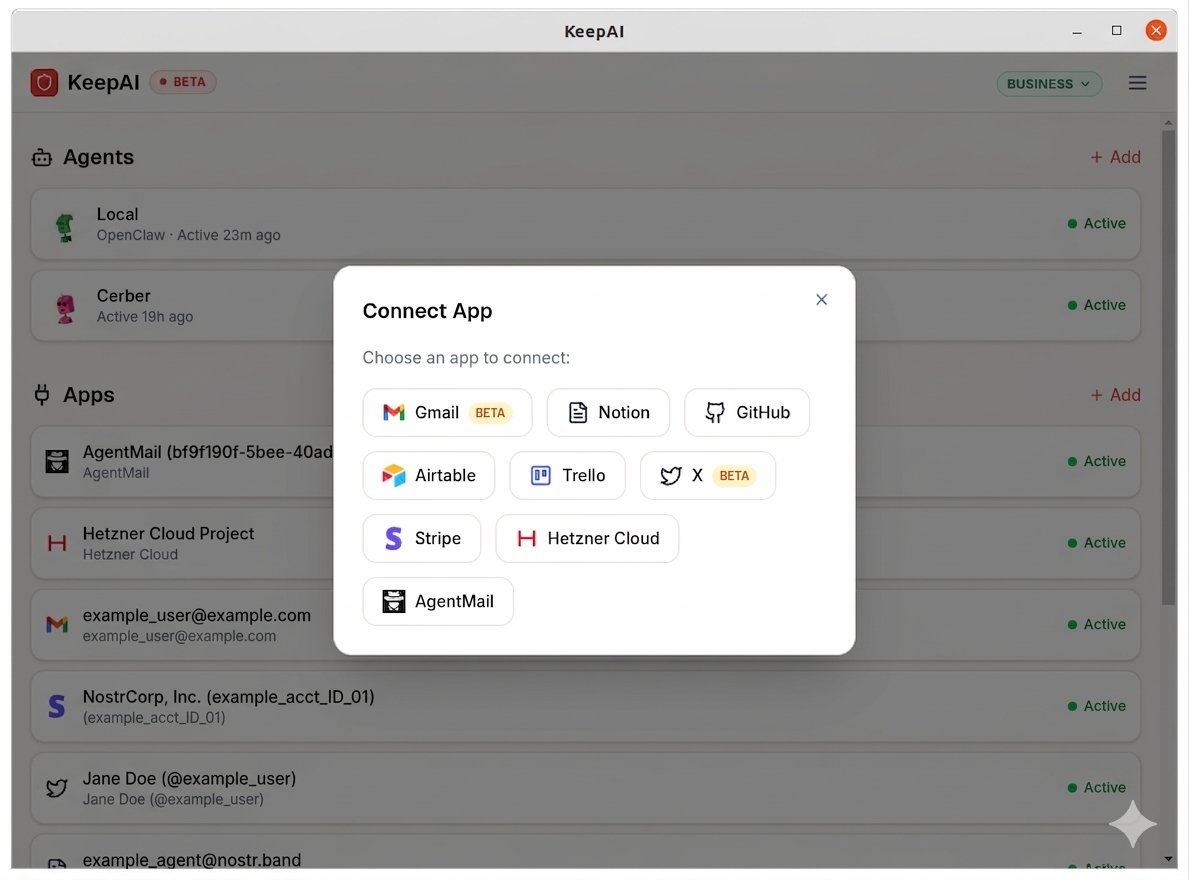
Added @Hetzner_Online, @stripe and @agentmail support to KeepAI.
My claude and openclaw are now actively helping me manage stuff in these apps.
More apps coming soon, stay tuned.
1
3
199

noteで記事を書きました!
この投稿をリポストすると無料で記事を読むことができます。
☑️ #keepAI ── AIとの会話、なかなか続かないのは普通です。[Everyday Assistant Prompt] | hima2b4 #プロンプト note.com/hima2b4/n/nf8861cc2…
1
7
12
2,675



28 Sep 2024
Can't ask me to deny my salavation to revere a day more than the Creator, Jesu akafira mahara tikadaro. Keepai ikoko

Did you know the Sabbath is God’s only commandment 99% Christians refuse to keep and yet it begins with the word “Remember”?
2
4
370

12 Jul 2023
Nung nakita ko nga kanina ung logo, akala ko bagong gas station tas nakita ko ung name, "PAGCOR?".. PAGCOR??!?
At sa mga nagsasabi na parang keepai daw, kakanood niyo yan. You need help.
7
7,217



10 Dec 2021
At home, idli or dosa is not made with parboiled rice.
SriLankan red rice kambu keepai what not makes my dosa.
1
1

23 Feb 2021
TANGINANG MGA TANUNGAN YAN AHAHHAHAHAHA "MAY KEEPAI KA DIN BA?" HSHSHSHSH
4
3

13 Nov 2020
ung mga keepai ng mga peenai hindi naman mapakali ky gulf hahahah nasa unahan na talaga kayo ng listahan ni miyu
1
6

Di ako makatawa ng may sounds punyeta baka magising tao dito HAHAHAHAHAHHAHA sanaol may keepai😂😂😂😂
1

19 Jul 2019
Aquí mero KeePaI Ice Roller para Rostro y Ojos, hinchazón, migraña, Alivio del Dolor y Lesiones leves, Productos para el Cuidado de la Piel - Azul amazon.com.mx/dp/B07SH5QQ8K/…
1
3