
27 May 2025
Unfolding AlphaFold’s Bayesian Roots in Probability Kinematics
1.This theoretical paper reinterprets AlphaFold1 (AF1)’s potential energy function as an instance of probability kinematics (PK), a principled Bayesian update mechanism for incorporating uncertain evidence—offering a rigorous alternative to its original justification via physical potentials of mean force (PMFs).
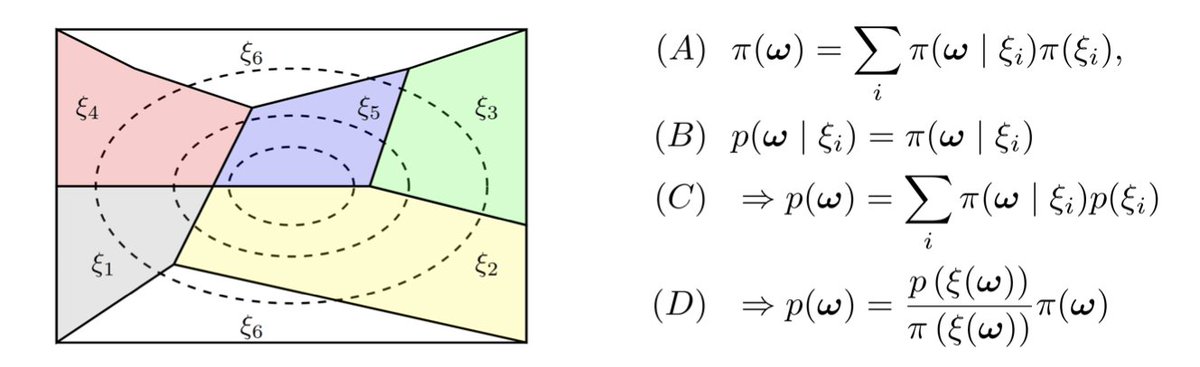
2.Unlike AlphaFold2 and AlphaFold3, AF1 minimizes a learned potential function parameterized over dihedral angles and pairwise distances. The authors argue this potential should not be seen as thermodynamic but as the result of a generalized Bayesian update using PK.
3.PK—also known as Jeffrey conditioning—updates a prior distribution based on revised probabilities over a partition, without conditioning on a specific observed event. It allows AF1’s prior over angles to be updated by "soft" evidence from deep-learning-predicted distance distributions.
4.The paper constructs a probabilistic framework tailored to AF1, showing how its three main potential terms (dihedral, distance, and reference potentials) fit into the PK update formula. The final AF1 potential corresponds to a maximum a posteriori (MAP) estimate under this model.
5.Unlike PMFs derived from Boltzmann distributions over physical systems, AF1's potential reflects updates of empirical priors based on distance evidence. The paper demonstrates that PK justifies knowledge-based potentials (KBPs) and that AF1’s form is a compositional Bayesian update.
6.The authors derive a formal PK update equation suitable for infinite partitions and continuous variables (e.g., distributions over protein dihedral angles and distances), and show how this framework allows principled probabilistic modeling of biomolecular structure.
7.To illustrate PK in a controlled setting, they introduce a synthetic 2D model where a von Mises angular prior (analogous to AF1's dihedral angle prior) is updated with evidence on Euclidean distances, achieving precise posterior recovery validated via hypothesis testing.
8.The synthetic experiment shows that omitting the PK reference term leads to poor posterior estimates, reinforcing the theoretical necessity of the reference distribution—a key aspect missing from naïve knowledge-based or PMF analogies.
9.The authors empirically confirm the validity of the J-condition (p(angles|distances) ≈ π(angles|distances)) using AF1-generated samples, justifying the use of PK to update local priors without retraining or redefining likelihoods.
10.This reinterpretation highlights AF1 as an early example of a compositional probabilistic deep learning model, where empirical Bayes priors are refined with learned evidence—a strategy with broad potential for future structural biology models.
11.The paper suggests that PK can serve as a foundation for combining simple probabilistic components (e.g., priors on angles, distances, and energies) into deep models, offering a path toward interpretable and generalizable generative frameworks in computational biology.
12.More broadly, the authors call for revisiting foundational assumptions in structural bioinformatics and view AF1’s success as evidence of the power of principled Bayesian updates even in high-dimensional deep learning systems.
📜Paper: arxiv.org/abs/2505.19763
#AlphaFold #BayesianLearning #ProteinFolding #ProbabilityKinematics #AF1 #GenerativeBiology #DeepLearning #CompositionalModels #StructuralBioinformatics #KnowledgeBasedPotentials
3
19
1,287
27 May 2025
Unfolding AlphaFold’s Bayesian Roots in Probability Kinematics
1.This theoretical paper reinterprets AlphaFold1 (AF1)’s potential energy function as an instance of probability kinematics (PK), a principled Bayesian update mechanism for incorporating uncertain evidence—offering a rigorous alternative to its original justification via physical potentials of mean force (PMFs).
2.Unlike AlphaFold2 and AlphaFold3, AF1 minimizes a learned potential function parameterized over dihedral angles and pairwise distances. The authors argue this potential should not be seen as thermodynamic but as the result of a generalized Bayesian update using PK.
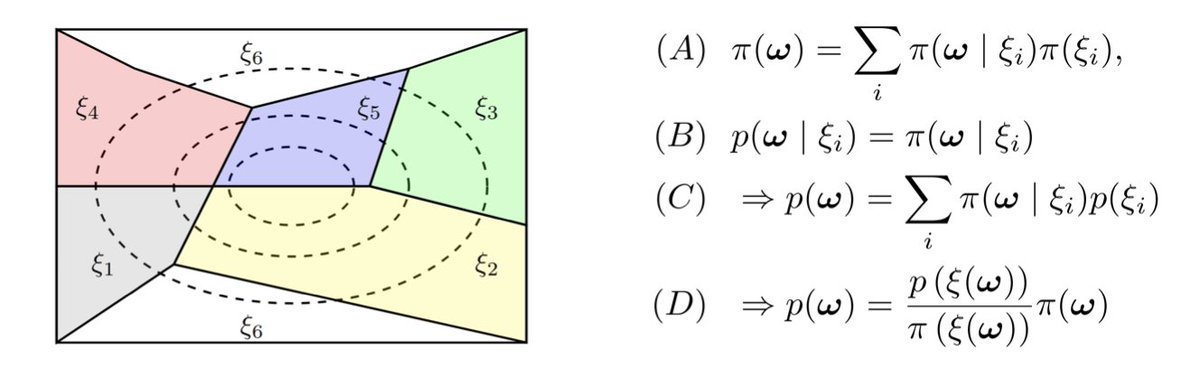
3.PK—also known as Jeffrey conditioning—updates a prior distribution based on revised probabilities over a partition, without conditioning on a specific observed event. It allows AF1’s prior over angles to be updated by "soft" evidence from deep-learning-predicted distance distributions.
4.The paper constructs a probabilistic framework tailored to AF1, showing how its three main potential terms (dihedral, distance, and reference potentials) fit into the PK update formula. The final AF1 potential corresponds to a maximum a posteriori (MAP) estimate under this model.
5.Unlike PMFs derived from Boltzmann distributions over physical systems, AF1's potential reflects updates of empirical priors based on distance evidence. The paper demonstrates that PK justifies knowledge-based potentials (KBPs) and that AF1’s form is a compositional Bayesian update.
6.The authors derive a formal PK update equation suitable for infinite partitions and continuous variables (e.g., distributions over protein dihedral angles and distances), and show how this framework allows principled probabilistic modeling of biomolecular structure.
7.To illustrate PK in a controlled setting, they introduce a synthetic 2D model where a von Mises angular prior (analogous to AF1's dihedral angle prior) is updated with evidence on Euclidean distances, achieving precise posterior recovery validated via hypothesis testing.
8.The synthetic experiment shows that omitting the PK reference term leads to poor posterior estimates, reinforcing the theoretical necessity of the reference distribution—a key aspect missing from naïve knowledge-based or PMF analogies.
9.The authors empirically confirm the validity of the J-condition (p(angles|distances) ≈ π(angles|distances)) using AF1-generated samples, justifying the use of PK to update local priors without retraining or redefining likelihoods.
10.This reinterpretation highlights AF1 as an early example of a compositional probabilistic deep learning model, where empirical Bayes priors are refined with learned evidence—a strategy with broad potential for future structural biology models.
11.The paper suggests that PK can serve as a foundation for combining simple probabilistic components (e.g., priors on angles, distances, and energies) into deep models, offering a path toward interpretable and generalizable generative frameworks in computational biology.
12.More broadly, the authors call for revisiting foundational assumptions in structural bioinformatics and view AF1’s success as evidence of the power of principled Bayesian updates even in high-dimensional deep learning systems.
📜Paper:
arxiv.org/abs/2505.19763
#AlphaFold #BayesianLearning #ProteinFolding #ProbabilityKinematics #AF1 #GenerativeBiology #DeepLearning #CompositionalModels #StructuralBioinformatics #KnowledgeBasedPotentials
1
3
6
1,761