
Most knowledge graphs force the world into pairs. Reality doesn't cooperate.
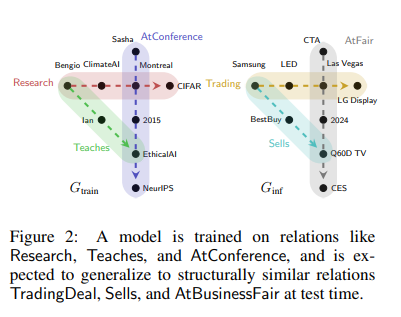
A standard knowledge graph stores facts as triples: (subject, relation, object). Two entities, one relation. But consider: "Bengio has a research project on ClimateAI in Montreal funded by CIFAR."
That's four participants in distinct roles. Forcing it into binary triples means splitting one atomic fact into several, losing the structure that made it meaningful. Knowledge hypergraphs solve this: a single hyperedge can connect any number of entities, each in a specific positional role.
The next problem: how do you build a model that reasons over hypergraphs it has never seen before, with entity types and relation types it has never encountered? That's inductive link prediction.
Inductive link prediction is what separates a model that can only work with graphs it was trained on from one that generalises to new graphs, new entities, new relations, straight out of the box. For any system where the graph keeps growing - new drugs, new companies, new events - this capability matters.
HYPER is the first foundation model to deliver both, natively, on knowledge hypergraphs.
The core idea: learn properties of relations that transfer across relation types of varying arity. A model trained on Research, Teaches, and AtConference should recognise structural analogues like Trading, Sells, and AtFair at inference time, even with entirely new entities and relation labels.
HYPER does this by encoding each entity together with its positional role within the hyperedge, and building a relation graph that captures how relations interact with one another.
What stands out:
* One pretrained checkpoint. Zero-shot generalisation to unseen entities AND unseen relations across arbitrary hypergraphs.
* No reification. Hyperedges stay native; no conversion to binary triples that strips away role information.
* Trained on just 2 hypergraphs and 3 KGs, HYPER consistently outperforms ULTRA trained on 50 KGs. Structural diversity beats volume.
* 16 new inductive benchmarks released alongside the model.
For those building KG systems in healthcare, science, or public administration - domains where facts naturally have more than two participants - this closes a real gap between academic research and production reality.
Trade-off worth noting: positional interactions scale quadratically with arity, so very high-arity edges still need care.
By Xingyue Huang, Mikhail Galkin, Michael Bronstein, İsmail İlkan Ceylan. H/T Giuseppe Futia
HYPER: A Foundation Model for Inductive Link Prediction with Knowledge Hypergraphs arxiv.org/abs/2506.12362
#KnowledgeHypergraphs #LinkPrediction #InductiveLearning #ICLR2026 #GraphML
--
📩 The Year of the Graph Spring 2026 newsletter issue is out!
Beyond Context Graphs: How Ontology, Semantics, and Knowledge Graphs Define Context 👇
yearofthegraph.xyz/newslette…
All things #KnowledgeGraph, #GraphDB, Graph #Analytics / #DataScience / #AI and #SemTech.
Subscribe and follow to be in the know. Reach out if you'd like to be featured
1
4
38
2,237