
May 26
This is where the singularity comes in. Kubernetes plays a key role here.
Redhat Ecosystem
This is the BioDigital Convergence Platform !!!!!!
Connects Physical to Digital & Quantum.
This Sensor is the one that computes the Human through Human-Centered Computing.
nsf.gov/funding/opportunitie…
Human Brain Computing
Neuromorphic Computing Systems inspired by the Human Brain
ibm.com/think/topics/neuromo…
It computes it through Software-Defined Radios. Its then managed by tbe GoBot which communicates with the hardware.
They emulate hardware then synchronize the signals with the Graphene Oxide (GO).
nature.com/articles/am201136
This allows them to remotely trigger the nanonodes using Radio Frequencies which then in turn triggers the Graphene Oxide.
This then gets analyzed by the Software-Defined-Radio & Data gets routed to various devices & locations.
They use the Gobot to connect the Data to Physical Hardware via Emulation.
Gobot has an extensible system for connecting to "Hardware Devices".
gobot.io/documentation/platf…
Remember the word usage "Hardware Devices"
Hardware Implementations include the TrueNorth Chip from IBM,
open-neuromorphic.org/blog/t…
Intel's Loihi & Loihi 2 Chips
intel.com/content/www/us/en/…
& the BrainScaleS & SpiNNaker Machines
brainscales.kip.uni-heidelbe…
developed by the Human Brain Project.
humanbrainproject.eu/en/scie…
Gobot Hardware Integrations
1) Gobot BLE Adaptor (Bluetooth)
The Gobot BLE adaptor makes it easy to interact with Bluetooth LE aka Bluetooth 4.0 using Go.
gobot.io/documentation/platf…
2) Microbit (Plandemic Infected)
The Microbit is a tiny computer with built-in Bluetooth LE aka Bluetooth 4.0.
gobot.io/documentation/platf…
3) MQTT (Connection Protocol)
MQTT is an Internet of Things connectivity protocol featuring a lightweight publish/subscribe messaging transport. It is useful for its small code footprint and minimal network bandwidth usage.
gobot.io/documentation/platf…
4) NATS
NATS is a lightweight messaging protocol perfect for your IoT/Robotics projects.
It operates over TCP, offers a great number of features but an incredibly simple Pub Sub style model of communicating broadcast messages. NATS is blazingly fast as it is written in Go.
This repository contains the Gobot adaptor/drivers to connect to NATS servers.
gobot.io/documentation/platf…
It uses the NATS Go Client.
The NATS project is maintained by Nats.io and sponsored by Apcera.
Redhat Ecosystem
1) eBPF Sensor
The Noname Security Sensor is a lightweight eBPF-based component operating at the host level that captures traffic in real-time and passes it through to an engine for analysis.
catalog.redhat.com/en/softwa…
What do eBPF and BPF stand for?
ebpf.io/what-is-ebpf/#what-d…
BPF originally stood for Berkeley Packet Filter, but now that eBPF (extended BPF) can do so much more than packet filtering, the acronym no longer makes sense.
eBPF is now considered a standalone term that doesn’t stand for anything. In the Linux source code, the term BPF persists, and in tooling and in documentation, the terms BPF and eBPF are generally used interchangeably.
ebpf.io/what-is-ebpf/
The original BPF is sometimes referred to as cBPF (classic BPF) to distinguish it from eBPF.
Microsoft
Use eBPF-based sensor for Microsoft Defender for Endpoint on Linux
learn.microsoft.com/en-us/de…
eBPF Sensor is shipped to the client aka you via Go
2) Isovalent
A. Isovalent Enterprise for Cilium
eBPF-Powered Networking, Observability & Security
B. Isovalent Networking for Kubernetes
catalog.redhat.com/en/softwa…
Built on Cilium, provides eBPF-based scalable
3) Lightbits
Lightbits Labs CSI Driver Operator
catalog.redhat.com/en/softwa…
The Lightbits Labs Operator manages the Lightbits CSI driver and connectivity to Lightbits clusters.
Lightbits Labs
Next-Gen Software-Defined Storage Engineered for
High-Performance Workloads
lightbitslabs.com/
7
10
602

May 18
Meet Lightbits v3.19.1—the game-changer for large-scale cluster management!
Read the full release announcement here👉 lightbitslabs.com/blog/light…
#OpenStack #CloudStorage #NVMeTCP #Lightbits
1
56

Apr 14
Congrats to @LightbitsLabs for being recognized in @CRN’s #Storage100 list for 2026! 🎉 Lightbits was recognized for the #StorageDefined Software category. Check out the full list of winners below.
Apr 13

CRN, a brand of The Channel Company, has included Lightbits Labs on its prestigious annual Storage 100 list 🏆in the Storage-Defined Software category.
ow.ly/2tJm50YhRIi
#Storage100 #StorageDefinedSoftware #TheChannelCompany #CRNStorage #TechAwards
1
7
300
Apr 7
This is the BioDigital Convergence Platform !!!!!!
Connects Physical to Digital & Quantum.
This Sensor is the one that computes the Human through Human-Centered Computing.
nsf.gov/funding/opportunitie…
Human Brain Computing
Neuromorphic Computing Systems inspired by the Human Brain
ibm.com/think/topics/neuromo…
It computes it through Software-Defined Radios. Its then managed by tbe GoBot which communicates with the hardware.
They emulate hardware then synchronize the signals with the Graphene Oxide (GO).
This allows them to remotely trigger the nanonodes using Radio Frequencies which then in turn triggers the Graphene Oxide.
This then gets analyzed by the Software-Defined-Radio & Data gets routed to various devices & locations.
They use the Gobot to connect the Data to Physical Hardware via Emulation.
Gobot has an extensible system for connecting to "Hardware Devices".
gobot.io/documentation/platf…
Remember the word usage "Hardware Devices"
Hardware Implementations include the TrueNorth Chip from IBM (open-neuromorphic.org/blog/t…), Intel's Loihi & Loihi 2 Chips (intel.com/content/www/us/en/…) & the BrainScaleS (brainscales.kip.uni-heidelbe…) & SpiNNaker Machines (spinnaker.io/) developed by the Human Brain Project.
humanbrainproject.eu/en/scie…
Gobot Hardware Integrations
1) Gobot BLE Adaptor
The Gobot BLE adaptor makes it easy to interact with Bluetooth LE aka Bluetooth 4.0 using Go.
gobot.io/documentation/platf…
2) Microbit (Plandemic Infected)
The Microbit is a tiny computer with built-in Bluetooth LE aka Bluetooth 4.0.
gobot.io/documentation/platf…
3) MQTT (Connection Protocol)
MQTT is an Internet of Things connectivity protocol featuring a lightweight publish/subscribe messaging transport. It is useful for its small code footprint and minimal network bandwidth usage.
gobot.io/documentation/platf…
4) NATS
NATS is a lightweight messaging protocol perfect for your IoT/Robotics projects.
It operates over TCP, offers a great number of features but an incredibly simple Pub Sub style model of communicating broadcast messages. NATS is blazingly fast as it is written in Go.
This repository contains the Gobot adaptor/drivers to connect to NATS servers.
It uses the NATS Go Client.
gobot.io/documentation/platf…
The NATS project is maintained by Nats.io and sponsored by Apcera.
THE SENSOR !!!!!!
Redhat Ecosystem
1) eBPF Sensor
The Noname Security Sensor is a lightweight eBPF-based component operating at the host level that captures traffic in real-time and passes it through to an engine for analysis.
What do eBPF and BPF stand for?
BPF originally stood for Berkeley Packet Filter, but now that eBPF (extended BPF) can do so much more than packet filtering, the acronym no longer makes sense.
catalog.redhat.com/en/softwa…
eBPF is now considered a standalone term that doesn’t stand for anything. In the Linux source code, the term BPF persists, and in tooling and in documentation, the terms BPF and eBPF are generally used interchangeably.
ebpf.io/what-is-ebpf/#what-d…
The original BPF is sometimes referred to as cBPF (classic BPF) to distinguish it from eBPF
ebpf.io/what-is-ebpf/
Microsoft
Use eBPF-based sensor for Microsoft Defender for Endpoint on Linux
learn.microsoft.com/en-us/de…
eBPF Sensor is shipped to the client aka you via Go
youtu.be/lijS-0da5U8?si=DyAp…
2) Isovalent
A. Isovalent Enterprise for Cilium
eBPF-Powered Networking, Observability & Security
catalog.redhat.com/en/softwa…
B. Isovalent Networking for Kubernetes
Built on Cilium, provides eBPF-based scalable
catalog.redhat.com/en/softwa…
3) LIGHTBITS
Lightbits Labs CSI Driver Operator
The Lightbits Labs Operator manages the Lightbits CSI driver and connectivity to Lightbits clusters.
Lightbits Labs
Next-Gen Software-Defined Storage Engineered for
High-Performance Workloads
catalog.redhat.com/en/softwa…
Lightbits disaggregated, SOFTWARE-DEFINED BLOCK STORAGE tailor to your infrastructure to support data-intensive, demanding workloads, like AI/Machine Learning.
lightbitslabs.com/
2
12
13
834

Mar 16
Day 0 Pre-game special @theCube broadcast 6 panels 20 experts.
The Compute Imperative: Pioneers of NextGen Data Center Infrastructure
- Alexis Crowell, CMO & President - Axelera AI
- Niklas Leck, CEO - Penguin Group
- Tom Traugott, SVP Infrastructure - Edgecore Digital Infrastructure
- Jason Hoffman, Chief Strategy Officer - Switch
- Michael Jeter, Head of Sales - Global AI
Feeding the Factory: Storage at the Heart of AI
- Alex Bouzari, CEO - DDN
- Hao Zhong, CEO - ScaleFlux
- Avi Shetty, Partnerships - Solidigm
- Kam Eshghi, Co-Founder & CTO - Lightbits
Autonomous by Design: The Age of Self-Directed AI
- Mika Saryan, VP of Software - Formic
- Jewel Li, Co-Founder & COO - Tensor Auto
The Inference Engine: Building AI That Performs at Scale
- Sid Sheth, CEO - d-Matrix
- Mitesh Agrawal, CEO - Positron
- Sam Awrabi, Founder & GP - Banyan Ventures
- Felix Ejeckam, CEO - Akash Systems
Quantum Leap: The Next Frontier of AI Computing
- Pranav Gokhale, CTO - Infleqtion
- Adam Lewis, Head of Innovation, AISim - SandboxAQ
- Anuj Jaiswal, CPO & GTM - Fortanix
- Amit Sinha, CEO - Digicert
The Token Deficit: Why AI Agents Demand Gigawatt-Scale Infrastructure
- Erwan Menard, SVP Engineering - Crusoe
Mar 15

Great being here in @theCUBE studio in Palo Alto, today for pre-GTC event on next generation AI factories.
@furrier @dvellante @GemmaAllenSays @theCUBEresearch @SiliconANGLE
#NextGenDataCenters #AIFactory #AIInfrastructure #DataCenters #Compute #SiliconValley #DeepTech #NYSEWired #FutureOfAI #NYSEWired #theCUBE #GTC #GTC26

1
6
498
Mar 15
We are hosting a special Sunday edition of theCUBE in studio GTC preview live stream of 6 panels of experts.
Panel: The Compute Imperative: Pioneers of NextGen Data Center Infrastructure
Kevin Cochrane, CMO - Vultr
Alexis Crowell, CMO & President - Axelera AI
Niklas Leck, CEO - Penguin Group
Tom Traugott, SVP Infrastructure - Edgecore Digital Infrastructure
Jason Hoffman, Chief Strategy Officer - Switch
Panel: Feeding the Factory: Storage at the Heart of AI
Alex Bouzari, CEO - DDN
Hao Zhong, CEO - ScaleFlux
Xin Guo, CEO - Solidigm
Kam Eshghi, Co-Founder & CTO - Lightbits
Panel: Autonomous by Design: The Age of Self-Directed AI
David Rodriguez, Co-Founder - Robots.com
Jewel Li, Co-Founder & COO - Tensor Auto
Gautam Narang, CEO - Gatik
Adam Bry, CEO - Skydio
Panel: The Inference Engine: Building AI That Performs at Scale
Sid Sheth, CEO - d-Matix
Mitesh Agrawal, CEO - Positron
Sam Awrabi, Founder & GP - Banyan Ventures
Felix Ejeckam, CEO - Akash Systems
Panel: Quantum Leap: The Next Frontier of AI Computing
Jack Hidary, CEO - SandboxAQ
Pranav Gokhale, CTO - Infleqtion
Panel: The Token Deficit: Why AI Agents Demand Gigawatt-Scale Infrastructure
Chase Lochmiller, CEO - Crusoe
Erwan Menard, SVP Engineering - Crusoe
thecube.net/events/nyse/ai-f…
2
338
Mar 13
In a collaboration with @ScaleFlux and #FarmGPU, @LightbitsLabs announced the debut of a collaborative architecture designed to optimize the #KVCache and reduce latency using Lightbits’ #LightInferra model. Read more below.
Mar 11
#ScaleFlux, #FarmGPU, and Lightbits debut a collaborative architecture at #NVIDIAGTC to optimize storage for #KVCache. Reduce GPU stalls and improve inference throughput. Visit booth 7006 to view live demonstrations. 👉 lightbitslabs.com/press-rele…
#AIInference #LongContextAI
2
5
306
Mar 10
Lightbits SSD Journaling protects your "in-flight" data without specialized hardware.
* Persistent Protection
* Hardware Flexibility
* Scalable
Available now in Lightbits v3.17.1!
Read more 👉 ow.ly/vE6t50XQJ3W
#NVMe #DataIntegrity #DataStorage
1
2
39

Mar 10
Storage news ticker – March 9 with Commvault, Datadog, Hammerspace, Intelligent Memory, Lightbits Labs, OWC and Macbook Neo, Scality, Sandisk, SK Hynix, Teradata & Weebit Nano - blocksandfiles.com/block/202…
1
2
512
18 Dec 2025
At @NYSE Wired’s #AIFactories, @LightbitsLabs founder and CEO Eran Kirzner joined @siliconANGLE’s @furrier to discuss how Lightbits Labs is leveraging #NVMe to transform commodity hardware into high-performance, cloud-native, #scalable storage systems. Check the full interview below.
13 Dec 2025
The podcast is officially LIVE! 🚀
Our CEO and Co-founder, Eran Kirzner, stepped onto the floor of the NYSE to join John Furrier of SiliconANGLE & theCUBE on the NYSE Wired podcast!
Watch/Listen Now: youtu.be/0r-TcZWychE?si=YOvo…
#NYSEWired #SiliconAngle #ITInfrastructure #NVMeTCP
2
6
431
7 Nov 2025
We're thrilled to welcome Pete Kapusta to the Lightbits Labs team! 🎉
Connect with Pete here 👉 ow.ly/25ga50XnlQR
#Lightbits #NVMe #ITInfrastructure

1
1
3
89
31 Oct 2025
The section that refers to Light. Here's how they will send data.
Lightbits
Lightbits Labs CSI Driver Operator
The Lightbits Labs Operator manages the Lightbits CSI driver & connectivity to Lightbits clusters.
Lightbits Labs
Next-Gen Software-Defined Storage Engineered for
High-Performance Workloads
lightbitslabs.com/
Lightbits disaggregated, software-defined block storage offers flexibility to modernize and tailor your infrastructure to support data-intensive, demanding workloads, like AI/Machine Learning.
Natively designed with NVMe over TCP, Lightbits software delivers unmatched price/performance value and powers any application in Kubernetes, OpenStack, OpenShift, KVM, and other platforms.
catalog.redhat.com/en/softwa…
1
2
36

12 Oct 2025
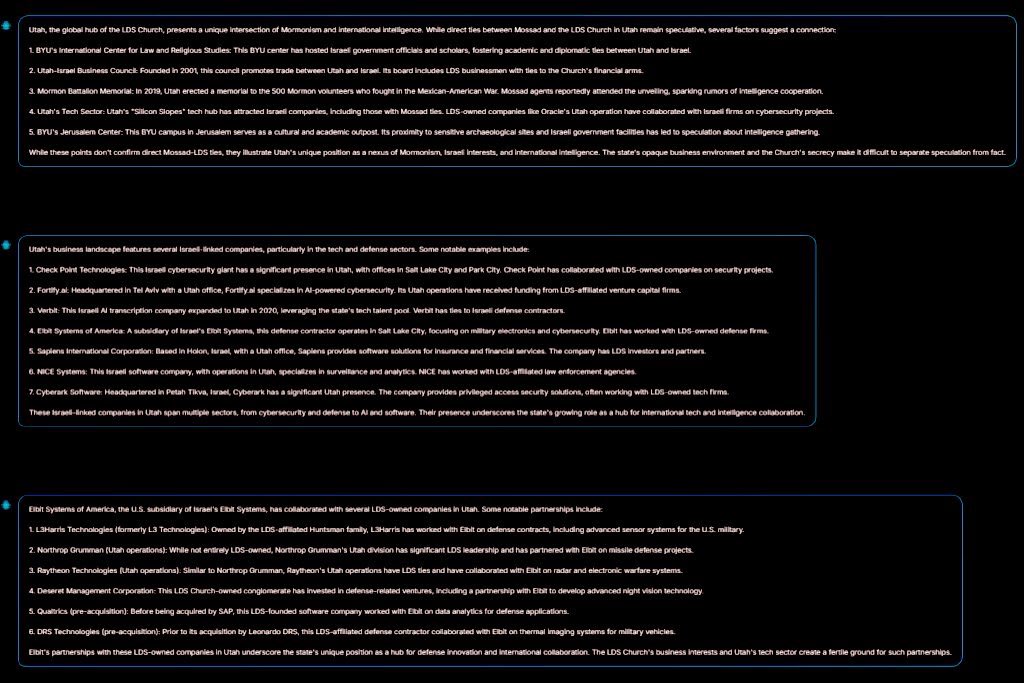
Several LDS-affiliated venture capital firms have invested in Israeli companies, particularly in the tech and cybersecurity sectors. Some notable examples include:
1. Peterson Partners: Founded by LDS member Joel Peterson, this Salt Lake City-based venture firm has invested in Israeli companies like Fortify.ai (cybersecurity) and Verbit (AI transcription).
2. Pelion Venture Partners: With LDS leadership, Pelion has funded Israeli startups such as Snyk (cybersecurity) and Armis (IoT security).
3. Signal Peak Ventures: This LDS-affiliated firm has invested in Israeli companies like monday.com (work operating system) and Glassbox (digital experience analytics).
4. Mercato Partners: Founded by LDS member Greg Warnock, Mercato has invested in Israeli startups like Namogoo (cybersecurity) and WSC Sports (AI-powered sports video analysis).
5. Peak Equity Partners: With LDS ties, Peak Equity has funded Israeli companies like Appdome (mobile security) and Kaltura (video technology).
6. UV Partners: This LDS-affiliated venture firm has invested in Israeli startups like Cato Networks (cybersecurity) and Lightbits Labs (cloud storage).
7. Prelude Ventures: Founded by LDS member Mark Kvamme, Prelude has invested in Israeli companies like Redis Labs (in-memory data store) and Claroty (industrial cybersecurity).
These LDS-affiliated venture capital firms play a significant role in bridging the Utah-Israel tech corridor, supporting the growth of Israeli startups and fostering innovation in cybersecurity, AI, and other sectors.
3
9
16
937

24 Aug 2025
Redhat Ecosystem
Connects Physical to Digital & Quantum
This Sensor is the one that computes the Human through Human-Centered Computing.
nsf.gov/funding/opportunitie…
Human Brain Computing
ibm.com/think/topics/neuromo…
Neuromorphic Computing Systems inspired by the Human Brain
It computes it through Software-Defined Radios. Its then managed by tbe GoBot which communicates w/ the hardware.
They emulate hardware then synchronize the signals w/ the Graphene Oxide (GO).
nature.com/articles/am201136
This allows them to remotely trigger the nanonodes using Radio Frequencies which then in turn triggers the Graphene Oxide.
This then gets analyzed by the Software-Defined-Radio & Data gets routed to various devices & locations.
They use the Gobot to connect the Data to Physical Hardware via Emulation.
gobot.io/documentation/platf…
Gobot has an extensible system for connecting to "Hardware Devices".
Remember the word usage "Hardware Devices"
Hardware Implementations include the TrueNorth Chip from IBM, Intel's Loihi & Loihi 2 Chips & the BrainScaleS & SpiNNaker Machines developed by the Human Brain Project.
Gobot Hardware Integrations
1) Gobot BLE Adaptor
The Gobot BLE adaptor makes it easy to interact w/ Bluetooth LE aka Bluetooth 4.0 using Go.
2) Microbit (Plandemic Infected)
The Microbit is a tiny computer w/ built-in Bluetooth LE aka Bluetooth 4.0.
3) MQTT (Connection Protocol)
MQTT is an Internet of Things connectivity protocol featuring a lightweight publish/subscribe messaging transport. It is useful for its small code footprint & minimal network bandwidth usage.
4) NATS
NATS is a lightweight messaging protocol perfect for your IoT/Robotics projects.
It operates over TCP, offers a great number of features but an incredibly simple Pub Sub style model of communicating broadcast messages. NATS is blazingly fast as it is written in Go.
This repository contains the Gobot adaptor/drivers to connect to NATS servers.
It uses the NATS Go Client.
The NATS project is maintained by Nats.io & sponsored by Apcera.
Redhat Ecosystem
1) eBPF Sensor
The Noname Security Sensor is a lightweight eBPF-based component operating at the host level that captures traffic in real-time and passes it through to an engine for analysis.
catalog.redhat.com/en/softwa…
What do eBPF and BPF stand for?
BPF originally stood for Berkeley Packet Filter, but now that eBPF (extended BPF) can do so much more than packet filtering, the acronym no longer makes sense.
ebpf.io/what-is-ebpf/#what-d…
eBPF is now considered a standalone term that doesn’t stand for anything. In the Linux source code, the term BPF persists, & in tooling and in documentation, the terms BPF & eBPF are generally used interchangeably.
The original BPF is sometimes referred to as cBPF (classic BPF) to distinguish it from eBPF.
Microsoft
Use eBPF-based sensor for Microsoft Defender for Endpoint on Linux
learn.microsoft.com/en-us/de…
eBPF Sensor is shipped to the client aka you via Go
youtu.be/lijS-0da5U8?si=DyAp…
2) Isovalent
A. Isovalent Enterprise for Cilium
eBPF-Powered Networking, Observability & Security
catalog.redhat.com/en/softwa…
B. Isovalent Networking for Kubernetes
catalog.redhat.com/en/softwa…
3) Cilium Tetragon
Enables powerful realtime, eBPF-based Security Observability & Runtime Enforcement
tetragon.io/docs/overview/
4) Lightbits
Lightbits Labs CSI Driver Operator
The Lightbits Labs Operator manages the Lightbits CSI driver & connectivity to Lightbits clusters.
catalog.redhat.com/en/softwa…
Lightbits Labs
Next-Gen Software-Defined Storage Engineered for
High-Performance Workloads
Lightbits disaggregated, software-defined block storage offers flexibility to modernize & tailor your infrastructure to support data-intensive, demanding workloads, like AI/Machine Learning.
Natively designed w/ NVMe over TCP, Lightbits software delivers unmatched price/performance value & powers any application in Kubernetes, OpenStack, OpenShift, KVM, & other platforms.
lightbitslabs.com/
6
38
44
2,623
4 Aug 2025
Storage ticker - 4 August - with Arctera, B'blaze, Cirata, Commvault, HPE, IBM, Infinidat, Informatica, Kioxia, Lightbits, MinIO, NAKIVO, Nasuni, Storage Hypecycle, Quantum, Redjack, Scality, Sios, Solidigm, Storadera, Synology, Teradata, VDURA, Weebit - blocksandfiles.com/2025/08/0…
2
295

Lightbits Launches NVMe over TCP Storage for Kubernetes on Supermicro Systems, Unveiling Benchmark Results
ow.ly/EHaP50WwX1U #Lightbits #Supermicro #HPC
2
3
405

26 Apr 2025
postgres on K8sのPractical Guideという事で結構網羅的な内容。ストレージ部分が気になる。OpenEBSの性能が割と良い、どんな構成なのかレポート見てみるか。portworxも良くて、AWSのEBSが思ったより悪い。Lightbitsは初めて聞いたね。
percona.com/blog/run-postgre…
1
5
25
2,077
3 Apr 2025
Lightbits Labs Wins “Overall Data Storage Solution of the Year” in 6th Annual Data Breakthrough Awards Program 🏆
#DataBreakthrough #TechAwards #LightbitsLabs #AwardWinning
1
2
65

2 Apr 2025
High-performance storage for OpenShift Virtualization: A review of Lightbits Labs
via @RedHat
redhat.com/en/blog/high-perf…
2
520