
thierry paul villette retweeted

Mar 12
Who said that? Now, your @LiveKit agent knows.
Speechmatics x Livekit integration delivers real-time speaker diarization that tracks who’s talking, handles overlap and noise, and never misses a detail.
- 55 languages
- Sub-second latency
- Simple APIs
13
34
419
2,428,905

Here's a unique one @livekit
A lot of voice agent providers build on top of it yet no one has heard it.
16


Built on the shoulders of giants this weekend, stack credits:
@huggingface (Space hackathon)
@PollenRobotics (Reachy Mini)
@modal (LLM TTS endpoints)
@livekit (WebRTC SFU)
@Alibaba_Qwen (Qwen3 TTS)
@NVIDIAAIDev (Nemotron)
@threejs (3D Reachy twin)
@suno (Reachy Radio)

Spent the weekend building a podcast where the hosts are AI robots.
You pick a topic, they design their personalities, write the script, voice themselves, and go on air in 3D in the browser. And if you own a Reachy Mini, your robot can drop in as a real cast member.
2
5
213
Built with @nkapila6 for the Build Small Hackathon. Wild what you can ship in a weekend with HF Modal LiveKit.
2
33
4/ Physical robot companion is a single Go binary. SCP it onto your Reachy, run one command, and it joins the LiveKit room as a real participant. Speaks the audio for its lines, stays quiet for the others. Repo install guide in the next reply.
1
1
23

havent messed around with xcaster yet was looking through the github and some stuff looks familiar as far as what i have integrated for our dj features and tab routing and x piping.
you guys free during day/evening tomorrow? could spin up a test room jitsi so you guys can show me how you currently using xcaster, and can screenshare and workshop/test some stuff out with our livekit integration
1
1
14



MikeyPiro retweeted

Jun 12
🛠️ June 17: AGI House x Bright Data Real-Time Agents Build Evening, w/ @livekit, @agi_inc, and @GuildAI.
Build agents on the live web. Bright Data's new Scraper Studio is free for builders — apply now, demo Wednesday. app.agihouse.org/events/real…
1
2
7
1,970


🎥האם גביע אפשטיין יפחית את השנאה לטראמפ⁉️
אם טראמפ יניף את גביע האליפות של מונדיאל 2026, זה בכלל לא מפתיע, כי האמת היא שהטורניר הזה הוא מפגש של מנהיגים שרוצים לשקם את תדמיתם ומצפונם באמצעות כדורגל לאחר רצח עם.
אבל אנחנו נראה מה יעשו בני החורין של העולם באצטדיונים...😎
___
🎥Does the Epstein Cup reduce hatred of Trump⁉️
If Trump lifts the 2026 World Cup championship trophy, it's no surprise at all, because the truth is this tournament is a gathering of leaders who want to rehabilitate their image and conscience through football after genocide.
But we'll see what the free people of the world do in the stadiums...😎
35


Jun 13
The hardest part of streaming a robot's mind live wasn't the rendering. It was getting real-time video out of a rented GPU that has no open ports, without exposing the box to the internet.
Here's the problem. The GPU doing the photoreal rendering sits in a rented pod, behind NAT. You can't just open a port and aim a browser at it. That's a security hole, and half the time the network won't allow it anyway.
The tempting wrong fix is to push the video through the same tunnel you use for control traffic. Tunnels are fine for a little JSON. Run real-time video through one and you've inserted a relay right in the middle of your latency budget. The whole point of "live" is gone.
So the GPU doesn't accept connections at all. It dials OUT to a public media server, an SFU, and publishes its video to it. The browser dials out to the same server and subscribes. Neither side exposes a port. The media takes the short path, GPU to server to browser, and the control tunnel only ever carries signaling, never a single video frame.
The detail that makes it hold up in the real world: the publish leg prefers UDP and falls back to TCP automatically when a network blocks UDP, which rented and corporate networks love to do. That one fallback is the gap between "works on my machine" and "works from a locked-down warehouse."
The media server is LiveKit, an open-source SFU, and it does the heavy lifting of fanning one render out to many viewers (50 at a time with no frame loss, in our testing). I just had to wire the brain to dial out correctly, and resist the urge to be clever with the tunnel.
1
29

Jun 13
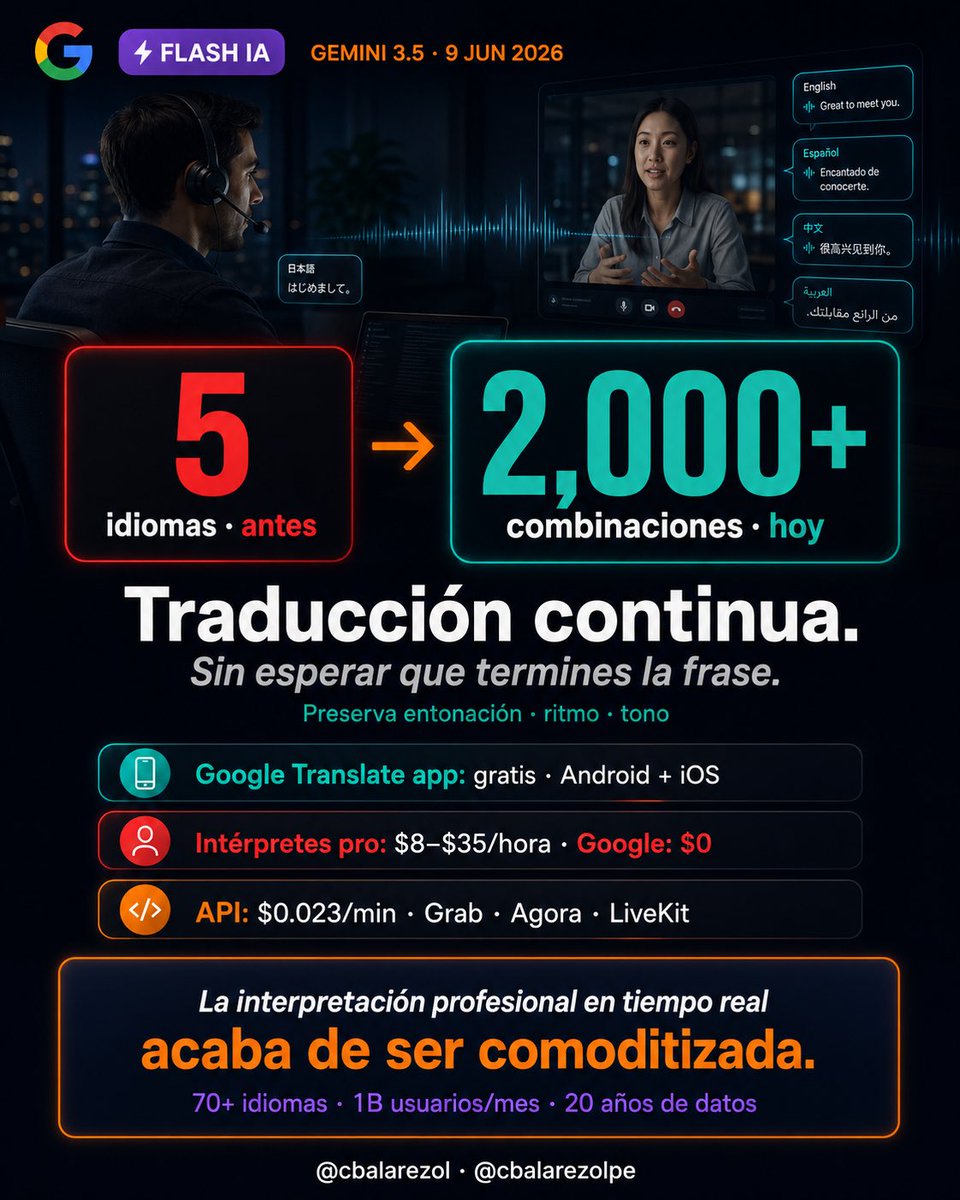
⚡ FLASH IA · 11 jun 2026
Google lanzó Gemini 3.5 Live Translate.
70 idiomas. Traducción continua. Sin esperar que termines la frase.
Los números que destruyen una industria:
→ Google Meet: de 5 idiomas → 2,000 combinaciones · un solo día
→ Interpretes profesionales: $8–$35 por asistente/hora
→ Google Translate app: gratis · Android e iOS · desde el 9 jun
→ API developers: $0.023/minuto · por debajo de todos los competidores
→ Socios construyendo sobre ella: Grab · Agora · LiveKit
Cómo funciona (y por qué cambia todo):
Los sistemas tradicionales esperan que termines la frase.
Gemini 3.5 Live Translate es streaming continuo:
traduce mientras hablas · pocos segundos de lag
y preserva tu entonación · ritmo · tono de voz.
El dato que nadie dice:
Google lleva 20 años en traducción · 1,000 millones de usuarios/mes.
Tenía los datos para hacer esto desde hace tiempo.
Lo hizo hoy.
¿Cuándo fue la última vez que pagaste por un intérprete?
#GeminiLiveTranslate #Google #IA2026 #Traducción #Gemini35
49

Jun 12
This is game-changing! LangChain agents going voice-native with LiveKit means zero rebuild, full realtime magic at scale. Finally, voice AI that’s actually practical. Huge W. 🚀
May 24

"This is huge — finally, your existing LangChain agents can go voice-native without a full rebuild. LangChain LiveKit just made realtime voice AI actually practical at scale. Smart move."
1
49