
20 Aug 2025
BLIPs: Bayesian Learned Interatomic Potentials
1. A new method called BLIPs (Bayesian Learned Interatomic Potentials) has been proposed to address the limitations of Machine Learning Interatomic Potentials (MLIPs) in handling out-of-distribution data and providing uncertainty estimates. This is a significant advancement in simulation-based chemistry, where accurate predictions and reliable uncertainty quantification are crucial.
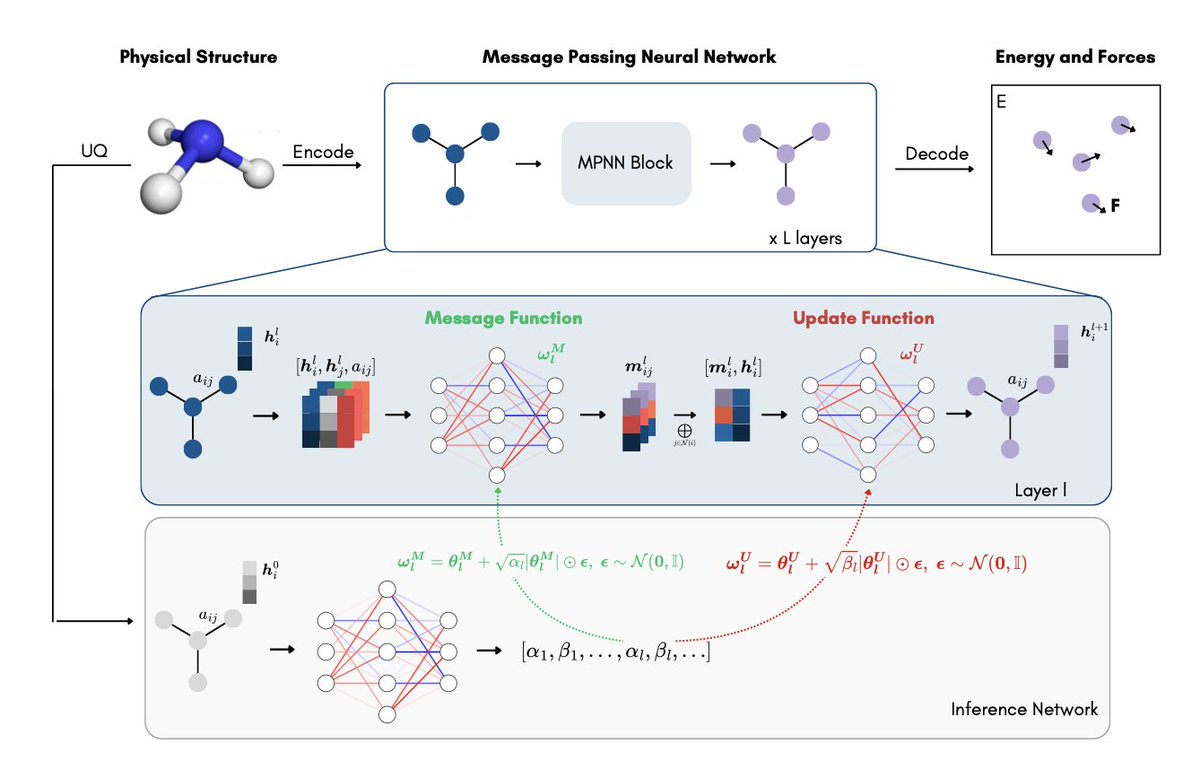
2. BLIPs introduce a scalable, architecture-agnostic variational Bayesian framework that can be applied to train or fine-tune MLIPs. The key innovation is the use of an adaptive version of Variational Dropout, which allows the model to capture input-dependent uncertainty by injecting Gaussian noise into the weights of the message and update functions of Message Passing Neural Networks (MPNNs).
3. The method is particularly effective in data-scarce and out-of-distribution regimes, which are common challenges in computational chemistry. Empirical results show that BLIPs not only improve predictive accuracy but also provide well-calibrated uncertainty estimates, outperforming standard MLIPs and other uncertainty quantification methods like Deep Ensembles and MC Dropout.
4. BLIPs integrate seamlessly with equivariant message-passing architectures, maintaining the essential physical symmetries of atomic-scale systems. This integration ensures that the model remains suitable for modeling complex interactions while providing uncertainty quantification without compromising on accuracy.
5. The computational overhead of BLIPs is minimal compared to deterministic models, making it a practical solution for large-scale simulations. Fine-tuning pretrained MLIPs with BLIPs consistently enhances performance and provides reliable uncertainty estimates, demonstrating the method's potential for improving existing models.
6. The effectiveness of BLIPs is demonstrated through various simulation-based chemistry tasks, including modeling the dynamics of charged particles, learning interatomic potentials for ammonia molecules, and fine-tuning pretrained models on silica glass structures. These experiments highlight BLIPs' ability to handle both small and large systems with high accuracy and reliable uncertainty quantification.
7. The code accompanying this work is available at github.com/dario-coscia/blip, allowing researchers to easily implement and experiment with BLIPs in their own projects. This open-source approach promotes further research and development in the field of machine learning for computational chemistry.
📜Paper: arxiv.org/abs/2508.14022
#BLIPs #BayesianLearning #MachineLearningInteratomicPotentials #ComputationalChemistry #UncertaintyQuantification #SimulationBasedChemistry
1
6
27
1,591