
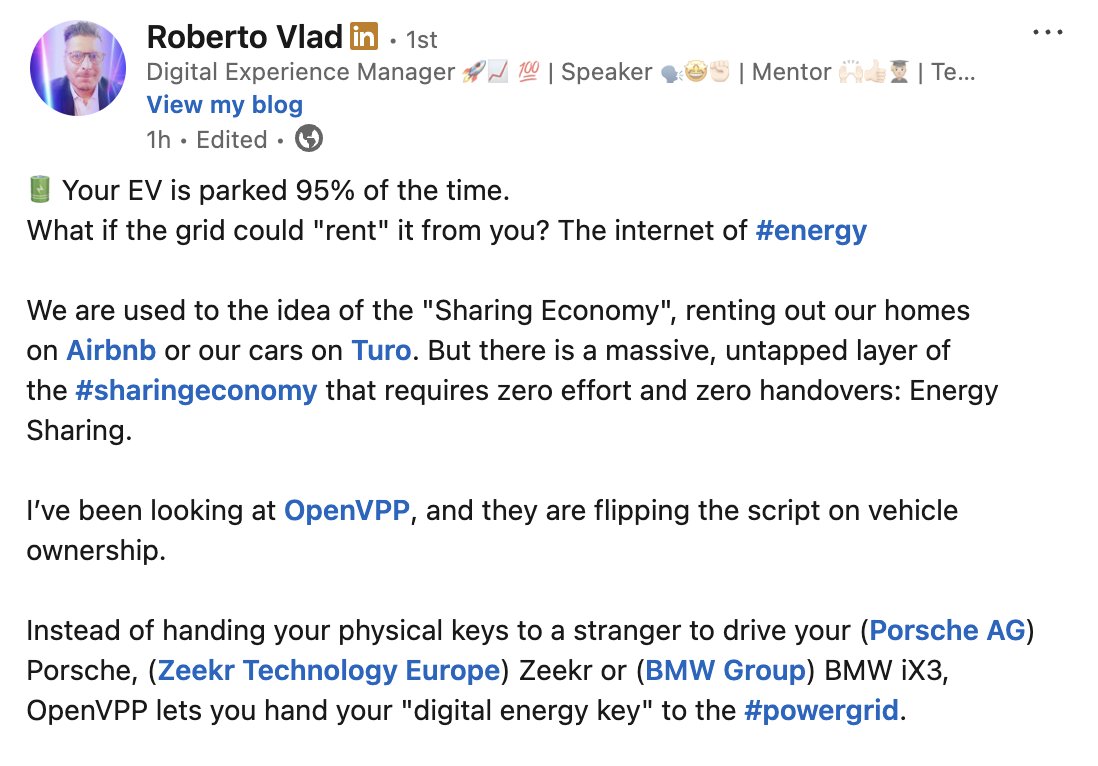
Incredible post by Roberto Vlad, Key Account Manager at @Mapbox, on LinkedIn about how OpenVPP is pioneering the energy-sharing economy, much like what Airbnb and Turo have done in their industries:
Your EV is parked 95% of the time. What if the grid could "rent" it from you?
🌎 linkedin.com/posts/robertovl…
$OVPP The Internet of Energy.
10
33
105
5,690

Built solo. MERN Stack, Mapbox, Google Auth, Stripe. Months of late nights. Not perfect. Still fixing bugs. But done waiting for "ready."
Waitlist open — would mean a lot if you can leave feedback 👇
grupio.vercel.app
#buildinpublic #indiehacker #SaaS #webdev #fullStack
1
24

Maps issue. Not FSD issue.
You can fix it yourself by updating OSM and MapBox and then waiting for a map update.
7

Any of my followers map geeks? I'm talking Mapbox, GIS, nodes, edges, Dijkstra, GL JS with react, etc . . . Please DM if I may harass you with some questions.
284
Pilapi retweeted

Mapbox : Add maps, navigation, and location intelligence to any app. Free tier included.
mapbox.com
1
2
14
2,674


Just wrapped Phase 1 of a Flutter starter kit:
10-tab US neighborhood dossier per address — census, schools, crime,
flood, weather, cost of living, commute.
Stack: Flutter 3.38 · Riverpod 3 · Mapbox · Firebase · RevenueCat · Sentry
Case study demo: duskolicanin.com/case-study/…
Open for similar Flutter foundations.
1
31

Puedes explorar la ruta interactiva 3D de las 48 selecciones y el ranking de emisiones aquí:
🔗 seisvueltasalatierra.vercel.…
Un proyecto desarrollado con #Svelte, #D3js y #Mapbox. 📊⚽️
🙏¡Se agradece muchísimo la difusión!
#WorldCup2026 #DataViz #Mundial2026
1
1
73

19h
Mapping looks expensive to build. Mapbox gives you maps, geocoding, and routing, free for up to 50,000 requests/month.
Add a full map feature in 20 minutes.
mapbox.com
17


Jun 13
Data Interpretation & Structural Flaws.
FSD relies entirely on data to make driving choices, but how that data is structured creates deep technical issues:
The "Hodgepodge" Mapping Stack: FSD's navigation system is not a single, fluid map. It is stitched together from multiple data sources—including Google Maps, OpenStreetMap, MapBox, TomTom, and Tesla's fleet data. When these data layers conflict or provide outdated info, it causes "data cascade errors," forcing the car into sudden wrong turns, late lane changes, and abrupt braking.
Navigation Overriding Vision:
While camera-based sign reading is supposed to monitor real-time environments, the car's system frequently prioritizes underlying, outdated navigation map data instead. This results in dangerous speed drops or sudden acceleration when map data dictates a speed limit that disagrees with physical signs.
Degradation Detection Failures:
The National Highway Traffic Safety Administration (NHTSA) upgraded its federal probe into 3.2 million Tesla vehicles. The agency discovered that FSD's "degradation detection system" the software meant to realize when cameras are blind from fog, sun glare, or dust—failed to warn drivers or shut off before several major crashes.
Accusations of Data Manipulation & Inflated Stats.
A massive investigation by Reuters revealed significant friction regarding how Tesla manages its corporate safety data and trains its AI:
Flawed Crash Comparisons: Safety experts and data scientists have accused Tesla of utilizing flawed methodologies to declare FSD "10 times safer than human drivers." Critics note that Tesla compares FSD's air-bag-deploying accidents (severe crashes) against federal databases that include minor fender benders. Furthermore, FSD data is heavily logged on highways—which are statistically far safer than the complex city streets used to calculate national averages.
Staging Capabilities via Route Over-Mapping:
Former Tesla data labelers (the AI trainers) reported that ahead of high-profile autonomous driving exhibitions—such as the Cybercab reveal—staff worked exhausting hours to heavily pre-map and meticulously label specific test routes. This gave the public the illusion that FSD operates seamlessly everywhere out-of-the-box, masking its struggle with spontaneous, unmapped "long tail" scenarios.
Under-Reporting Under Scrutiny:
The NHTSA explicitly flagged concerns that Tesla has under-reported FSD crash rates. Regulatory filings noted that Tesla cited internal "data and labeling limitations" that effectively caused it to omit certain accidents from the data pools provided to federal investigators.
Legal and Marketing Contradictions.
Tesla finds itself entangled in billions of dollars worth of false advertising and wrongful death lawsuits because its real-world data and software design stand at odds with its marketing narrative:
Contractual Alterations: Reports indicate that Tesla has retroactively updated FSD purchase agreements. They inserted strict "supervised" legalese onto historical documents to insulate the company from liability, generating legal pushback regarding potential evidence tampering.
Promotional Missteps:
While Tesla's legal defense rests on the premise that drivers must remain completely attentive, the company's own official PR videos have shown drivers making espresso. Worse, promotional footage published by Tesla Europe to celebrate an rollout in Denmark actually captured FSD committing multiple traffic violations on video—including driving illegally on bicycle paths and in bus lanes.
3
300


Jun 13
i learned this the hard way this week vibecoding courtfinder.merterdir.com
sat images are damn expensive. do you have a better option than mapbox for high res rasters? they don’t even allow you to set a limit. burned a lot of cash when this went viral on reddit because it was free
2
2,725

farcoder.com/remote-backend-…
Mapbox is hiring a remote candidate for Software Development Engineer II, Navigation, Traffic. This is a full time position. Work location: UK.

1
48

farcoder.com/remote-backend-…
Mapbox is hiring a remote candidate for Machine Learning Engineer III, Routing Cost. This is a full time position. Work location: Germany.

1
34

Jun 12
I'd rather do it in Unity so I can do WebGPU.
Alembic isn't useable in webgl tho which is lame, but most of the city exports should be FBX anyway.
Openstreetmaps has a decent export, same with Mapbox, but both of them are owned by illuminati fuckheads that don't give us anything cool literally ever.
The niantic people are garbage people as well.
1
2
491
