Sjoe! Doors Wide Open, Floors Still Cracked: Why SA Education Needs a Second Transition 🚪📉📚 ~ When Access Isn’t Equity: How Governance Failure Undermined Education Reform 🏛️📚 ~ The Cascade Effect: How Reading Failure in Grade 4 Echoes Into Youth Unemployment 📉👷🏾♂️
Imagine achieving something truly historic—flinging open doors that were welded shut for generations—and then discovering, three decades later, that far fewer people are walking through to the other side than when the doors were barely cracked.
In October 2017, then-Statistician-General Pali Lehohla dropped a statistical bombshell that still reverberates: during the darkest years of apartheid, the proportion of black students who actually graduated from university was higher than it became after democracy removed every legal barrier to entry (Lehohla, 2017).
Apartheid’s deliberate starvation of black education is not up for debate—its evil is etched in law and memory—but for the tiny, hyper-selected cohort it reluctantly admitted, full funding and elite preparation produced completion rates that post-1994 “massification” could not match.
Black African enrolment soared to 80–85% of total university students by the mid-2020s, a transformation triumph no honest observer would deny. Yet proportional graduation rates for those students fell to around 5% by 2016–2017. The doors were wide open. Fewer crossed the stage.
This single paradox is the thread that runs through South Africa’s entire post-apartheid education story: heroic quantitative expansion celebrated with annual fanfare, shadowed by qualitative collapse that no press conference ever quite addresses.
The central claim of this investigation is simple and testable: after 30 years, South Africa needs a second transition—from proudly counting bodies in classrooms to ruthlessly demanding actual learning, mastery, and workplace-ready skills.
The evidence network that follows—drawn from official statistics, international benchmarks, commission findings, and labour data—builds an interlocking case that the current path is no longer sustainable.
Stirring Questions:
Why does a statistic from 2017 still feel like the most honest summary of our education story in 2026?
If opening doors was the first victory, what exactly is stopping us from building solid floors inside the building?
And if access without outcomes is not true equity, what have three decades of policy headlines actually bought us?
Are we measuring the right things?
Are we willing to measure the hard things?
Together, these questions matter because they force us to confront whether “progress” is real or merely ceremonial.
Historical Context: From Deliberate Starvation to Celebrated Survival
Apartheid’s Bantu Education was designed to produce hewers of wood and drawers of water, not graduates. Black universities were underfunded “bush colleges,” access brutally restricted, and the system engineered to keep most black South Africans functionally limited.
Democracy’s first transition was therefore understandably focused on quantity: desegregate, enrol, include. Enrolment exploded. Matric participation grew. Budgets rose—South Africa consistently spends a higher proportion of GDP on education than most middle-income countries. Policies multiplied: curriculum changes, school nutrition, no-fee schools, NSFAS expansion.
The intention was noble, the achievements real. Yet the system that emerged retained an academic-heavy, university-or-bust orientation, while foundational delivery remained uneven. Governance structures intended to drive transformation sometimes hardened into protective networks. Increased spending met persistent waste. And every January, the ritual of record-breaking matric passes became the national feel-good moment.
The context is not one of total failure, but of half-victory: doors open, but too many who enter still stumble in the dark.
Stirring Questions:
If the first transition was about getting children into school, why does the second—getting them properly educated once inside—feel so much harder?
When budgets rise but reading ability stagnates, where exactly is the money going?
Is the system still carrying apartheid’s structural damage, or has it added new layers of its own?
Why do these intertwined histories matter? Because without naming both the inherited wound and the self-inflicted scar, no healing is possible.
Evidence Network: Four Interlocking Strands
Strand 1: The University Paradox – Doors Wide, Graduation Narrow
The Lehohla observation remains the cleanest diagnostic tool we have. Black students, once a tiny elite under restriction, completed degrees at higher proportional rates than the mass cohorts of today. Massification without matching academic support, foundational preparation, and campus expansion turned inclusion into a different kind of bottleneck (Lehohla, 2017).
The same unpreparedness that drags university success down begins far earlier.
Strand 2: The Matric Celebration and Its Asterisks
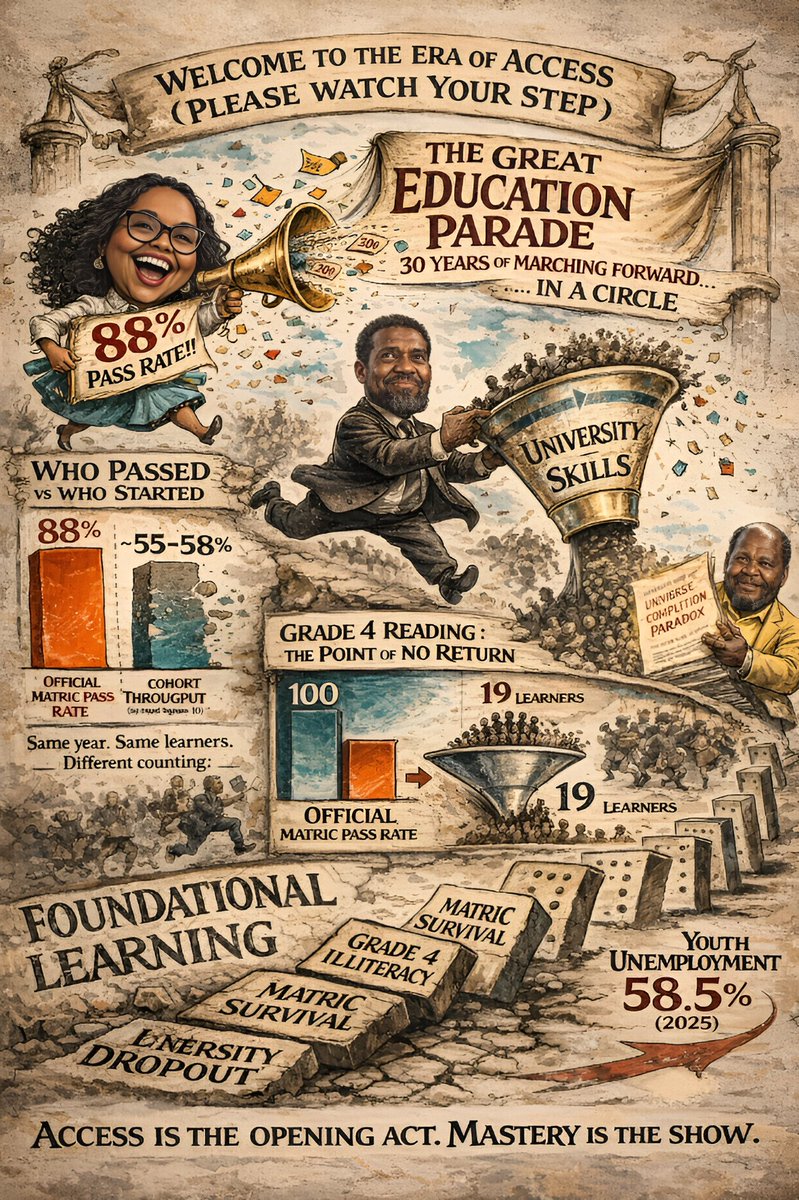
January 2026 saw Basic Education Minister Siviwe Gwarube announce the Class of 2025’s 88% pass rate—the highest in democratic history, with all provinces and districts above 80% for the first time, and a record 345,000 bachelor passes (Department of Basic Education, 2026). The pride was palpable.
Yet the fine print tells a different story. The 88% counts only those who wrote the exams.
Independent cohort analyses place the real throughput—from Grade 10 two years earlier—at 54.7–57.7%. Between 40–45% of potential matriculants never reached the exam hall. The NSC allows 30% minima in several subjects, producing certificates that certify endurance more than mastery.
The same learners celebrated in January arrive at university underprepared, feeding the throughput collapse documented in Strand 1.
Strand 3: Governance and the Patronage Question
Formalised at the ANC’s 1997 Mafikeng conference, cadre deployment began as redress: place capable, previously excluded people in institutions long dominated by apartheid appointees (African National Congress, 1997). Yet the Zondo Commission found the policy had enabled widespread blurring of party and state, contributing to corruption losses estimated between R500 billion and R1 trillion across the public sector (Zondo, 2022).
Education felt the impact through repeated teacher-appointment scandals, textbook tender irregularities, and infrastructure decay. SADTU’s “jobs-for-cash” allegations, first officially documented in 2016, continued to surface in 2025 probes.
High spending met persistent foundational stagnation.
Strand 4: The Foundational Indictment
The Progress in International Reading Literacy Study (PIRLS) 2021 found 81% of Grade 4 learners unable to read for meaning in any language—placing South Africa last among participating countries (Mullis et al., 2023).
That figure, repeatedly cited into 2026, has become the quiet national shame no budget speech fully dislodges. Overcrowded classrooms, teacher absenteeism, language transitions, and district mismanagement compound the crisis.
A child who cannot read by Grade 4 rarely recovers; the cascade runs straight through matric survival into university struggle and workplace exclusion.
Stirring Questions
If every strand reinforces the others—university failure fed by matric inflation, fed by foundational collapse, protected by governance choices—how much longer can we treat them as separate problems?
When increased budgets meet unchanged reading scores, who benefits from the status quo? Are we afraid of the political cost of real reform?
Do vested interests outweigh children’s futures?
Together these questions matter because they reveal a system no longer merely broken by inheritance, but sustained in dysfunction by choice.
Synthesis: The Cumulative Weight
Taken in isolation, each strand is concerning. Interlocked, they form an evidence network that points to one conclusion: quantitative expansion has been achieved; qualitative transformation has not. The evidence converges across independent sources—official statistics, international benchmarks, judicial findings, labour surveys—making the argument robust and falsifiable.
Change the governance model, strengthen foundational delivery, raise expectations, and outcomes should improve. Fail to do so, and the cascade continues. The collective strength lies in consilience: no single data point carries the argument alone, but together they form a picture no reasonable observer can dismiss.
Objections: Facing the Counterarguments Head-On
“You’re ignoring massive progress—millions more children in school, higher pass rates, more graduates than ever.” Valid. Absolute numbers are up dramatically, and that matters. Yet proportional outcomes and foundational mastery have stagnated or declined, producing more survivors rather than thriving graduates. Quantity without quality is not sustainable equity.
“Criticising cadre deployment ignores the need for continued transformation.” Redress remains necessary. But when a policy enables documented corruption and protects mediocrity, it ceases to serve transformation and begins to hinder it (Zondo, 2022).
“International comparisons are unfair—South Africa carries unique historical baggage.”
True, the legacy is heavy. Yet countries emerging from conflict or deep inequality—Rwanda, Vietnam—have achieved faster foundational gains. History explains; it does not excuse indefinite stagnation.
Conclusion: The Crossroads We Cannot Keep Ignoring
Thirty years after democracy’s dawn, South Africa’s education system stands at an unspoken crossroads. One path keeps polishing quantitative trophies while the qualitative crisis deepens: children who cannot read, matriculants who barely passed, graduates who cannot graduate, young adults facing 58.5% unemployment (Statistics South Africa, 2025).
The other path demands courage: a second transition that measures success not by entrance but by exit—not by how many we enrol, but by how many we truly educate.
The evidence network proves with undeniable evidence that South Africa’s education system requires a second transition from quantity to quality—one rooted in rigorous accountability, foundational mastery, and workplace-relevant skills.
The evidence is assembled. The children are waiting. The choice is ours.
South Africa’s education system requires a second transition from quantity-focused redress to quality-driven mastery with undeniable evidence.
#SjoeNews 😮📰
#SjoeEducation 😳📚
#DoorsOpenFloorsMissing 🚪🕳️
#PassRateFlex 📈💃
#ReadingIsKindOfImportant 📖😬
#MathAintMathing 🧮🤨
#FromAccessToExcellence 🎓➡️🧠
#QuantityIsNotQuality 📊❌
#Grade4GateCrash 🚨📖
#FoundationFirst 🧱📚
#EducationButMakeItWork 💼🎓
#StopCountingBodies 👀✋
#TeachDontTweet 🧑🏾🏫📵
#SecondTransitionNow ⏳🔥
#SjoeMoment 😮💥
#CascadeContinues 🌊📉
#ReadBeforeYouLead 📖👔
#PolicyButNoMastery 🏛️🤦
#SchoolsOrStorageUnits 🏫📦
#DemocracyNeedsHomework 📝🗳️
References
African National Congress. (1997). 50th national conference resolutions. ANC.
Department of Basic Education. (2026). National Senior Certificate examination report 2025. Government of South Africa.
Lehohla, P. (2017, October 25). Remarks on higher education funding and throughput rates [Press statement]. Statistics South Africa.
Mullis, I. V. S., von Davier, M., Fishbein, B., & Foy, P. (2023). PIRLS 2021 international results in reading. International Association for the Evaluation of Educational Achievement (IEA).
Statistics South Africa. (2025). Quarterly Labour Force Survey (QLFS), Q3:2025. Stats SA.
Zondo, R. M. (2022). Judicial Commission of Inquiry into Allegations of State Capture report (Parts 1–6). Government of South Africa.










 LuigiWrestling


