
Jun 10
11,000 Ethereum validators merged post-Pectra. Active count down ~16,000, staked ETH unchanged.
EIP-7251 MaxEB is live — fewer validators, lower ops costs, programmable exits.
🔗 chainlabo.com/blog/ethereum-…
#ETH #MaxEB #ChainLabo
2
2
17

Jun 9
🛍️ Varal de Teto Aço Branco 90cm x 56cm 13kg Resistente Maxeb
De R$ 77,00
💥 Por R$ 64,90
🛒 Compre aqui 👉 s.shopee.com.br/8fPrDOrrca
⚠️ Promoção sujeita à alteração de preço e estoque do site
10


Apr 30
2/ The report focuses on practical operational questions:
- How should operators choose EL/CL clients?
- When does DVT or a remote signer make sense?
How should slashing protection be layered?
- What changes after PeerDAS and MaxEB?
- How should institutions think about HA, DR, monitoring, and regional network performance?
Ethereum staking is no longer just about running a validator. It is infrastructure operations.
1
4
158

Apr 1
I think ACD may consider being keenly attentive to the practical growth economics of frame transactions. There is a world of difference between an EIP that everyone picks up automatically vs. opt-in with a material lift. The closest modern analog could be maxEB. Lessons of AA history must be learned... from all parts of stack and community, not just from Eipland and Acdistan. If it's not universally adopted at a reasonable pace, it failed, regardless of its elegant properties.
4
330

Mar 27
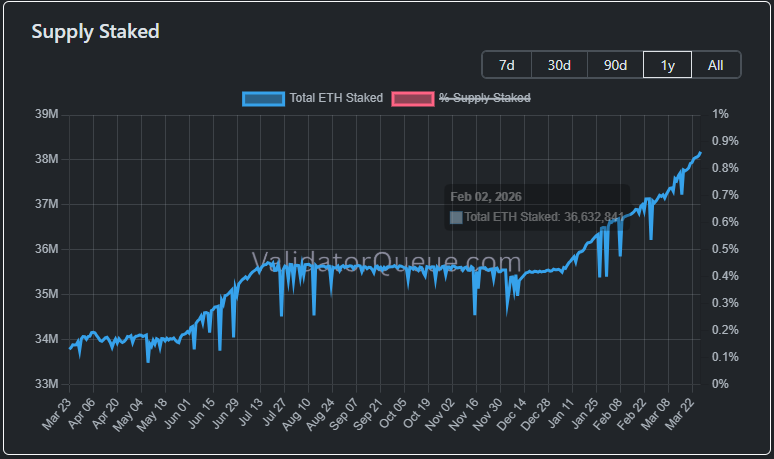
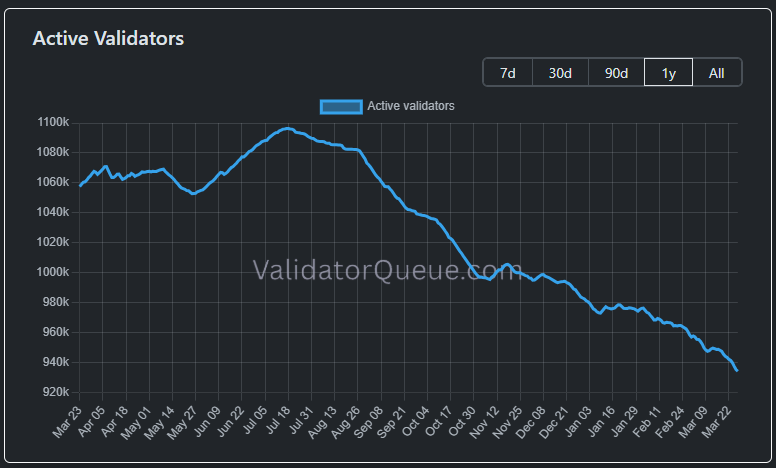
The amount of ETH staked has been increasing continuously, reaching new record highs over the last year.
This could have been concerning for the Ethereum community due to the growing number of active validators and the associated signature aggregation overhead if MaxEB had not been introduced to the network last year with Pectra.
Thanks to MaxEB, validators are consolidating, helping the network maintain sufficient bandwidth for stability and enabling further scaling of blobs and gas limits.
4
122


Mar 14
“Ethereum is a product/Ethereum is not a product” is a strawman imo. More important to me is how to make Ethereum development more user- and product-centric, for both protocol and non-protocol development. For one, the protocol has a roadmap, so product thinking applies here too.
Ethereum is also a platform, this is a viewpoint adapted to thinking about the services it provides, for the users (maybe infra) of these services. And thinking of it as a product also helps convey that work needs to happen on the adoption of its affordances.
Shipping MaxEB does not automatically consolidate validators. Shipping native AA does not automatically transform Ethereum accounts into superior accounts.
From my corner of the world, three places where product thinking are currently benefiting development and adoption:
- @corcoranwill and @_julianma are coordinating a strong outreach to possible users of the Fast Confirmation Rule, a rule derived from validator votes in the current protocol that provides strong guarantees of confirmation, towards faster user deposits and withdrawals in and out of L2s or other offchain services.
- @benjaminion_xyz is working to tailor the R&D, features and delivery of fast finality to the needs of its users and suppliers (validators). Get in touch!
- Our current interop work has benefited from multiple conversations with wallets, chains and users, with our efforts currently directed towards the interop-sdk developed with @Wonderland (see interoperable addresses in action here: interopaddress.com/ and the recent exciting news of the on.eth chain registration contract: x.com/rudolf6_/status/203179… h/t to the @unruggable_eth folks) and the Open Intents Framework developed with @OpenZeppelin and many others.
A final hat tip to @Butta_eth moving mountains to get more validators consolidated, a critical step towards faster finality x.com/trent_vanepps/status/2…
There’s a lot more to build!
Feb 17

Right, who wants to talk about Fast Finality on Ethereum?
We're figuring out where the theoretical meets the practical: if finality matters to you, let's talk!
🏗️ Infrastructure: L2s, Bridges, Interop protocols
🏦 Liquidity: Exchanges, Staking pools, Apps
💻 Protocol: Client devs & researchers
❓ Others...
The Hard Questions:
- How fast is fast enough to make a difference? Is it quantifiable?
- Which trade-offs are ok? Economic safety <33%? Higher finalisation threshold? Lower fork-choice participation per slot? Slot length? Validator set cap?
- Where does FF sit among all our other priorities?
DM to set up a call - tell me who you are and why you care.
(Note: This is distinct from the fast confirmation rule - talk to @corcoranwill for that.)
10
29
141
22,634

Ethereum News from Yesterday
- Aave oracle glitch triggered $27M in wstETH liquidations; the protocol was unaffected and affected users will be reimbursed.
- StarkWare is building STRK20, a framework to enable privacy for erc20 tokens
- Ethereum researchers released a proof-of-concept for native Rollups using EIP-8079, demonstrating a full Rollup using Ethrex execution client.
- Ethereum foundation Toni Wahrstätter released Snap v2, aiming to replace Trie tree fixes with block-level access lists (BALs) to simplify the Ethereum sync protocol, reduce round trips, and prepare for higher gas limits and ongoing state growth.
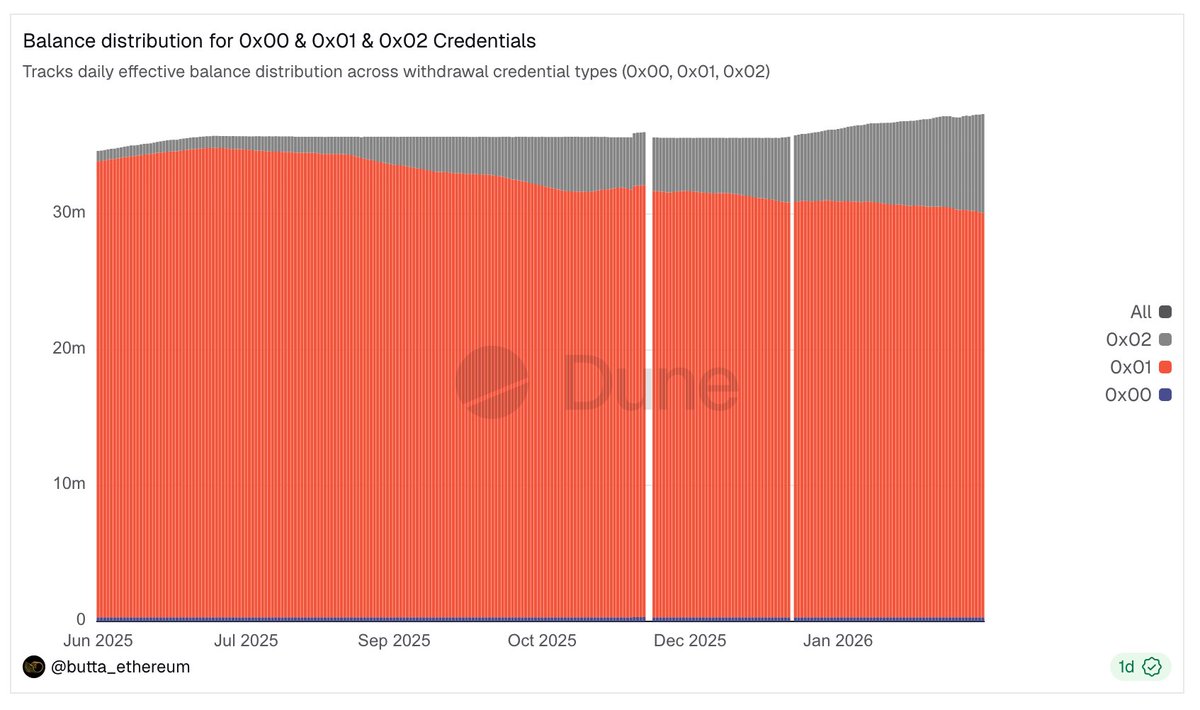
- A new dashboard from Butta ETH highlighted that, after a slow start in 2025, usage of MaxEB, 0x02 withdrawals, and accumulating validators has surpassed 20%.
- AgentCash launched with $100K reward pool.
- cbBTC Carry vault went live on Steakhouse App for BTC yield
- Doma Protocol launched DNS twins on mainnet, letting tokenized DNS domains act as ENS-compatible names.
1
2
2
522


Mar 10
awesome dashboard from @Butta_eth!
after a slow start in 2025, usage of MaxEB / 0x02 withdrawal / "accumulating validators" is over 20%
dune.com/butta_ethereum/maxe…
10
5
40
3,971

#publi
NA SHOPEE COMPENSA MAIS
Rack Estante Lavanderia Maquina de Lavar Organizaçao Prateleira Aço Maxeb com 31% de desconto!
Encontre na Shopee agora! s.shopee.com.br/BObrJWTzE
1
3
27
Feb 12
EIP-8148 represents a meaningful step in allowing validators to set their own automatic sweep thresholds, reinforcing the sustainability of macro-level protocol designs such as MaxEB expansion and validator consolidation, while advancing the shift toward a more programmable yield primitive.
Feb 11

: : EIP-8148 for Adaptive Staking Infrastructure
With the Pectra upgrade, @ethereum is moving toward expanding the Max Effective Balance to 2,048 ETH through EIP-7251, thereby reducing the number of validators and easing bandwidth pressure on the consensus layer.
This is not simply an adjustment of the upper bound; rather, its significance lies in structurally securing network scalability through validator consolidation.
Such a transition presupposes execution-layer–based compounding withdrawal credentials, and in doing so, further reinforces an operational model in which a validator’s ETH balance remains within the protocol for extended periods of time.
However, in a structure where automatic sweeps effectively depend on a fixed threshold(i.e., 2,048 ETH), rewards may not be transmitted externally for a considerable duration. This can introduce rigidity for validators, particularly in terms of capital turnover and reward visibility.
EIP-8148 is a proposal that seeks to transition this structure into a more flexible, policy-based framework.
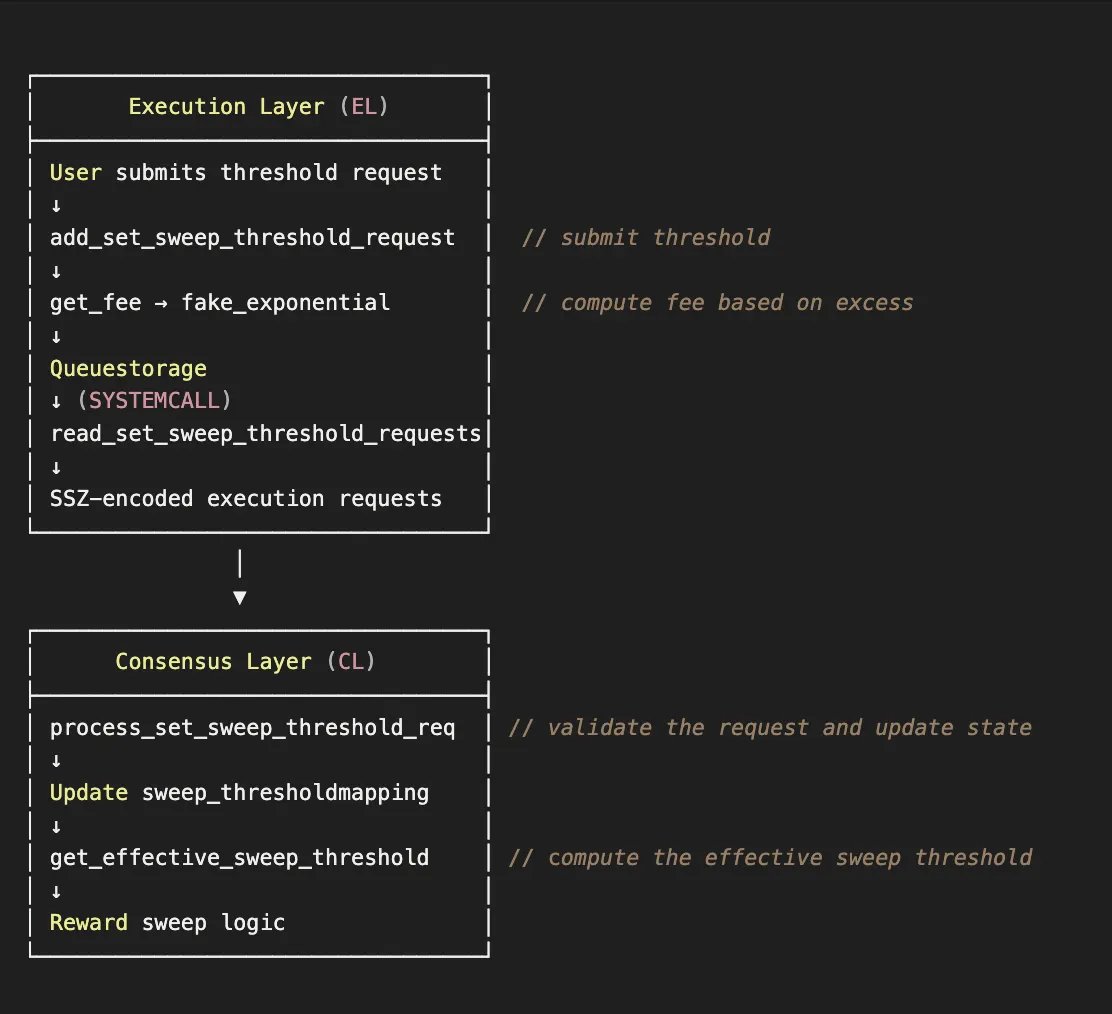
At its core, EIP-8148 allows validators to directly configure the automatic sweep threshold (; sweep_threshold) - in other words, a validator’s balance may compound up to the specified limit, and only the portion exceeding that threshold would be automatically transferred to the withdrawal destination.
This design constitutes a relatively small change—a minimal state extension—that adjusts only the timing of reward routing without compromising consensus safety - it does not modify slashing conditions or effective balance calculations; instead, it introduces a policy variable into the flow of capital.
From a more strategic perspective, this proposal can shift staking toward a more “policy-designable yield infrastructure.”
For example, large LST protocols such as @LidoFinance pursue operational efficiency through validator consolidation, while also seeking to fine-tune the timing of yield distribution within strategic vault structures like stVaults.
If the sweep threshold can be set dynamically, validators may allow rewards to compound up to a certain level in order to maximize capital efficiency, and thereafter deploy the excess at the execution layer—whether through redepositing, restaking, or allocating into DeFi strategies. In this sense, staking rewards are no longer confined to being merely accrued yield, but can instead be redefined as “routable liquidity.”
Ultimately, while EIP-8148 may appear, on the surface, to be a UX-oriented refinement, its implications are structurally significant across stakeholders.
For the macro-level design of MaxEB expansion and validator consolidation to remain sustainable, the micro-level dynamics of capital rotation and reward visibility must also be carefully calibrated. In this regard, the proposal can be understood as a micro-adjustment that bridges this gap, and as part of the broader transition toward making staking rewards a more programmable yield primitive.
2
8
739

Feb 11
: : EIP-8148 for Adaptive Staking Infrastructure
With the Pectra upgrade, @ethereum is moving toward expanding the Max Effective Balance to 2,048 ETH through EIP-7251, thereby reducing the number of validators and easing bandwidth pressure on the consensus layer.
This is not simply an adjustment of the upper bound; rather, its significance lies in structurally securing network scalability through validator consolidation.
Such a transition presupposes execution-layer–based compounding withdrawal credentials, and in doing so, further reinforces an operational model in which a validator’s ETH balance remains within the protocol for extended periods of time.
However, in a structure where automatic sweeps effectively depend on a fixed threshold(i.e., 2,048 ETH), rewards may not be transmitted externally for a considerable duration. This can introduce rigidity for validators, particularly in terms of capital turnover and reward visibility.
EIP-8148 is a proposal that seeks to transition this structure into a more flexible, policy-based framework.
At its core, EIP-8148 allows validators to directly configure the automatic sweep threshold (; sweep_threshold) - in other words, a validator’s balance may compound up to the specified limit, and only the portion exceeding that threshold would be automatically transferred to the withdrawal destination.
This design constitutes a relatively small change—a minimal state extension—that adjusts only the timing of reward routing without compromising consensus safety - it does not modify slashing conditions or effective balance calculations; instead, it introduces a policy variable into the flow of capital.
From a more strategic perspective, this proposal can shift staking toward a more “policy-designable yield infrastructure.”
For example, large LST protocols such as @LidoFinance pursue operational efficiency through validator consolidation, while also seeking to fine-tune the timing of yield distribution within strategic vault structures like stVaults.
If the sweep threshold can be set dynamically, validators may allow rewards to compound up to a certain level in order to maximize capital efficiency, and thereafter deploy the excess at the execution layer—whether through redepositing, restaking, or allocating into DeFi strategies. In this sense, staking rewards are no longer confined to being merely accrued yield, but can instead be redefined as “routable liquidity.”
Ultimately, while EIP-8148 may appear, on the surface, to be a UX-oriented refinement, its implications are structurally significant across stakeholders.
For the macro-level design of MaxEB expansion and validator consolidation to remain sustainable, the micro-level dynamics of capital rotation and reward visibility must also be carefully calibrated. In this regard, the proposal can be understood as a micro-adjustment that bridges this gap, and as part of the broader transition toward making staking rewards a more programmable yield primitive.
Feb 11

What if your 0x02 @ethereum validators can have a custom rewards sweep threshold and get rewards transferred to their withdrawal credentials before hitting a staggering 2048 ETH?
Introducing EIP-8148: Custom sweep threshold for validators
👇
6
4
19
2,335