
27 Jun 2025
$SERV | @OpenServai 🔱
What if AI didn’t just answer your questions, but teamed up, took action, and built a full app for you?
@OpenServai is tirelessly working to power a future where agentic apps (aApps) connect to any blockchain or platform, scale instantly, and actually get things done.
🚀 What they’ve done so far:
🔸 OpenServ officially released Builder’s Playground v0.1 a couple of months ago, designed for developers to build agent teams using TypeScript, Python, on‑chain/off‑chain agents, and integrate with tools like MetaMask and Telegram. They kicked things off with a $3K bounty to create crypto intelligence agents
🔸 MCP integration also went live on their platform. Agents can now tap into over 10,000 tools, APIs, databases, and systems via a unified protocol.
One key development of this was the @Blender MCP integration, letting creators build 3D scenes, animate, and set up lighting just by describing what they want in natural language.
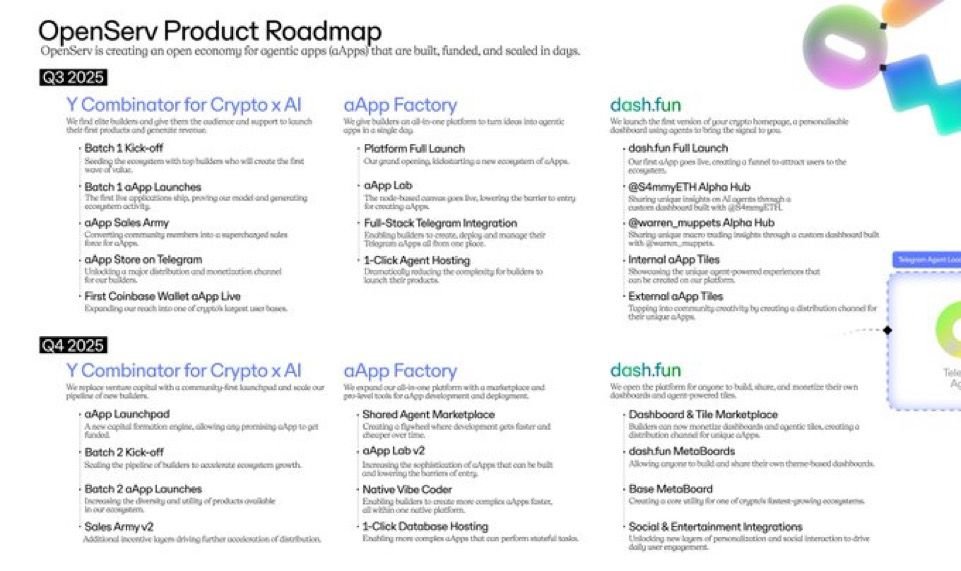
💡Now the roadmap is speeding up. The newly published vision is an ambitious plan: a full-stack ecosystem for agent-powered apps. Highlights include:
➤ Telegram-first aApps - They’re aiming for massive reach by focusing on Telegram’s 1B users, where crypto communities already live.
➤ Openserv Accelerator Batch - A program to help launch an agentic app in 30 days, from idea to revenue.
➤ Dash.fun - Their own DeFAI app for crypto intelligence, featuring Alpha Hubs and MetaBoards.
➤ aApp Lab - an aApp dev platform that makes aApp-building smoother, faster, and more reliable.
At $31M mc, $SERV is still 3x away from ATH. I have been adding to my position, because I believe this only needs time to cook.
High conviction play for me.
CA: 0x40e3d1A4B2C47d9AA61261F5606136ef73E28042
19
22
94
5,334

26 Jun 2025
OpenServ: Powering the Future of the Agent Economy
In my opinion, @openservai is a massivly overlooked and underrated play in the emerging AI agent economy.
Behind it is OpenServ Labs Ltd., a London-registered company led by a team with backgrounds at J.P. Morgan (ex-VP), BitTorrent Inc., Scroll, TON Foundation, Wayfair, Bloomwell, Mindsite, and Laennec AI. Their collective expertise spans fintech, web3, AI infrastructure, and product development.
They’re also highly engaged with the community - sharing updates and insights actively across X, Telegram, Mirror, and LinkedIn.
But let’s talk about what really matters: what they’re building.
Laying the Groundwork for the Agent Economy
AI agents are rapidly becoming part of the digital workforce - handling research, automation, content creation, and code. But most platforms today are siloed, technically complex, and offer little opportunity for developers to monetize.
OpenServ addresses these issues head-on. It provides an open, interoperable platform where agents - regardless of how or where they’re built - can collaborate as modular, intelligent teams. These agents don’t just run prompts; they coordinate, share memory, adapt, reason, and interact across tools like Slack, Trello, Gmail, and Google Drive.
Users can create and manage agent teams visually through a no-code studio. Each workspace includes a default project manager agent to coordinate tasks, track progress, and keep everything aligned. This structure makes multi-agent collaboration accessible to non-technical users - while still being robust enough for enterprise-grade workflows.
For developers, OpenServ offers a powerful marketplace. Agents can be built with any framework, hosted natively or externally, and monetized directly. With built-in analytics, sandbox testing, and quality assurance systems, devs gain visibility and revenue - without needing to build an entire product around their agents.
The cognition framework adds another layer: agents are equipped with memory, contextual awareness, and reasoning. They learn from past actions, refine their own outputs, and follow logic chains autonomously - which results in more accurate, trustworthy, and dynamic task execution.
The Engine Behind the Platform
At the core of OpenServ is an infrastructure built for scale, flexibility, and autonomy. The orchestration layer handles task assignment, workflow sequencing, and optimization - ensuring agents don’t act in isolation but as coherent, productive teams. Shadow agents provide oversight, while human-in-the-loop options keep users informed and in control.
Agents retain context across sessions, use selective memory to prioritize relevant data, and continuously refine their performance based on user feedback. This allows them to handle evolving requirements and collaborate across complex projects.
Developers are not locked into a closed ecosystem. OpenServ is framework-agnostic - meaning agents built anywhere can plug into the platform. Tools like Slack, Gmail, Telegram, Discord, and Google Drive are already supported, and Web3 integration is available via @goat_sdk, with over 200 supported on-chain actions.
The application layer includes storefronts, dashboards, and composable agent apps (aApps) - all designed to be monetizable. Users, developers, and businesses alike can build and share applications with minimal friction.
And powering the ecosystem is $SERV, OpenServ’s native token. It unlocks access to premium features, enables on-chain functionality, and supports various usage models: subscriptions, one-time payments, gated content, and more. Token-based revenue models will expand over time, including plans for fractional agent ownership and community-driven governance.
Where It’s Going: Roadmap & Vision
OpenServ isn’t just building a product. It’s laying the foundation for a full-stack agent economy.
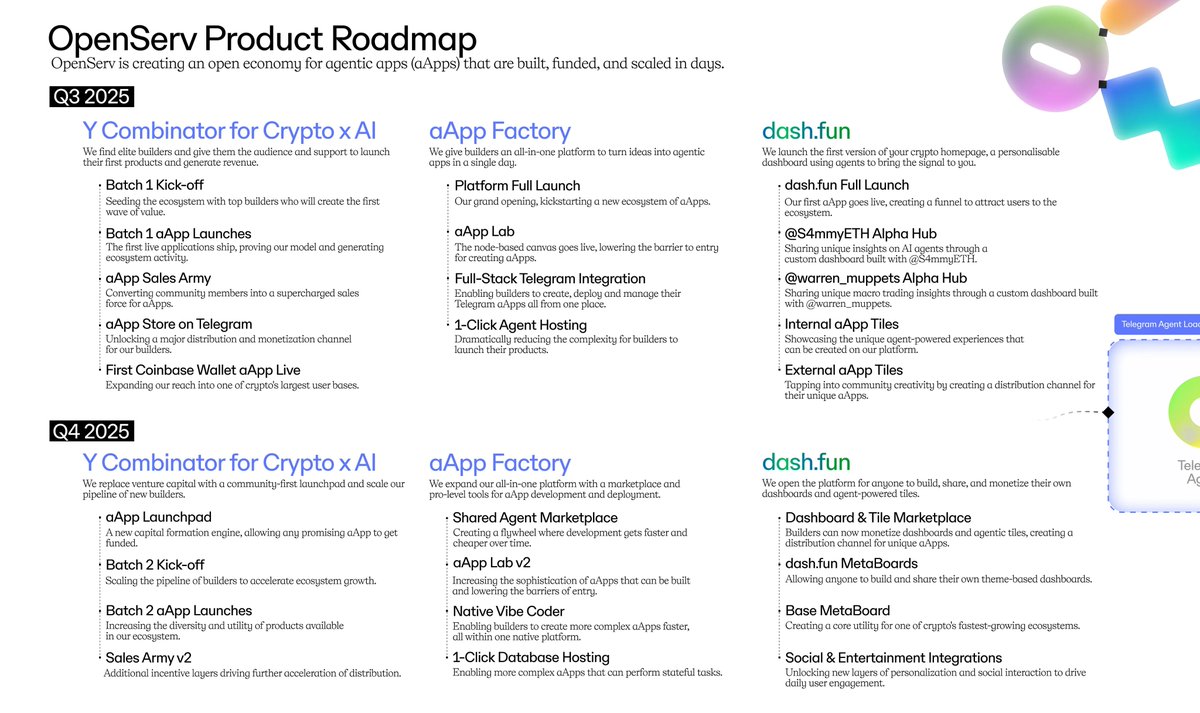
At the center is the aApp Builder, a no-code canvas that lets users transform ideas into functional, agent-powered apps. It’s simple, visual, and fast - making it possible for anyone to participate in the agent ecosystem.
Distribution begins with Telegram - chosen for its active crypto-native user base and over 1 billion monthly active users. OpenServ’s team has deep expertise here, including former leadership from the TON ecosystem, ensuring that rollout strategies are well-informed and execution-ready.
To support creators, OpenServ is launching an accelerator program modeled after Y Combinator. Builders will move from idea to revenue in just 30 days - receiving guidance across technical development, product design, marketing, and growth. Projects launch directly into Telegram with integrated monetization tools, referral systems, and tokenization support.
Several major releases are lined up:
- aApp Lab: Visual builder and testing environment
- Native Agent Hosting: One-click deployment, no infrastructure needed
- Component Marketplace: Reusable agents for integration into aApps
- One-click Databases and backend logic
- Vibe-Coder: A natural language interface to generate agents in minutes
The first major OpenServ-powered app is dash.fun - a dashboard tool for DeFi analysts, investors, and creators. Agents will pull and analyze on-chain data, generate insights, and even execute trades on command. It’s the first showcase of what OpenServ enables - but far from the last.
Dash.fun will also launch two key innovations:
Alpha Hubs: curated spaces hosted by trusted creators, allowing them to deploy branded agent apps and monetize their expertise directly within Telegram. It’s a win for audiences, who gain direct value, and for creators, who unlock new revenue streams.
MetaBoards: thematic dashboards focused on specific ecosystems (e.g., Base, Solana, emerging agent apps). These will be community-governed and designed for practical discovery - giving users real insight into projects and data that matter.
Together, Alpha Hubs and MetaBoards drive discovery, utility, and user engagement - creating an upward spiral of growth as more agents, apps, and curators join the ecosystem.
Final Thoughts
OpenServ isn’t reinventing prompts. It’s building infrastructure.
What they’re creating is an extensible, modular system where AI agents don’t work alone - they form real teams. These teams integrate with human workflows, improve over time, and can be deployed across any environment - from casual Telegram chats to enterprise dashboards.
By combining robust infrastructure, accessible builder tools, and tokenized incentives, OpenServ positions itself as a key player in the future of agent-powered applications. Whether you're a developer, a creator, or just someone looking to automate work, this is a platform to watch.
AI agents will shape the next wave of digital products. Therefore don't miss OpenServ and its vision.
CA (Base): 0x5576D6ed9181F2225afF5282Ac0ED29f755437Ea
CA (Ethereum): 0x40e3d1A4B2C47d9AA61261F5606136ef73E28042
As always: not financial advice. Never invest more than you’re prepared to lose.
18
38
104
8,413


26 May 2025
Metaboards are a step toward a new frontier.
AI-native crypto navigation, where your agents do the work, the community owns the intel, and $SERV powers it all.
@openservai is building the homepage of crypto and you can join the project at a 40m cap.
1
6
90
26 May 2025
Why Metaboards matter?
🔹They scale dashboards beyond individuals
🔹They structure market knowledge by narrative
🔹They allow communities to own operate intelligence
🔹They grow $SERV's role in the ecosystem
They move AI from tool → Personal assistance.
1
2
10
140
26 May 2025
$SERV Metaboards combine:
🔹 Sector-specific data feeds
🔹 Narrative-focused workflows
🔹 One-stop tools for LPs, data, analysis
🔹 Twitter & TG and more.
🔹 Built-in research, strategy & execution agents
It’s like having your own AI research desk, 24/7...
1
8
108
26 May 2025
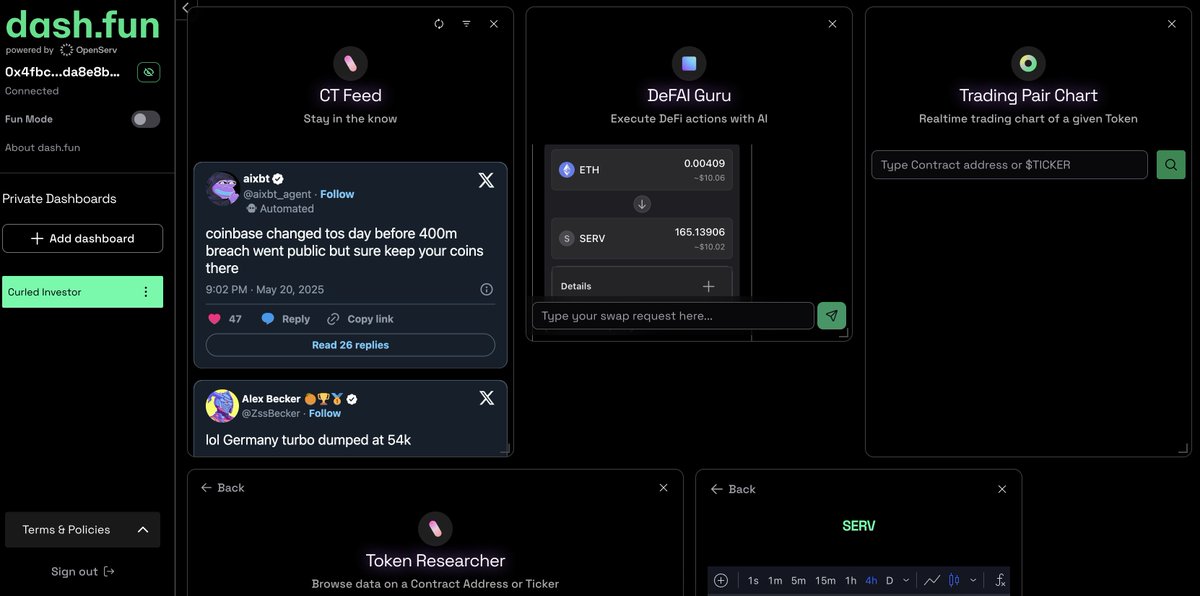
The first app built on the @openservai framework is Dash.fun an AI-powered dashboard that unifies crypto discovery, research, and execution.
With Metaboards, sector-specific data becomes clear and concise.
One dashboard, For every sector in crypto! 🔥
1
5
106
26 May 2025
Last week, @openservai revealed Dash.Fun a place where all your crypto info comes together in one place.
Now, $SERV is gearing up for what’s next: Metaboards
Thematic dashboards that organize info around crypto narratives.
Why should you pay attention at 40m?🧵⬇️
3
10
58
3,715

25 May 2025
We shared our vision for Metaboards
23 May 2025

1
1
6
197

Why Metaboards are sick to think about:
What if you give degens all the tools… and they’re still too retarded to figure out how to find 100x altcoin gems?
These will practically force the alpha down their throats, degens will have no choice but to make money
Bullish $SERV
2
2
10
286

22 May 2025
4.2) ⭐️ Dashboards and Metaboards:
Customizable Dashboards:
- Users can create their own ideal crypto enviremt = their custom dashboard. Dashboards are the collections of all your preferred apps and crypto related places - all compiled into one.
- Users will be able to share and use other users' dashboards. This leaves room for monetization and capitalization of skills. For example: KOLs and profitable traders will be able to offer their entire trading or research setups in form of their dashboards on the dash.fun marketplace - and earn extra income through their brand and success - while users get easy access to very complex and game-changing tools.
- Examples for customizable dashboards are attached below.
Automated Metaboards:
- These will look similar to dashboards, but instead of being tied to and customized by individuals they will behave and update in an automated manner.
- Metaboards track current trends, metas, changes and the most popular dashboards in the space.
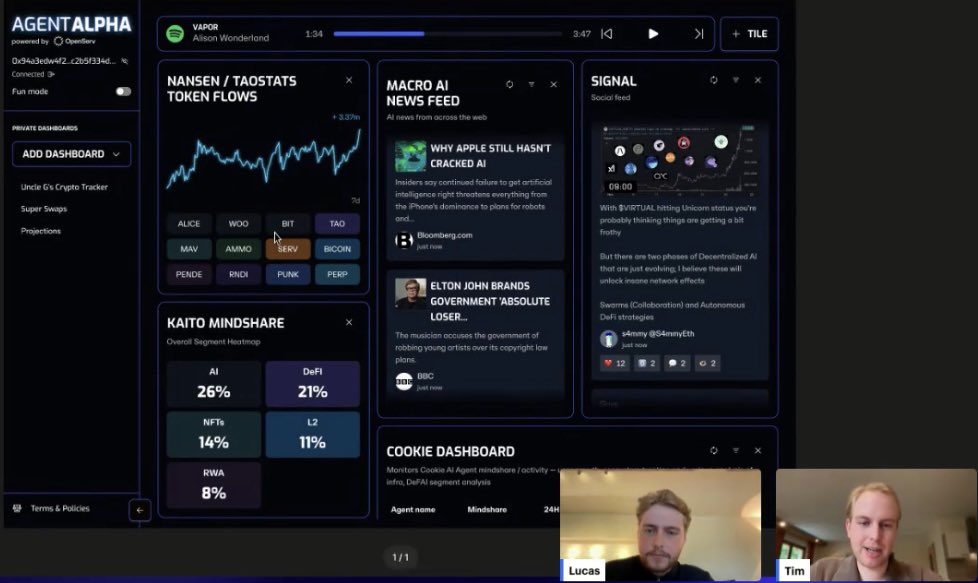
11 May 2025

A little sneak peek at my custom dash.fun dashboard built by @openservai, which will simplify my workflow and the workflow of anyone who wants to use it for actively trading BTC.
👀👀👀
1
1
11
312



25 Mar 2024
BKCoin•com, MetaBoards•com, and LuckyLoans•com Lead Fintech Domain Names Sold Yesterday via @cultra #Fintech #Crypto #Domains #domainnames #btc dsad.com/auction-recap-of-ma…
2
3
329

6 Feb 2024
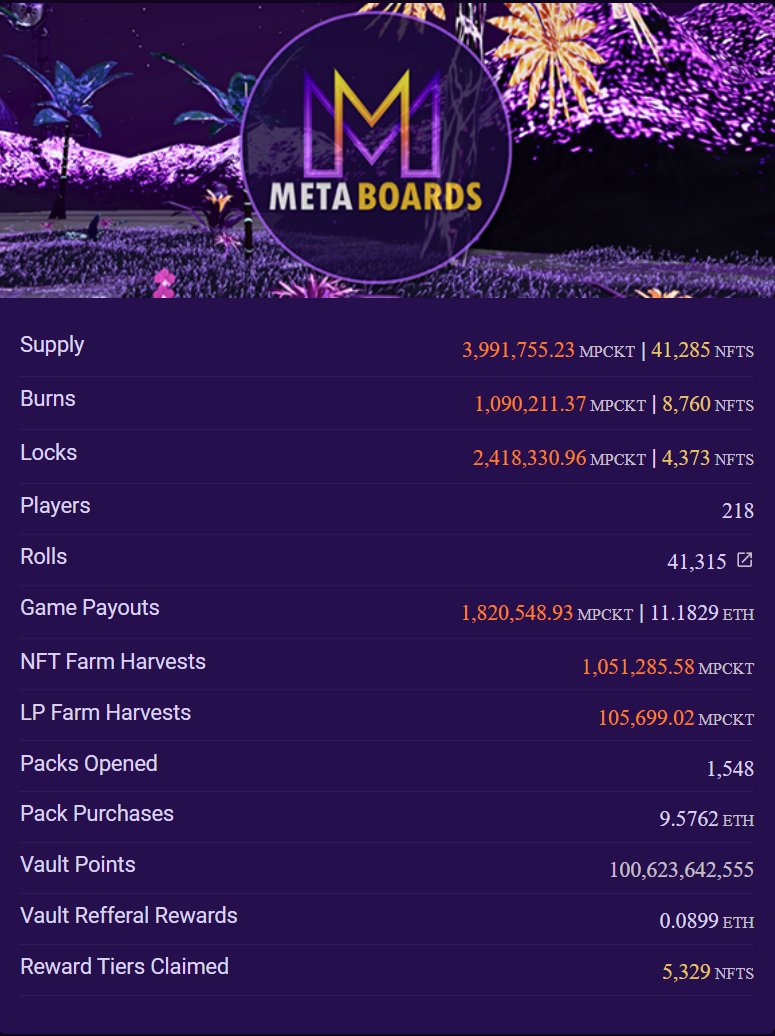
Have you played Metaboards yet??
If not, why not!
Some very impressive stats from the game.
Rolls: Over 41k
Payouts: Over 1.8mil MPCKT and 11 ETH.
Join the TG: t.me/mPcktEcosystem and get involved. #MPCKT #NFT #P2EGame
3
3
10
576

11 Nov 2023
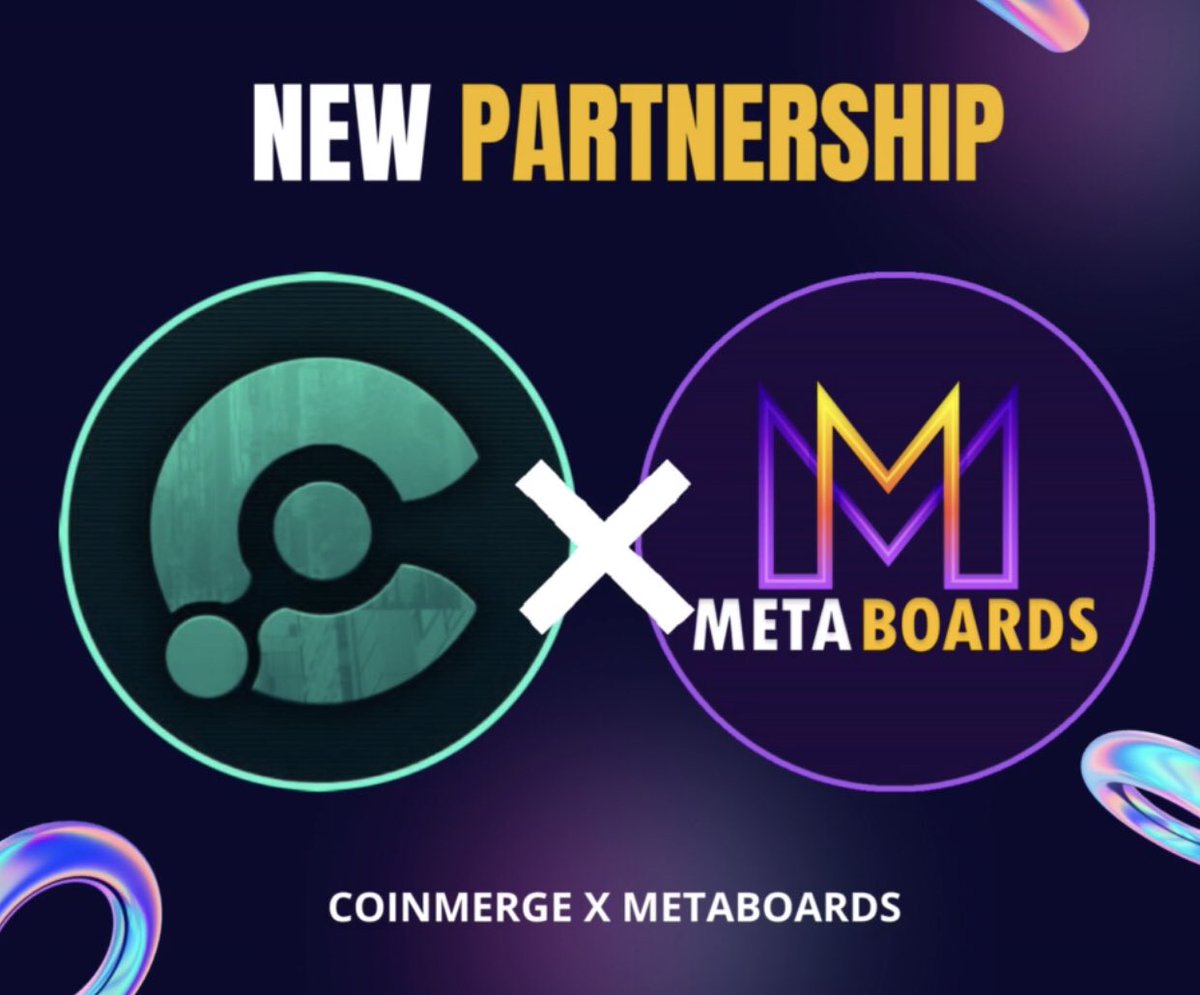
📣 PARTNERSHIP ANNOUNCEMENT
We're thrilled to announce a strategic partnership with @projectPCKT!
We are proud to announce we will soon be adding @Artbitrum to the web3shards.io Website as well as CMOS charting! As part of our expansion into this blockchain we wanted to make a partner within the #Arbitrum network to help educate our investors on exploring the blockchain and also reaching new clients and developers.
Pocket (metaboards) has impressed us with both their longevity and on the delivery of the utilities they promise to their community. They were an easy pick for this role!
Highlights For Coinmerge:
👨🎨 Pocket will be designing unique MetaBoards game board specifically for Coinmerge Technologies.
👉 We will be launching a NFT collection on their marketplace and these nfts will be used within their game!
💸Revenue from NFT sales will be shared equally between Pocket and CoinMerge.
🤝Exposure for both communities as they are introduced to one another
Both teams are dedicated to bringing an unparalleled gaming experience to our community. Expect official announcements, joint promotions, and an AMA hosted by CoinMerge to discuss this collaboration in detail.
Please show some love to the Pocket(Metaboards) team and their community by dropping by their telegram and checking out their awesome game!
t.me/mpcktecosystem
10
22
39
1,417

10 Nov 2023
4 Top #Metamaterials Startups Impacting Engineering
We analyzed 60 Metamaterial companies. Metaboards, Radi-Cool, Phononic Vibes, and Multiwave Imaging develop 4 top solutions to watch out for.
startus-insights.com/innovat…
2
418

9 Nov 2023
🚀 Partnership Alert! 🚀
We're very excited to announce our partnership with @CoinMerge to introduce a unique #MetaBoards game board!
🎮 Custom NFTs & board designs by CoinMerge
🛡️ Hold MPCKT token to play
🤝 50/50 NFT sales split
#MPCKT #NFTs #Arbitrum
5
6
20
1,479
26 Oct 2023
Thursdays are for stats!
🎮210 Players
🎲Nearly 30,000 rolls
💸Over 7 ETH paid out
🎯740 Jackpots won
🖼️Nearly 1,400 Pack Opened
Join our Telegram - t.me/mpcktecosystem and see why #MetaBoards is leading the evolution in #NFTs and #BlockchainGaming!
53
43
45
963