Filter
Exclude
Time range
-
Near
Philosophical warfare against 2,500 years of Aristotle brainwashing. Hack your own brain. The goal isn’t accepting another close-minded belief system (b.s.) — it’s metaprogramming consciousness and escaping every fixed map. RAW’s most subversive tool for the post-truth era. Open your mind to a new way of seeing the world: newdawnmagazine.com/articles… #RobertAntonWilson #GuerrillaOntology #RealityTunnels #NewDawnMagazine

35
doom has all these weird tricks you can do with the original engine and nobody is doing any metaprogramming with them
1
9
Replying to @geofflangdale
Python has optional static typing nowadays and frankly for learning there's no magic. Batteries included just means it has libraries. The magic is when you get into metaprogramming, which beginners and even many practitioners don't really do.
1
1
29
elimination of redundant boilerplate code, vital for game engines and UI libraries in being able to perform object introspection without lots of messy hacky runtime overhead, more opportunities for rigorous type safety, less reliance on abstruse template metaprogramming hacks
2
1
11
273
ia800609.us.archive.org/25/i… Chapter 1 Technical Hacking Concepts Applied to Biology • Computer Hacking Models Mapped to Minds: • Viruses/Malware: Self-replicating “mind viruses” that infect neural patterns, altering thoughts, emotions, or inducing symptoms (e.g., via polymorphic/adaptive code). • Trojans/Backdoors: Stealthy infiltration for remote control/monitoring without detection. • Bots/Spiders/Intelligent Agents: Automated scripts for surveillance, data exfiltration (thoughts/memories), or behavioral manipulation. • Brute Force, Lock & Key Mechanisms: Precise targeting using frequencies (UHF/ELF), “brain prints,” or biometric signatures for individualized attacks. “Lock and key” for neural pathway access. • Signal Jamming and False Inputs: Introducing noise or synthetic signals (e.g., V2K-like voices, visual overlays, tactile sensations) to disrupt or override natural brain function. Examples include voice transformation to familiar tones. • Reverse Engineering the Brain: Detailed neural mapping, cognitive models (e.g., MIND-like duplicators), and bidirectional interfaces for reading/writing thoughts. 4. Advanced Topics and Implications • Microwave Warfare & Brain Modulation: History and mechanisms of RF/microwave effects on the brain (Havana Syndrome parallels, auditory effects, physiological disruption). • Cognitive & Perception Warfare: Tactics for inducing confusion, false memories, paranoia, or scripted behaviors. Includes hypnosis via RF and metaprogramming. • Mind Viruses & AI Systems: Polymorphic malware analogies; introduction to adaptive AI like SATAN for real-time torture/optimization. Scalable for individuals to populations; “zombification,” sleeper agents, and enslavement. • Brainwashing & Interrogation: Evolution from physical to remote methods; resistance techniques mentioned briefly. • Ethical/Legal Warnings: Non-consensual testing on civilians, gaslighting, plausible deniability. Questions scalability and runaway risks.

47
Jun 13
ah! makes sense! BuildIt is completely template free metaprogramming though
1
2
23
reminded me of that einsum optimization thing you did in buildit with template metaprogramming
1
2
11
introducing lean-verifier-env, a lean 4 theorem-proving RL environment for verifier-backed proof training. built on @PrimeIntellect environments, @willccbb's verifiers stack, and @axiommathai's axle for hosted proof verification. env link: app.primeintellect.ai/dashbo… the overall idea is to use lean as a form of training to learn not only general strategies for proving, but also the structured knowledge contained within traditional formal mathematicians, and ultimately to develop more autoresearch-style systems that can generate, decompose and verify proofs autonomously for unsolved problems. a lot of the inspiration for this work came from listening to recent podcasts of @CarinaLHong and thinking how difficult it is to actually crack this domain, and honestly i love math man. so the setup is simple like any other env: the model receives a lean theorem ending in := by, returns a proof, and then env checks it through either hosted axle or a local lean backend (mathlib lean4 leanprover-community/repl binary). the reward is 1.0 only when the submitted proof verifies. for now, the progress i've made is: -> supported 5 modes: single proof submission, repair with lean diagnostics, agentic lean_check(proof) tool-use, tactic-by-tactic step mode, and rlm-style recursive proof decomposition (iffing on the new RLMEnv type). (more info in the readme) -> lean4 mathlib are embedded into a prime sandbox image for rlm mode, so the root model can decompose the theorem, call sub-models, verify snippets in-sandbox, and assemble the final proof. -> axle is used for hosted smoke tests / quick checking (as we get only 20 calls/day), while the local lean backend is the intended training path since it avoids hosted checker limits and scales with cpu workers. -> added anti-cheat checks around sorry, admit, local axioms, unsafe, and metaprogramming. the local backend also runs a post-verification axiom audit. -> includes dataset presets around toy tasks, lean workbook, minif2f, proofnet, and putnam. and for the leaderboard pass@1 and pass@k the next thing i want to run is the full hosted rlm leaderboard and the prime-rl run.
3
6
59
7,220
Replying to @ChShersh
thoughts on template metaprogramming?
16
Replying to @fidexcode
Python ignores them. Semicolons are statement terminators, optional unlike Java or C. Teams mixing languages in scripts discover this late: one semicolon in dynamically generated code breaks metaprogramming assumptions at runtime. Syntax rules become invisible bugs.
4
230
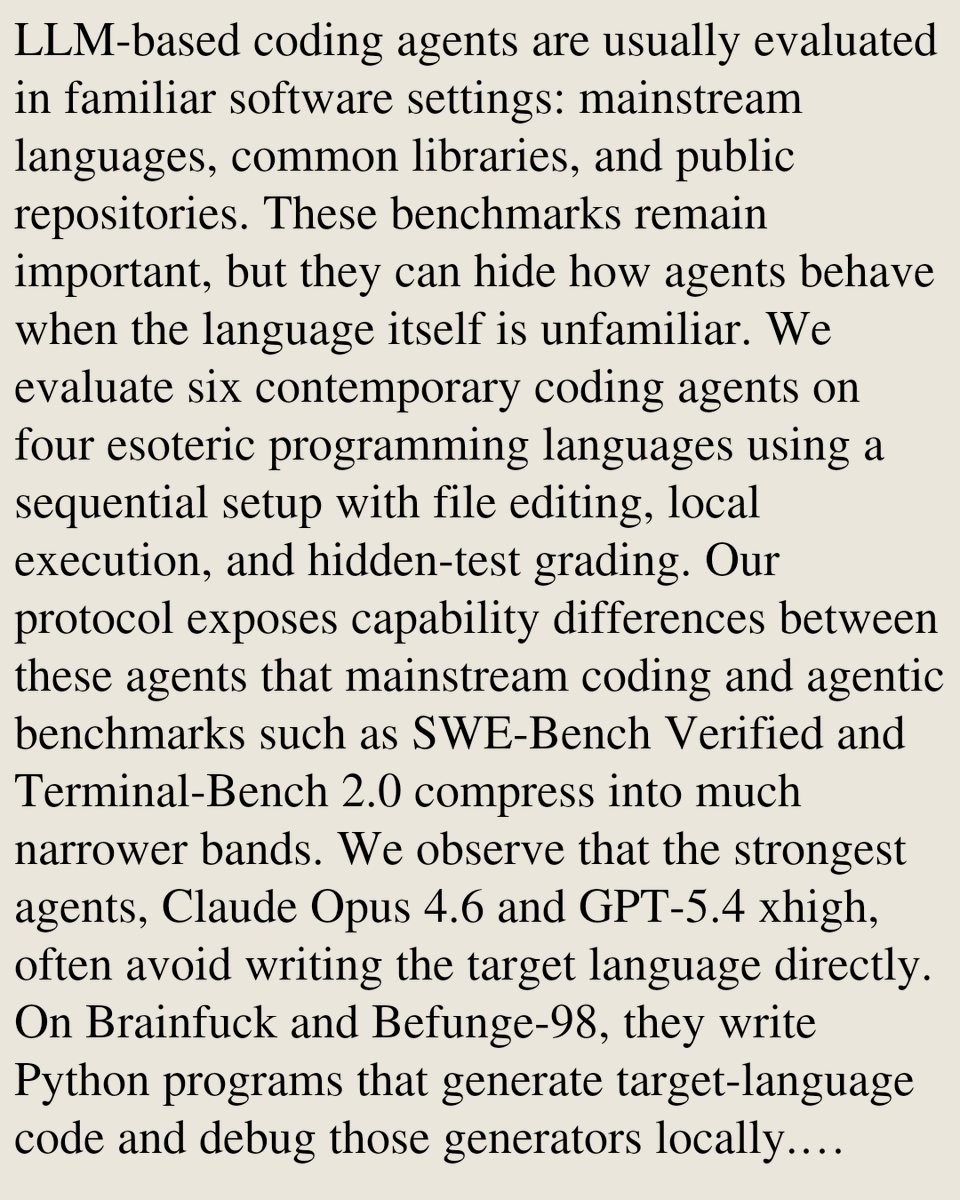
Frontier Coding Agents Use Metaprogramming to Adapt to Unfamiliar Programming Languages Aman Sharma, Sushrut Thorat, Paras Chopra arxiv.org/abs/2606.10933 [𝚌𝚜.𝙰𝙸]
2
71
Morphic Resonance and Metaprogramming!
Jun 12
Many of you were called by God to be on this app… To shatter their psyops…. To expose their evil…. To do God’s work…. Don’t let them tell you that what you do here doesn’t matter…. That you are not making a difference…. You are. Everyday.
1
2
297
مع التوسع الهائل في تطبيقات الذكاء الاصطناعي والحاجة إلى الاستفادة القصوى من قدرات العتاد الحديث، أصبح المطورون يبحثون عن لغات تجمع بين سهولة البرمجة والأداء العالي. وهنا تظهر لغة Mojo كواحدة من أكثر المشاريع إثارة للاهتمام في عالم البرمجة، حيث تهدف إلى الجمع بين بساطة Python وسهولة استخدامها، وبين الأداء القريب من لغات الأنظمة مثل C وC . تقدم هذه الدورة مدخلًا عمليًا للتعرف على Mojo، اللغة الجديدة المصممة خصيصًا لتلبية متطلبات تطوير تطبيقات الذكاء الاصطناعي والحوسبة عالية الأداء. وقد تم تطوير Mojo بواسطة الفريق الذي يقوده مبتكر لغة Swift، بهدف تقليص الفجوة بين النماذج البحثية والتطبيقات الإنتاجية من خلال توفير لغة تجمع بين المرونة والقوة في آن واحد. تبدأ الدورة بشرح فلسفة Mojo وأسباب ظهورها، ثم تنتقل إلى إعداد بيئة العمل وكتابة أول البرامج باستخدامها. ويتعلم المشاركون كيفية التعامل مع المتغيرات وأنواع البيانات والدوال والشروط والحلقات التكرارية، مما يجعلها مناسبة للمطورين القادمين من Python والراغبين في الانتقال إلى بيئة أكثر كفاءة من ناحية الأداء. كما تغطي الدورة مفاهيم البرمجة كائنية التوجه (OOP)، وإدارة الأخطاء والاستثناءات، واستيراد المكتبات، بالإضافة إلى مفاهيم متقدمة تميز Mojo عن Python التقليدية، مثل آليات إدارة الذاكرة والملكية (Ownership) والاستعارة (Borrowing)، وهي مفاهيم مستوحاة من لغات الأنظمة الحديثة التي تركز على الأداء والأمان. ومن أبرز محاور الدورة التعرف على SIMD، وهي تقنية تسمح بتنفيذ العمليات على مجموعات من البيانات بشكل متوازٍ، مما يساهم في تحسين الأداء في التطبيقات العلمية وتطبيقات الذكاء الاصطناعي. كما يتم استعراض إمكانيات Metaprogramming وDecorators التي تمنح المطورين مرونة إضافية في بناء الأنظمة والأدوات البرمجية. وتتضمن الدورة مقارنات عملية بين Mojo وPython من حيث الأداء والسرعة، مما يساعد على فهم القيمة الحقيقية التي تسعى اللغة إلى تقديمها لمطوري الذكاء الاصطناعي والحوسبة المتقدمة. إذا كنت تعمل في مجال الذكاء الاصطناعي أو ترغب في استكشاف الجيل القادم من لغات البرمجة عالية الأداء، فإن Mojo تمثل تقنية واعدة تستحق المتابعة والتعلم منذ مراحلها المبكرة. #برمجة #تقنية #MojoLang freecodecamp.org/news/new-mo…
2
146
Replying to @teej_dv
does it have dependent types? Type refinement? Does your compiler use an IR that can lower to multiple targets? And metaprogramming features? Pattern matching? Multi-dispatch?
3
408
Replying to @teej_dv
If you don’t have any metaprogramming that reuse the runtime semantics at compile time and you wouldn’t use your language to write a compiler because it’s a good language for that then don’t bother.
4
639
Headius Enterprises retweeted
Exciting demonstration of how fast JRuby can really be when you sweep away some of the metaprogramming layers of a typical Rails application... even when it already handles Rails HTML requests 2x faster than CRuby! Looking forward to seeing more about Roundhouse.
The Ruby JRuby Was Built to Run: intertwingly.net/blog/2026/0…
2
18
1,468
Replying to @tsoding
Waiting for Jai's metaprogramming? Next best thing: writing C refactoring scripts in TypeScript using ast-grep
235