
25 May 2024
🔬 Step 5 of our series unveils "Model Interpretation and Deployment in Drug Discovery"! 🌟 Explore how we decipher AI model predictions and deploy them for real-world impact. 💊 #AIDrugDiscovery #ModelInterpretation #BioInnovation #BioDawnInnovations
biodawninnovations.com/found…
1
1
29

1 Sep 2023
The intricacies of compartmental models (SIR, SEIR) and their role in understanding and predicting disease dynamics:
1/ Understanding disease dynamics is crucial for predicting outbreaks and implementing effective public health measures. Compartmental models like SIR and SEIR are fundamental tools used by epidemiologists for this purpose. Let's delve deeper into how they work. #Epidemiology
2/ The SIR model divides the population into three compartments: Susceptible (S), Infected (I), and Recovered (R). It assumes that everyone in the population belongs to one of these compartments. #SIRmodel #DiseaseDynamics
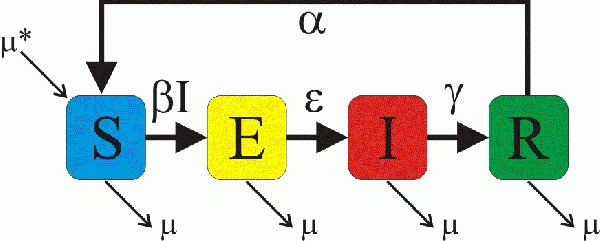
3/ The SEIR model adds another compartment, Exposed (E), to the SIR model. Individuals in the Exposed compartment have been infected but are not yet infectious. This accounts for the incubation period of the disease. #SEIRmodel #IncubationPeriod
4/ The transition of individuals between compartments is represented by parameters: beta (infection rate), gamma (recovery rate), and in the case of the SEIR model, sigma (rate of progression from exposed to infectious). #Parameters #InfectionRate #RecoveryRate
5/ These parameters are crucial because they determine the dynamics of the disease. For example, 'R0', the basic reproduction number, is calculated as beta/gamma in the SIR model. It represents the average number of people an infected person will infect. But this is a simplification, and actual calculations may vary based on the disease and model specifics.
#R0 #ReproductionNumber
6/ The parameters (beta, gamma, sigma) may vary over time and between different populations. More advanced models can incorporate this variability to provide more accurate predictions.
7/ The models can be further refined by adding more compartments, such as a compartment for deceased individuals, or by dividing the population into different age groups or geographical locations. #ModelRefinement #PopulationDynamics
8/ Compartmental models are usually fitted to real-world data to estimate the parameters and make predictions. This involves using statistical methods to find the values of the parameters that best explain the observed data. #ModelFitting #Predictions
9/ It is important to note that these models make several assumptions, such as homogeneous mixing of the population and constant parameters over time. In reality, these assumptions may not hold, and more complex models may be needed. #ModelAssumptions #ComplexModels
10/ There are several R packages available for fitting and analyzing compartmental models. Some popular ones include 'EpiModel', 'epimdr ' and 'deSolve'. #Rpackages #DataAnalysis
11/ Understanding the intricacies of compartmental models is key to interpreting their results and using them to inform public health decisions. Compartmental models like SIR and SEIR can be used to estimate the impact of interventions like social distancing or vaccination. This helps policymakers make informed decisions to control the spread of the disease. #PublicHealth #ModelInterpretation
12/ While SIR and SEIR models are valuable tools for understanding and predicting disease dynamics, they are simplifications of reality. They should be used with caution and in conjunction with other forms of analysis and expert opinion. #epidemiology #publichealth #DataScience
2
33
137
12,299

23 Mar 2022
ModelRunner: an Open Source, #NoCode, #NLU and voice ready Data Platform buff.ly/3D6IXok via @JordiCabot
#voicemodeling #modelinterpretation #voicebot
1
4

24 Jan 2022
Interpret high-dimensional ML models from a transformed perspective using #RStats package `wiml` -> quick example from #RemoteSensing in my blog geods.netlify.app/post/inter… #ModelInterpretation
13 Apr 2021

Transforming Feature Space to Interpret Machine Learning Models
deepai.org/publication/trans…
by Alexander Brenning
#PatternRecognition #MachineLearning
2
1

24 Dec 2020
Explainable AI in Python with LIME
In this video, I'm collaborating with Diogo Alves de Resende who will be showing us how to use #LIME to explain a #machinelearning model's prediction in #Python.
youtu.be/Qs0V5ntEWWQ
#explainableai #datascience #modelinterpretation #youtube
5

7 Jun 2018
The #predictive power of #machinelearning models often move inversely to their #interpretability. This post is the 1st in a series of 4 explaining the importance & application of #ModelInterpretation ow.ly/Mlp530kilA8 #datascience
4

28 Nov 2017
If you'll be at the TextXD conference at UC Berkeley this Thursday, don't miss the 11:15am talk on #NLP by our very own #DataScience expert @MaverickPramit. hubs.ly/H09hJ9y0 #ModelInterpretation #skater #python
1