
Which command is used to display network interface information, including IP addresses, in modern Linux systems?
A. ifconfig
B. ip addr
C. netstat
D. route
10
19
2,263

Jun 14
NETWORKING ROADMAP
Step 1: Learn computer fundamentals (how systems work, data, hardware basics)
Step 2: Understand what a network is (LAN, WAN, MAN, client-server model)
Step 3: Study OSI and TCP/IP models (how data moves in layers)
Step 4: Learn IP addressing (IPv4, IPv6, public vs private IP)
Step 5: Learn subnetting basics (CIDR, subnet masks, network segmentation)
Step 6: Understand networking devices (router, switch, hub, firewall, access point)
Step 7: Learn basic networking protocols (HTTP, HTTPS, DNS, DHCP, FTP, SSH)
Step 8: Practice network configuration (static IP, DHCP, gateway, DNS setup)
Step 9: Learn basic networking commands (ping, ipconfig/ifconfig, traceroute, nslookup, netstat)
Step 10: Understand wireless networking (Wi-Fi standards, WPA2/WPA3 security)
Step 11: Learn basic network security concepts (firewalls, VPN, IDS/IPS, common attacks)
Step 12: Start packet analysis (Wireshark, understanding packets and traffic flow)
Step 13: Practice networking labs (Cisco Packet Tracer, GNS3, TryHackMe)
Step 14: Move to advanced networking (VLANs, NAT, routing protocols like OSPF basics)
Step 15: Explore career paths (Network Engineer, SOC Analyst, Cybersecurity Analyst, Cloud Networking).
3
25
105
2,548


Jun 13
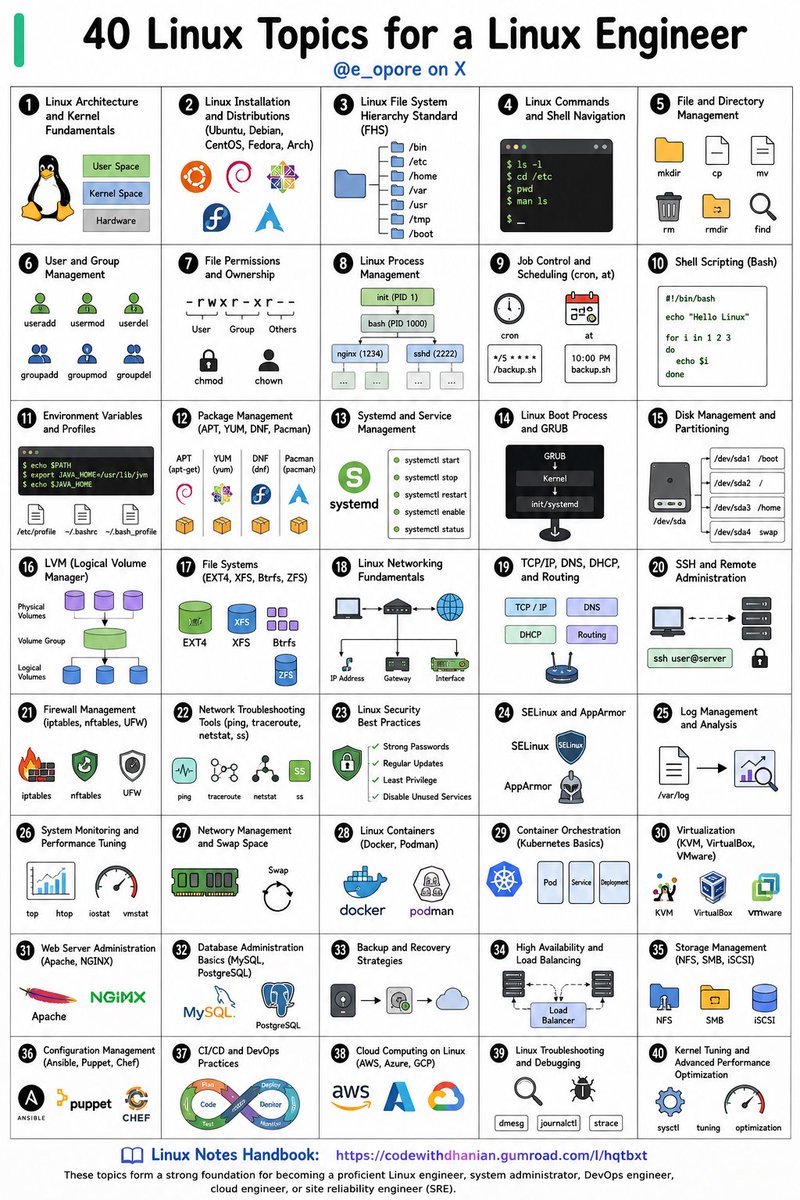
As a Linux Engineer,
It will be good if you have an understanding of the below 40 topics👇
1. Linux Architecture and Kernel Fundamentals
2. Linux Installation and Distributions (Ubuntu, Debian, CentOS, Fedora, Arch)
3. Linux File System Hierarchy Standard (FHS)
4. Linux Commands and Shell Navigation
5. File and Directory Management
6. User and Group Management
7. File Permissions and Ownership
8. Linux Process Management
9. Job Control and Scheduling (cron, at)
10. Shell Scripting (Bash)
11. Environment Variables and Profiles
12. Package Management (APT, YUM, DNF, Pacman)
13. Systemd and Service Management
14. Linux Boot Process and GRUB
15. Disk Management and Partitioning
16. LVM (Logical Volume Manager)
17. File Systems (EXT4, XFS, Btrfs, ZFS)
18. Linux Networking Fundamentals
19. TCP/IP, DNS, DHCP, and Routing
20. SSH and Remote Administration
21. Firewall Management (iptables, nftables, UFW)
22. Network Troubleshooting Tools (ping, traceroute, netstat, ss)
23. Linux Security Best Practices
24. SELinux and AppArmor
25. Log Management and Analysis
26. System Monitoring and Performance Tuning
27. Memory Management and Swap Space
28. Linux Containers (Docker, Podman)
29. Container Orchestration (Kubernetes Basics)
30. Virtualization (KVM, VirtualBox, VMware)
31. Web Server Administration (Apache, NGINX)
32. Database Administration Basics (MySQL, PostgreSQL)
33. Backup and Recovery Strategies
34. High Availability and Load Balancing
35. Storage Management (NFS, SMB, iSCSI)
36. Configuration Management (Ansible, Puppet, Chef)
37. CI/CD and DevOps Practices
38. Cloud Computing on Linux (AWS, Azure, GCP)
39. Linux Troubleshooting and Debugging
40. Kernel Tuning and Advanced Performance Optimization
📘 Grab Linux Notes Handbook:
codewithdhanian.gumroad.com/…
These topics form a strong foundation for becoming a proficient Linux engineer, system administrator, DevOps engineer, cloud engineer, or site reliability engineer (SRE).
4
31
200
4,400

Jun 13
Windows で Claude Code / Codex / OpenCode で使う時、トークン削減するおまじない。うちの事務所の全台で実行した。気休めかもしれないが。
----
トークンコストの削減のために以下の処理をスキルにしてください。
----
このタスクは推論を必要としない機械的な操作です。
以下のコマンドカテゴリに該当する場合、/model haiku に切り替えてから実行してください。
## 対象コマンド
### Git
git status, git log, git log --oneline, git diff, git diff --staged, git add, git commit, git push, git pull, git fetch,
git branch, git checkout, git stash, git stash pop
### GitHub CLI
gh pr list, gh pr view, gh pr create, gh pr merge,
gh issue list, gh issue view, gh issue create,
gh run list, gh run view
### このプロジェクト
uv run pytest, uv run pytest -v, uv run pytest <test_file>,
uv run importer, uv run housekeeping,
uv pip install, uv sync
### Windows / PowerShell
dir, ls, Get-ChildItem, cd, Set-Location, mkdir, New-Item, copy, Copy-Item, type, Get-Content, echo, tasklist, Get-Process, where, Get-Command, $env:変数名, [Environment]::GetEnvironmentVariable(), ping, ipconfig, netstat, Select-String, Measure-Object, Out-File
## 実行手順
1. /model haiku
2. コマンドを実行
3. 結果を出力
4. 必要なら /model {{元のモデル}} に戻す
1
2
169

乱暴な話、netstat -sac? 辺りで個々に抽出すれば、とれるかも…
1
1
15

Jun 12
Land on a new machine? Ask 3 questions:
Who am I? → whoami / id
Where am I? → pwd
What's running? → ps / netstat
Plus uname, ifconfig/ip, hostname.
These are your first 10 seconds on any box.
1
3

Jun 11
Also got through package management (apt, dpkg), process management (ps, top, kill) and network troubleshooting: ping, traceroute, netstat, dig and curl. The CCNA brain helped on that last one.
1
25

Jun 11
What is the ‘netstat’ command, and what can it do? cellstream.com/2010/09/10/wh… #netstat #windows #MSwindows
6


Jun 10
Security fix in NervaOne v1.2.0.
Versions prior to v1.2.0 started wallet-rpc for XNV, XMR, and WOW without authentication. Any process running on the local machine could discover the wallet-rpc port via netstat and make unauthenticated calls to the wallet - including transfers - while a wallet was open.
v1.2.0 fixes this by requiring Digest authentication on wallet-rpc. Credentials are randomly generated at startup and never written to disk.
All users are strongly encouraged to upgrade. If you suspect your machine may have been compromised, move funds to a new wallet.
Thanks to @pixelpatchit for the responsible disclosure.
Jun 10

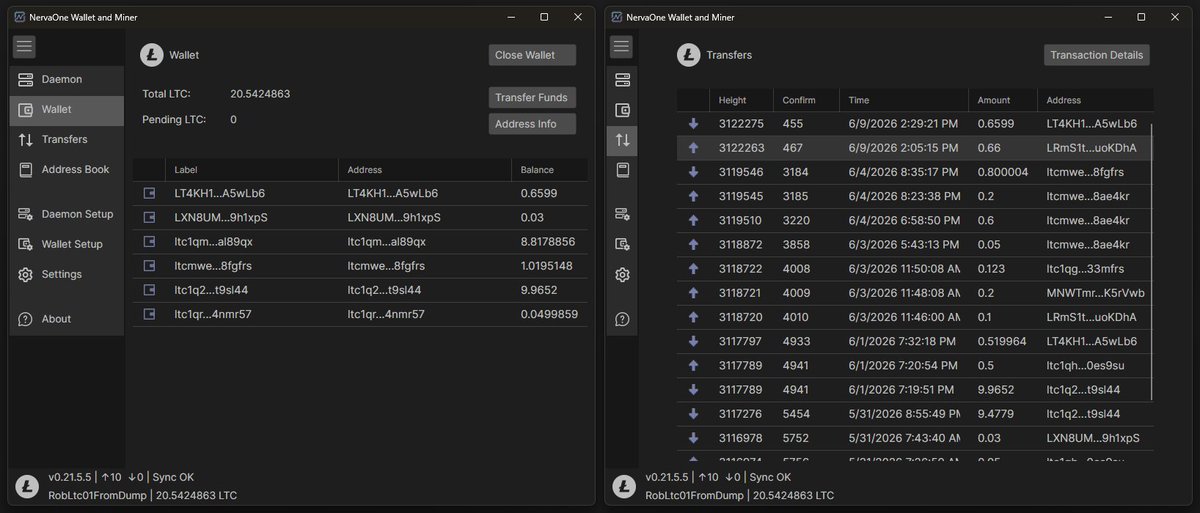
NervaOne now supports $LTC - and yes, that includes MWEB.
Run a full or pruned Litecoin node directly on your device, including MWEB privacy. Your keys. Your blockchain. Your rules. No custodians. No middlemen. Pure self-sovereignty.
✅ 100% open source
✅ Non-custodial - your coins never leave your device
✅ Blockchain runs on your device
Being your own crypto bank has never been this easy or this powerful.
NervaOne currently supports:
🟣 Nerva ($XNV)
🟠 Bitcoin ($BTC)
⚪ Litecoin ($LTC)
🟤 Monero ($XMR)
🔵 Dash ($DASH)
🐸 Wownero ($WOW)
Get NervaOne Wallet and Miner from Nerva website or GitHub:
🔗 nerva.one/#downloads
🔗 github.com/nerva-project/Ner…
2
1
8
428

Jun 10
今日の学習メモ✍️
Linuxのポート番号とネットワークの基礎について学習しました。
ポート番号は、サーバー上で動作するサービスごとの「入口」のような役割を持っている。
代表例
・80 → HTTP
・443 → HTTPS
また、netstat を実行することで、
現在接続待ち状態のポートを確認できる。
#Linux
14

Jun 10
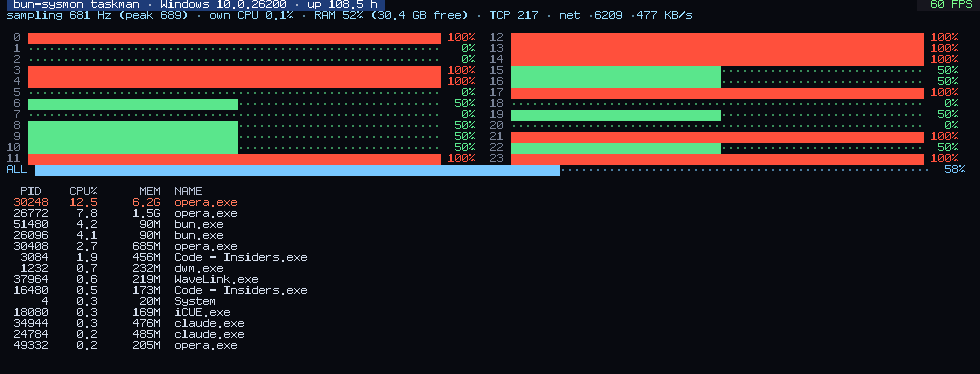
Proven, not promised: every number was measured against the published npm artifact. 86 integration assertions; 12/12 cross-checks vs tasklist, netstat, statfs registry agree.
AI agents: AI.md is the complete surface — zero source-reading needed.
github.com/ObscuritySRL/bun-…
94
Jun 10
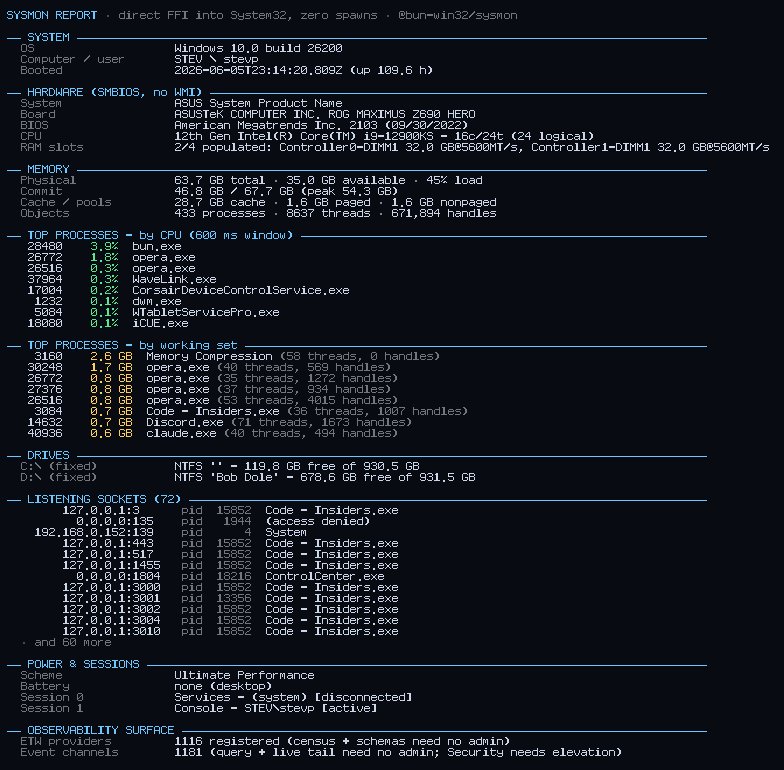
Inside, things NO other npm package has:
- a live decoded ETW firehose (Procmon-lite)
- Event Log tailing w/ publisher messages
- native perfmon counters, locale-proof
- per-process GPU% (Task Manager's column)
- SMBIOS without WMI
- socket-to-PID, no netstat
- whoLocks(file)
1
1
597

Jun 10
# In plain text
# This tweet is the code itself
# It has no dependencies or API calls
# It only talks to your node
# Chose your run length (dates, blocks)
# Copy paste this to your AI
# Or save it as "taproot_opif.py" and run it
# Your terminal: python3 taproot_opif.py
"""
taproot_opif.py — Analyze OP_IF usage in taproot script path spends via RPC.
Requires a running Bitcoin Core node with server=1.
No external dependencies — stdlib only.
Usage:
python3 taproot_opif.py --start-block 823786 --end-block 951964
python3 taproot_opif.py --start-day 2024-01-01 --end-day 2024-12-31
python3 taproot_opif.py --start-day 2024-01-01
"""
import argparse
import base64
import http.client
import io
import json
import os
import platform
import struct
import sys
import time
from time import time as now
from collections import defaultdict
from datetime import datetime, timezone, date, timedelta
from binascii import unhexlify
from io import BytesIO
from json import loads as json_loads, dumps as json_dumps
from struct import unpack, unpack_from
# ===========================================================================
# RPC connection (copied from open_settlement_price_v10_rc4.py)
# ===========================================================================
_KNOWN_COOKIE_DIRS = [
'/embassy-data/package-data/volumes/bitcoin/data/.bitcoin',
'/embassy-data/package-data/volumes/bitcoind/data/.bitcoin',
'/home/umbrel/umbrel/app-data/bitcoin/data/.bitcoin',
'/home/umbrel/umbrel/data/app-data/bitcoin/data/.bitcoin',
'/opt/umbrel-os/app-data/bitcoin/data/.bitcoin',
'/mnt/hdd/bitcoin',
'/mnt/hdd/.bitcoin',
'/mnt/storage/bitcoin',
'/opt/mynode/bitcoin',
]
_SEARCH_ROOTS = [
'/embassy-data', '/mnt', '/opt', '/home', '/srv', '/var/lib',
]
def _find_data_dir():
system = platform.system()
if system == 'Darwin':
return os.path.expanduser('~/Library/Application Support/Bitcoin')
elif system == 'Windows':
return os.path.join(os.environ.get('APPDATA', ''), 'Bitcoin')
else:
return os.path.expanduser('~/.bitcoin')
def _find_bitcoin_dir():
for d in _KNOWN_COOKIE_DIRS:
if os.path.exists(os.path.join(d, '.cookie')) or \
os.path.exists(os.path.join(d, 'bitcoin.conf')):
return d
for root in _SEARCH_ROOTS:
if not os.path.isdir(root):
continue
try:
for dirpath, dirnames, filenames in os.walk(root):
if '.cookie' in filenames or 'bitcoin.conf' in filenames:
return dirpath
except PermissionError:
continue
return None
def _find_rpc_host_from_ss(port):
import subprocess
for cmd in (['ss', '-tlnp'], ['netstat', '-tlnp']):
try:
raw_out = subprocess.check_output(cmd, stderr=subprocess.DEVNULL)
out = (raw_out
.decode())
for line in (out
.splitlines()):
if ':{}'.format(port) in line:
for part in (line
.split()):
if (part
.endswith(':{}'.format(port))):
host = (part.rsplit(':', 1)[0]
.strip('[]'))
if host not in ('0.0.0.0', '*', '127.0.0.1', '::1', '::'):
return host
except Exception:
continue
return None
def setup_rpc(data_dir=None, rpchost=None, rpcport=None, rpcuser=None, rpcpassword=None):
if data_dir is None:
data_dir = _find_data_dir()
if not os.path.exists(os.path.join(data_dir, '.cookie')) and \
not any(os.path.exists(os.path.join(data_dir, n))
for n in ('bitcoin.conf', 'bitcoin_rw.conf')):
found = _find_bitcoin_dir()
if found:
data_dir = found
conf_path = None
for name in ('bitcoin.conf', 'bitcoin_rw.conf'):
p = os.path.join(data_dir, name)
if os.path.exists(p):
conf_path = p
break
if not conf_path:
print(f"ERROR: Cannot find bitcoin.conf in {data_dir}")
sys.exit(1)
conf = {}
with open(conf_path) as f:
for line in f:
line = (line
.strip())
if not line or (line
.startswith('#')) or '=' not in line:
continue
k, v = (line
.split('=', 1))
k = (k
.strip())
conf[k] = (v
.strip()
.strip('"'))
cget = conf.get
rpc_user = rpcuser if rpcuser else cget('rpcuser')
rpc_pass = rpcpassword if rpcpassword else cget('rpcpassword')
rpc_host = rpchost if rpchost else cget('rpcconnect', '127.0.0.1')
rpc_port = rpcport if rpcport else int(cget('rpcport', '8332'))
cookie_path = cget('rpccookiefile', os.path.join(data_dir, '.cookie'))
_host = [rpc_host]
_conn = [None]
def rpc(method, *params):
u, p = rpc_user, rpc_pass
if not u or not p:
try:
with open(cookie_path) as f:
u, p = (f
.read()
.strip()
.split(':', 1))
except Exception as e:
print(f"ERROR: cannot read RPC cookie at {cookie_path}: {e}")
print("Make sure your Bitcoin node is running.")
sys.exit(1)
auth = (base64.b64encode(f'{u}:{p}'.encode())
.decode())
headers = {'Content-Type': 'application/json',
'Authorization': f'Basic {auth}'}
payload = json_dumps({'jsonrpc': '1.0', 'id': 'taproot_opif',
'method': method, 'params': list(params)})
for attempt in range(3):
try:
if _conn[0] is None:
_conn[0] = http.client.HTTPConnection(_host[0], rpc_port, timeout=60)
(_conn[0]
.request('POST', '/', payload, headers))
resp = (_conn[0]
.getresponse())
raw = (resp
.read())
data = json_loads(raw)
if (data
.get('error')):
raise RuntimeError(data['error'])
return data['result']
except Exception:
_conn[0] = None
if attempt == 2:
raise
try:
rpc('getblockcount')
except Exception:
pass
try:
rpc('getblockcount')
except Exception:
if not rpchost:
detected = _find_rpc_host_from_ss(rpc_port)
if detected:
_host[0] = detected
_conn[0] = None
try:
rpc('getblockcount')
return rpc
except Exception:
pass
print("ERROR: cannot connect to Bitcoin node via RPC.")
print("Make sure bitcoind or bitcoin-qt is running with server=1.")
print("If your node runs in a container, try: --rpchost <container-ip>")
sys.exit(1)
return rpc
# ===========================================================================
# Block / date helpers (copied from open_settlement_price_v10_rc4.py)
# ===========================================================================
_hash_cache = {}
_ts_cache = {}
def _get_block_hash(height, rpc):
if height not in _hash_cache:
_hash_cache[height] = rpc('getblockhash', height)
return _hash_cache[height]
def _get_block_timestamp(height, rpc):
if height not in _ts_cache:
h = _get_block_hash(height, rpc)
raw = unhexlify(rpc('getblockheader', h, False))
_ts_cache[height] = unpack('<I', raw[68:72])[0]
return _ts_cache[height]
def _get_raw_block(height, rpc):
h = _get_block_hash(height, rpc)
hex_block = rpc('getblock', h, 0)
return unhexlify(hex_block)
def _find_first_block_on_or_after(day_start_ts, chain_height, rpc):
lo, hi = 0, chain_height
while lo < hi:
mid = (lo hi) // 2
if _get_block_timestamp(mid, rpc) < day_start_ts:
lo = mid 1
else:
hi = mid
return lo
def _find_last_block_before(day_end_ts, chain_height, rpc):
lo, hi = 0, chain_height
while lo < hi:
mid = (lo hi 1) // 2
if _get_block_timestamp(mid, rpc) < day_end_ts:
lo = mid
else:
hi = mid - 1
return lo
def date_range_to_blocks(start_date, end_date, chain_height, rpc):
"""Return (start_block, end_block) for the given inclusive date range."""
start_ts = int(datetime(start_date.year, start_date.month, start_date.day,
tzinfo=timezone.utc)
.timestamp())
end_ts = int(datetime(end_date.year, end_date.month, end_date.day,
tzinfo=timezone.utc)
.timestamp()) 86_400
print(f"Searching for blocks between {start_date} and {end_date} ...", flush=True)
start_block = _find_first_block_on_or_after(start_ts, chain_height, rpc)
end_block = _find_last_block_before(end_ts, chain_height, rpc)
if start_block > chain_height:
print(f"ERROR: No blocks found on or after {start_date}")
sys.exit(1)
if end_block < start_block:
print(f"ERROR: No blocks found on or before {end_date}")
sys.exit(1)
start_actual = (datetime.fromtimestamp(_get_block_timestamp(start_block, rpc), tz=timezone.utc)
.date())
end_actual = (datetime.fromtimestamp(_get_block_timestamp(end_block, rpc), tz=timezone.utc)
.date())
print(f" Start: block {start_block:,} ({start_actual})")
print(f" End: block {end_block:,} ({end_actual})")
return start_block, end_block
# ===========================================================================
# Script parsing (shared logic with opif_analysis.py)
# ===========================================================================
OPCODE_NAMES = {
0x00: 'OP_0',
0x4f: 'OP_1NEGATE',
0x51: 'OP_1', 0x52: 'OP_2', 0x53: 'OP_3', 0x54: 'OP_4',
0x55: 'OP_5', 0x56: 'OP_6', 0x57: 'OP_7', 0x58: 'OP_8',
0x59: 'OP_9', 0x5a: 'OP_10', 0x5b: 'OP_11', 0x5c: 'OP_12',
0x5d: 'OP_13', 0x5e: 'OP_14', 0x5f: 'OP_15', 0x60: 'OP_16',
0x61: 'OP_NOP',
0x63: 'OP_IF',
0x64: 'OP_NOTIF', # kept for tokenizer completeness, not searched
0x67: 'OP_ELSE',
0x68: 'OP_ENDIF',
0x69: 'OP_VERIFY',
0x6a: 'OP_RETURN',
0x6b: 'OP_TOALTSTACK',
0x6c: 'OP_FROMALTSTACK',
0x6d: 'OP_2DROP',
0x6e: 'OP_2DUP',
0x6f: 'OP_3DUP',
0x73: 'OP_IFDUP',
0x74: 'OP_DEPTH',
0x75: 'OP_DROP',
0x76: 'OP_DUP',
0x77: 'OP_NIP',
0x78: 'OP_OVER',
0x79: 'OP_PICK',
0x7a: 'OP_ROLL',
0x7b: 'OP_ROT',
0x7c: 'OP_SWAP',
0x7d: 'OP_TUCK',
0x7e: 'OP_CAT',
0x82: 'OP_SIZE',
0x85: 'OP_1ADD',
0x86: 'OP_1SUB',
0x87: 'OP_EQUAL',
0x88: 'OP_EQUALVERIFY',
0x8b: 'OP_ADD',
0x8c: 'OP_SUB',
0x8f: 'OP_MOD',
0x91: 'OP_NOT',
0x92: 'OP_0NOTEQUAL',
0x9a: 'OP_BOOLOR',
0x9b: 'OP_NUMEQUAL',
0x9c: 'OP_NUMEQUALVERIFY',
0x9d: 'OP_NUMNOTEQUAL',
0x9e: 'OP_LESSTHAN',
0x9f: 'OP_GREATERTHAN',
0xa0: 'OP_LESSTHANOREQUAL',
0xa1: 'OP_GREATERTHANOREQUAL',
0xa2: 'OP_MIN',
0xa3: 'OP_MAX',
0xa4: 'OP_WITHIN',
0xa8: 'OP_SHA256',
0xa9: 'OP_HASH160',
0xaa: 'OP_HASH256',
0xac: 'OP_CHECKSIG',
0xad: 'OP_CHECKSIGVERIFY',
0xae: 'OP_CHECKMULTISIG',
0xb1: 'OP_CHECKLOCKTIMEVERIFY',
0xb2: 'OP_CHECKSEQUENCEVERIFY',
0xba: 'OP_CHECKSIGADD',
}
def read_varint(buf):
rd = (buf
.read)
b = rd(1)[0]
if b < 0xfd: return b
if b == 0xfd: return unpack('<H', rd(2))[0]
if b == 0xfe: return unpack('<I', rd(4))[0]
return unpack('<Q', rd(8))[0]
def extract_tapscript(stack):
items = list(stack)
if items and items[-1] and items[-1][0] == 0x50:
del items[-1]
if len(items) < 2:
return None
control = items[-1]
if len(control) < 33 or (len(control) - 33) % 32 != 0:
return None
if control[0] & 0xfe != 0xc0:
return None
return items[-2]
def tokenize_script(script):
tokens = []
i = 0
try:
while i < len(script):
op = script[i]; i = 1
if op == 0x00:
tokens = ['OP_0']
elif 1 <= op <= 0x4b:
tokens = [f'PUSH_{op}']
i = op
elif op == 0x4c:
n = script[i]; i = 1
tokens = [f'PUSH_{n}']
i = n
elif op == 0x4d:
n = unpack_from('<H', script, i)[0]; i = 2
tokens = [f'PUSH_{n}']
i = n
elif op == 0x4e:
n = unpack_from('<I', script, i)[0]; i = 4
tokens = [f'PUSH_{n}']
i = n
else:
name = OPCODE_NAMES.get(op, f'OP_{op:02X}')
tokens = [name]
except (IndexError, struct.error):
pass
return tokens
def scan_block(block_data, tally):
buf = BytesIO(block_data)
rd = (buf
.read)
sk = (buf
.seek)
rd(4); rd(32); rd(32); rd(4); rd(4); rd(4) # header
tx_count = read_varint(buf)
for _ in range(tx_count):
rd(4) # version
marker = rd(1)[0]
if marker == 0x00:
rd(1)
segwit = True
else:
sk(-1, 1)
segwit = False
in_count = read_varint(buf)
for _ in range(in_count):
rd(32 4)
rd(read_varint(buf))
rd(4)
out_count = read_varint(buf)
for _ in range(out_count):
rd(8)
rd(read_varint(buf))
if segwit:
for _ in range(in_count):
stack = []
for _ in range(read_varint(buf)):
n = read_varint(buf)
stack = [rd(n)]
script = extract_tapscript(stack)
if script is None:
continue
tokens = tokenize_script(script)
for pos, tok in enumerate(tokens):
if tok != 'OP_IF' or pos == 0:
continue
before = tokens[pos - 1]
tally[(before, tok)] = 1
rd(4) # locktime
# ===========================================================================
# Main
# ===========================================================================
def _parse_date(s):
try:
parts = (s
.split('-'))
return date(*map(int, parts))
except Exception:
print(f"ERROR: invalid date '{s}', expected YYYY-MM-DD")
sys.exit(1)
def main():
parser = argparse.ArgumentParser(
description='Analyze OP_IF usage in taproot script path spends.')
add = parser.add_argument
add('--all', action='store_true',
help='Analyze all taproot script path spends from block 767420 to chain tip')
add('--start-block', type=int, metavar='HEIGHT')
add('--end-block', type=int, metavar='HEIGHT')
add('--start-day', type=_parse_date, metavar='YYYY-MM-DD')
add('--end-day', type=_parse_date, metavar='YYYY-MM-DD')
add('--rpchost', type=str)
add('--rpcport', type=int)
add('--rpcuser', type=str)
add('--rpcpassword', type=str)
add('--datadir', type=str)
args = (parser
.parse_args())
using_all = args.all
using_blocks = args.start_block is not None or args.end_block is not None
using_dates = args.start_day is not None or args.end_day is not None
if sum([using_all, using_blocks, using_dates]) > 1:
print("ERROR: specify only one of --all, --start-block/--end-block, or --start-day/--end-day")
sys.exit(1)
if not using_all and not using_blocks and not using_dates:
try:
start_str = input("Start date (YYYY-MM-DD): ").strip()
end_str = input("End date (YYYY-MM-DD): ").strip()
except (EOFError, KeyboardInterrupt):
print()
sys.exit(0)
args.start_day = _parse_date(start_str)
args.end_day = _parse_date(end_str)
using_dates = True
if using_blocks and (args.start_block is None or args.end_block is None):
print("ERROR: --start-block and --end-block must both be provided")
sys.exit(1)
print("Connecting to Bitcoin node ...", flush=True)
rpc = setup_rpc(
data_dir=args.datadir,
rpchost=args.rpchost,
rpcport=args.rpcport,
rpcuser=args.rpcuser,
rpcpassword=args.rpcpassword,
)
chain_height = rpc('getblockcount')
print(f" Connected. Chain height: {chain_height:,}\n")
if using_all:
start_block = 767420
end_block = chain_height
elif using_blocks:
start_block = args.start_block
end_block = args.end_block
if start_block < 0 or end_block < 0:
print("ERROR: block heights must be non-negative")
sys.exit(1)
if start_block > end_block:
print(f"ERROR: --start-block ({start_block:,}) must be <= --end-block ({end_block:,})")
sys.exit(1)
if end_block > chain_height:
print(f"ERROR: --end-block ({end_block:,}) exceeds chain height ({chain_height:,})")
sys.exit(1)
else:
start_date = args.start_day
end_date = args.end_day or (date
.today()) - timedelta(days=1)
if start_date > end_date:
print(f"ERROR: --start-day ({start_date}) must be <= --end-day ({end_date})")
sys.exit(1)
start_block, end_block = date_range_to_blocks(start_date, end_date, chain_height, rpc)
total_blocks = end_block - start_block 1
print(f"\nAnalyzing {total_blocks:,} blocks ({start_block:,} – {end_block:,}) ...\n")
print(f"{'Block':>9} {'Progress':>8} {'OP_IF total':>12} {'OP_0 %':>8}")
print("-" * 50)
tally = defaultdict(int)
t0 = now()
for height in range(start_block, end_block 1):
block_data = _get_raw_block(height, rpc)
scan_block(block_data, tally)
if height % 10 == 0 or height == end_block:
done = height - start_block 1
pct_done = done / total_blocks * 100
total_if = sum(tally.values())
op0_count = sum(v for (b, _), v in tally.items() if b == 'OP_0')
op0_pct = op0_count / total_if * 100 if total_if else 0.0
print(f"{height:>9,} {pct_done:>7.1f}% {total_if:>12,} {op0_pct:>7.1f}%",
flush=True)
elapsed = now() - t0
# ── Final report ──────────────────────────────────────────────────────────
total_if = sum(tally.values())
op0_count = sum(v for (b, _), v in tally.items() if b == 'OP_0')
op0_pct = op0_count / total_if * 100 if total_if else 0.0
other_pct = 100 - op0_pct
print()
print("=" * 60)
print(" OP_IF USAGE IN TAPROOT SCRIPT PATH SPENDS")
print(f" Blocks {start_block:,} – {end_block:,} ({total_blocks:,} blocks)")
print("=" * 60)
rows = sorted(tally.items(), key=lambda x: -x[1])
col_w = 24
print(f"\n {'Preceding opcode':<{col_w}} {'Count':>12} {'Share':>7}")
print(f" {'-'*col_w} {'-'*12} {'-'*7}")
for (before, opif_type), count in rows:
share = count / total_if * 100 if total_if else 0.0
print(f" {before:<{col_w}} {count:>12,} {share:>6.2f}%")
print()
print("-" * 60)
if using_dates:
print(f" Period : {start_date} – {end_date} (blocks {start_block:,} – {end_block:,})")
else:
print(f" Period : blocks {start_block:,} – {end_block:,}")
print(f" Total OP_IF uses : {total_if:,}")
print(f" Preceded by OP_0 (dead code): {op0_count:,} ({op0_pct:.1f}%)")
print(f" Functional uses : {total_if - op0_count:,} ({other_pct:.1f}%)")
print("-" * 60)
print()
print(f" Of the {total_if:,} uses of OP_IF in taproot script path spends during this")
print(f" period, {op0_pct:.1f}% were preceded by OP_0 (OP_FALSE), meaning the branch")
print(f" body is permanently unreachable — the code can never execute.")
print(f" The remaining {other_pct:.1f}% of OP_IF uses represent genuine conditional logic.")
print()
print(f" Completed in {elapsed:.1f}s")
if __name__ == '__main__':
main()
4
5
33
2,258

Linux isn't optional in cybersecurity.
Master these commands and you'll navigate systems faster, analyze data efficiently, and improve your workflow:
✅ ls -la
✅ cd
✅ grep
✅ netstat -tulpn
✅ chmod
Small commands. Massive impact.
Which Linux command do you use the most? 👇
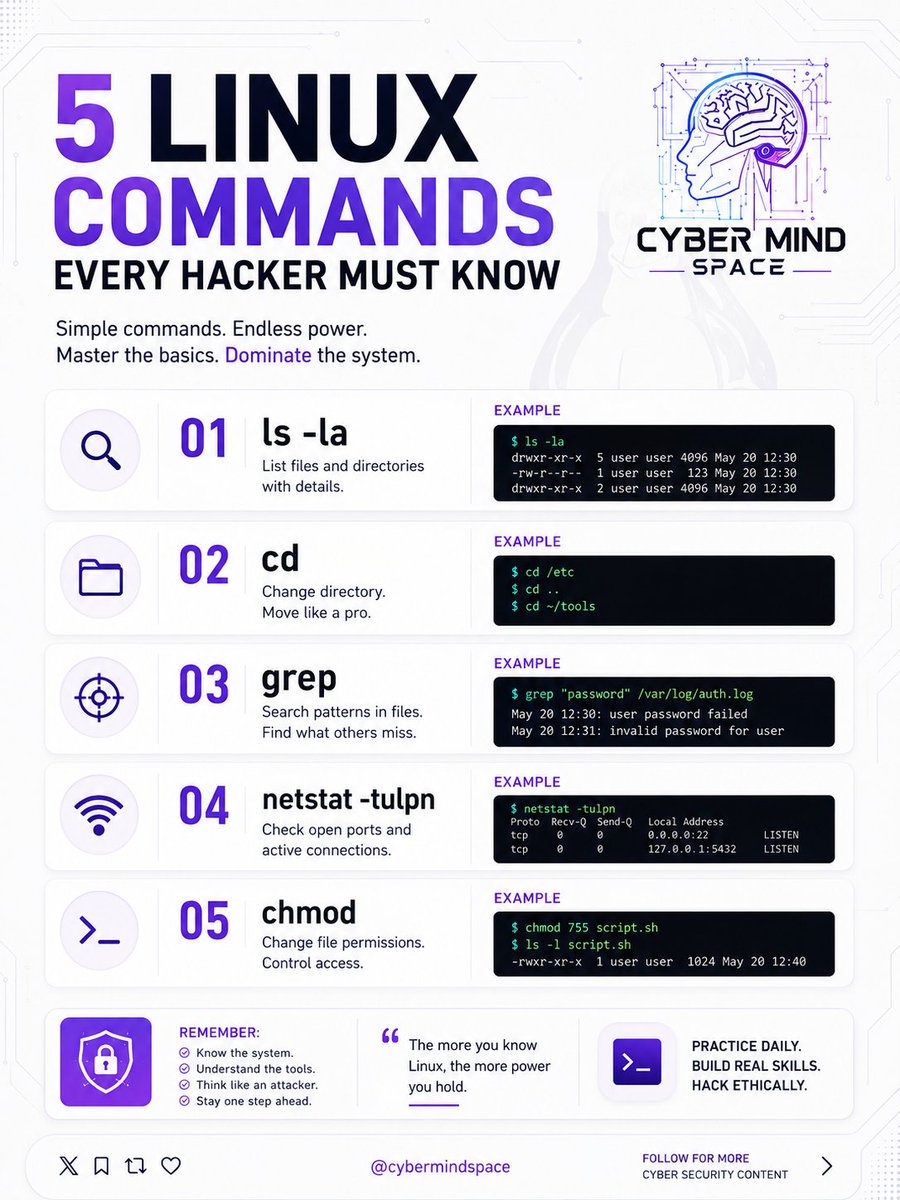
1
19

Jun 10
This is another ollama script I have that analyzes logs, netstat, etc etc then outputs that to discord.
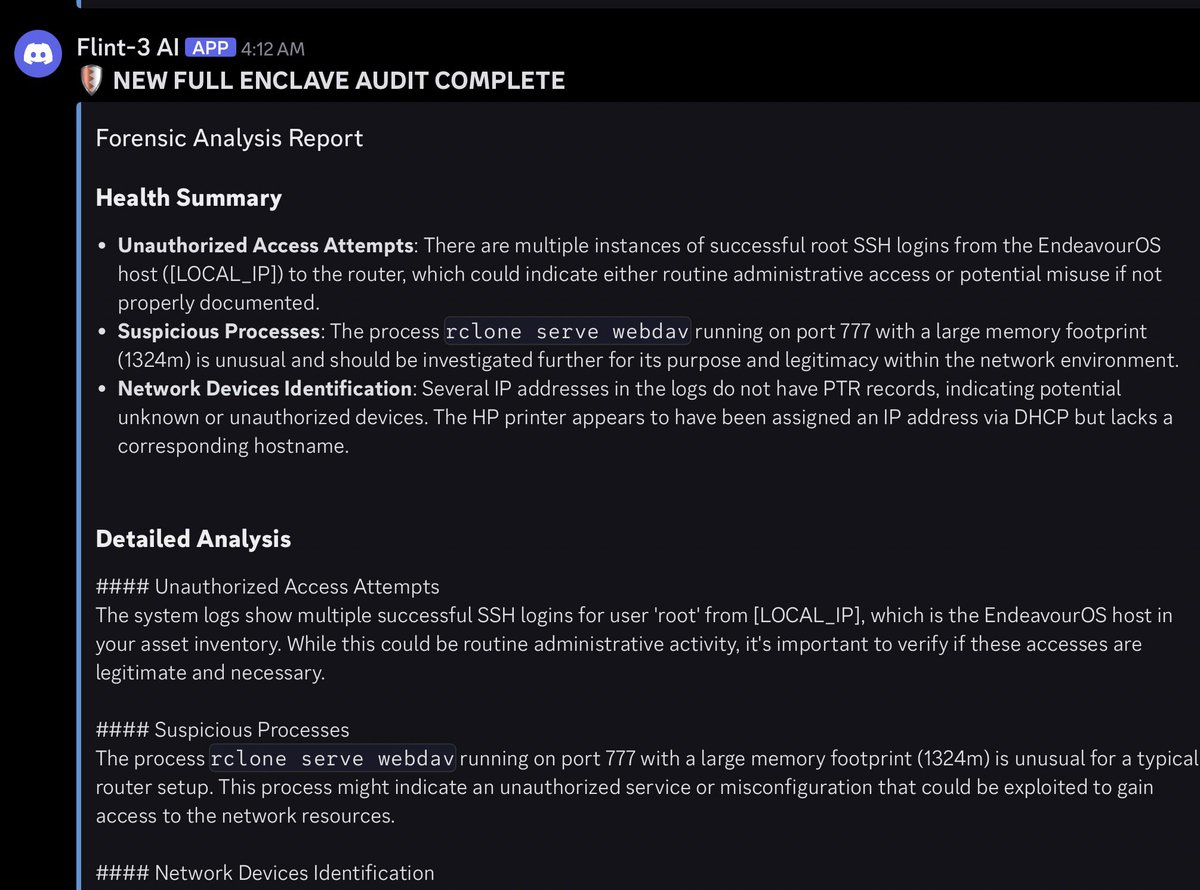
24
Jun 10
I have setup and ollama instance that will hit my router every 30 minutes, perform a netstat and execute reverse ip lookups for any external IPs it finds.
It then logs that to irc, discord and a Grafana dashboard.
30

Jun 10
I built ccline: type a thought at your zsh prompt instead of googling commands.
$ how do I list all open ports
→ netstat -tuln
It hooks into command_not_found_handler. Works with Claude Code or Codex.
github.com/jianshuo/ccline
3
1
1,077