Catherine Foster 🇺🇸 retweeted

Four years ago, my wife was diagnosed with a rare type of oral cancer.
They cut out 1/3rd of her tongue.
We have to come back to Charleston SC for regular cancer scans.
Today, the scan came back clear!!!
BONUS: we found this nostalgic diner... a total blast from the past!!!
2,348
1,992
37,327
367,445

Hehe. @nikita_helene keeps telling people this. We are an oral society. So, one outlier who has buckets of money, but is an ill mannered imp from Buwekula who didn't go past primary 3, will have everyone believe the 'Owino guys have money/are the richest' factoid

A standard is a global unit of measurement.
Like how people think the uneducated are as rich as the educated.
The real truth is most people are yet to meet an educated or powerful person.
2
3
9
1,066


Timing & memory. Paul’s letters are from the 50s AD. The creed in 1 Corinthians 15:3-8 empty tomb appearances to Peter, the Twelve, 500 brothers most still alive, James, etc. is an early tradition Paul received within a few years of the events widely dated by scholars to AD 30-35. Gospels were written while many eyewitnesses were still alive. Ancient oral tradition was reliable for core events, especially with multiple independent sources.
Claims don’t prove truth. Correct, but the resurrection validates the claims. Jesus predicted His death and resurrection, it happened, with an empty tomb known to both friends and enemies, and appearances to skeptics James and Paul. Alexander the Great comparison fails: no empty tomb, no transformed movement that turned the world upside down.
Dying for belief. People die for what they believe. The apostles died for what they saw; they were eyewitnesses who went from hiding in fear to boldly proclaiming the risen Jesus, even under torture. They had every opportunity to recant if it was false. That’s different from later ideological martyrs. Eyewitnesses, 1 Cor 15 explicitly names groups and individuals: Peter, the Twelve, James, 500 . The Gospels name many more women at the tomb, disciples, etc. Multiple sources, not just Paul. Paul met Peter and James early on in Galatians 1-2.
Many Christians, including scientists, hold an old Earth view. Genesis 1 is theological poetry/literary framework emphasizing who created and why, not a strict scientific timeline. “Day” can mean a period of time. No inherent conflict with an ancient Earth. The resurrection remains the best explanation for the historical facts. Jesus is risen, and that changes everything.
8

Melanie Russell retweeted

Form the Lowy Institute job description requirements of candidates: must possess "excellent written and oral communication skills, including for non-specialist audiences".
1. Academic Ethical Integrity?
As an example, consider the recent Sam Roggeveen David Vallance authored paper "Understanding the Chinese military threat to Australia" recently making headlines. Specifically: in the Introduction, the authors state "Nevertheless, Xi has also instructed the PLA to be ready for a Taiwan invasion by 2027, and training activity around the island has increased and become more sophisticated in recent years" but give no source, footnote or other reference indicating where and when exactly Xi issued this supposed instruction. That omission / lack of qualification (especially if deliberate) arguably serves Lowy/ASPI stakeholder interests, such being another job description requirement of candidates: "Strong stakeholder engagement skills across government, business, and civil society".
Xi has not in any public statement used that language. Xi publicly set 2027 (the PLA’s centenary) as a milestone for PLA modernization: achieving “basic modernization” and the capability to “win regional wars”, not a public deadline to “invade".
The specific claim that Xi instructed the PLA to be ready to conduct a successful invasion of Taiwan by 2027 originates from US intelligence assessments, not a direct, verifiable public Xi directive. Specifically: to 1) Adm. Philip Davidson’s March 2021 Senate testimony that the "China threat" to Taiwan was “manifest... in the next six years" - this became known as the “Davidson Window”, and 2) CIA Director William Burns in 2023 stated publicly that US intelligence knew “as a matter of intelligence” that Xi had instructed the PLA to be ready by 2027 to conduct a successful "invasion" (while noting it was not a decision to attack in 2027) - this became known as the "Burns Formulation".
Burns was referring to US intelligence indicating that Xi Jinping had given instructions or directives to PLA leadership to achieve a certain level of readiness for a Taiwan contingency (often framed by Western officials as an “invasion”) by 2027, the 100th anniversary of the founding of the People’s Liberation Army. However, no public details on the supposed intelligence itself, whether declassified reports, specific sources (human intelligence, signals intelligence, etc.), or documents have been released. This is presented as a capability/ readiness goal, not evidence that Xi had decided on war or set 2027 as an invasion deadline. Burns explicitly and repeatedly caveated his remarks on this point. More recent US intelligence assessments (including the 2026 Annual Threat Assessment) have nuanced this: China does not currently plan to "invade" Taiwan in 2027 - 2027 is a readiness/capability benchmark, not a fixed invasion date or commitment.
Burns made the most precise reference to “as a matter of intelligence” on February 2, 2023, during public remarks at an event at Georgetown University in Washington, D.C. (while accepting an award/ceremony at the School of Foreign Service). According to contemporaneous reporting by such as Reuters, Burns said that the United States knew "as a matter of intelligence" that Xi had ordered his military to be ready to conduct an invasion of self-governed Taiwan by 2027, noting that “now, that does not mean that he’s decided to conduct an invasion in 2027, or any other year, but it’s a reminder of the seriousness of his focus and his ambition.” A few weeks later, on CBS’s Face the Nation (interview recorded/ aired around Feb 26–27, 2023), Burns gave a very similar statement: “We do know, as has been made public, that President Xi has instructed the PLA to be ready by 2027 to 'invade' Taiwan, but that doesn’t mean that he’s decided to invade in 2027 or any other year as well.”
Hence: When Burns said “as a matter of intelligence,” he was referring to classified US IC judgments about Xi’s internal directives to the PLA. The specific evidence behind that judgment has never been made public. Yet, the Lowy article authors assume it as a given fact - "invasion" - while claiming to analyze capabilities, not intentions. It is a typical Lowy / “establishment” Australian "security theory" driven think-tank product: data-driven on hardware/trends, forward-looking, and aligned with the policy consensus favoring AUKUS, higher defense spending (~2.4% GDP target), and US alliance strengthening: i.e. pre-suppositional confirmation bias.
2. "Securitization Theory" Hedging?
“中国威胁论” (“China threat theory”) is a Western securitization process that constructs China as an existential threat to justify containment, alliances (e.g., AUKUS), and military spending. Speculative / conditional language ("might", "if", etc.) in this so-defined "China Threat" discourse reflects a confirmation bias inherent in strategized modal verb sequencing, as informs the Lowy paper's heavy use of hedging language throughout the scenarios and projections sections:
- “If China merely sought to send a warning, it might strike an offshore oil facility... If it sought to achieve economic effects... it might attack ports... If it sought to coerce the government by punishing the Australian population... it might use missiles or cyber weapons...”
- “... It might seek to disrupt Australia’s national life at sea.”
- “Two developments could dramatically escalate this threat: ”
- “China could plausibly develop it over the next decade.” “Could quickly and dramatically escalate...”
This is standard practice in risk/threat security theory premised assessment writing. Analysts use conditionals because capabilities do not equal intent or inevitability. However, the cumulative effect of enumerating multiple plausible “might/could/if” scenarios does create a sense of expanding risk and vulnerability, even when qualified. This style is characteristic of the “China Threat” discourse prevalent in Australian (and US) security institutions and aligned think tanks like Lowy and ASPI. These organizations often frame PLA modernization primarily through the lens of worst-case regional contingencies (Taiwan counter-intervention), then extend the implications to Australia. Critics (including some Chinese state media responses to this specific paper: @globaltimesnews reporting CN Foreign Ministry spokesman Lin Jian, the full transcript of Lin's remarks: fmprc.gov.cn/mfa_eng/xw/fyrb…) argue this approach prioritizes threat inflation to justify policy choices like AUKUS and defense budget growth, while downplaying diplomatic or economic de-risking options.
If the Lowy Institute job candidate is required to represent "stakeholder needs" and the stakeholders in the Lowy/ASPI think tank sector are US Weapons Manufacturers and US State Dept. / Defence Dept. alliances, the candidate might seek to obfuscate an appropriated phraseology attributed to Xi by omitting context in order to create "China Threat" discourse style securitized confirmation bias. They could then structurally frame conditional modal verb use to construct an imminent threat capability which, while purely speculative, is rendered urgent through its succession of modal verb conditionals. Their intention in doing so could thus be to justify AUKUS at a time when, in Australia, there is a public hearing into AUKUS. They could then publish this as a capability "paper" timed in release to counter this public hearing.
3. "Invasion" Rhetoric in China Threat Discourse Construction
Of the recent Melbourne testimonials for the AUKUS public hearing, Jennifer Parker dismissively noted the contribution of "🇦🇺’s former Deputy Ambassador to 🇨🇳 in the 1970s". Most revealingly, she did not even mention this former diplomat by name, anonymizing him in effect.
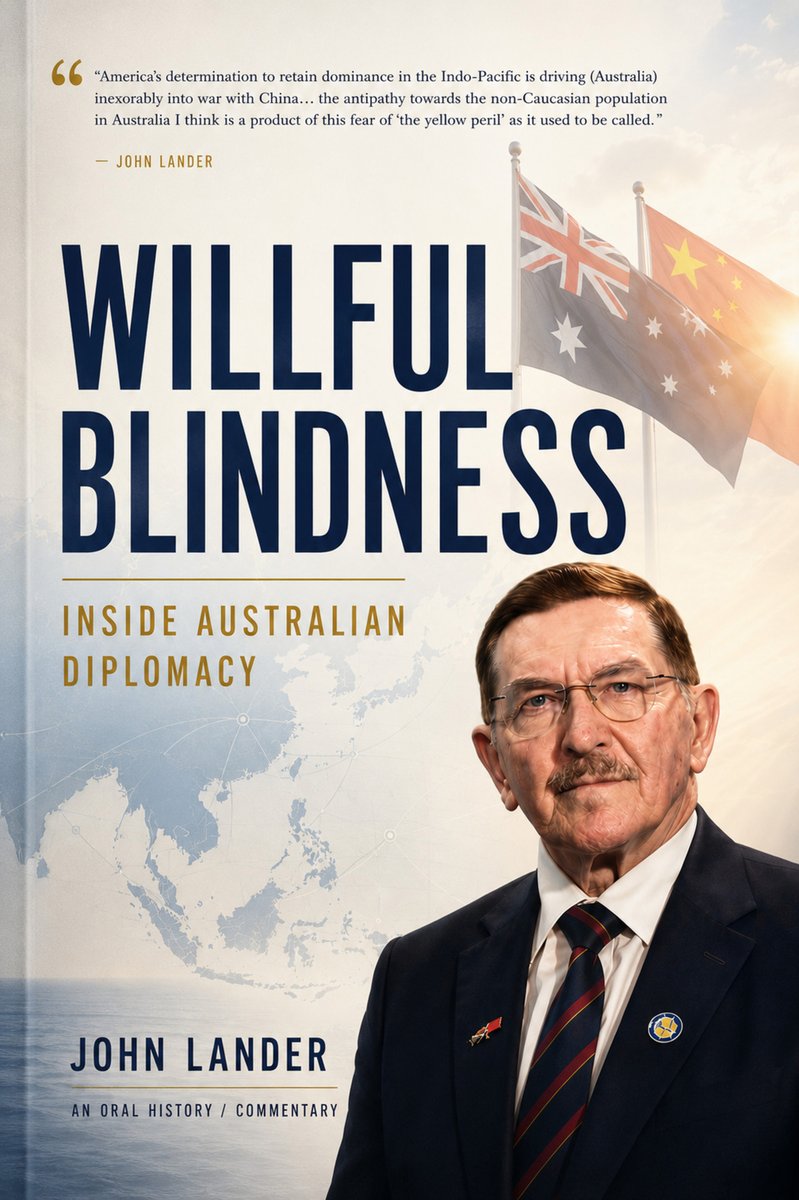
His name is John Lander. He was in fact not only Australia's Deputy Ambassador to China (1974-1976) but also Australia's 1st Ambassador to the Islamic Republic of Iran (1985-1988) and thereafter worked in the Office of Multicultural Affairs under the Hawke and Keating Governments. To elaborate Lander's core points, in his own words as in the accompanying video interview series below:
(from video 1 🔽): "In July 1971,... we produced a Policy Planning Paper providing policy advice to the government, which said that the alliance with the United States would mean less to us in the future than it had in the past and that Australia should develop independent policies based on Australian national interest and the interest of our near neighbors. This was a reaction to the fact that we realized that we couldn’t rely on the United States to protect Australia’s interests... and that United States policy actions could in fact be quite inimical to Australia’s interests. And of course today its far more relevant than it was then.
With the revelation that the US was moving to the recognition of the People’s Republic of China, plus the fact that Gough Whitlam as leader of the Opposition had already declared that were he to win government he would immediately recognize the PRC... We had spent all that time in the lead-up to the election preparing for the transition from recognition of the ROC to the recognition of the PRC. So I was also involved, as a very junior officer at the time in the documentation and preparation of advice and so on regarding the negotiations for the Joint Communique on the Recognition of the PRC. That led fairly quickly to the formulation of the wording that is now in the Joint Communique of the Recognition of the PRC which acknowledged, that is recognized and accepted the position of the PRC that Taiwan is a province of China. The narrative these days, that somehow Taiwan is separate from China and must be protected from any ‘invasion’ by China, is a false narrative."
(from video 2 🔽): "The military activities by the PLA and PLA-Navy and Airforce around Taiwan I see as essentially expressions of the determination of the PRC to prevent the alienation of Taiwan from China’s sovereign territory. And it is interesting that most of the military activity around Taiwan is in response to provocative actions by the United States and its allies, including Australia. And it is important to note that since Australia does not deny that Taiwan is part of China’s sovereign territory, intrusions by Australian warships or Australian aircraft into Taiwan’s waters or into Taiwan’s airspace, are in fact intrusions into the territory of China. And it could be argued quite reasonably I think that China has the right to defend itself and, if necessary, forcibly repel such intrusions. We’re very lucky that China has until now chosen not to take that kind of action. So Australia’s policy with regards to Taiwan’s status is paradoxical because on the one hand we say yes Taiwan is part of China’s sovereign territory and on the other we say we have the right to conduct freedom of navigation operations in China’s sovereign territory."
"And so that translates very quickly to the whole question of China, and Elbridge Colby, one of the United States warmonger strategists, made it very clear in his book The Strategy of Denial that it was the intention of the US to use Taiwan both as pretext and proxy to instigate a war involving China again with the purpose of bogging China in a protracted conflict which would inhibit its economic growth and impede its capacity to cooperate in economic development with other countries. And the US has made it perfectly clear that it expects Japan, the Philippines and Australia to come to the defense of Taiwan. So that (the 3 countries) would be part of the network of proxies that would be used to embroil China in a war that would distract it from its peaceful development, cooperation right across the Global South."
(from video 3 🔽): "So the US sees China’s role as the alternative guarantor of a world economic system distinct from the system set up by the United States, as the principal threat to US interests and even its survival. Because increasingly the countries that are cooperating within the BRICS framework, in their bilateral trade relationships, are moving towards trade
in each other’s own currencies and reducing the reliance on the USD as the currency of exchange. That hasn’t reached crisis point yet but the trend is in that direction. And it is that decline that I think the US sees as really the principal long term existential threat because once the US dollar ceases to be in demand by countries all around the globe it will cease to have value. And that will then render the 37 trillion dollar debt the US owes to a large number of countries in the rest of the world un-payable. It will render the United States basically insolvent which is why Trump said it would be like losing World War Three.
The US has of course described Australia as, I quote, the epicenter of the projection of US power in the Indo-Pacific. So even if the US engaged in a kinetic war with China, it would be launched from, and conducted from, Australia. Which would inevitably make the facilities in Australia a target for China."
An Oral History of John Lander's diplomatic career is forthcoming through transmedia publisher @OpalSkyMedia.

🚨JOB ALERT🚨
The @LowyInstitute is looking for an exceptional researcher and analyst to lead its China and East Asia Program as Program Director.
👉lowyinstitute.org/program-di…

2
2
108

Rétention de permis : ce n’est pas encore une suspension.
Réflexe utile : notez l’heure du contrôle, gardez l’avis remis, puis attendez la décision écrite avant de conclure sur la durée.
Le droit à conduire dépend du document reçu, pas d’un échange oral sur place.
2

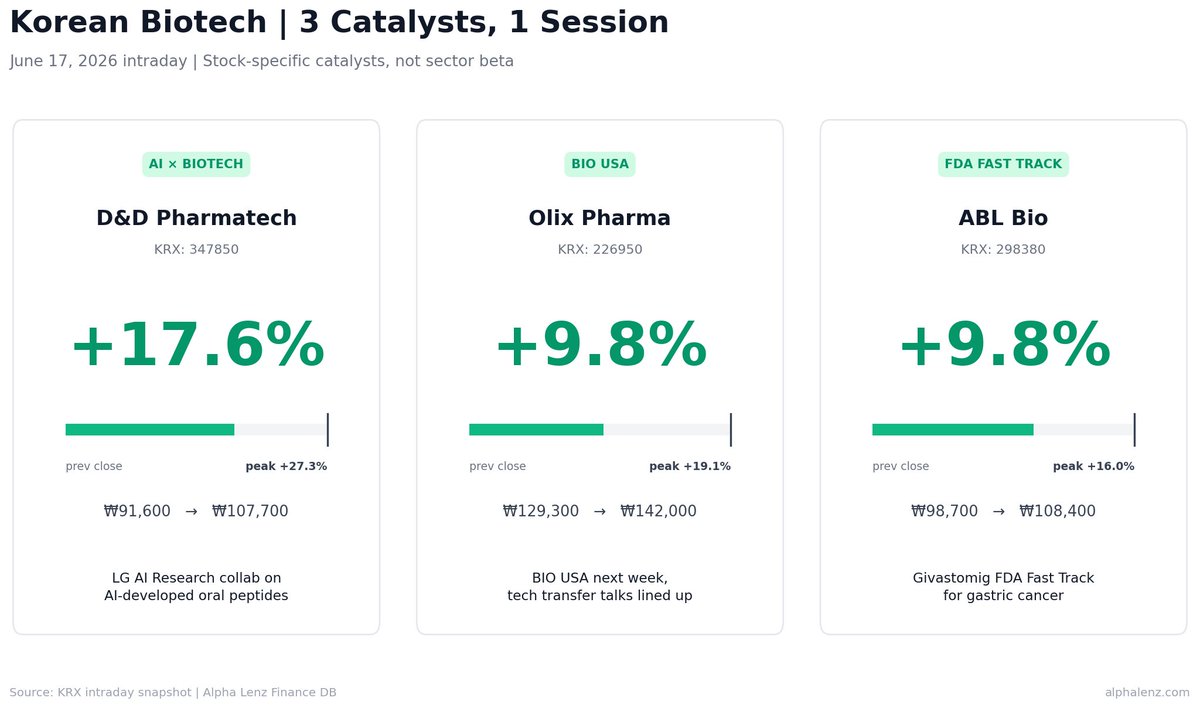
Korean biotech is rallying on three stock-specific catalysts today, not on broad sector beta.
D&D Pharmatech (347850) is up 17.6% after LG AI Research unveiled a collaboration to develop oral peptide drugs using AI. Olix Pharma (226950) 9.8% as the company prepares for BIO USA next week to advance tech transfer talks. ABL Bio (298380) 9.8% on FDA Fast Track designation for its gastric cancer candidate Givastomig.
Healthcare ( ): Three names hit independent catalysts in a single session. That's coincident execution across KOSDAQ biotech, not coordinated theme buying.
AI Infrastructure ( ): The LG-D&D tie-up extends Korea's AI infrastructure narrative into drug discovery, a previously underweighted intersection.
Licensing flow ( ): BIO USA opens June 22. Olix and peers face binary headline risk over the next 10 days.
Watchlist: D&D Pharmatech (347850), Olix Pharma (226950), ABL Bio (298380), Alteogen (196170), Hanmi Pharmaceutical (128940).
Can today's multi-catalyst session sustain into BIO USA next week, or is the easy money already priced in?
#KOSDAQ #KoreanBiotech #FDA #BIOUSA
2

In short: Both groups’ ancestors have been in the lands now known as the USA for at least 12,000–18,000 years (with broader American peopling evidence extending potentially to ~23,000 years in some areas). This is “time immemorial” from Indigenous perspectives and is backed by converging archaeological, genetic, and oral evidence.These timelines refer to ancestral presence and genetic/cultural continuity. Specific named tribes and their social structures evolved and adapted over thousands of years. Many Indigenous nations today emphasize their enduring connection to these lands despite later displacements. For the most authoritative details on any specific nation’s history, their own tribal historic preservation offices or cultural resources are the best sources.The ancestors of both the Lenape (also spelled Lenni Lenape or known as the Delaware people) and the Blackfoot (Blackfeet Nation in the U.S. context, part of the Blackfoot Confederacy) have deep roots in North America, with presence in the territories now part of the United States dating back many thousands of years—far predating European arrival or the formation of the USA in 1776.General Context: Peopling of the AmericasScientific consensus holds that the first humans reached the Americas from Asia (via Beringia) roughly 15,000–20,000 years ago, with some evidence suggesting even earlier arrivals. Key points include:Possible coastal (“kelp highway”) or inland routes.
Pre-Clovis sites (before the widespread ~13,000-year-old Clovis culture) confirm presence south of the ice sheets by at least 15,000–16,000 years ago.
Notable evidence includes human footprints at White Sands, New Mexico, dated to ~21,000–23,000 years ago (with some studies supporting dates up to ~23,600 years old).en.wikipedia.orgThese early peoples’ descendants include all Indigenous groups across the Americas. Specific tribal/cultural identities (as known at European contact) developed over subsequent millennia through adaptation, migration within the continent, and cultural evolution.Lenape (Lenni Lenape) RootsThe Lenape’s traditional homelands (Lenapehoking) centered on the Delaware River valley and surrounding areas—what is now eastern Pennsylvania, New Jersey, Delaware, and parts of New York and Maryland.
Tribal sources, such as the Delaware Nation, state that the Lenape people have over 15,000 years of history in these homelands before Europeans arrived.delawarenation-nsn.govArchaeological evidence supports human occupation in the broader Northeast and Pennsylvania region for 12,000–18,000 years. This includes Paleo-Indian sites (earliest period after the Ice Age), Archaic period settlements, and later Woodland period villages. Some specific sites show continuous or repeated use for 6,000–10,000 years.
Ancestors are understood to have been part of the early migrations into North America, arriving in the Delaware Valley region roughly 12,000–15,000 years ago. They were Algonquian-speaking peoples who developed agriculture (the “Three Sisters” of corn, beans, and squash) and established villages over time.
Oral traditions often describe deep, ancient connections to the land (sometimes referencing origins involving a land bridge or creation stories tied to Turtle Island). The distinct Lenape identity and society as encountered in the 1600s–1700s emerged from these long-established roots.Blackfoot (Blackfeet) RootsThe Blackfoot Confederacy (including the Blackfeet Nation in Montana, USA, and related nations in Alberta and Saskatchewan, Canada) traditionally occupied the northern Great Plains and Rocky Mountain foothills, with significant territory in what is now the northern United States (especially Montana).
A major 2024 genetic study found that modern Blackfoot people descend from a previously unknown ancient lineage that diverged roughly 18,000 years ago during the initial peopling of the Americas. This supports deep, persistent roots in or near their ancestral territory.science.orgArchaeological evidence documents human presence and use of the region for at least 12,000–13,000 years (post-Ice Age), with sites showing continuous occupation, bison hunting, and adaptation as glaciers retreated. Specific excavations (e.g., Billy Big Spring site) confirm persistent use over the last 12,000 years.
Oral traditions and tribal perspectives describe presence in their lands “since time immemorial,” with strong cultural and spiritual ties to the landscape.
The Blackfoot are also Algonquian-speaking. While some older theories suggested later migrations onto the Plains, recent genetics and archaeology strongly support very deep local continuity. The Blackfeet Nation in Montana remains on ancestral lands.albertanativenews.comwayfinderscircle.orgExample maps of traditional Blackfoot/Blackfoot Confederacy territory (spanning the U.S.-Canada border, with core areas in Montana and Alberta).Summary of TimelinesGroupEstimated Ancestral Presence in Region (USA territory focus)Key Evidence SourcesNotesLenape12,000–15,000 years (tribal sources: 15,000 years in homelands)Archaeology (Paleo-Indian to Woodland sites), tribal historyNortheast U.S. (NJ/PA/DE area); cultural identity developed over millenniaBlackfoot12,000–18,000 years (genetic lineage divergence ~18,000 ya)2024 genetic study, archaeology (12,000 ya sites), oral historyNorthern Plains (Montana focus in USA); strong evidence of deep persistence
1
SERKEŞ GÖNLÜM KONYALIII retweeted

Kız oral sexte kendinden geçiyor
1
2
4
56

They refuse to make out or do foreplay or oral and then they'll scream "why won't you communicate?! Just tell me! Muh dead bedrooooomerino 😭"
77
Jarushka Naidoo retweeted

During the recent #ASCO26 oncology meeting in Chicago and one day before the oral presentation, I had the opportunity to present the main findings of our study on intracranial efficacy of #Tarlatamab in patients with small-cell lung cancer #SCLC from the DeLLphi-304 trial in a video Interview with @ASCO Post.
You can find the 5-minute video link below: 👇
📌 ascopost.com/videos/asco-202…
Thank you @ASCO for highlighting our study!!
@SclcSMASHERS
@OncoAlert @oncodaily @OncBrothers @PeerView
@myESMO @IASLC @Amgen @AmgenOncology
@LUNGevity @LungCancerEu @YoungLungCancer
@fairlifelcc @HeSMO_X @EllokGr @lcsmchat @HenryDunantGR @ConquerCancerFd @LungSummit

1
5
18
583
Mason Cross retweeted

! The heterosexual trying for the first time penis doing an oral!
6
135
411
7,657


New project delivered🦷✨
Built the UX/UI for Happy Smiles — an e-commerce site for kids' oral care (toothpaste, brushes, sand timers & more).
Turning "ugh, brushing time" into "let's go brush!" one playful screen at a time.
#UIUXDesign #WebDesign #EcommerceDesign #KidsBrand



2
1
3
Aybie 🏳️⚧️ retweeted

I know I’m the oral fixation girl and all but today I’ve been watching way more mating press videos than ever they’re sooo hot😵💫😵💫😵💫😵💫
Now to post an oral video to throw yall off boom bam
 Karen Carter
9
59
640
7,362
CnY.PH ♠️ retweeted

Slim College Brunette Deepthroat Queen Takes Massive BBC OnlyFans Blowjob Sloppy Gagging Interracial Oral Worship Big Black Cock Closeup Spit Play Petite Babe Sucks Huge Dick Facial Cumshot Tease #BBC #nsfwtwt #horny cute cheating girlfriend hotwife
 ♠️Bbclover♠️
26
202
1,785
114,844