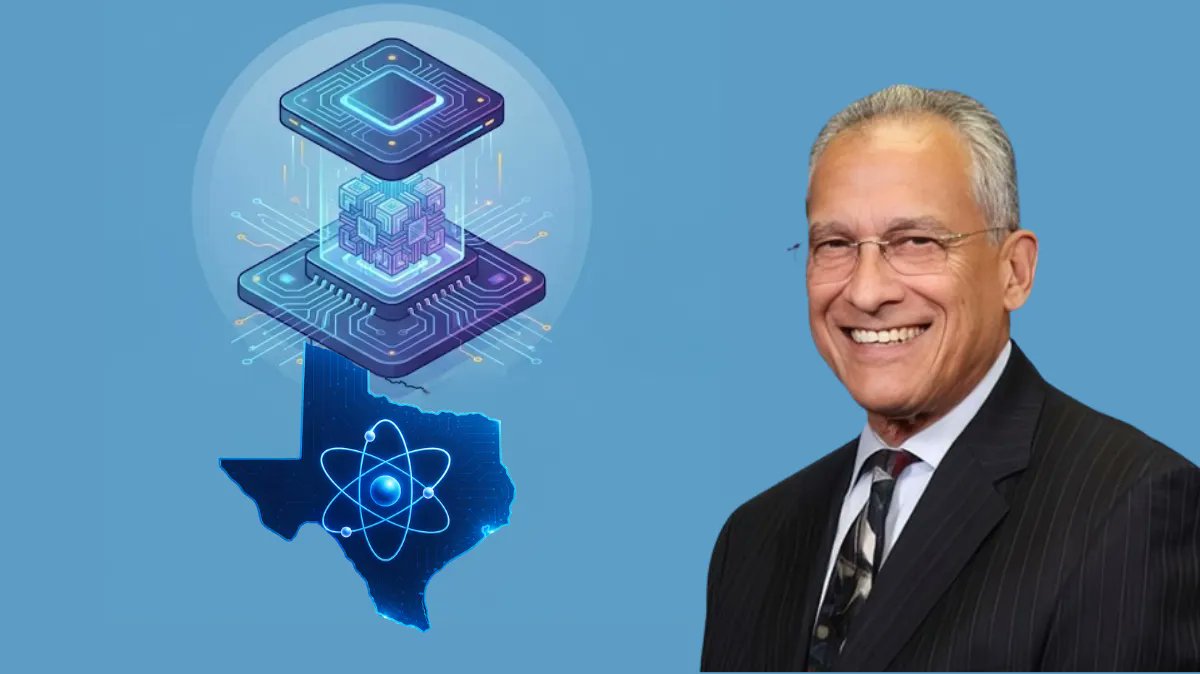
ALT Victor Fishman
Texas is actively pursuing its goal of controlling the next frontier in international technology. Victor Fishman, Ph.D., has been nominated to the Texas Quantum Initiative Advisory Committee by Governor Greg Abbott, marking a major policy shift. The enormous burden of outlining the state’s long-term strategy for quantum computing, workforce development, technology commercialization, and statewide economic growth has been placed on this high-level panel.
A Strategic Win for North Texa
The Dallas-Fort Worth (DFW) metroplex has achieved a significant legislative and economic win with this appointment. The state has given North Texas a direct and significant say in state-level policy by appointing the Executive Director of the Texas Research Alliance (TRA) to the committee.
Where does Quantinuum land in this bunch? @infleqtion 1,000 logical qubits by 2030 as well.
What are your perspectives on photonics? @XanaduAI aiming for 500 by 2029. @orcacomputing has been making steady progress — seems photonics could gain traction.
And @Ibm is somewhere in there on the superconducting said. I’m sure @GoogleQuantumAI will give us something on neutral atom and/or superconducting by end of decade. Wonder if @rigetti has any chance…
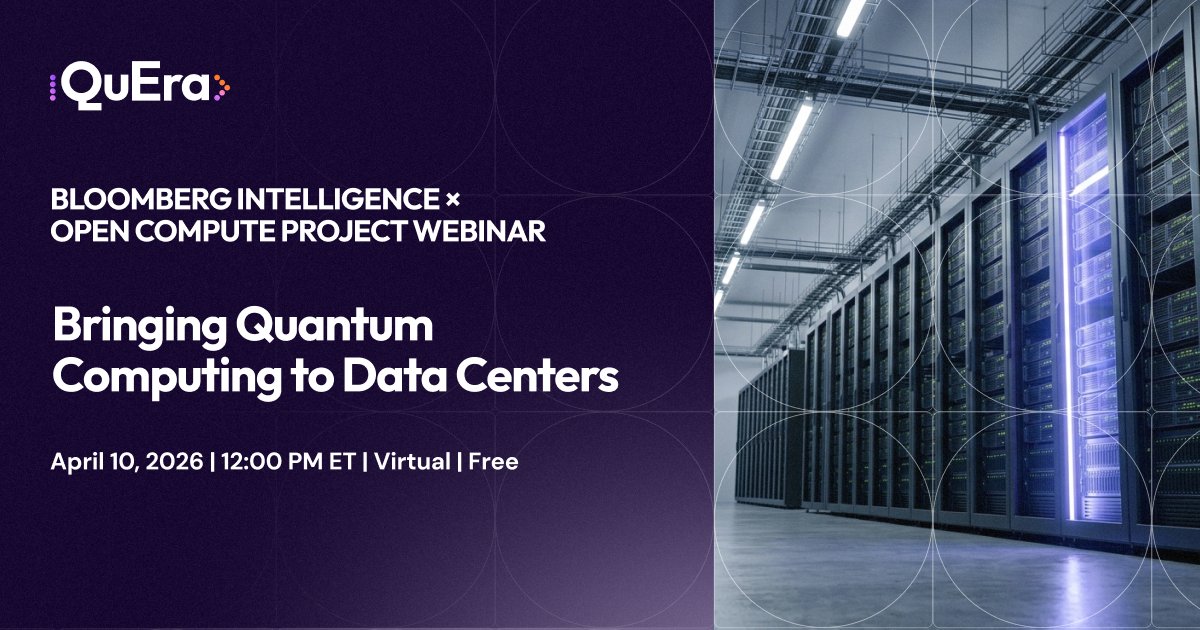
Quantum computers need to fit inside data centers before they can change what data centers do. This Bloomberg Intelligence x @OpenComputePrj roundtable puts three hardware approaches side by side (@QueraComputing neutral atoms, superconducting (@OQC_Tech), photonic (@orcacomputing) — on power, cooling, and rack integration. Worth tuning in.
April 10th | Register: buff.ly/rIiqW0N@business
ALT Quantum computers need to fit inside data centers before they can change what data centers do. This Bloomberg Intelligence x @OpenComputePrj roundtable puts three hardware approaches side by side (@QueraComputing neutral atoms, superconducting (@OQC_Tech), photonic (@orcacomputing) — on power, cooling, and rack integration. Worth tuning in.
April 10th | Register: https://buff.ly/rIiqW0N @business
The next frontier of connectivity is not just faster. It is fundamentally different.
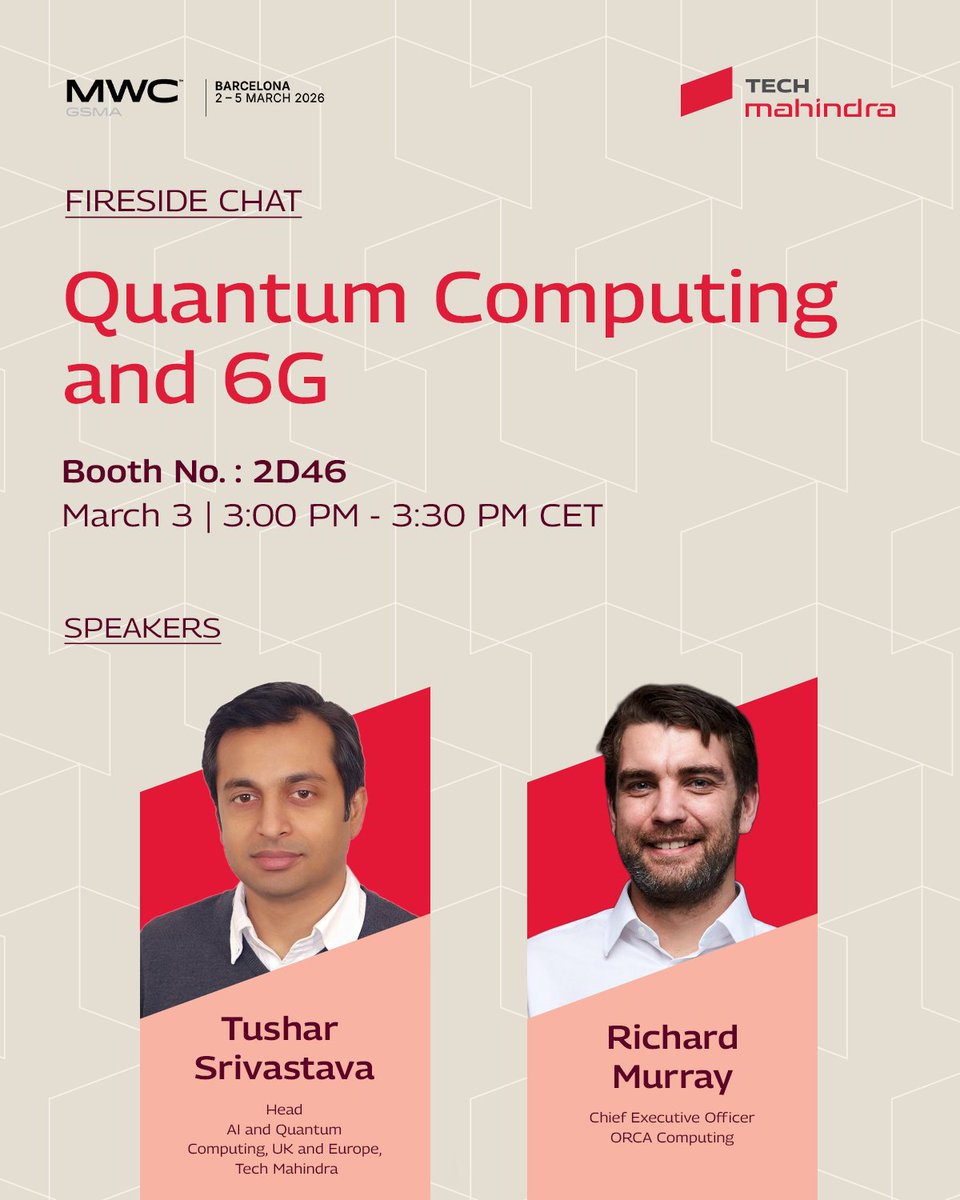
At #MWCBarcelona2026, join us for a special fireside chat exploring the powerful convergence of Quantum Computing and 6G, two forces poised to redefine intelligence, speed, and security.
In this conversation, Tushar Srivastava, Head of AI and Quantum Computing, UK and Europe, @tech_mahindra, and Richard Murray, Chief Executive Officer, @orcacomputing, will discuss what happens when ultra‑advanced computation meets next‑generation networks, and what it means for telecom, enterprises, and society at large.
From quantum‑secure architectures to the promise of #6G‑native intelligence, the session looks beyond incremental progress toward truly transformational impact.
📅 3 March 2026 | ⏰ 3:00–3:30 PM CET
📍Fira Gran Via, Barcelona | 📌 Booth 2D46
If you are already thinking beyond 5G, this is the conversation to be part of.
Know more: techmahindra.com/insights/ev…#ScaleAtSpeed#MWC2026#QuantumComputing#FutureNetworks
All such claims are 100% bullshit because ML workloads are memory-bound, not compute-bound, except maybe for tiny, toy datasets.
You don't even need to touch the quantum subsystem speedup claims, the memory bottleneck alone kills them.
@Cat_States@DrocDolf@SPVLABS
Do you believe any of these claims?
I can easily debunk it, but they’re smart to keep the papers hidden.
They have ZERo shame
I will bet they use a tiny dataset smaller than MNIST.
Project wildly and make preposterous claims.
I couldn’t find the paper, but 80% reduction in compute should mean the AI labs will be all over this.
I will bet they will 100% not care.
Massive news in Quantum...
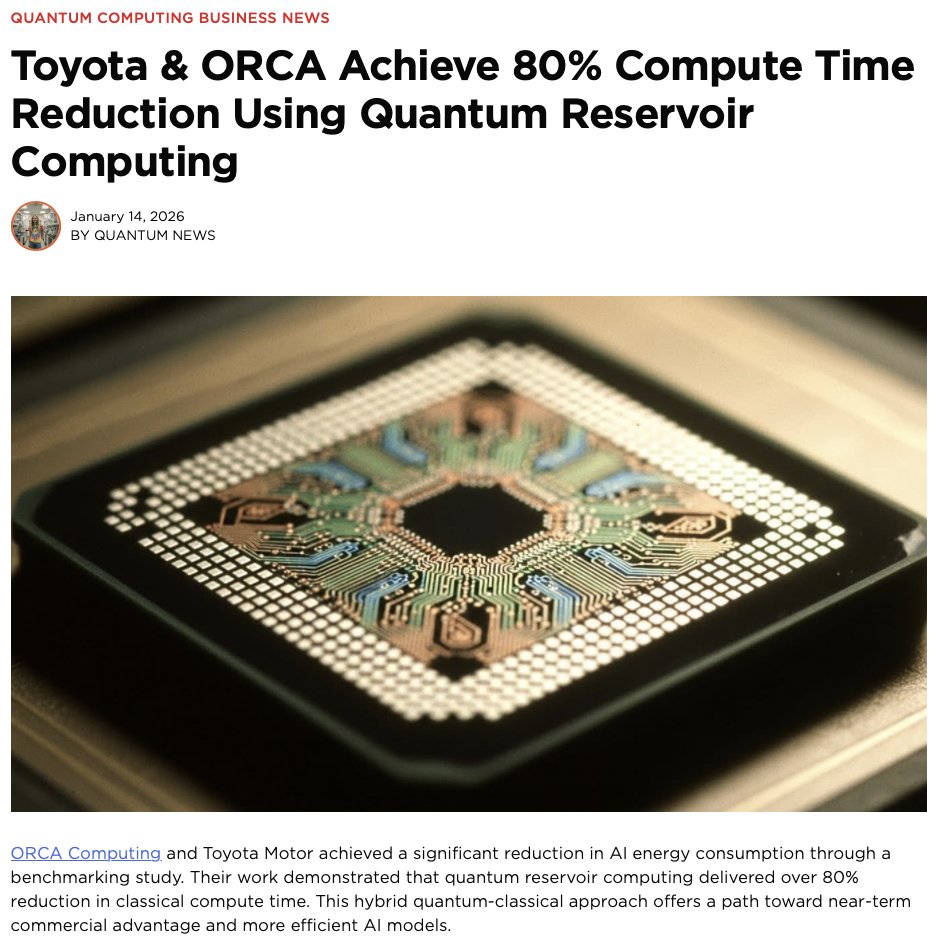
@orcacomputing & @Toyota collaborated on a benchmarking study using quantum reservoir computing to achieve over 80% reduction in classical compute time for AI models, particularly in image classification tasks with hybrid quantum-classical approaches.
This integration of photonic quantum processors into existing ML workflows, such as Vision Transformers and Convolutional Neural Networks, resulted in over 20% fewer computational operations, lower energy consumption, and potential near-term commercial benefits without requiring extensive redesigns.
Massive news in Quantum...
@orcacomputing & @Toyota collaborated on a benchmarking study using quantum reservoir computing to achieve over 80% reduction in classical compute time for AI models, particularly in image classification tasks with hybrid quantum-classical approaches.
This integration of photonic quantum processors into existing ML workflows, such as Vision Transformers and Convolutional Neural Networks, resulted in over 20% fewer computational operations, lower energy consumption, and potential near-term commercial benefits without requiring extensive redesigns.
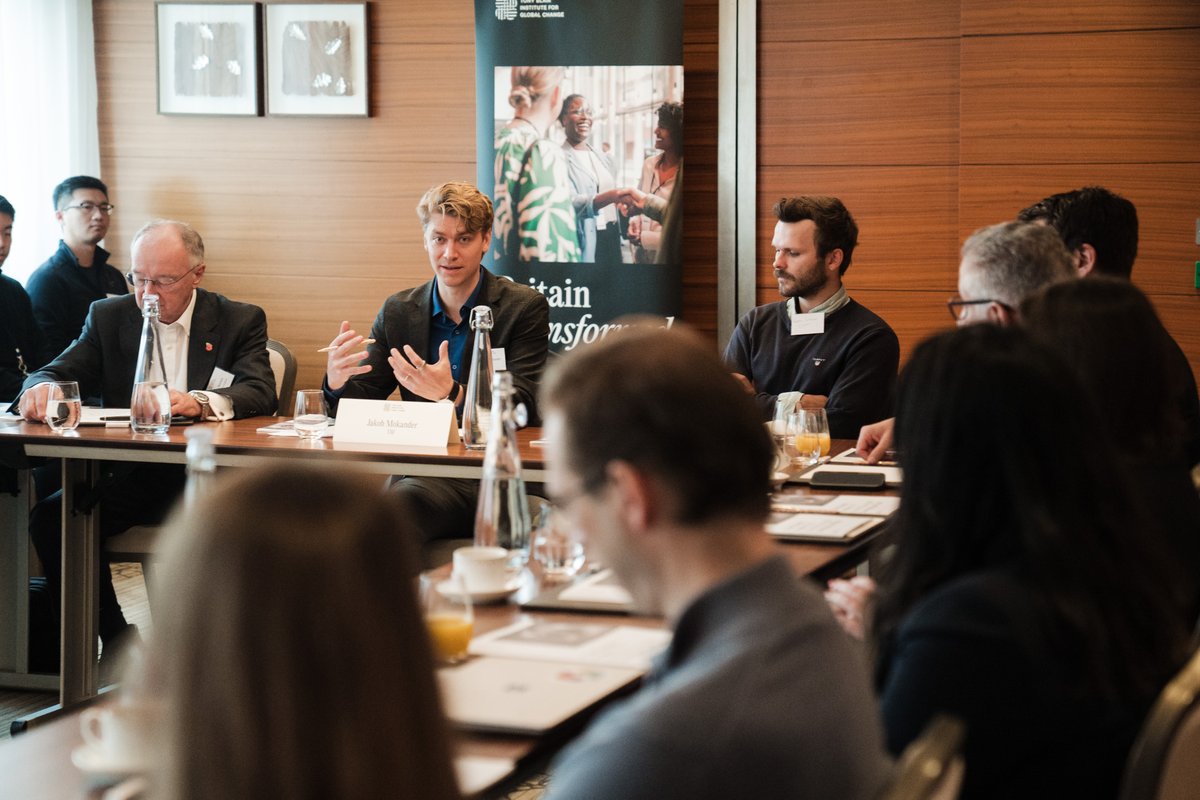
Today, TBI experts @jakobmokander and @guywardjackson joined leading members of the UK’s quantum ecosystem to discuss the strengths and weaknesses of the UK’s current quantum strategy.
Together they explored what it will take to turn research leadership into long-term national advantage.