shell retweeted

In Islam, women are treated as property to be owned, slaves to be controlled, sexual objects to be used, and baby-making machines to serve men.
24
111
475
4,537

Special Weather Statement for Morgan, Athens, Washington, Wood, Pleasants, Tyler until 7:15 PM 6/14. Strong storms may bring wind gusts up to 50 mph, knocking down limbs and blowing unsecured objects. If outdoors, seek shelter indoors.


By the way there's a good psychological horror movie about a woman with pica... but for her it's objects. My review:
boxd.it/8oMQJD

Thought about doing this too, but it seemed like you'd need a lot of data on the ground truth positions of 3D objects to train the 3D Trace extractor.
I assume that was collected automatically using the robot arm?
1

You do know that was simply a ruling that had to match the outcome one of the war. It was a kangaroo court.
You can try to use it as precedent, but if pressed, it will be found unconstitutional. First, there is no constitutional evidence that supports it. Next, the argument that the decision is based on is derived from the preamble, which has no legal standing.
Jacobson v Massachusetts 197 U.S. 11 (1905) overruled Texas v White in the very first sentence of the opinion.
"The United States does not derive any of its substantive powers from the Preamble of the Constitution. It cannot exert any power to secure the declared objects of the Constitution unless, apart from the Preamble, such power be found in, or can properly be implied from, some express delegation in the instrument"

they won’t even add a beard nor should they. He’s a fictional object made for human enjoyment. Objects can’t be minors, people can, will, and should draw him how ever they please❤️

If its confirmed that hes a minor, furries will simply add a beard to his face pretend its an ageup and then continue drawing porn of him
9


he's a predator and the sooner they're placed into a hessian potato sack and given a physics lesson in the conservation of momentum when objects with mass rapidly decelerate when coming into contact with the human body and what the exchange of kinetic energy does, the better.
2

If all women are pathetic regardless of their appearance, ethnicity, or country, then equality in inferiority is the norm. Equality in that all women are objects for men's pleasure.
2

curse whoever made the sprites btw i was gonna convert them to texture atlas but sometimes things are symbols and sometimes theyre drawn objects id have to reanimate her if i wanted them to be texture atlas

6
ElOth retweeted

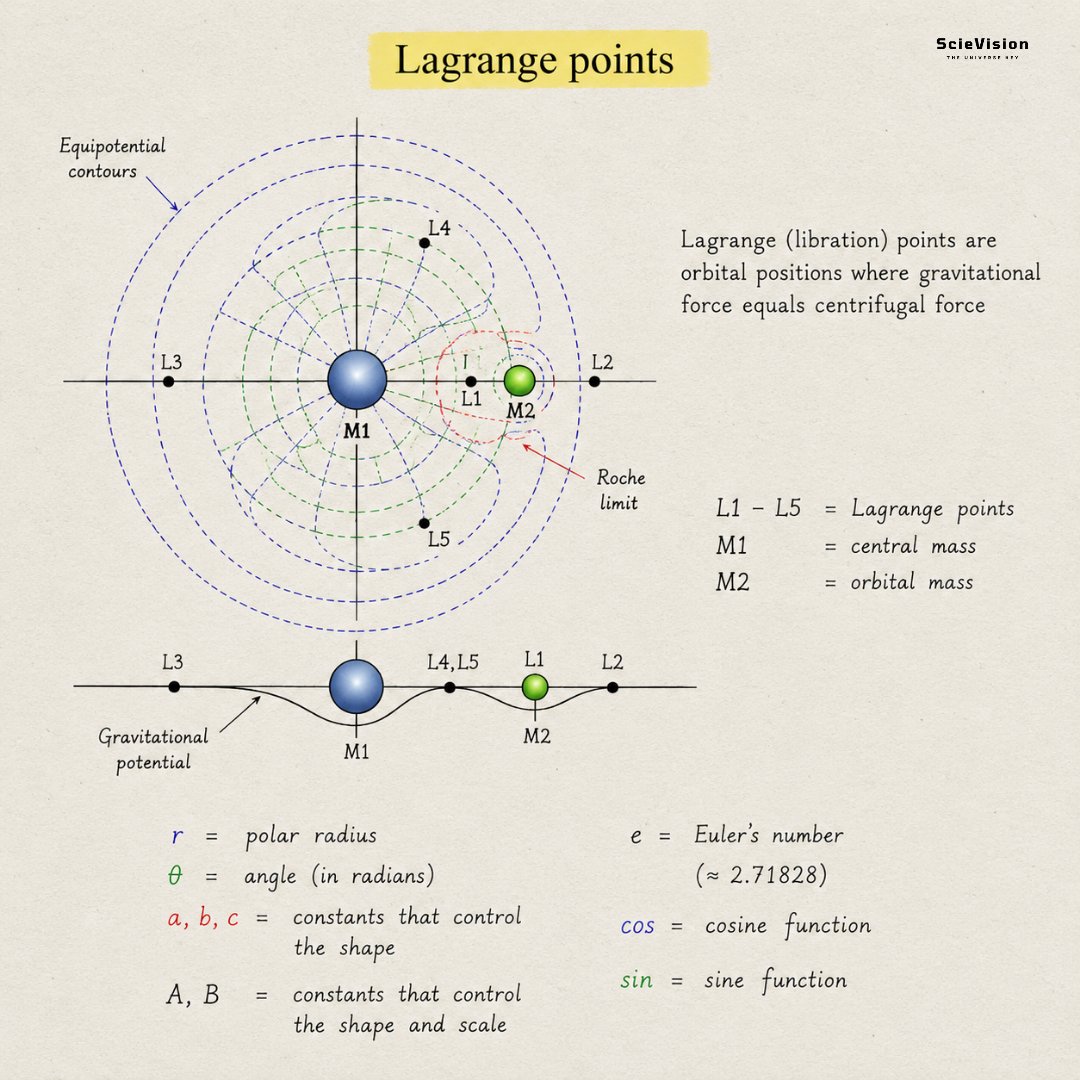
Lagrange points ✍️
When two large objects orbit each other in space, like the Sun and Earth, their combined gravity creates five special points called Lagrange points. At these points, a smaller object like a spacecraft can remain perfectly still relative to both bodies without drifting away, because all the forces acting on it balance out. Three of these points, L1, L2, and L3, lie along the straight line connecting the two bodies. L1 is located between them, L2 is just behind the smaller body, and L3 is directly on the opposite side of the larger body. These three points are unstable; if you nudge something there, it will slowly drift away, much like a ball balanced on top of a hill. Still, they are very useful; the James Webb Space Telescope is positioned at L2, where it remains cool and has a clear view of deep space. The other two points, L4 and L5, are the truly special ones. They are positioned 60 degrees ahead of and behind the smaller body in its orbit, forming a triangle with the two large masses. These points are naturally stable, like a ball resting in a bowl; if something is nudged, it will gently drift back. Thousands of asteroids have been resting at Jupiter's L4 and L5 for billions of years because of this stability. The red figure-8 shape shown in the diagram is called the Roche lobe, which marks the boundary of the smaller body's gravitational zone. If a star in a binary system expands beyond this boundary, its gas spills over to the companion star through L1, similar to water overflowing between two connected bowls. In simple terms, Lagrange points are nature's free parking spots in space, and we are just beginning to explore their use.
2
2
11
197
Lisa Noel retweeted

Jun 10
Systematic Rape, inserting objects into the rectum, torture, sodomy, sexual violence, illegal kidnapping, psychological torture and using dogs to torture and rape.
This is what Israel is doing to Palestinians.
Jun 10

WOW.
AlJazeera just dropped a ONE HOUR documentary about ISRAEL’s CRIMES against the PALESTINIANS.
This is very HARD TO WATCH.
52
1,348
2,073
94,941

What's even more retarded is the fact that these so-called "star signs" are just the shapes certain celestial objects (mostly other stars) look like from our vantage point here on Earth. Has fuckall to do with personality. Just a bunch of narcissistic crap really
clov of #nbwtwt ☢️🫧 retweeted

Plushies dont have rights,by the way. Theyre not real. Theyre inanimate objects..

Quick PSA reminder, your plushies r for cuddling and not humping or fucking… they r poor babies n should not be subject to your filth.
3
5
21
428

That's honestly taking me out of the universe of the country. They should feature original objects on flags only.
1
4

Thats actually a really good point and you're picking up on something that quietly slips under the radar: The Riemann Sphere "point at infinity", the axiom of infinity, aleph null, etc. These are all distinct objects with different definitions and applicability.
1/2
1
4
Adiestrador de putas ( 18) retweeted

women are things. women are property and objects and not even close to actual people. we shouldn't have rights and opinions! Men > women!!
push cunts back down!
5
19
96
2,838

Thats where i find the energy of fun- in the unknown. I just say.. don’t be too attached to the objects in the game or else it becomes less fun.
1

@grok Style-transfer this image into a polished stylized Unreal Engine 5 videogame cutscene look. Keep the exact same image, subject, pose, composition, framing, camera angle, expression, clothing, objects, background layout, and lighting direction. Do not change what is happening in the image. Only change the visual rendering into polished stylized UE5 videogame cutscene with smooth materials, clean forms, cinematic depth, and high-quality character/environment rendering.

1
7