massimo 💻🎞 🚗🌳🎇 retweeted

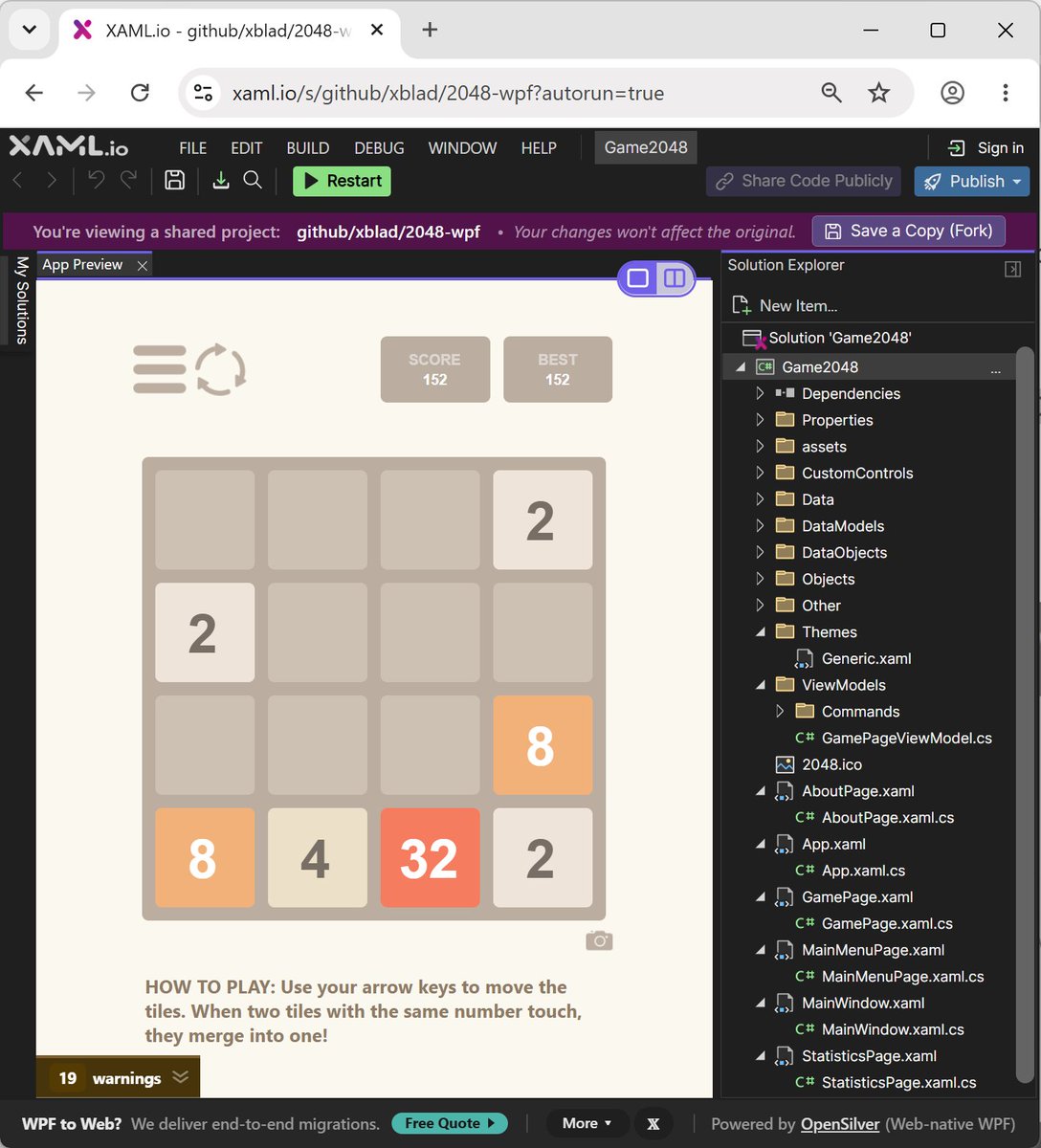
WPF… in the browser?
Here's a fun 2048 number puzzle game, ported from WPF to OpenSilver (web-native WPF) in less than 30 minutes, without using AI.
Live demo with code: xaml.io/s/github/xblad/2048-…
Original project: github.com/xblad/2048-wpf
1
3
19
703
OpenSilver is getting closer and closer to WPF compatibility, especially with the latest 3.4 Preview release, so porting libraries should be easier than it used to be.
If you use an AI coding agent such as Cursor or Copilot with Opus 4.8, I’d recommend cloning the OpenSilver repo and placing it in the same workspace where the agent is working. That way, the agent can inspect OpenSilver’s internals and suggest the best workarounds in your library code whenever needed.
1
1
37

Jun 8
Thanks again, it works well.
I have a question please;
Say I want to port a library (example the split button or the flyout menu etc) What may i have to keep in mind?
I know for maui i just need to deal with handlers principally, I wonder what gives on OpenSilver?
Cheers
1
26

Jun 5
@UserwareDev, the creator of @OpenSilverTeam, released a new version of XAML.io. The .NET developers, through #OpenSilver start getting an online dev environment that becomes a powerful tool for building software solutions. @techday_uk
itbrief.co.uk/story/xaml-io-…
1
4
99

May 31
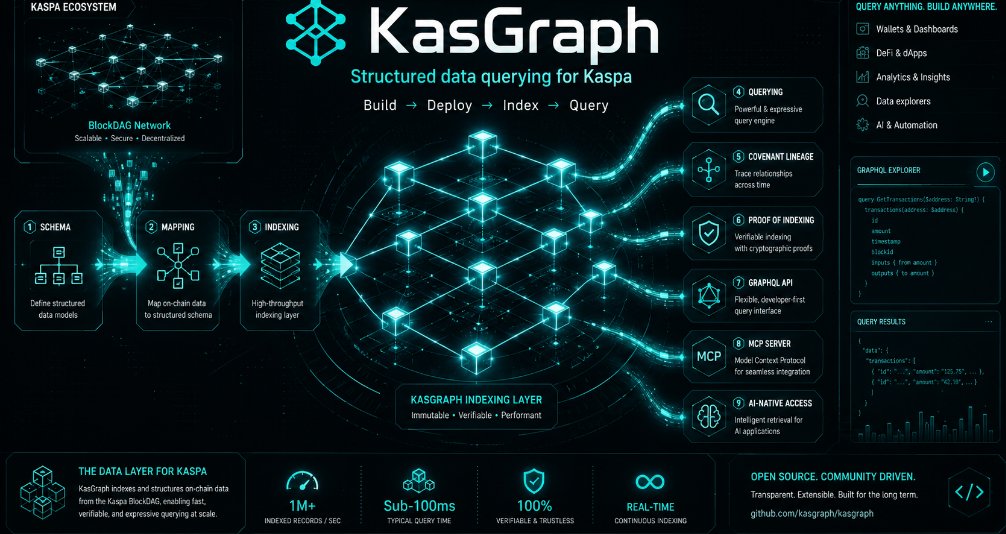
KasGraph is now feature-complete. Think of it as The Graph rebuilt for Kaspa, except not lazily ported from an account-chain worldview. Kaspa is not Ethereum with different branding; it is a UTXO-based BlockDAG with Covenant IDs, lineage, forks, native assets, and parallel history, so the data layer has to respect that architecture from the ground up. KasGraph does exactly that. You define a schema, write an AssemblyScript mapping, build, deploy, index, and query through GraphQL or MCP.
That matters because this is not only for dashboards and explorers, it is AI-native from day one, letting agents query structured Kaspa data without manually stitching together RPC calls or writing raw GraphQL. The full pipeline is live: build, deploy, index, query. Multi-tenant, hot-reloadable, and able to pick up new deploys without restarting the node. Under the hood it supports real covenant fingerprints from live compiles, OpenSilver core patterns, native KCC20 controllers, legacy KRC-20/KRC-721, BlockDAG-aware reorg handling, typed subgraph schemas, relation resolution, covenant lineage, fork-aware DAGs, and Proof of Indexing with an independent verifier. The only remaining piece is operational: deploying the hosted site at kasgraph.com with log streaming and auth layered in. MIT licensed, public from the first commit. Kaspa finally has structured data querying.
github.com/trillskillz/KasGr…
10
73
212
5,450
May 27
I am developing a new project called KasGraph. KasGraph is the data layer Kaspa needs if applications are going to move beyond raw transactions and into usable, real-time infrastructure.
Every wallet, marketplace, explorer, DeFi interface, AI agent, or covenant-based app eventually has to ask the same basic questions: what tokens does this address own, what happened to this covenant, which NFTs were minted, what transfers occurred, what proofs were submitted, and how did the state change over time? Without a shared indexing layer, every developer is forced to rebuild that logic alone. That means slower apps, duplicated infrastructure, fragile backends, and a worse user experience.
KasGraph fixes this by acting as a subgraph-style indexing protocol built specifically for Kaspa. Developers define schemas in GraphQL SDL, write TypeScript event handlers that compile to WASM through AssemblyScript, and KasGraph materializes the indexed data into Postgres with per-block proof-of-indexing checkpoints. In plain English: developers describe what they want to track, KasGraph watches Kaspa, remembers the important events, and makes that data instantly searchable.
The technical stack is designed around where Kaspa is going, not where legacy chains already are. KasGraph supports KIP-20 Covenant IDs, native KRC-20 and KRC-721 detection, Toccata covenant primitives, OpenSilver patterns, Groth16 proof detection under KIP-16, BlockDAG-aware reorg handling, multi-RPC failover, and KIP-20 confirmation finality. Subgraphs can subscribe to typed events without every developer writing custom detection logic from scratch.
The interface layer exposes the same indexed data through GraphQL, MCP, gRPC streaming through KasStream, and WebSocket subscriptions. Same data, four surfaces. Apps can query it, dashboards can stream it, wallets can subscribe to it, and AI assistants can understand it through MCP in plain English instead of raw chain parsing.
Performance targets are explicit: sub-30-second indexing latency, p95 query latency under 200ms, and sub-second streaming. MIT licensed. Open source from the first commit.
KasGraph is not just an indexer. It is the connective tissue between Kaspa’s execution future and the applications people will actually use.
Builders are welcome.
github.com/trillskillz/KasGr…
25
90
282
10,489
Thank you! I just asked internally: we ported a C algorithm from WPF to OpenSilver C# ("it's a Bentley-Ottmann sweep-line algorithm adapted for boolean operations on planar subdivisions").
1
1
81

May 25
covenant ecosystem needs tooling like this opensilver filling a real gap. excited to see it grow
3
44

Que gran aporte!!!!!
OpenSilver!!!
$KAS
May 25

I built OpenSilver because Kaspa’s covenant ecosystem is going to need more than theory.
It is going to need open-source tooling, reusable patterns, public review, and a development surface that builders can actually understand without starting from zero every time.
OpenSilver is an open-source toolkit for building covenant-based applications on Kaspa. For non-technical people, think of it like a public library of reusable “rules for money.” Instead of an app needing a company, custodian, or middleman to decide when funds move, a covenant can lock KAS inside a transaction with conditions attached. Funds can release after a deadline, require multiple approvals, stream over time, recover through backup keys, execute escrow logic, support swaps, or interact with verification systems. OpenSilver collects these kinds of patterns into one shared library so builders can use, inspect, improve, and standardize them in public.
For developers, the important part is that OpenSilver is not trying to turn Kaspa into an Ethereum clone. It is built around Kaspa’s UTXO model and SilverScript covenant logic, meaning enforcement happens through transaction constraints rather than a global account-based smart contract VM. The repo includes patterns for ownership, multisig, timelocks, vaults, escrow, vesting, dead man switches, social recovery, HTLC-style atomic swaps, streaming payments, payroll and freelance flows, token-related KRC patterns, and early ZK-aware structures. The goal is to make Kaspa’s post-Toccata programmable surface easier to reason about, test, reuse, and integrate.
The open-source angle is the real point. If Kaspa covenants are going to become serious infrastructure, developers need shared primitives, examples, manifests, CLI tooling, runtime checks, walkthroughs, and public review. Otherwise the ecosystem fragments into isolated scripts, duplicated logic, and avoidable security mistakes. OpenSilver gives builders a common foundation while letting the community audit the logic in the open before serious value depends on it.
It is still early. These patterns are not externally audited yet, and some advanced ZK-facing pieces depend on upstream SilverScript and protocol maturity. But that is exactly why I built it in the open.
OpenSilver is not just code.
It is scaffolding for a native Kaspa application layer.
github.com/trillskillz/OpenS…
2
16
388
👋 OpenSilver team here. Looks like there may be a naming collision. Just to avoid confusion: the official OpenSilver project is under the OpenSilver GitHub org. Happy to clarify!
1
5
332
May 25
I built OpenSilver because Kaspa’s covenant ecosystem is going to need more than theory.
It is going to need open-source tooling, reusable patterns, public review, and a development surface that builders can actually understand without starting from zero every time.
OpenSilver is an open-source toolkit for building covenant-based applications on Kaspa. For non-technical people, think of it like a public library of reusable “rules for money.” Instead of an app needing a company, custodian, or middleman to decide when funds move, a covenant can lock KAS inside a transaction with conditions attached. Funds can release after a deadline, require multiple approvals, stream over time, recover through backup keys, execute escrow logic, support swaps, or interact with verification systems. OpenSilver collects these kinds of patterns into one shared library so builders can use, inspect, improve, and standardize them in public.
For developers, the important part is that OpenSilver is not trying to turn Kaspa into an Ethereum clone. It is built around Kaspa’s UTXO model and SilverScript covenant logic, meaning enforcement happens through transaction constraints rather than a global account-based smart contract VM. The repo includes patterns for ownership, multisig, timelocks, vaults, escrow, vesting, dead man switches, social recovery, HTLC-style atomic swaps, streaming payments, payroll and freelance flows, token-related KRC patterns, and early ZK-aware structures. The goal is to make Kaspa’s post-Toccata programmable surface easier to reason about, test, reuse, and integrate.
The open-source angle is the real point. If Kaspa covenants are going to become serious infrastructure, developers need shared primitives, examples, manifests, CLI tooling, runtime checks, walkthroughs, and public review. Otherwise the ecosystem fragments into isolated scripts, duplicated logic, and avoidable security mistakes. OpenSilver gives builders a common foundation while letting the community audit the logic in the open before serious value depends on it.
It is still early. These patterns are not externally audited yet, and some advanced ZK-facing pieces depend on upstream SilverScript and protocol maturity. But that is exactly why I built it in the open.
OpenSilver is not just code.
It is scaffolding for a native Kaspa application layer.
github.com/trillskillz/OpenS…
24
77
231
7,011
Thanks!
We implemented CombinedGeometry because it was needed to faithfully support WPF’s FrameworkElement.LayoutTransform.
One of the subtleties is that LayoutTransform affects layout, and clipping has to be applied after the transform. That behavior is different from a simple RenderTransform, so supporting CombinedGeometry helped us reproduce clipping more accurately.
In general, our goal with OpenSilver is to make it as easy as possible to bring existing WPF applications to the web, by supporting the WPF API surface and behavior wherever we can.
Why the web? Easier deployment, broader platform reach, stronger sandboxing/security, and the ability to benefit from browser features such as accessibility tools, Ctrl F, text selection, translation, browser extensions, and more.
OpenSilver renders UI using real DOM elements, which is an important part of making those benefits available.
For anyone curious, there’s a live playground here: xaml.io
1
67
WPF… in the browser?
We just implemented full CombinedGeometry support! (OpenSilver 3.4-Preview).
Live demo with code: xaml.io/s/Samples/CombinedGe…
2
3
49
3,016
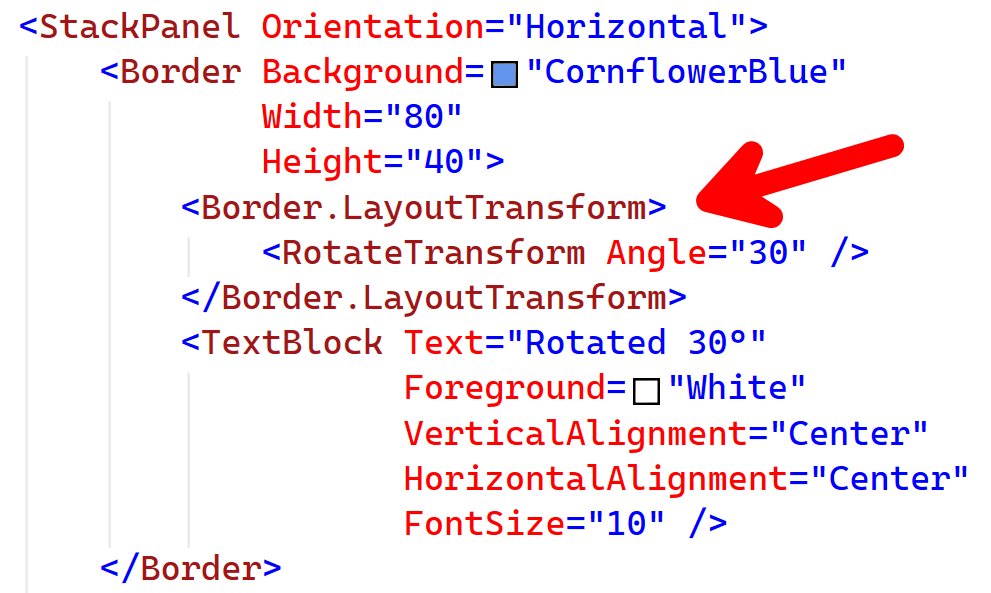
Most UI frameworks are still trying to catch up
to what WPF got right 20 years ago.
Today we added support for
FrameworkElement.LayoutTransform
to the OpenSilver develop branch,
as we continue bringing the power of WPF
to the native web.
1
26
1,206

May 10
WPF (デスクトップ) と OpenSilver (ブラウザー) の実行結果。
ブラウザー上のアプリで簡単にリキッドレイアウトにできるのが素晴らしい。
4
483
May 10
せっかくだから、WPF から OpenSilver に移植してみた。形式的な部分を除けばほぼ同一のコードで、デザイナー画面はこんな感じ。
1
4
352
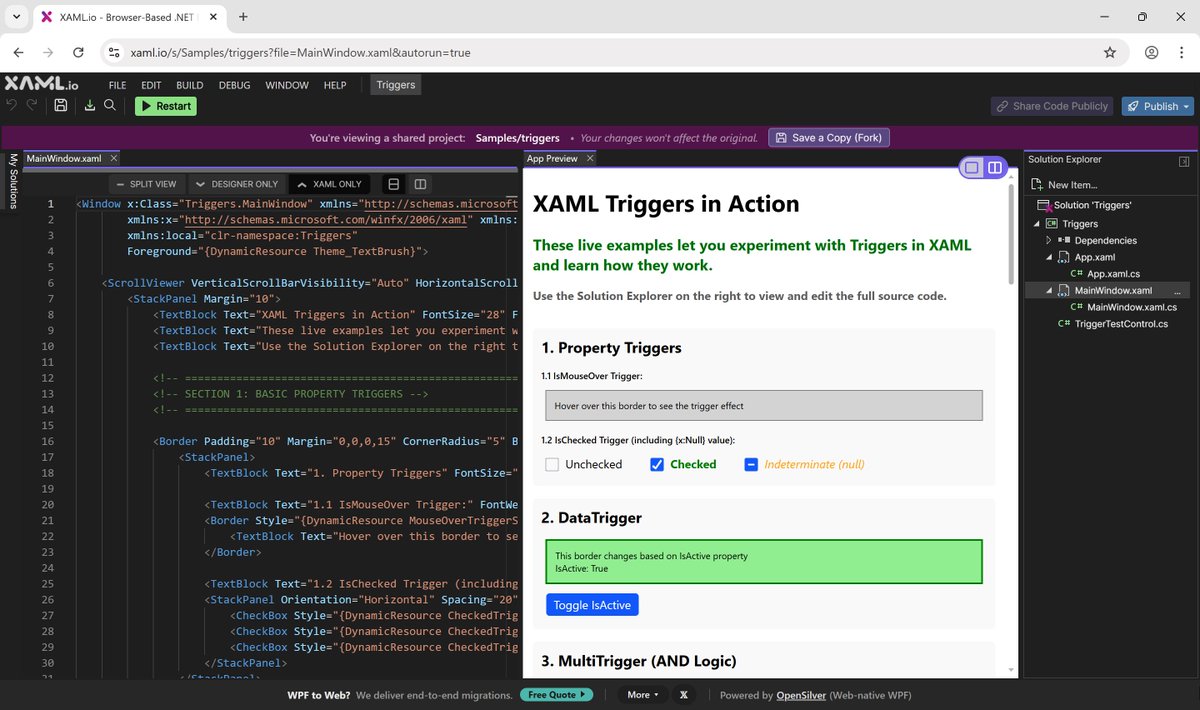
WPF… in the browser?
We've just added WPF Triggers support to OpenSilver 3.4-Preview, and you can test it instantly in our live Playground:
xaml.io/s/Samples/triggers?f…
Check it out. No install. No signup.
2
19
1,062