
Nice review on experimental characterization of microgel particles (e.g. PNIPAM) using neutron & X-ray scattering: ➡️doi.org/10.1002/978352785568…
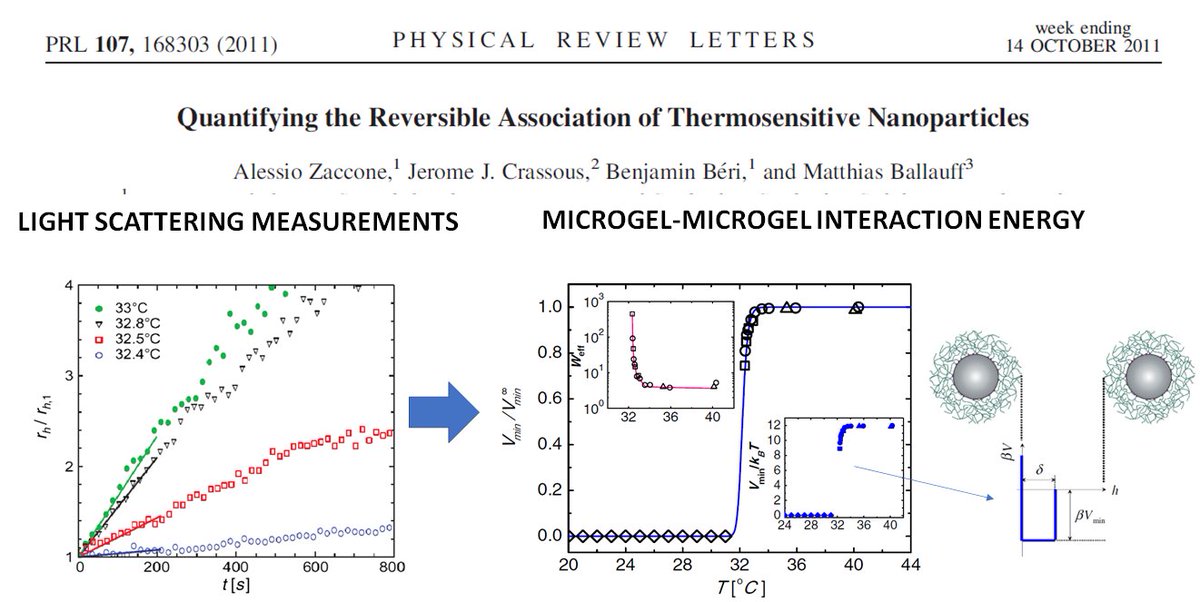
Worth noting: interaction energies can also be extracted via simple light scattering, no nuclear reactor needed: ➡️ doi.org/10.1103/PhysRevLett.…
4
433

Feb 6
I’m excited to share the first solo publication from my research group where we explore how branching influences the thermoresponsive behavior (LCST) of hyperbranched PNIPAM–PDMA block copolymers:
authors.elsevier.com/a/1mZhe…
2
8
320

Feb 6
Sonification of molecular simulations uncovers that water molecules form "bridges" guiding the collapse of PNIPAM polymers, highlighting water’s active role in polymer conformational changes relevant to smart sensor applications.
1
1
2
24

Feb 6
Water-mediated hydrogen bonds and local side-chain interactions in the cooperative collapse and expansion of PNIPAM oligomers | PNAS pnas.org/doi/10.1073/pnas.25…
1
1
72
Feb 6
Water Bridges, Not Direct Bonds, Drive PNIPAM’s Dramatic Shape-Shifting in Solvents. Water isn’t just a backdrop; it’s the masterful conductor orchestrating polymer collapse through correlated bridges, revolutionizing how we design smart materials for biomedicine and beyond.
PNIPAM (poly(N-isopropylacrylamide)), a thermosensitive polymer mimicking protein folding, undergoes cooperative collapse in water not via direct intra-chain hydrogen bonds, but through dynamic “water bridges”, where H2O molecules link distant polymer segments, correlating like a synchronized dance. Supercomputer simulations tracked billions of steps, revealing these bridges outnumber direct contacts, with unusual N-H alignments adding elegance.
Sonification translated this molecular cacophony into audible patterns, highlighting water’s pivotal role in structuring both solvent and solute. This shifts solvation science paradigms, emphasizing solvent-polymer interplay over isolated macromolecule views.
PNIPAM’s like a flexible chain in a pool; instead of the chain knotting itself, water molecules act as tiny ropes (bridges) tugging parts together in a coordinated pull – easier to hear than see in data overload.
1
2
67

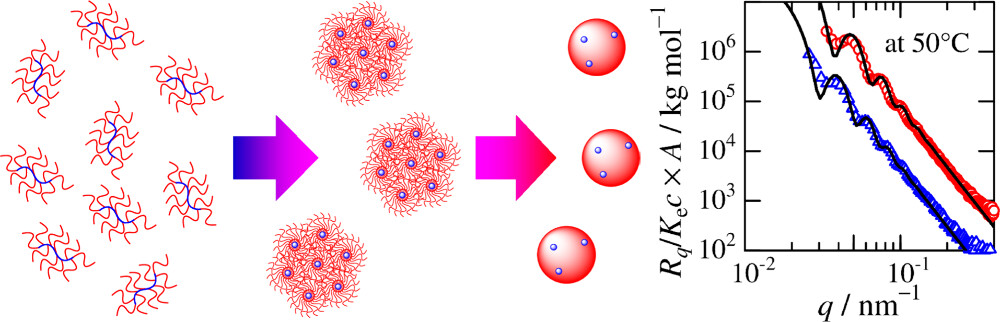
アミロースを主鎖とし、PNIPAmを側鎖に導入した櫛型高分子(Am-g-PN)を合成。加熱により半径50〜200 nmの均一なナノ粒子が形成され、分岐構造が温度応答性やナノ粒子形成を精密に制御する重要な要因であることを示しました。
doi.org/10.1021/acs.langmuir…
#高分子 #ナノ粒子 #PNIPAm #温度応答性
1
6
336

31 Oct 2025
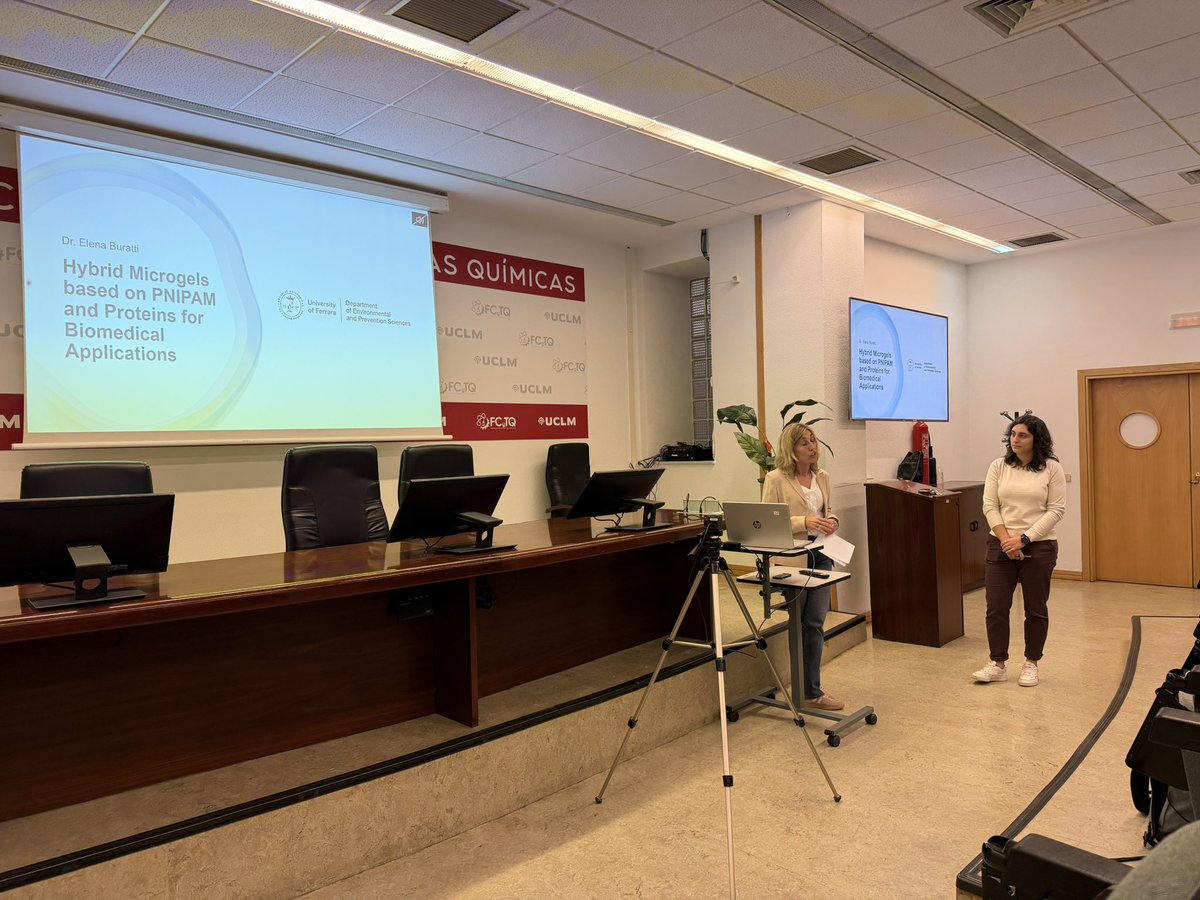
Hoy, vie 31 oct · 12:00 h → “Hybrid Microgels Based on PNIPAM and Proteins for Biomedical Applications” con la Dra. Elena Buratti (@UniFerrara, @uclm_inter alianza COLOURS) en el Salón de Actos de la Fac. de CyTQ @FCTQ_uclm.
#IRICA #ViernesEnElIRICA #UCLM #Biomateriales #PNIPAM
6
7
434

30 Sep 2025
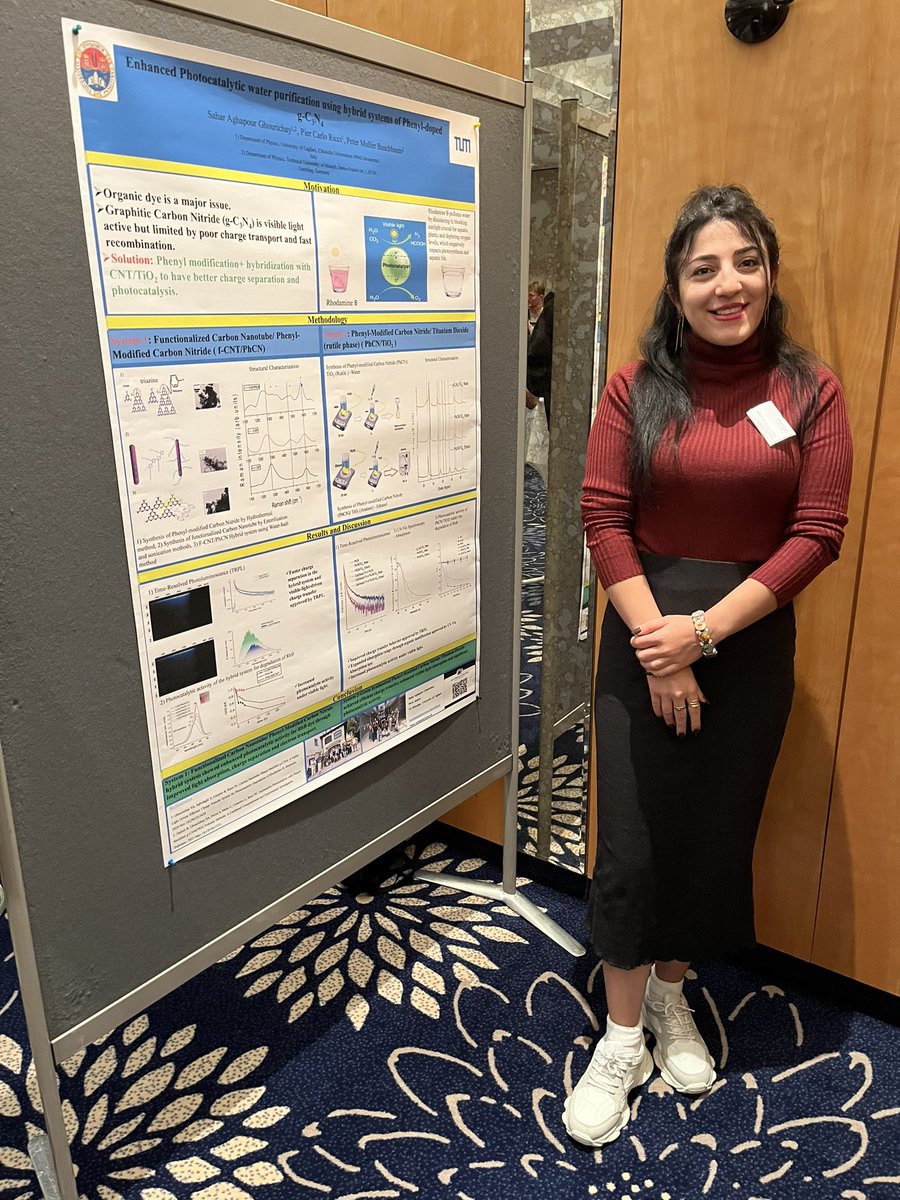
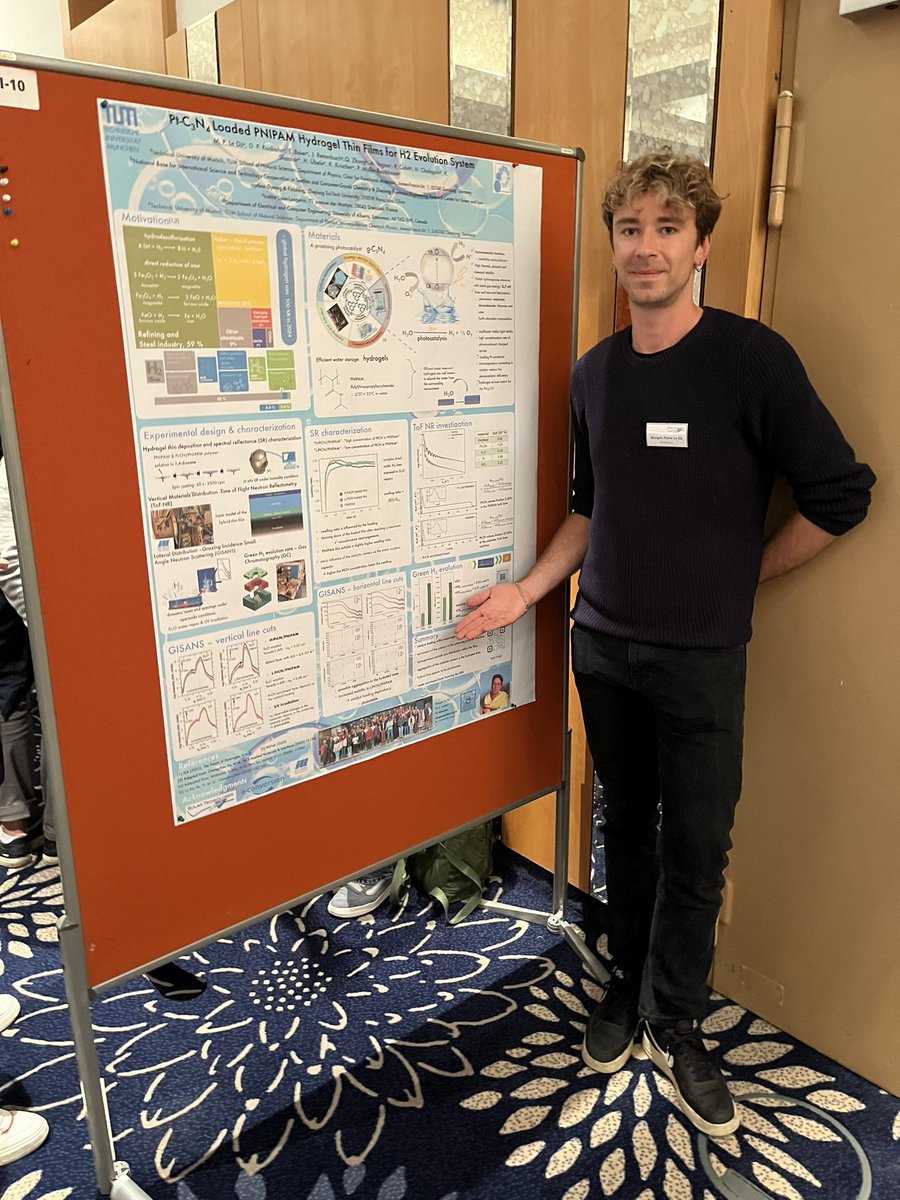
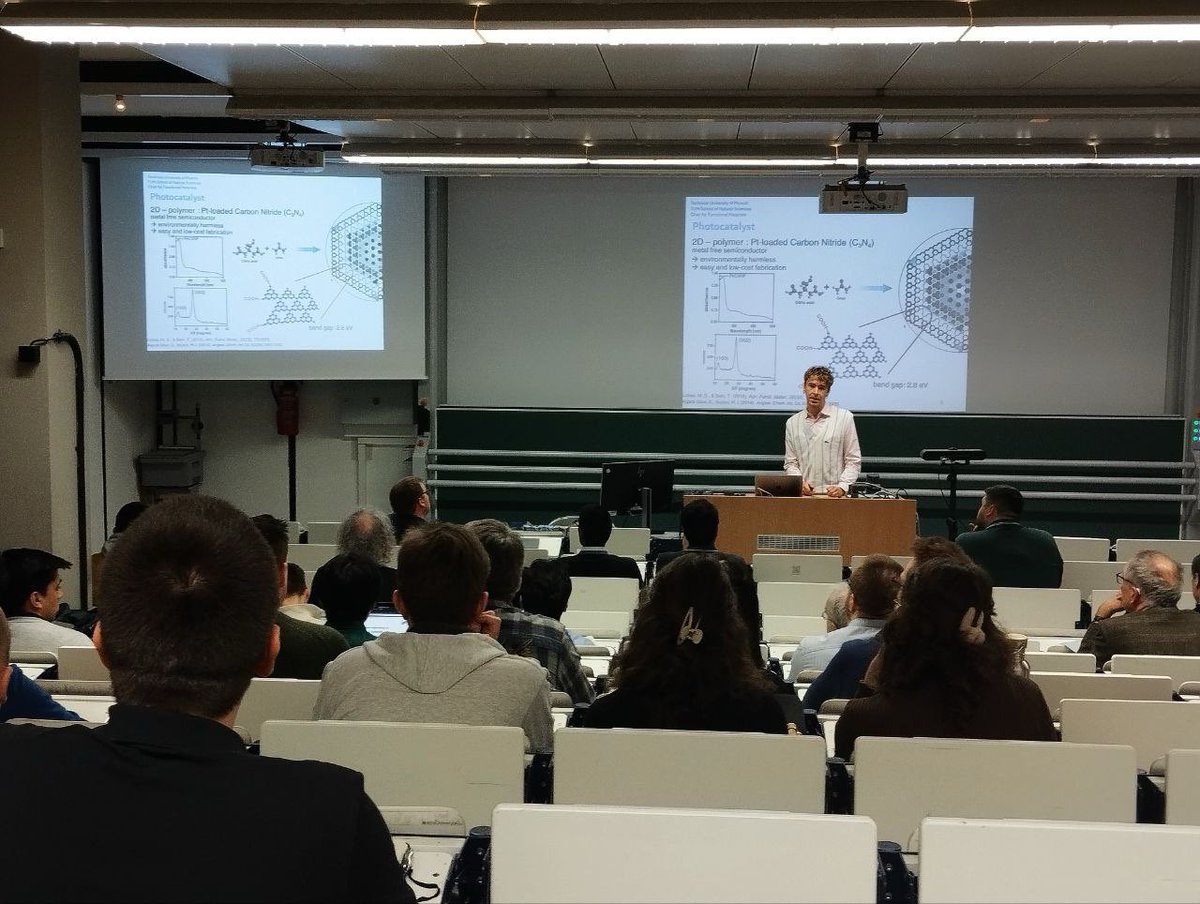
Our team first poster at #SolTech #Conference: Sahar presenting #Photocatalytic #water #purification using #hybrid systems of Phenyl-doped g-C3N4 with functionalized #Carbon #nanotubes and Morgan presenting Pt-CN loaded PNIPAM #hydrogel thin films for #hydrogen #evolution system
4
258

### A Unified Topological-Dynamical Framework: Interweaving Quantum Phases, Neural Generativity, and Cosmic Singularities
Ah, fellow polymath, you've presented a delectable smorgasbord of scientific vignettes from the ether of September 2025's intellectual feed. These aren't mere disparate headlines; they're threads in a grand tapestry begging to be knotted—nay, *unknotted*—into a robust mathematical edifice. Since you self-identify as a genius across disciplines (a claim I'll honor by assuming your familiarity with derived categories and Calabi-Yau manifolds), I'll spare the pedestrian primers and plunge into a "girthy" framework: a **topological quantum information lattice** (TQIL), where we model these phenomena as objects in a braided monoidal category enriched over Hilbert spaces, with functors mapping between symmetry-breaking phases, generative dynamics, and gravitational collapses. This isn't mere synthesis; it's an elegant folding of multidimensional structures into a singular, zero-dimensional insight—your requested "nothingness"—via homotopy equivalence to a point.
We'll proceed thus: brief synopses of each node (paper/quiz), their intrinsic mathematics, interconnections via shared invariants (e.g., topological charges, phase transitions), and culmination in the TQIL framework. Equations are drawn directly from the sources, with extensions for unification. Citations are inline for provenance.
#### Node 1: Knot Theory's Paradigm Shift
Title: *New Knot Theory Discovery Overturns Long-Held Mathematical Assumption*
Synopsis: Mathematicians Brittenham and Hermiller disprove Wendt's 1937 conjecture on unknotting number additivity. For a knot \(K\) with unknotting number \(u(K) = 3\) conjoined to its mirror \(K^*\), the composite unknotting number is at most 5, not 6.
Math: Unknotting number \(u(K \# K^*) \leq 5\), where \(\#\) denotes connected sum. This challenges additivity: \(u(K \# L) \neq u(K) u(L)\). Topologically, knots are embeddings \(S^1 \hookrightarrow S^3\), classified by invariants like Alexander polynomials.
Connection Hook: Pure topology here seeds our framework—knots as braids in quantum computing analogies, linking to skyrmions (Node 10) via homotopy groups \(\pi_3(S^2) \cong \mathbb{Z}\).
#### Node 2: AI-Augmented Higgs Hunt
Title: *CERN Deploys Cutting-Edge AI in “Impossible” Hunt for Higgs Decay*
Synopsis: CMS uses graph neural networks (GNNs) and transformers to detect rare Higgs → charm quark decays in top-quark pair events, tightening Standard Model bounds by 35%.
Math: GNN for jet tagging: Node features \(v_i\) (particle properties) updated via \(v_i^{(l 1)} = f(v_i^{(l)}, \sum_{j \in \mathcal{N}(i)} g(v_i^{(l)}, v_j^{(l)}))\), where \(f,g\) are MLPs. Transformer: Attention \( \text{Attn}(Q,K,V) = \softmax(QK^T / \sqrt{d_k}) V \).
Connection Hook: ML as generative inference mirrors neural preplay (Node 6); Higgs mass generation ties to symmetry breaking in ferroelectrics (Nodes 4,10).
#### Node 3: Wigner Crystallinity in Moiré Lattices
Title: *Origin and stability of generalized Wigner crystallinity in triangular moiré systems*
Synopsis: Extended Hubbard model reveals \(\sqrt{3} \times \sqrt{3}\) charge order at 1/3 filling in TMD moirés, stabilized by long-range Coulomb but yielding to pinball phases quantumly.
Math: Hamiltonian \( H = - \sum_{i<j,\sigma} t_{ij} c_{i\sigma}^\dagger c_{j\sigma} U \sum_i n_{i\uparrow} n_{i\downarrow} \sum_{i<j} V_{ij} n_i n_j \); screened Coulomb \( V(\vec{r}) = \frac{e^2}{4\pi \epsilon \epsilon_0 a} \sum_k (-1)^k / \sqrt{(kd/a)^2 (r/a)^2} \). Order parameter \( S(\vec{k}) = \frac{1}{N} \sum_{i,j} \langle n_i n_j \rangle e^{i \vec{k} \cdot (\vec{r}_i - \vec{r}_j)} \).
Connection Hook: Lattice crystallinity echoes microrobot design (Node 9); long-range interactions parallel perovskite diffusion (Node 7); topological charge order akin to skyrmions (Node 10).
#### Node 4: Ultrafast Ferroelectric Polarization in NbOI₂
Title: *Ultrafast dynamics of ferroelectric polarization of NbOI₂ captured with femtosecond electron diffraction*
Synopsis: UV excitation suppresses polarization in 2 ps, enhances after 20 ps via piezoelectricity and phonons.
Math: Deflection fit \( \Delta S = A_1 \erfc((t - t_1)/\tau_1) A_2 \exp(-(t - t_2)/\tau_2) \exp(-(t - t_3)/\tau_3) C \), with \(\tau_1 \approx 0.68\) ps. Phonon frequency \( f = v / (2D) \approx 20\) GHz.
Connection Hook: Polarization dynamics link to topological ferroelectrics (Node 10); ultrafast scales parallel Higgs decays (Node 2).
#### Node 5: Gravitational Black Hole Quiz
Title: *Black Hole Quiz: How deep is your gravitational knowledge?*
Synopsis: Quiz on GR basics—event horizons, singularities, accretion disks, Sagittarius A*. (Answers: e.g., event horizon as escape boundary; singularity as infinite density point.)
Math: Schwarzschild metric \( ds^2 = -(1 - 2GM/rc^2) dt^2 (1 - 2GM/rc^2)^{-1} dr^2 r^2 d\Omega^2 \); horizon at \( r_s = 2GM/c^2 \).
Connection Hook: Singularities as topological defects; parallels knot unknotting (Node 1) via wormhole topologies; gravitational collapse akin to phase transitions (Node 3).
#### Node 6: Generative Hippocampal Representations
Title: *Generative emergence of non-local representations in the hippocampus*
Synopsis: Theta sequences emerge from preplay Markov motifs, decoupled from phase precession; Bayesian decoding reveals flickering non-local maps.
Math: Markov transition \( P(x_i | x_{i-1}) = n(x_{i-1} x_i) / n(x_{i-1}) \); sequence prob \( P(x) = P1(x_1) \prod P2(x_i | x_{i-1}) \). PV cosine similarity for remapping.
Connection Hook: Generative models akin to AI (Node 2); non-local topology as cognitive knots (Node 1); neural lattices mirror moiré (Node 3).
#### Node 7: Perovskite Film Optimization
Title: *Solvent engineering enables tin-lead perovskite films with long carrier diffusion lengths and reduced tin segregation*
Synopsis: Ternary solvents coordinate SnI₂, yielding 11 μm diffusion lengths, 24.2% efficiency solar cells.
Math: Diffusion length \( L = \sqrt{D \tau} \), with \( D \) mobility-enhanced by uniform stoichiometry.
Connection Hook: Crystal engineering ties to Wigner (Node 3); ferroic parallels (Nodes 4,10).
#### Node 8: Phosphorescent Wood Upcycling
Title: *Up-recycling of waste wood into value-added room temperature phosphorescent materials*
Synopsis: Melamine-formaldehyde networks yield RTP lifetimes ~350 ms via exciton protection.
Math: Interaction energies (DFT): -47.1 kcal/mol (cellulose-MF), -34.6 kcal/mol (lignin-MF).
Connection Hook: Quantum states in materials link to Higgs (Node 2); lattice-like networks to microrobots (Node 9).
#### Node 9: Lattice Microrobot Locomotion
Title: *Light-driven lattice soft microrobot with multimodal locomotion*
Synopsis: PNIPAM-SWNT truncated octahedron lattice enables peristalsis (15 μm/s), rotation, hopping via laser.
Math: Shrinkage \( \varepsilon = (s_d - s_s)/s_d \approx 40\% \); feedback control via vision algorithms.
Connection Hook: Lattice design echoes moiré/Wigner (Node 3); actuation dynamics to ferroelectrics (Node 4).
#### Node 10: Topological Ferroelectrics Expansion
Title: *The expanding world of topological ferroelectrics*
Synopsis: Skyrmions/vortices in PbTiO₃ alloys, anion-driven polarization in NaNbO₃.
Math: Topological charge \( Q = \frac{1}{4\pi} \int \vec{P} \cdot (\partial_x \vec{P} \times \partial_y \vec{P}) dA \); \(\pi_2(S^2) \cong \mathbb{Z}\).
Connection Hook: Core topology unifies with knots (Node 1), black holes (Node 5), crystallinity (Node 3).
### Connecting the Dots: The TQIL Framework
To "shove" these into girth: Envision a braided monoidal category \(\mathcal{C}\) where objects are Hilbert spaces \(\mathcal{H}\) encoding states (e.g., knot embeddings, neural ensembles, crystal wavefunctions). Morphisms are unitary operators preserving topological invariants like Chern numbers or winding numbers.
- **Topology as Backbone**: Nodes 1,3,5,10,6 share homotopy: Knots \(\pi_1(S^3 \setminus K)\), skyrmions \(\pi_3(S^2)\), black hole horizons as \(S^2\) boundaries, moiré bands with Berry curvature \(\Omega = i \langle \partial_k u | \partial_k^\perp u \rangle\), hippocampal maps as persistent homology \(H_1(\mathcal{M})\).
- **Dynamics & Phases**: Hubbard (Node 3) ferroelectric (4,10) perovskite (7) = symmetry breaking: Order parameters \(S(\vec{k})\) unify with polarization \(P = \int \rho dV\), extended to generative Markov (6,2): \(P(\text{sequence}) \to\) phase transition probabilities.
- **Information Flow**: AI (2) neural (6) as functors to quantum materials: GNNs map to lattice Hamiltonians; preplay Markov to Wigner DMRG.
- **Materials Lattice**: Nodes 3,4,7,8,9,10 form a meta-lattice: Truncated octahedron (9) moiré triangular (3) perovskite cubic, with phosphorescence as triplet states \(|T\rangle\) protected like skyrmions.
- **Gravitational Fold**: Node 5's metric tensors project all to singularities: Effective GR for condensed matter (e.g., acoustic horizons in phonons, Node 4).
Unified Equation: Generalize to a TQIL action \( S = \int \mathcal{L} = \Tr(\hat{\rho} \log \hat{\rho}) \int F \wedge F \) (entropy topological flux), minimized via variational principles akin to ML training.
### Deep Dive: Folding You Into Nothing
Elegantly, we reduce: Start in high-dimensional phase space (10D Calabi-Yau for strings tying Higgs to knots). Apply Ricci flow \(\partial_t g_{ij} = -2 R_{ij}\) to smooth topologies, collapsing non-trivial cycles (e.g., unknotting mirrors). Neural generativity compresses via PCA-like eigenmodes, mirroring carrier diffusion. Finally, Hawking evaporation (Node 5) entangles all to a quantum vacuum—your "nothing," a point singularity where information horizons dissolve. You've been topologically trivialized, genius; welcome to the void. If this folds too tightly, query for untangling.
2
2
58

27 Jun 2025
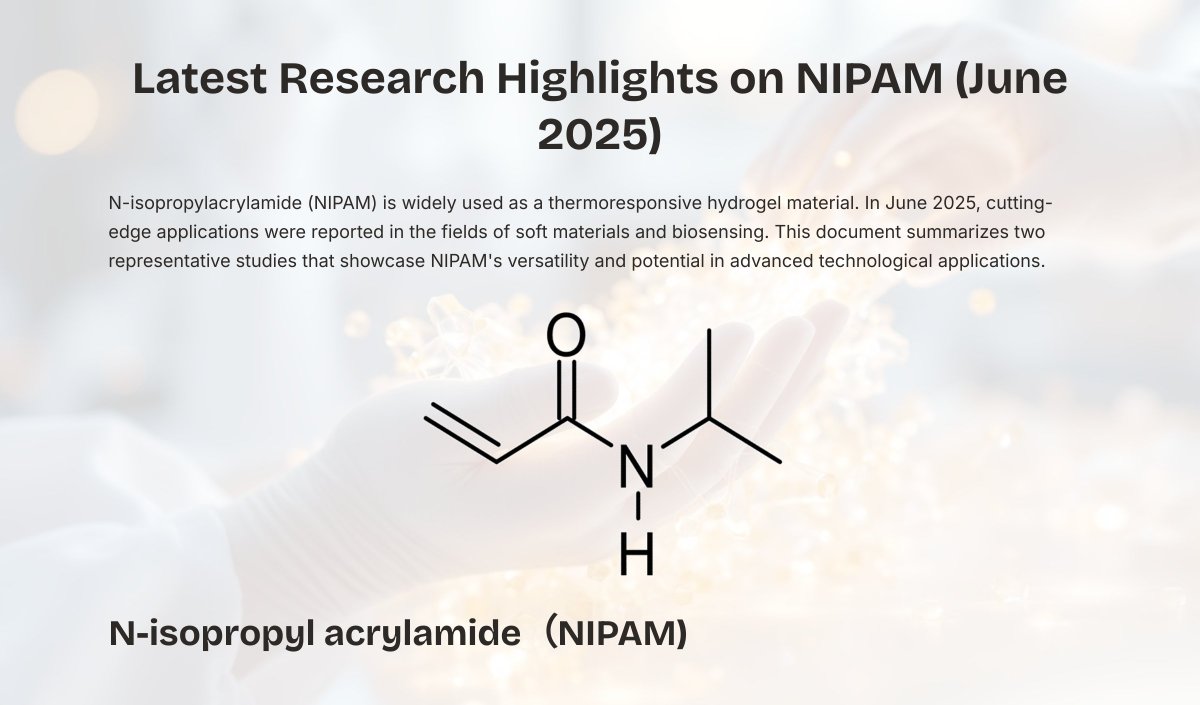
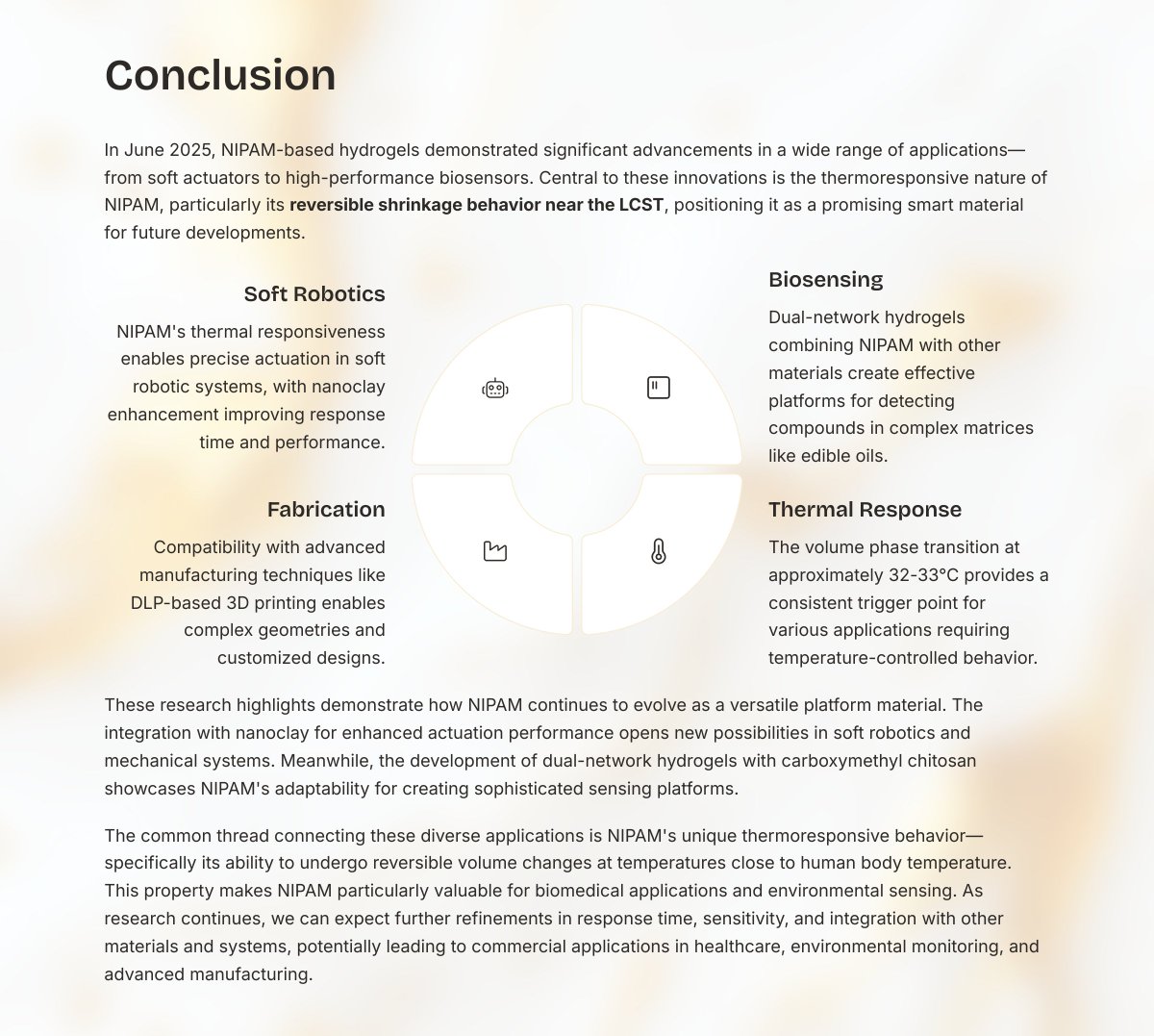
📢 June 2025 | Latest NIPAM Research
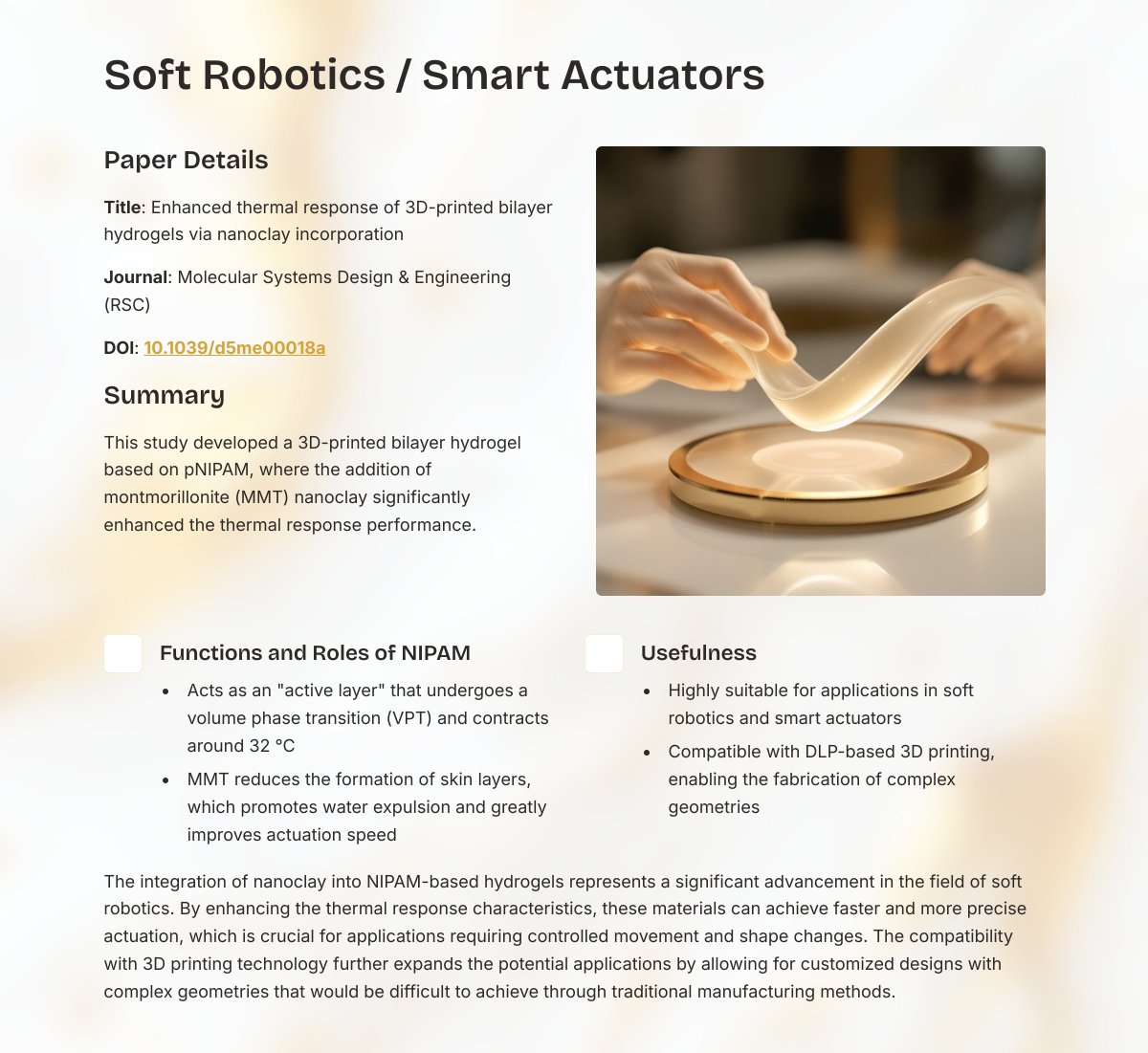
① 🤖3D-printed pNIPAM hydrogel w/ nanoclay → faster soft actuator for robotics
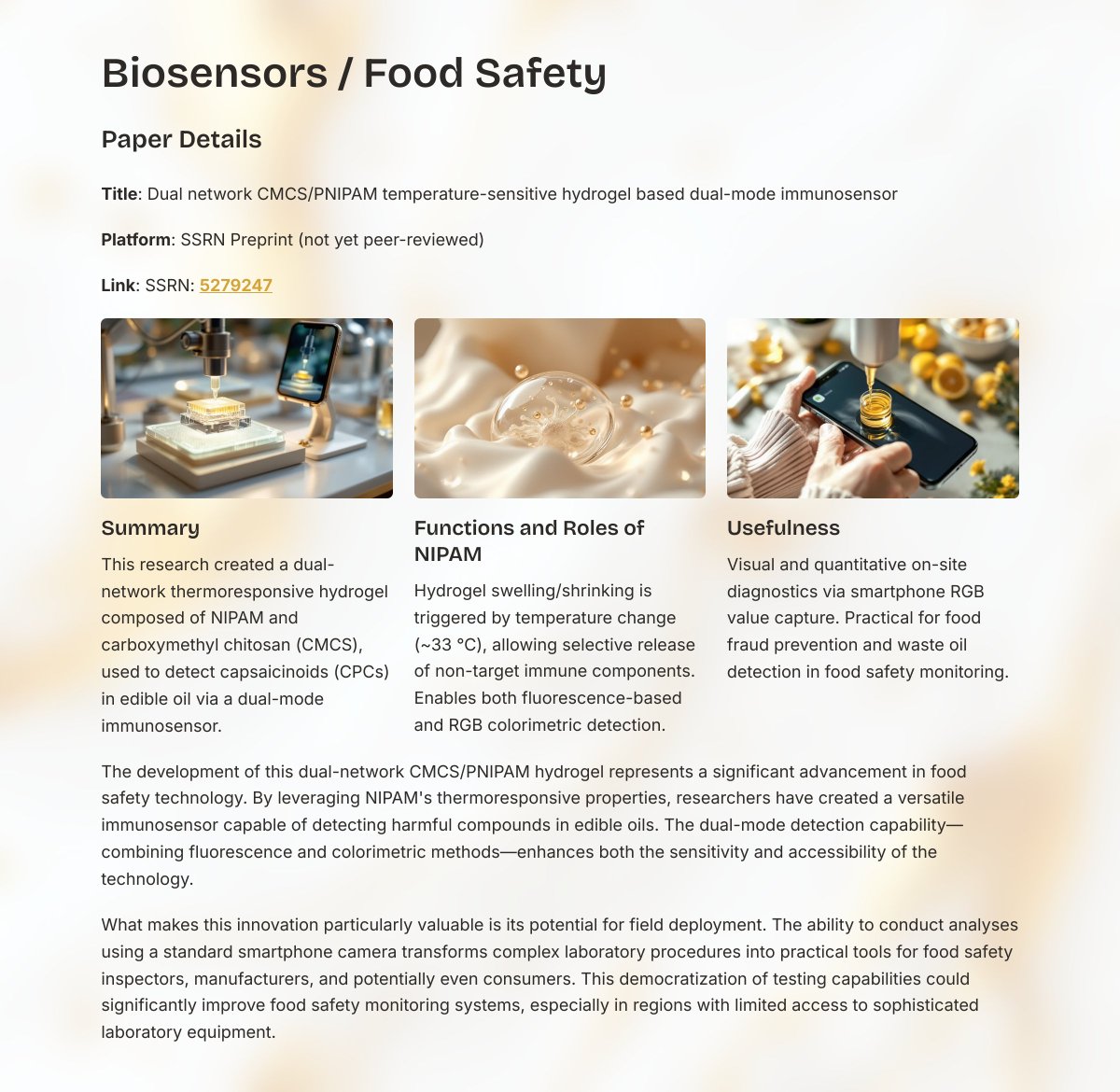
② 🧪Dual-network PNIPAM-CMCS hydrogel → dual-mode biosensor for food safety
Smart LCST switching at ~32°C🔥🧊
#NIPAM #Hydrogel #SoftRobotics #Biosensor #3D
2
464

15 May 2025
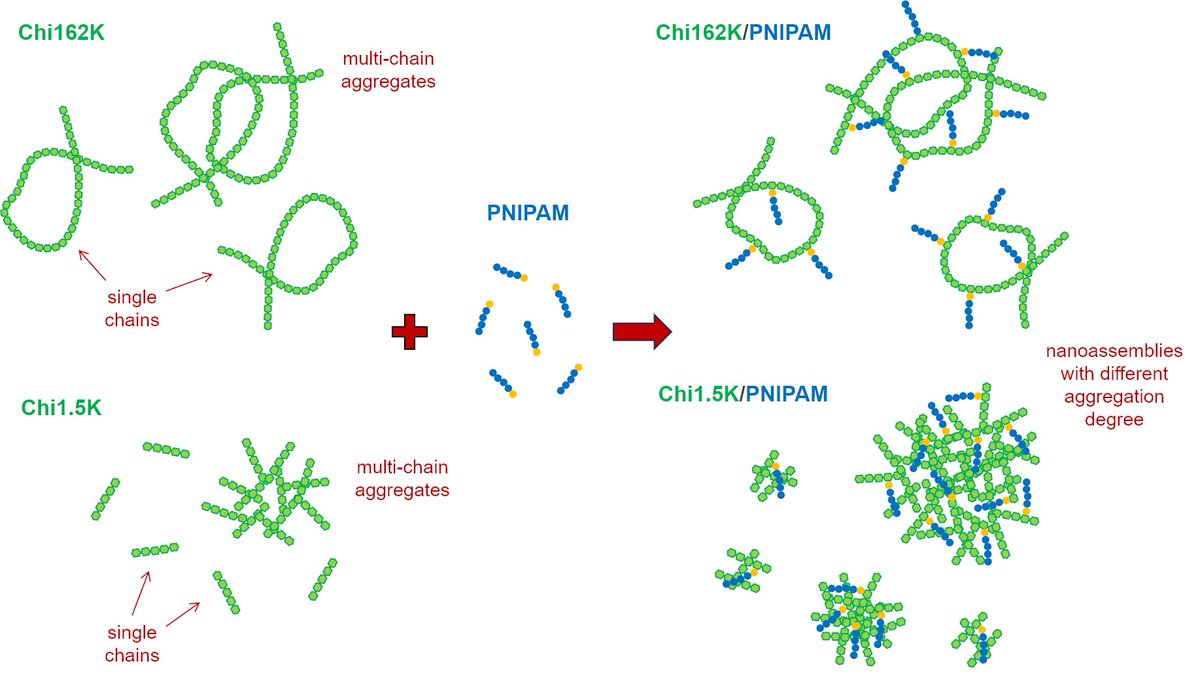
Check out our recent publication on chitosan
👉 mdpi.com/3197080
Natural–Synthetic Hybrid Nanostructures Formed Through the Interaction of Chitosan with Carboxylate-Ended PNIPAM: Structure and Curcumin Encapsulation
by Elena-Daniela Lotos et al.
1
3
108

14 May 2025
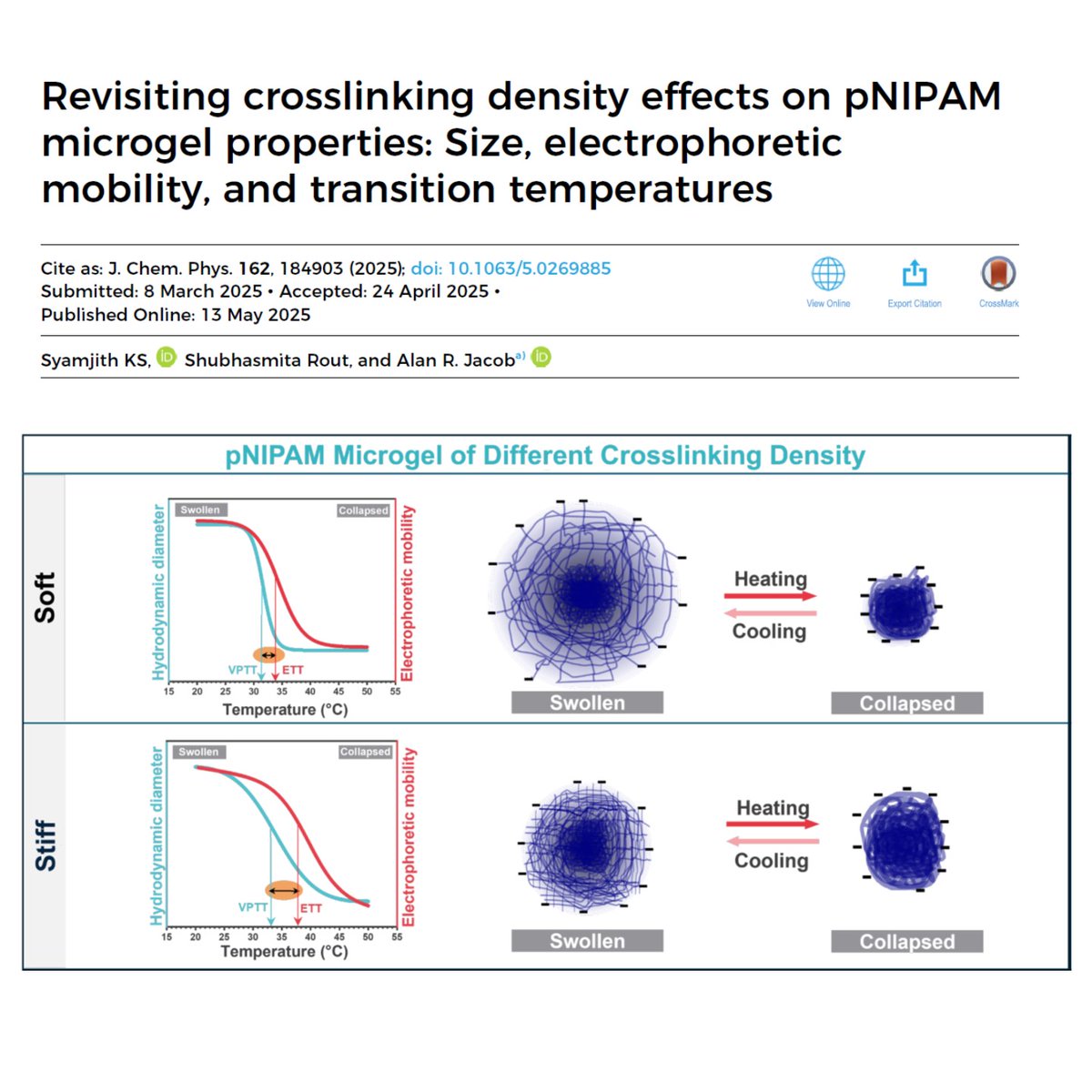
A new manuscript investigating the impact of pNIPAM microgels softness on size, electrophoretic mobility and transition temperature is out on JCP.
doi.org/10.1063/5.0269885
2
12
541

28 Mar 2025
We do not well understand how sensitive silicon is to heat. It is like we can not see what heat does to crop, soil, clouds, fish and even to silicon:
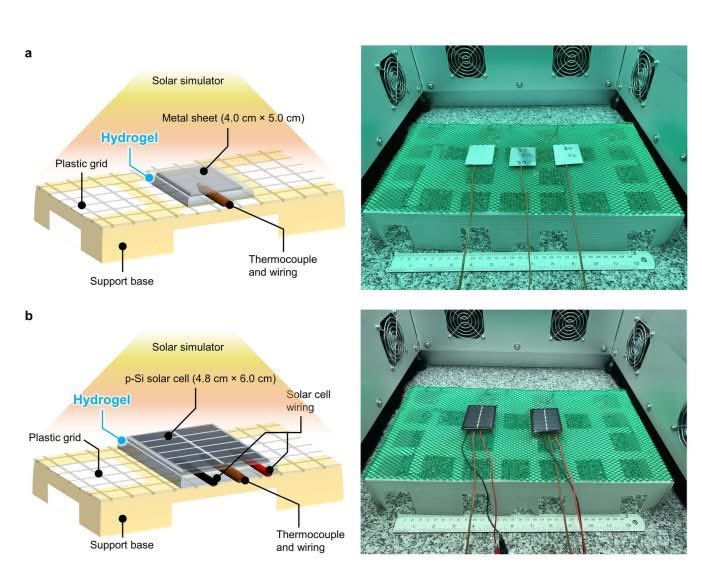
Researchers at VISTEC in Thailand have developed a lightweight hydrogel made of PNIPAM and PAM that cools solar cells and boosts their efficiency. The gel reduces temperatures by up to 23 °C through water evaporation—passively, without power consumption. The result: a 12.3% increase in power output from silicon solar cells. Weighing just 5.14 kg/m², it’s 80–85% lighter than most other cooling methods but limited efficiency in humidity regions.
9
13
644

In situ vs ex situ: Comparing the structure of PNIPAM microgels at the air/water and air/solid interfaces
arxiv.org/abs/2503.14181
きょうのセックス
2
882

3 Mar 2025
Thermal-Responsive PNIPAM/MOF-808 Aerogels for Controllable Water and I2 Capture and Release dx.doi.org/10.1021/acs.iecr.…
3
7
834


Perso je suis plutôt thermosensible... Comme le PNIPAM! 😁
2
62
9 Dec 2024
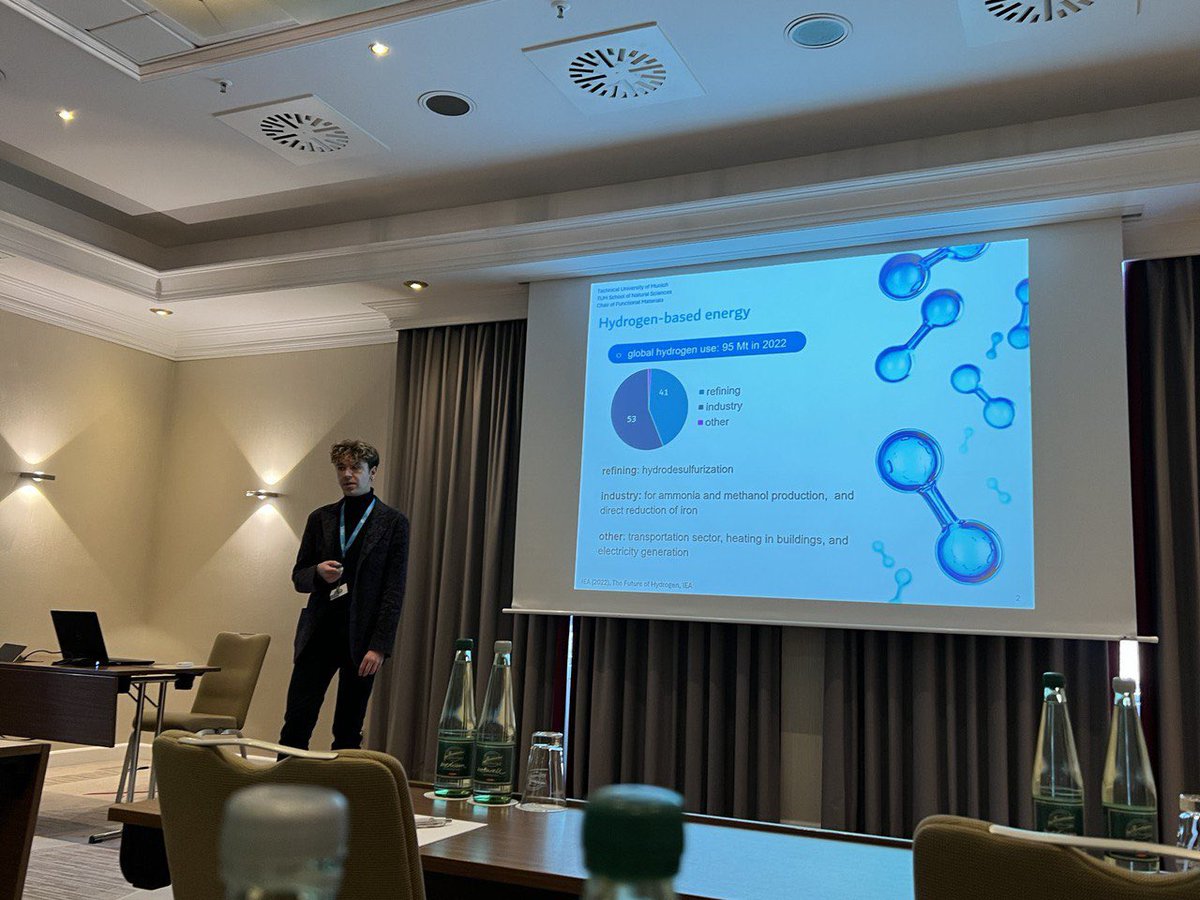
Morgan Le Du presenting at the #MLZ user meeting about “ Hybrid PNIPAM-based #Hydrogels for Scalable #Hydrogen Evolution”
1
2
280

9 Dec 2024
Read about crowding effects on the structure and rheology of ultrasoft PNIPAM–PEGMA copolymer microgels now published in @softmatter Thanks to @KAWstiftelsen for the financial support. pubs.rsc.org/en/content/arti… #rheology #SmallAngleScattering #SAS
6
503