
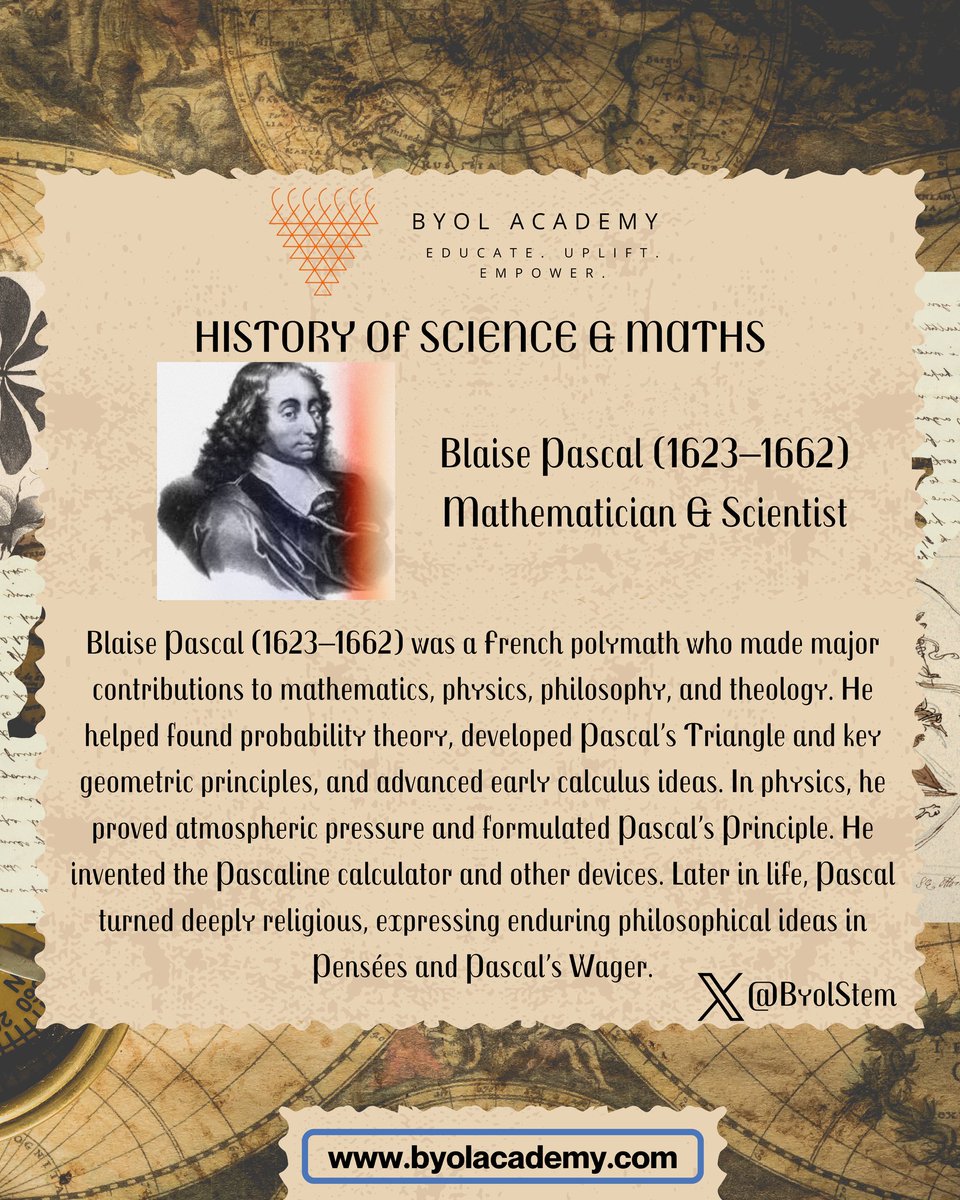
From Pascal’s Triangle to the foundations of probability, Blaise Pascal shaped the way we understand maths and science.
A true polymath whose ideas still inspire minds today.
#HistoryOfScience #HistoryOfMaths #BlaisePascal #PascalTriangle #ProbabilityTheory #MathsLovers #ScienceEducation #STEM
2
4
51

Jan 12
🚀 Day 12/365 — Self-Improvement Challenge
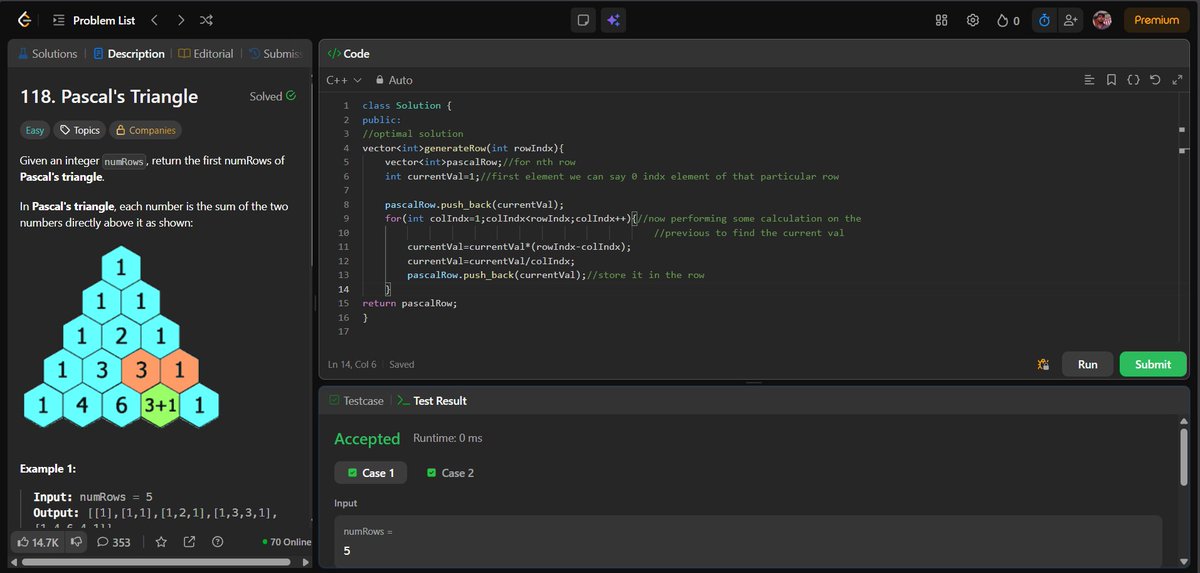
• Solved Pascal’s Triangle
• Implemented optimal approach using combinatorial formula 🧮
• Also explored brute-force row sum method
• Learned how math logic = efficient solutions
#Day12of365 #DSA #PascalTriangle #ProblemSolving
3
38

29 Dec 2025
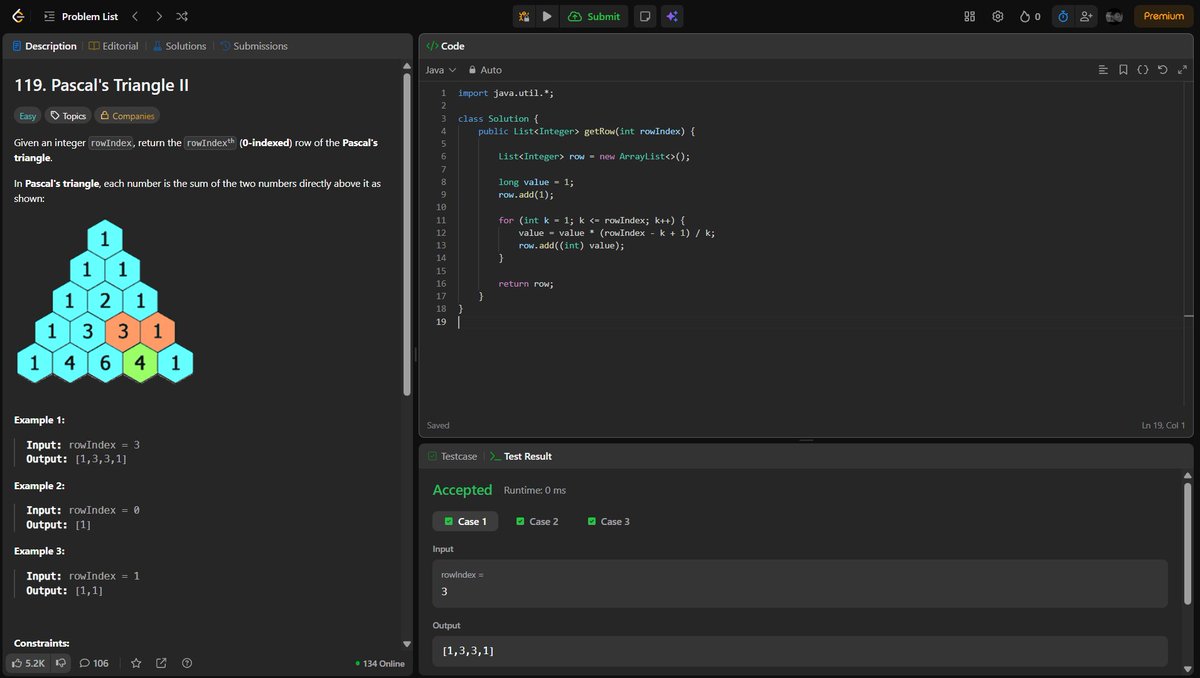
🚀 Day 16/30 LeetCode 119 - Pascal’s Triangle II
- The k-th element in a row can be computed using combinations
- Use iterative formula to build the row without generating the full triangle
- Avoid factorials to prevent overflow
#LeetCode #DSA #Java #PascalTriangle #Coding
8
99

Day: 2🤧
Solved Pascal’s Triangle on LeetCode.
Finally understood how nCr gives any specific element, and how simple loops can generate full rows or the entire triangle.
#LeetCode #100DaysOfCode #CodingJourney #DSA #PascalTriangle #Combinatorics #nCr #ProblemSolving #CodeNewbie
1
4
81

1 Nov 2025
ضریبهای دوجملهای از مثلث پاسکال (Pascal’s Triangle) میآیند:
الگویی که جبر، احتمال و ترکیبیات را به هم وصل میکند.
ریاضی یعنی دیدن تقارن در دل الگوها.
#PascalTriangle
#BinomialTheorem
#Mathematics
31 Oct 2025

دنبالهٔ فیبوناچی (Fibonacci Sequence) جایی است که سادگی به الگوهای شگفتانگیز میرسد:
هر عدد = مجموع دو عدد قبلی.
از همین قانون ساده، مارپیچ فیبوناچی و نسبت طلایی ظاهر میشوند.
#Mathematics
#Fibonacci
#GoldenRatio
3
15
966

3 Oct 2025
🧵 Thread: How a 2nd century BCE Indian sage laid the foundation for modern computing! 🇮🇳💻
Ever heard of Maharishi Pingala?
He wasn’t a mathematician in the modern sense—he was a prosody expert.
But his work on Sanskrit poetry led to discoveries that now power your smartphone.
Let’s dive in! 👇
Pingala’s treatise Chandaḥśāstra was about poetic meters—laghu (short) & guru (long) syllables.
But in analyzing these, he invented something wild:
👉 A binary system
👉 Pascal’s triangle
👉 Fibonacci numbers
Centuries before the West did! 🤯
🔢 Binary System
Pingala used sequences of laghu/guru syllables to represent patterns.
Laghu = 0, Guru = 1
Yes, that’s binary!
He even described how to convert numbers into binary using division—just like we do today.
Leibniz? 1703.
Pingala? ~200 BCE. 😮
📐 Meru Prastāra = Pascal’s Triangle
To count poetic patterns, Pingala built a triangle of numbers.
Each number = sum of two above it.
Sound familiar?
It’s Pascal’s triangle, used in binomial coefficients, probability, and algebra.
Pingala did it first. 🔺
🌀 Fibonacci Numbers
“How many ways to compose a poetic line of n beats using 1-beat & 2-beat syllables?”
Pingala answered this using a recursive method.
Result?
1, 2, 3, 5, 8, 13…
Fibonacci sequence!
Centuries before Fibonacci’s rabbit problem. 🐇
📊 Algorithms & Recursion
Pingala didn’t just give answers—he gave methods.
He described how to list patterns, count them, and find a pattern by its rank.
That’s algorithmic thinking!
Recursive logic, dynamic programming… all in a poetry book. 🤓📜
💡 Impact on Modern Fields
Pingala’s binary system = foundation of computing
Fibonacci = key in algorithms, nature, data structures
Pascal’s triangle = core of combinatorics
His work connects ancient India to today’s tech world. 🌍💡
🧠 Fun fact:
Pingala didn’t use 0—zero came later.
But his commentator Halayudha (10th century) did.
He explained Pingala’s binary using 0 and 1.
India had binary zero before Europe even knew what zero was. 🔥
📚 Legacy
Pingala’s work was preserved by scholars like Virahanka, Hemachandra, and Halayudha.
Their commentaries kept the math alive.
Fibonacci learned from Arab scholars, who learned from India.
Global knowledge, ancient roots. 🌐
🎯 Conclusion
Pingala wasn’t trying to invent math.
He was analyzing poetry.
But in doing so, he discovered the building blocks of modern computing.
Binary, recursion, Fibonacci—all from Sanskrit prosody.
Respect to the OG coder! 🙏🧠
RT if you’re amazed that ancient Indian poetry led to modern algorithms.
And next time you write code, remember:
Pingala walked so computers could run. 💻🚀
#AncientIndia #Pingala #Math #ComputerScience #Fibonacci #Binary #PascalTriangle #GandhiJayanti #KantaraChapter1
3
235

30 Sep 2025
10. Topology fun fact
– A donut and a coffee cup are the same in topology (both have one hole).
#MathFacts #FascinatingMath #MathParadox #MathSecrets #GödelTheorem #PascalTriangle #FourColorTheorem #ZenoParadox #MagicSquares #Topology #MathAndMusic #QuantAndLogic
2
3
19

22 Aug 2025
✅ Today’s #LeetCode grind:
Solved #PascalTriangle (easy)
Solved #BipartiteGraph (medium)
Revised #CloneLinkedList question
Feeling good with #DSA #Coding #Programming #LeetCodeJourney #CodeNewbie #100DaysOfCode #DataStructures #Algorithms #Cplusplus #DevCommunity 🚀
4
21

4 Aug 2025
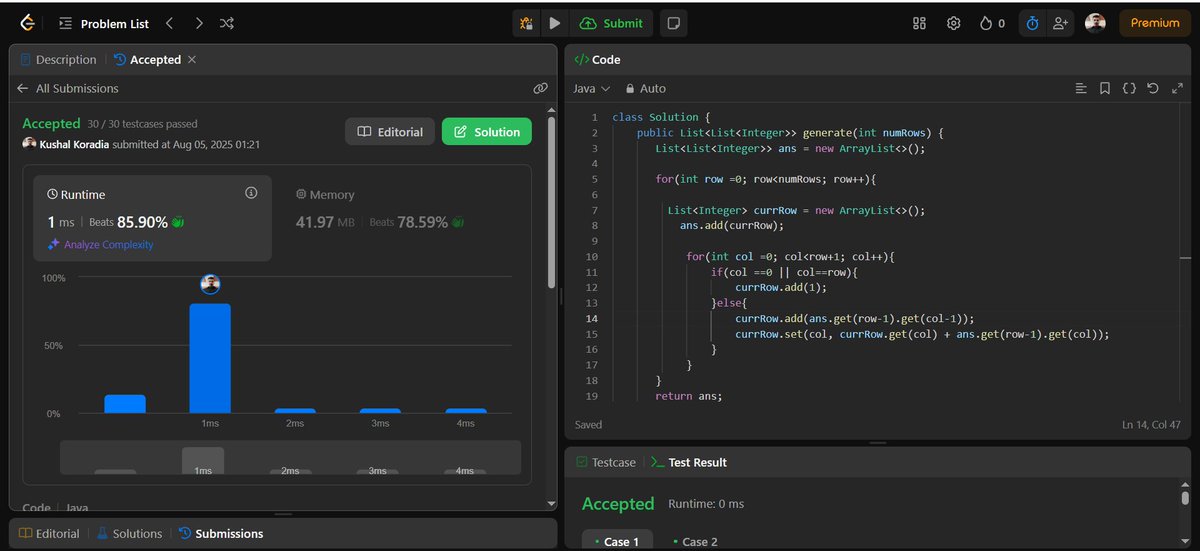
✅ Day 75 of #100DaysOfDSA
📍LC 118: Pascal's Triangle
• Used List of Lists to simulate triangle
• Each row starts/ends with 1
• Inner elements = sum of two above
• Time: O(n²), Space: O(n²) — storing full triangle
#PascalTriangle #DSA #Java #100DaysOfCode
1
4
99

1 Aug 2025
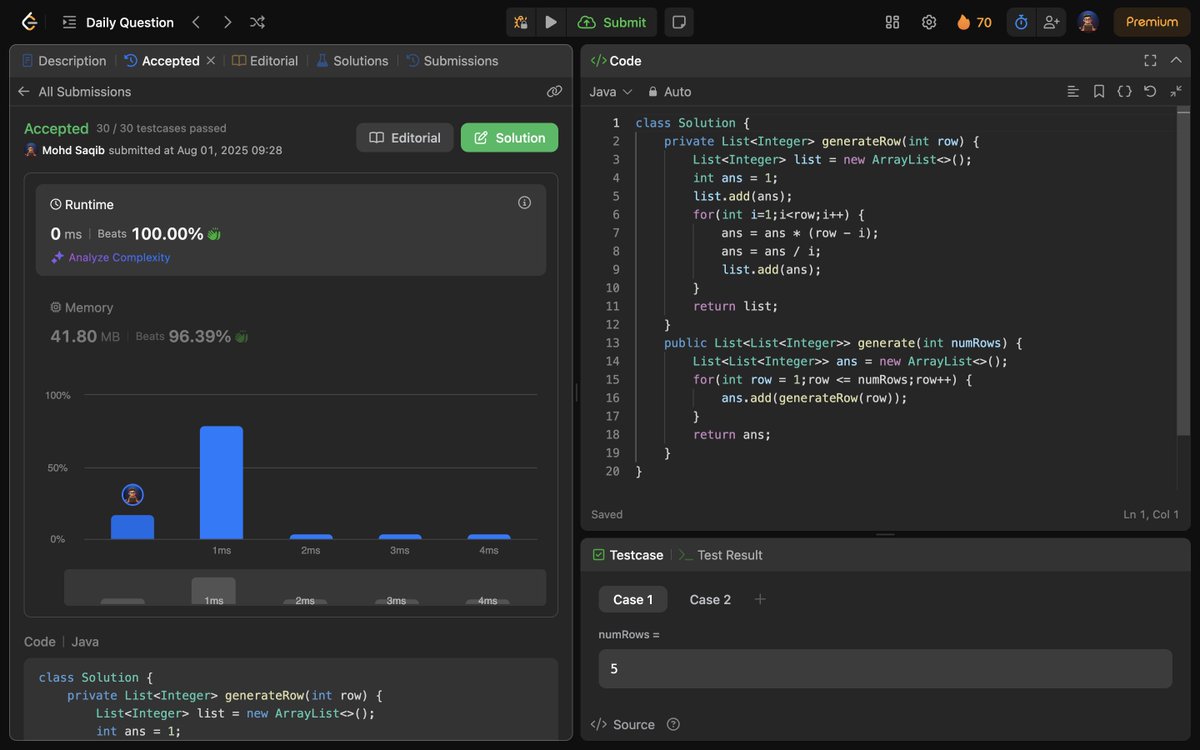
🚀 Day 373 of Code 🚀
Solved :
✅ Problem: 118. Pascal’s Triangle
#Day373 #LeetCode #DSA #PascalTriangle #DynamicProgramming #ProblemSolving #CodingJourney #100DaysOfCode
3
5
82

26 Jul 2025
Visualize patterns like powers of 2, Fibonacci diagonals, triangular numbers & the Sierpinski triangle (mod 2). Fork this demo to experiment; Open source code is available in the link below 👇
codepen.io/equant_org/pen/Wb…
Have a nice day 🙂
#Math #JavaScript #PascalTriangle #WebDev
1
3
207

24 Jul 2025
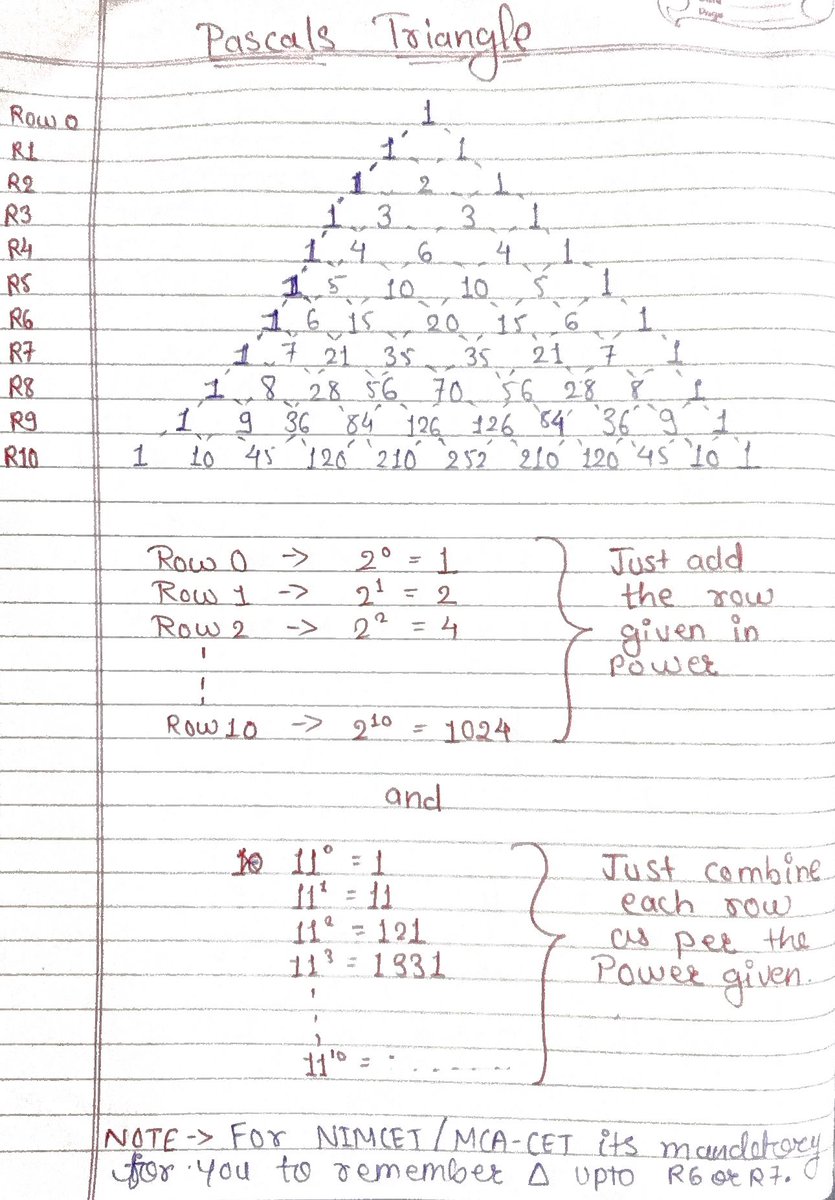
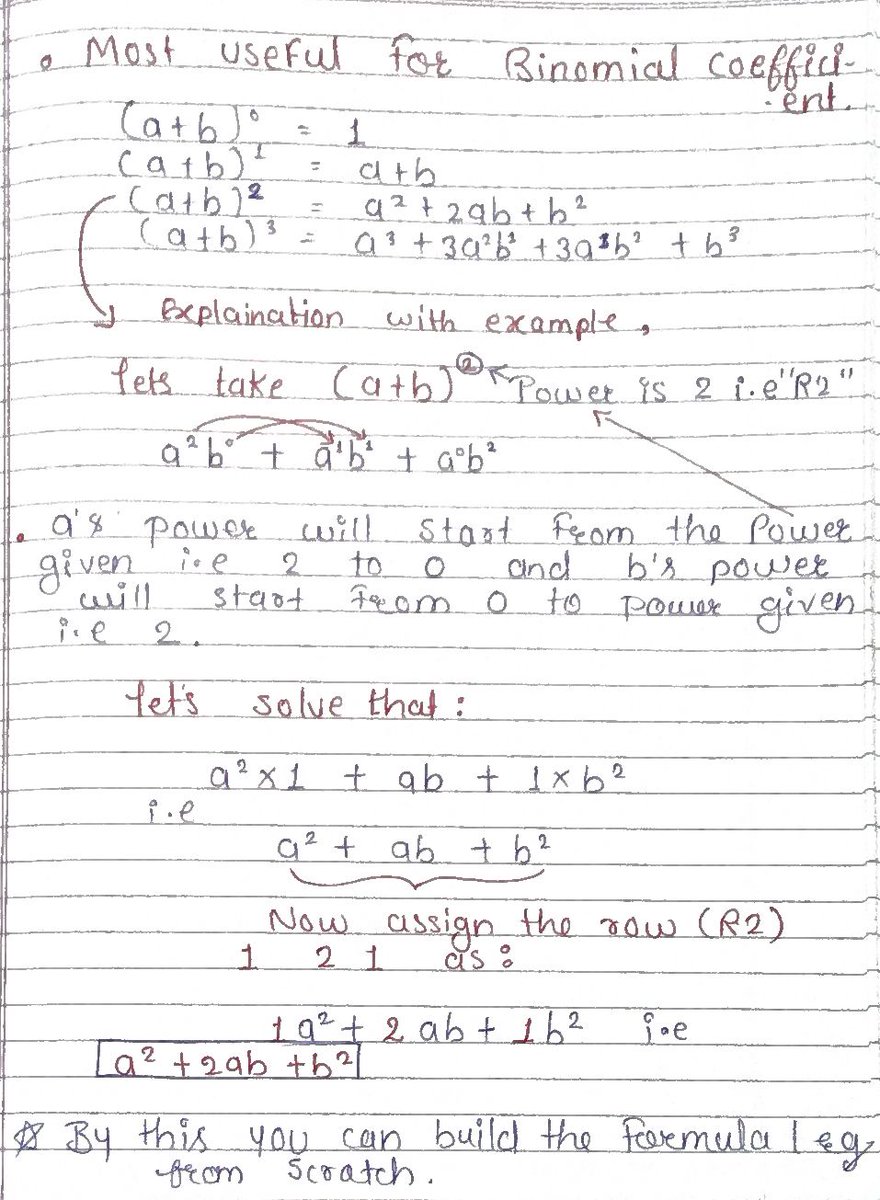
Basics don’t lie — they just brutally expose who didn’t revise.
🧠 Day 20/336
📌 Pascal’s Triangle (R0–R7)
📌 Binomial Coefficient
📌 Basics
Focus? Not just solving.
Understanding.
#NIMCET2025 #MathGrind #StudentLife #PascalTriangle #MCAEntrance #PascalTriangle
2
35

19 Jul 2025
🚀 Day 33 of #100DaysOfCode
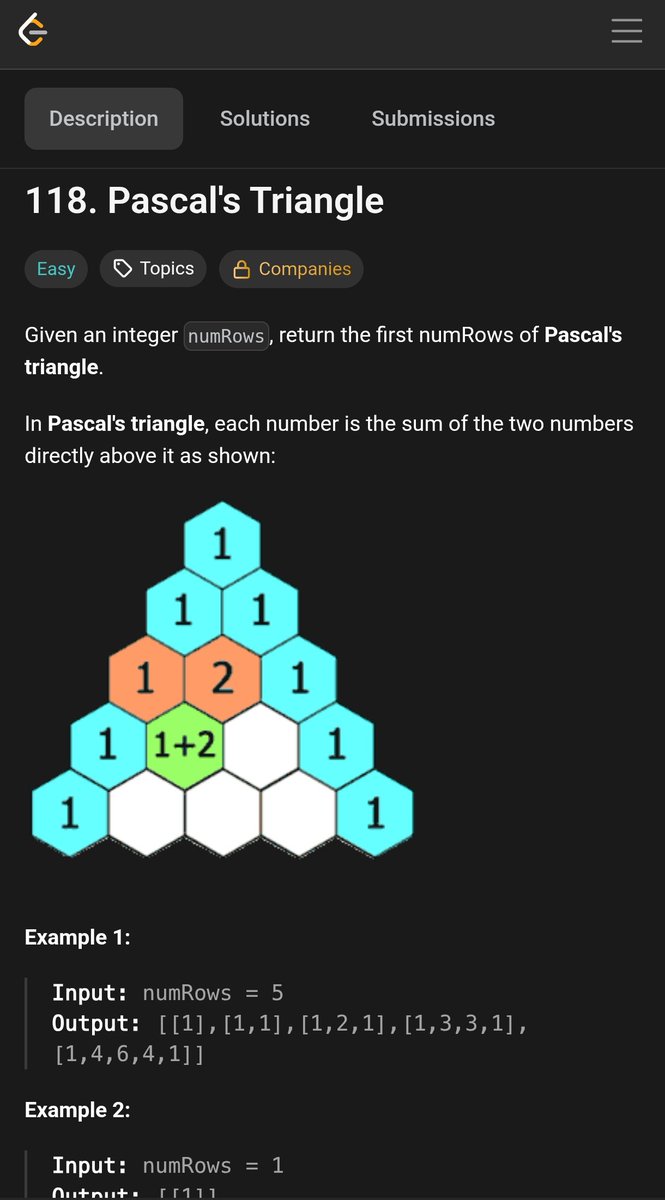
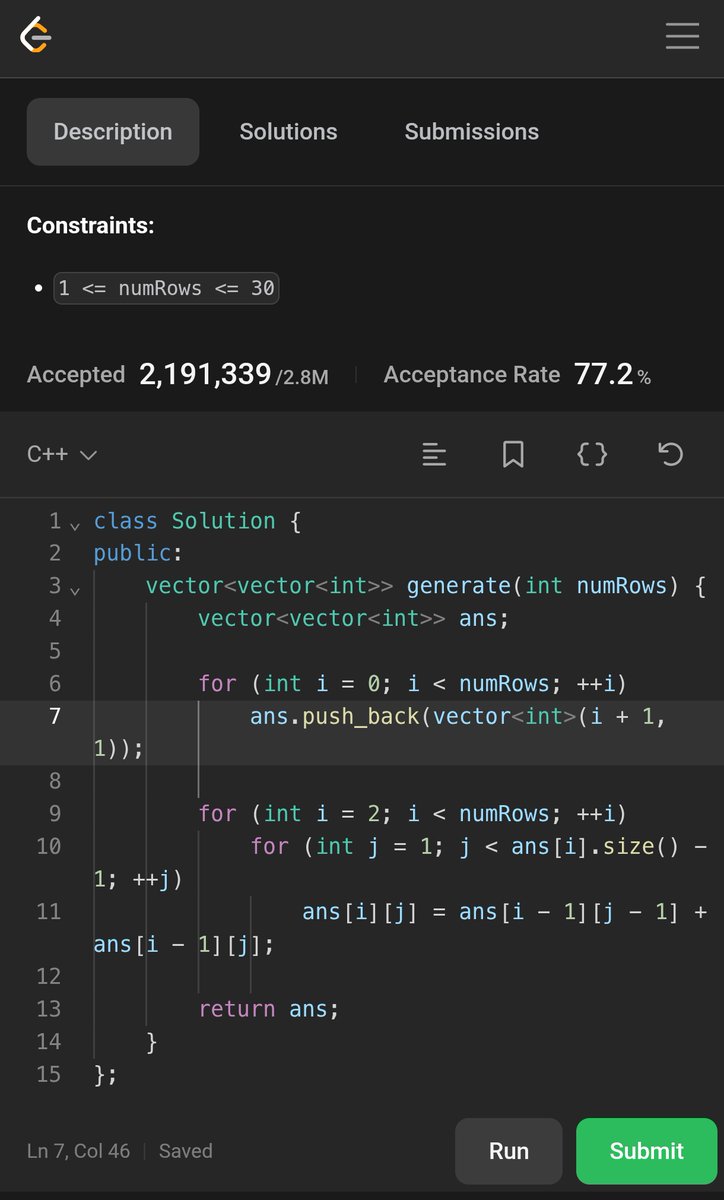
Today's Problem: Pascal’s Triangle
• Approach:
* Initialize triangle,
* Set 1 at boundaries,
* Fill inner elements: ans[i][j] = ans[i-1][j-1] ans[i-1][j]
• Time Complexity: O(numRows²)
#LeetCode #DSA #cpp #PascalTriangle #100DaysChallenge
1
15
249

1 Jul 2025
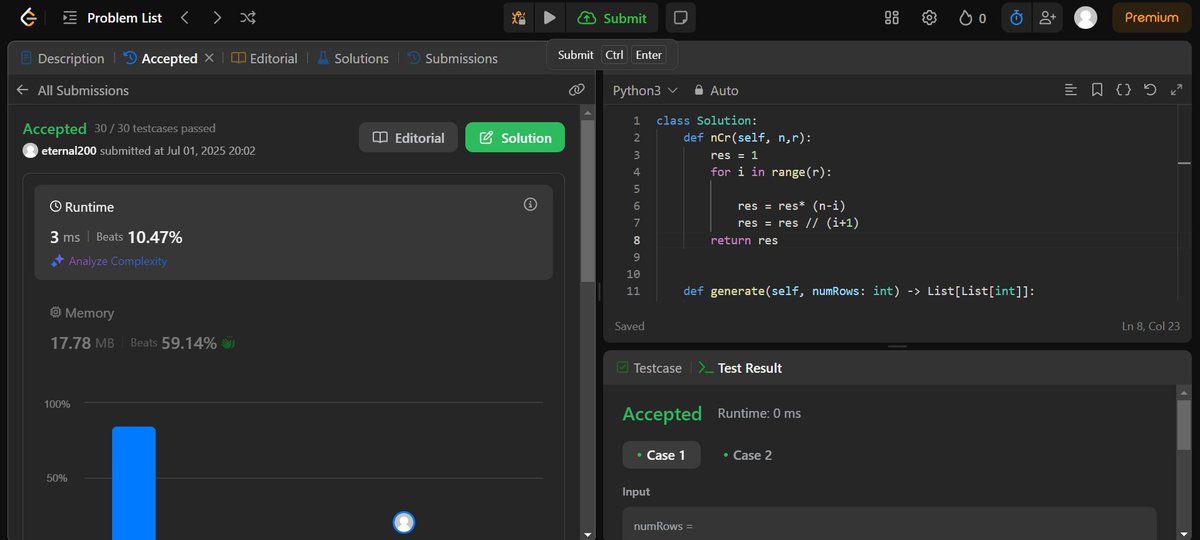
✅ Day 2 of #100DaysOfCode
Solved 1 LeetCode challenge today!
🔹 Pascal’s Triangle (Used nCr logic for clean generation)
#LeetCode #DSA #ProblemSolving #PascalTriangle #Python #vitbhopal #DrGVishwanathan
6
47

19 Jun 2025
🧠⛪ Blaise Pascal (Born June 19, 1623)
French mathematician, physicist, and philosopher who contributed to probability theory, fluid mechanics, and early computing.
#BlaisePascal #MathGenius #PhilosophyAndScience #PascalTriangle #OnThisDay
#LearnSpaceScience #MobilePlanetarium
2
4
74

21 May 2025
LeetCode Day 41
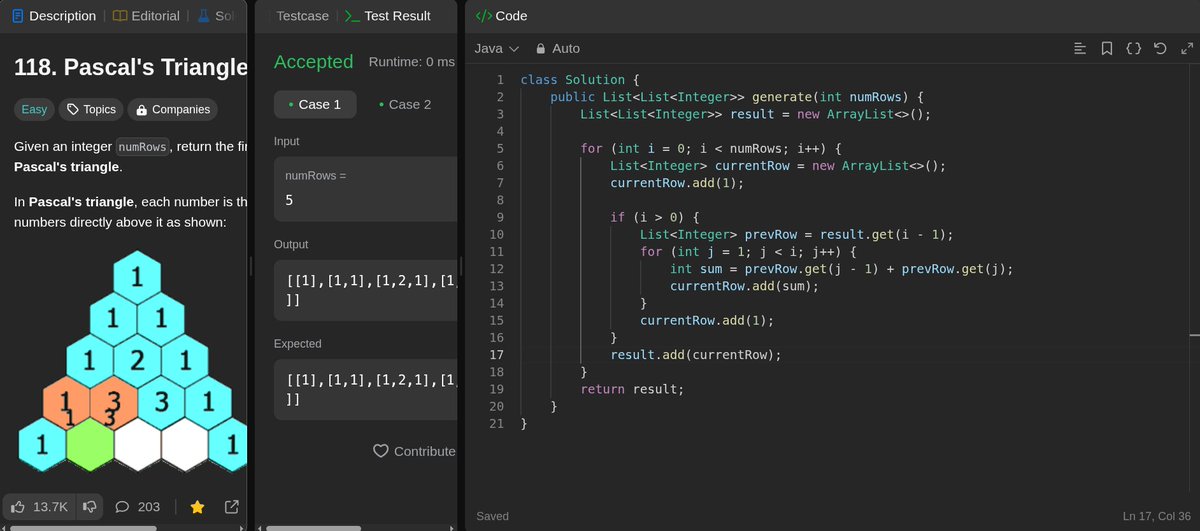
118. Pascal's Triangle
Build row by row
Edges = 1, inner = sum of two above
📈 O(n²) 💾 O(n²)
#LeetCode #100DaysOfCode #PascalTriangle
3
39

Day 45/100 - #DSAChallenge 🚀
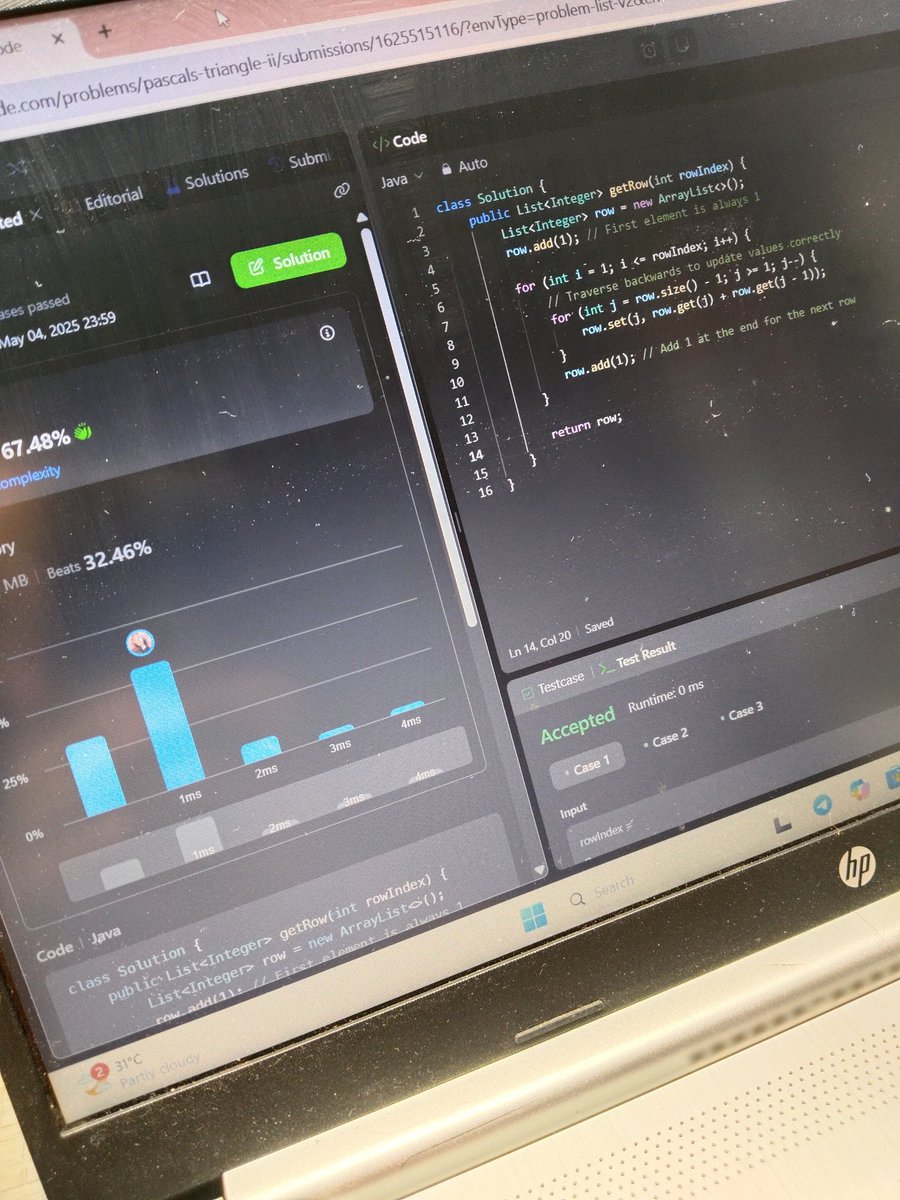
Just solved Pascal’s Triangle II (Easy) today.
Kept it light, but I’m hopeful — tomorrow’s gonna be better.
Small wins still count.
#100DaysOfCode #DSA #LeetCode #KeepPushing #PascalTriangle
1
36
752

6 Apr 2025
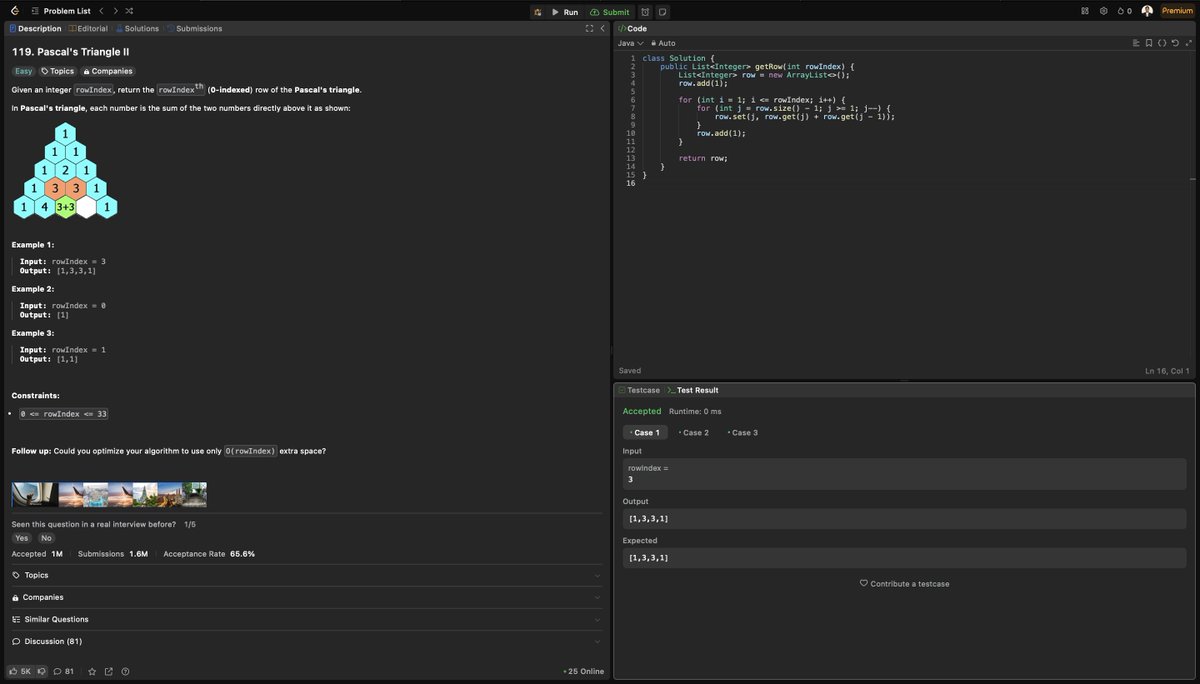
🚀 Day 35.2 of #100DaysOfCode – Pascal's Triangle II 🔺💡
LeetCode 119 – Pascal’s Triangle II
Today’s task: Return the k-th row of Pascal’s Triangle (0-indexed).
#DSA #LeetCode #100DaysOfCode #Java #ProblemSolving #PascalTriangle #KeepCoding
2
5
6 Apr 2025
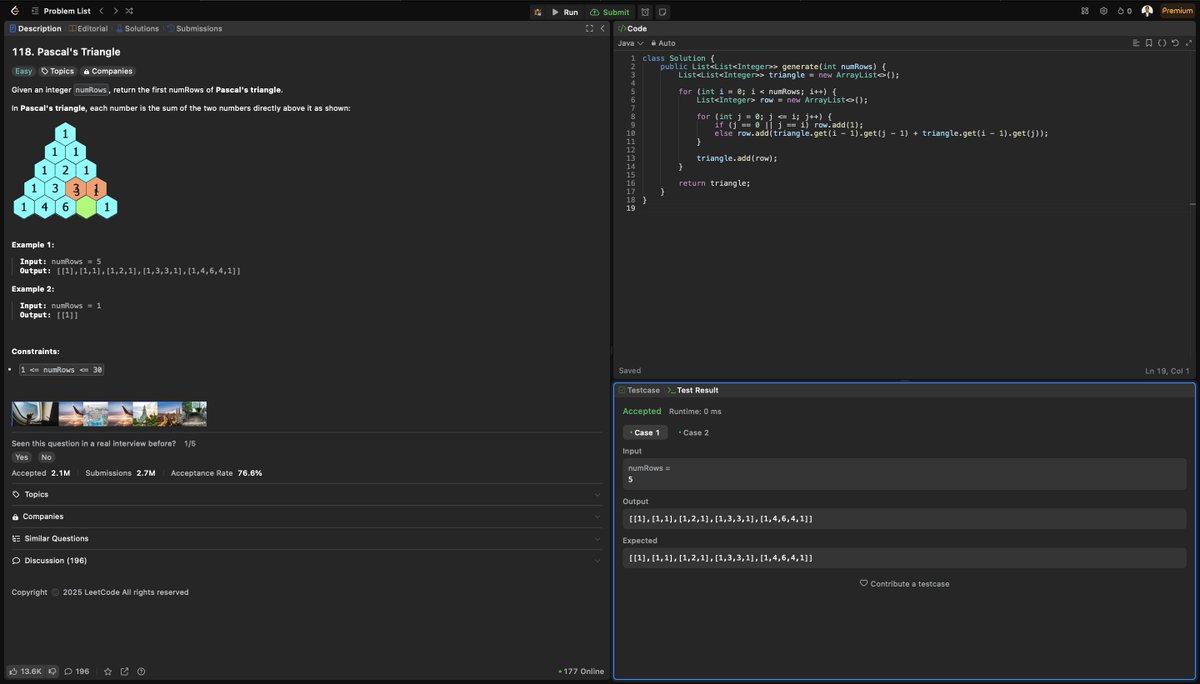
🚀 Day 35.1 of #100DaysOfCode – Pascal's Triangle 🔺✨
Today’s challenge: LeetCode 118 – Pascal’s Triangle
🧠 Given numRows, generate the first numRows of Pascal’s Triangle.
#DSA #LeetCode #PascalTriangle #Java #ProblemSolving #100DaysOfCode
3
12

17 Mar 2025
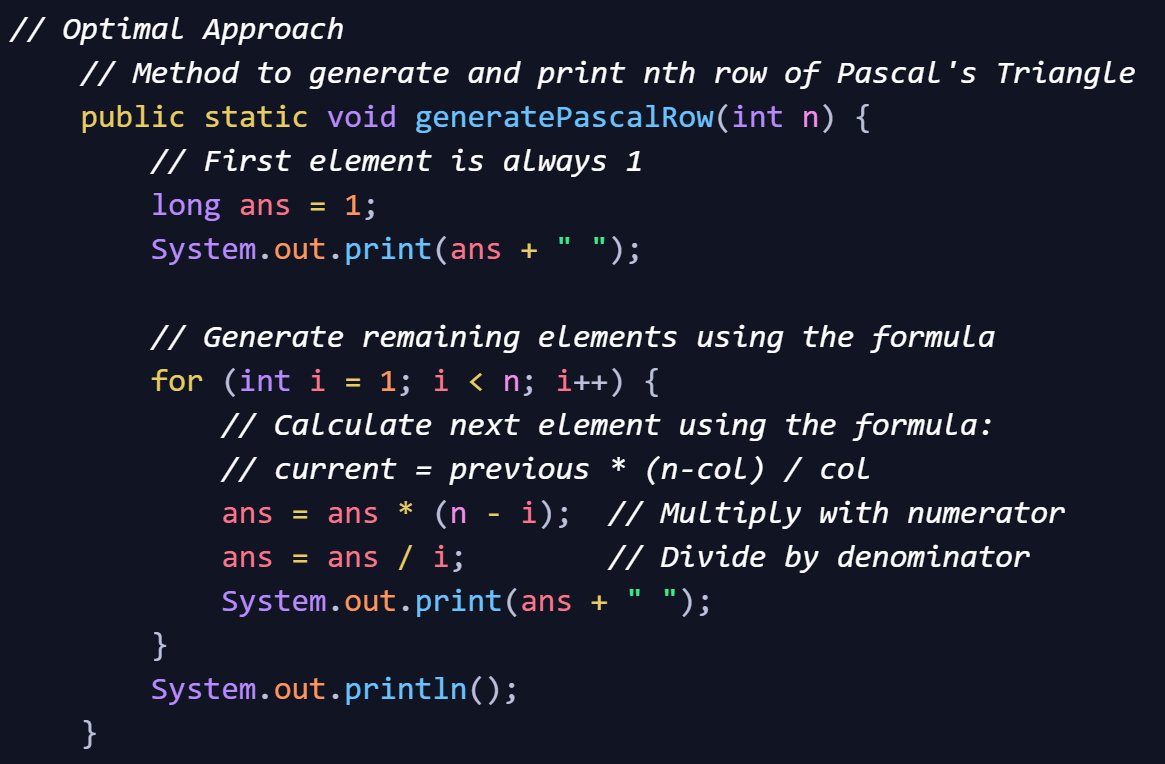
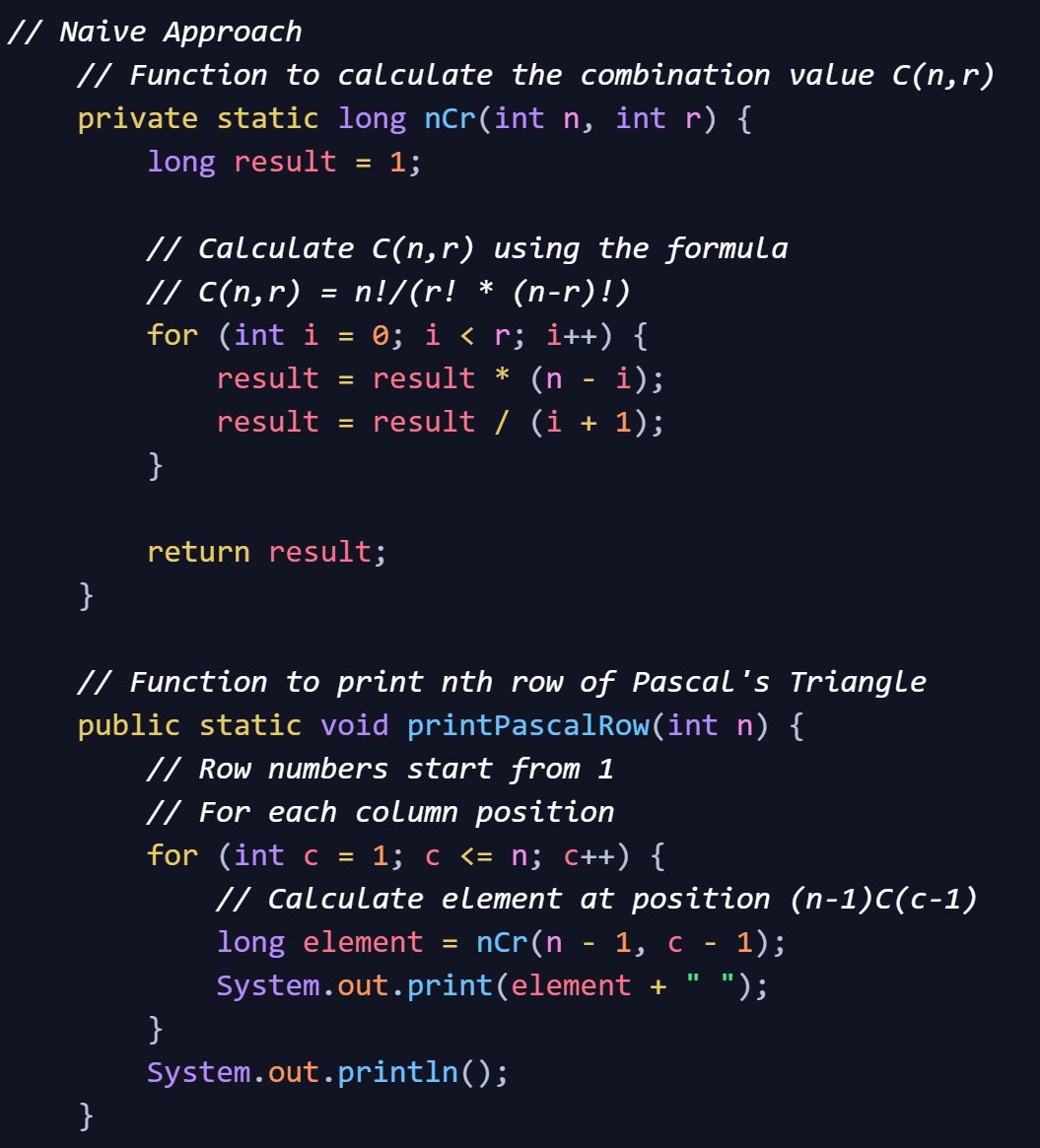
💡 Solved Pascal’s Triangle Variant 2 – Print the N-th row using 2 approaches:
1️⃣ Naive (C(n, r) formula) - O(n²) time
2️⃣ Optimal (Iterative formula) - O(n) time
🔹 Pascal’s Triangle is a must-know for combinatorics & binomial expansion!
#DSA #Coding #LeetCode #PascalTriangle
2
37