ADAPT: Lightweight, Long-Range Machine Learning Force Fields Without Graphs
1. The article introduces ADAPT, a novel machine learning force field (MLFF) designed to address the limitations of existing graph neural network (GNN)-based models in capturing long-range interactions and avoiding oversmoothing when modeling point defects in materials.
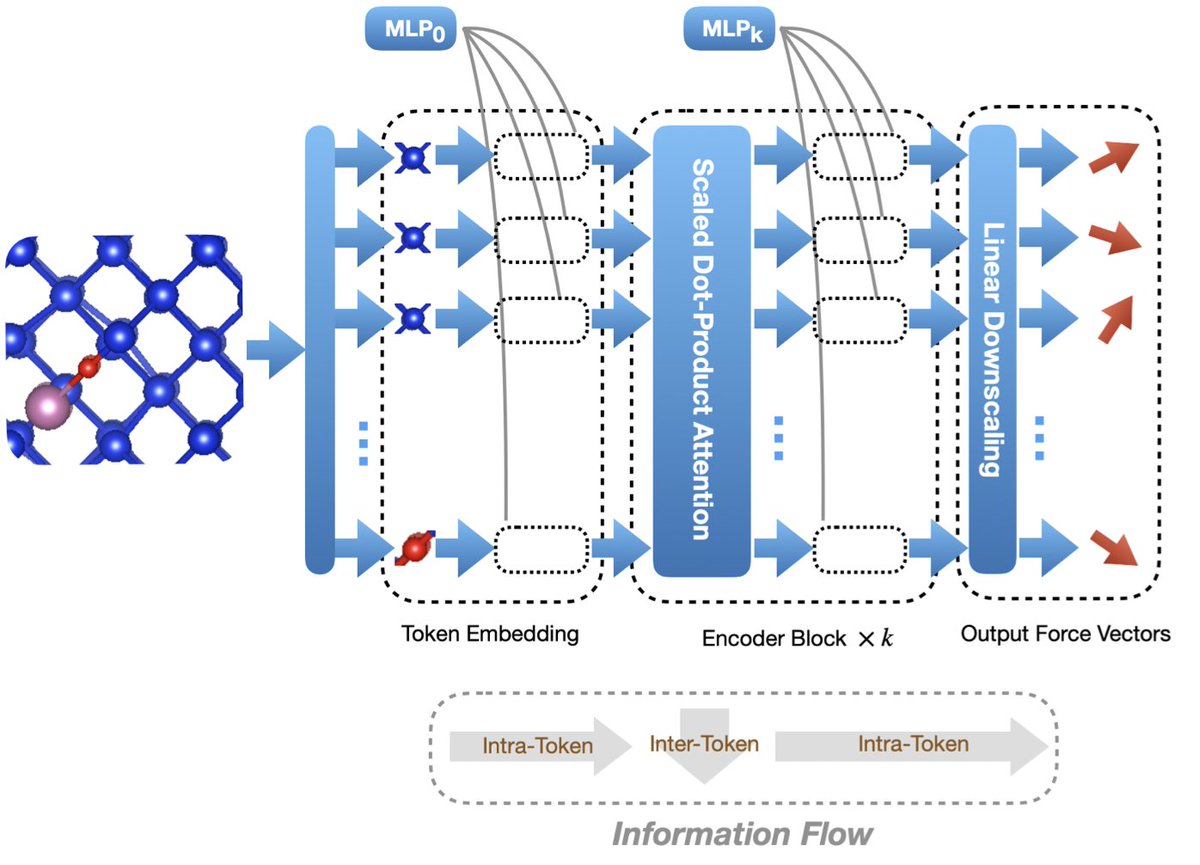
2. ADAPT replaces graph representations with a direct coordinates-in-space formulation, treating atoms as "tokens" and using a Transformer encoder to model their interactions. This approach allows for explicit consideration of all pairwise atomic interactions, which is crucial for accurately predicting the properties of point defects.
3. The study demonstrates that ADAPT achieves a significant reduction in both force and energy prediction errors compared to state-of-the-art GNN-based models. Specifically, it shows a ∼33% reduction in errors on a dataset of silicon point defects, while requiring only a fraction of the computational resources.
4. ADAPT's architecture includes an importance-weighted mean squared error (MSE) loss function, which emphasizes the critical regions near defects during training. This specialized loss function helps improve the model's performance in practical applications where defect regions dominate the mechanical response of the material.
5. The training cost of ADAPT is remarkably lower than that of message-passing architectures. The small ADAPT model requires only 2.24 minutes per epoch on a single NVIDIA A100 GPU, converging after 80 epochs, whereas retraining MACE requires 8.5 minutes per epoch for 300 epochs on 16 NVIDIA A100 GPUs.
6. The authors also developed a separate formation energy-predictor model using a MLP residual architecture, which outperformed both MACE and MatterSim in predicting defect formation energies. This model achieves a better than 30% reduction in mean absolute error (MAE) over MatterSim 5M after 400 epochs of training.
7. ADAPT's design allows for independent deployment of the force and energy prediction models when only one quantity is needed, reducing runtime and memory consumption. This modularity also enables incremental model refinements without retraining the entire model.
8. The article highlights that while ADAPT's separation of force and energy predictions offers practical advantages, it results in a non-conservative MLFF where forces are not guaranteed to correspond to gradients of the energy surface. This trade-off is important to consider for applications requiring conservative force fields.
9. The authors suggest future directions for ADAPT, including enforcing physical invariances within the architecture and loss function, extending training to a wider class of defects and materials, and developing models that integrate physical constraints directly into the architecture.
📜Paper:
arxiv.org/abs/2509.24115
#MachineLearning #MaterialsScience #PointDefects #TransformerModel #ComputationalEfficiency #ForceFields