
5 May 2025
Before you dive into Lambda code optimization, check out these 5 Lambda tips that can slash your AWS bill without changing a single line of code 💰
Every AWS project I start, I'll typically have 5 things I look out for to save Lambda costs:
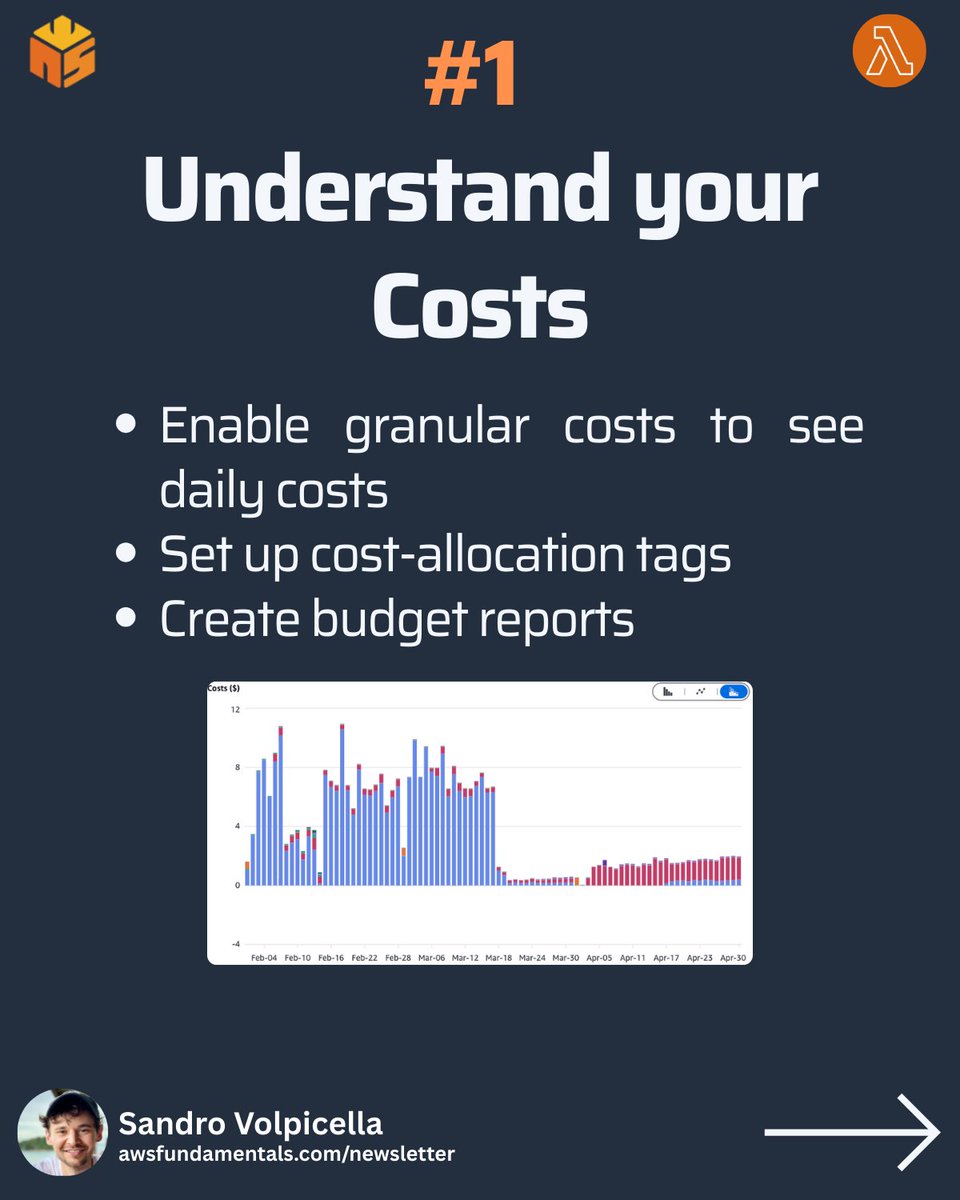
1️⃣ Set up proper cost tags - can't optimize what you don't measure!
We need to understand our costs. Activate granular costs to see your daily usage. And set up cost-allocation tags.
I typically use the function names or the CloudFormation stacks as tags.
Then find your Lambda functions that emit 80% of the costs and ignore the rest.
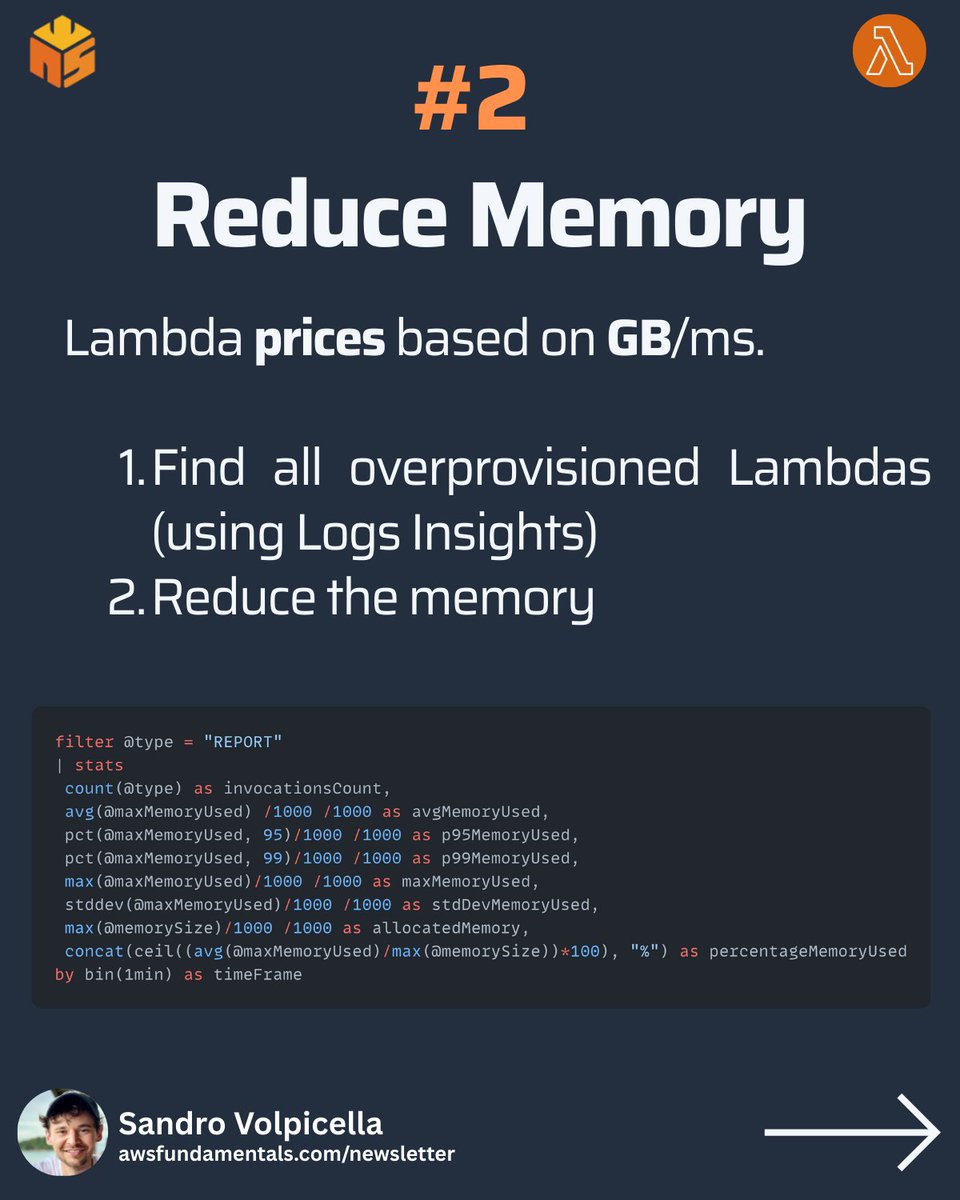
2️⃣ Cut that memory allocation - most functions use way less than they're given
Lambda bills by GB/ms. That means you can optimize on two different dimensions:
1. Memory
2. Execution time
Start with memory.
Check out if your Lambda functions are overprovisioned.
If they are -> Lower the memory.
⚠️ But be cautious: Lowering memory also means lowering compute. Use Lambda Powertuning to find out the perfect value
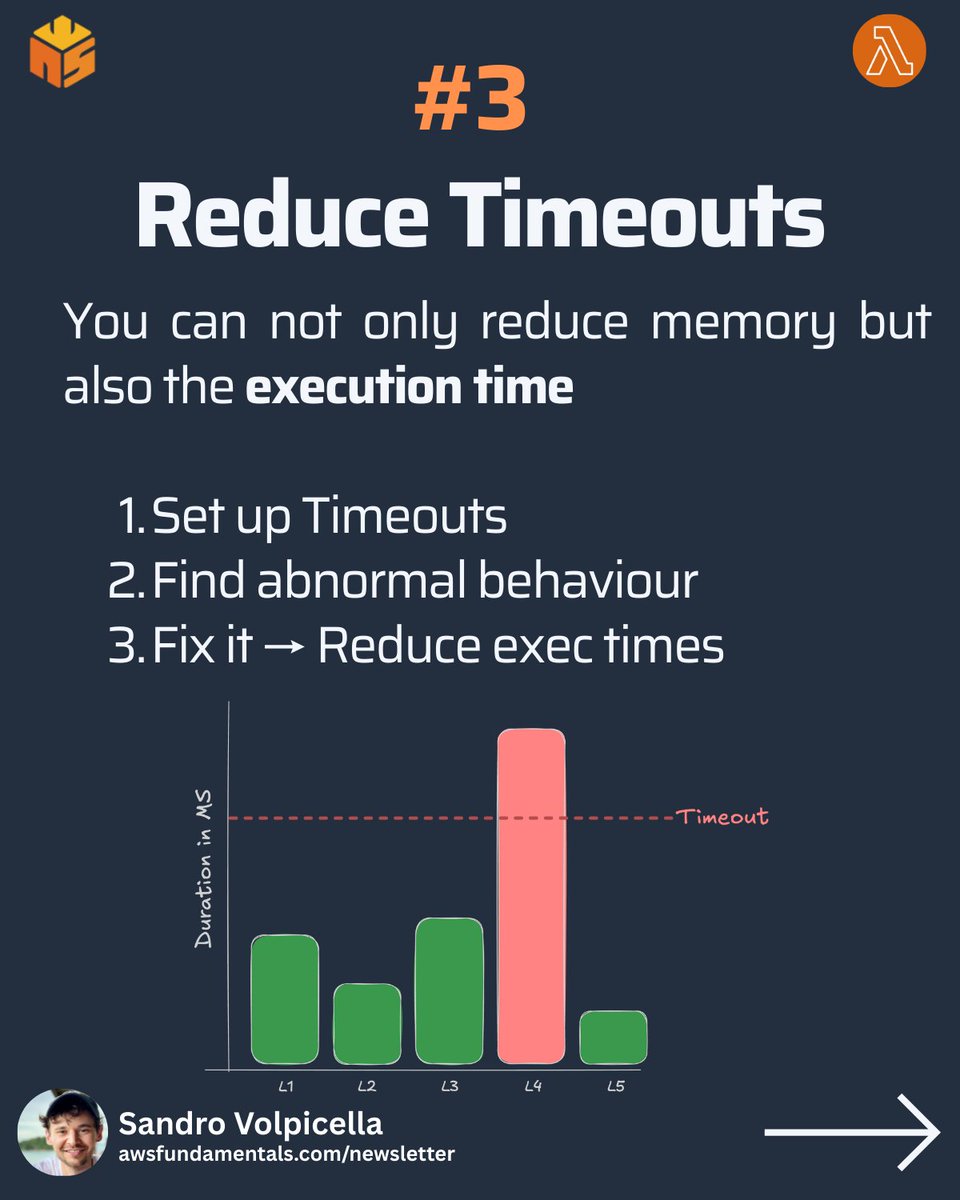
3️⃣ Lower those timeouts
The second dimensions to improve: Execution time
Don't use the maximum timeout of 15 minutes.
Find out how long your Lambda functions should run, set it as a maximum timeout, and figure out the outlier.
Once you fix things that let your Lambda run for a longer time than needed you will save money. Often removing the outliers will already help.
But have alerts in place so you'll find those!
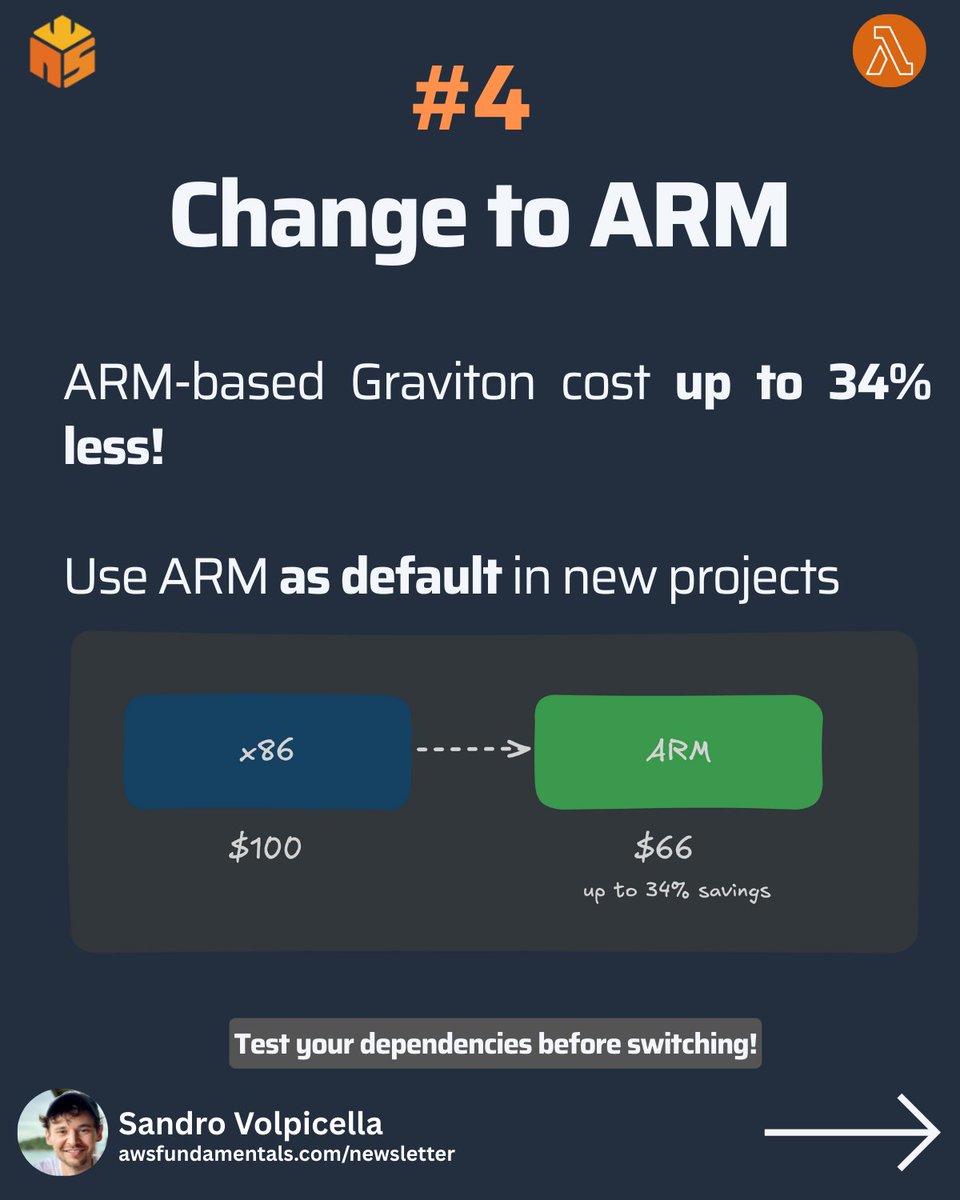
4️⃣ Switch to ARM - easy 34% savings (just test your deps first!)
With ARM-Graviton you save up to 34% without doing anything. For new Lambdas I use ARM as a default.
Try switching your Lambda to ARM.
But test your workloads!
- ARM can increase your dependency size
- Some dependencies don't work on ARM (e.g. Pydantic v1)
If everything works -> Switch
5️⃣ Use Lambda less -> Batching & Caching
By invoking your Lambda functions fewer times you will save money as well (obvious isn't it).
You can do that by making use of batching and caching:
- Batch your messages and work on them in parallel
- Cache your data closer to the user (Edge, API, Database, Redis)
After you did all of that you can start with code improvements.
3
2
14
1,163

16 Jan 2025
For most functions, there's no ROI for the engineering time it takes to do powertuning.
Powertuning still requires manual steps to figure out the payload, run it, interpret the result and action.
2
119

6 Aug 2024
Se você estava de férias na semana passada, segue novamente a apresentação do Power Pilot, o assistente de IA da Power Tuning presente no Power Embedded.
Essa é a primeira oferta de IA da Power Tuning.
Primeira de muitas!!!
#IA #powerpilot #powertuning #powerembedded
1
2
54

12 Jul 2024
Here is some Friday night goodness. Did you know that there is an official Lambda Power Tuning module for Terraform? If you haven't tried power Tuning to help get the right balance of cost and performance, I encourage you to immediately. And now, for Terraform users, it's even easier!
PowerTuning = docs.aws.amazon.com/lambda/l…
Terraform Module = registry.terraform.io/module…
Happy Friday!!
2
8
1,067

🌱Did you know Exascend offers Power Tuning? Our service meets the need for low power consumption & high performance, supporting your sustainability goals! 🔋Learn more & see our success stories: bit.ly/3XWZ2Jv
#PowerTuning #Sustainability #StorageSolutions

2
146
5 Jul 2024
Melhor parte da Live de 10 anos da Power Tuning! 😍😍😍
Família, nosso maior incentivo!
#powertuning #10anos
1
1
4
124
14 Jun 2024
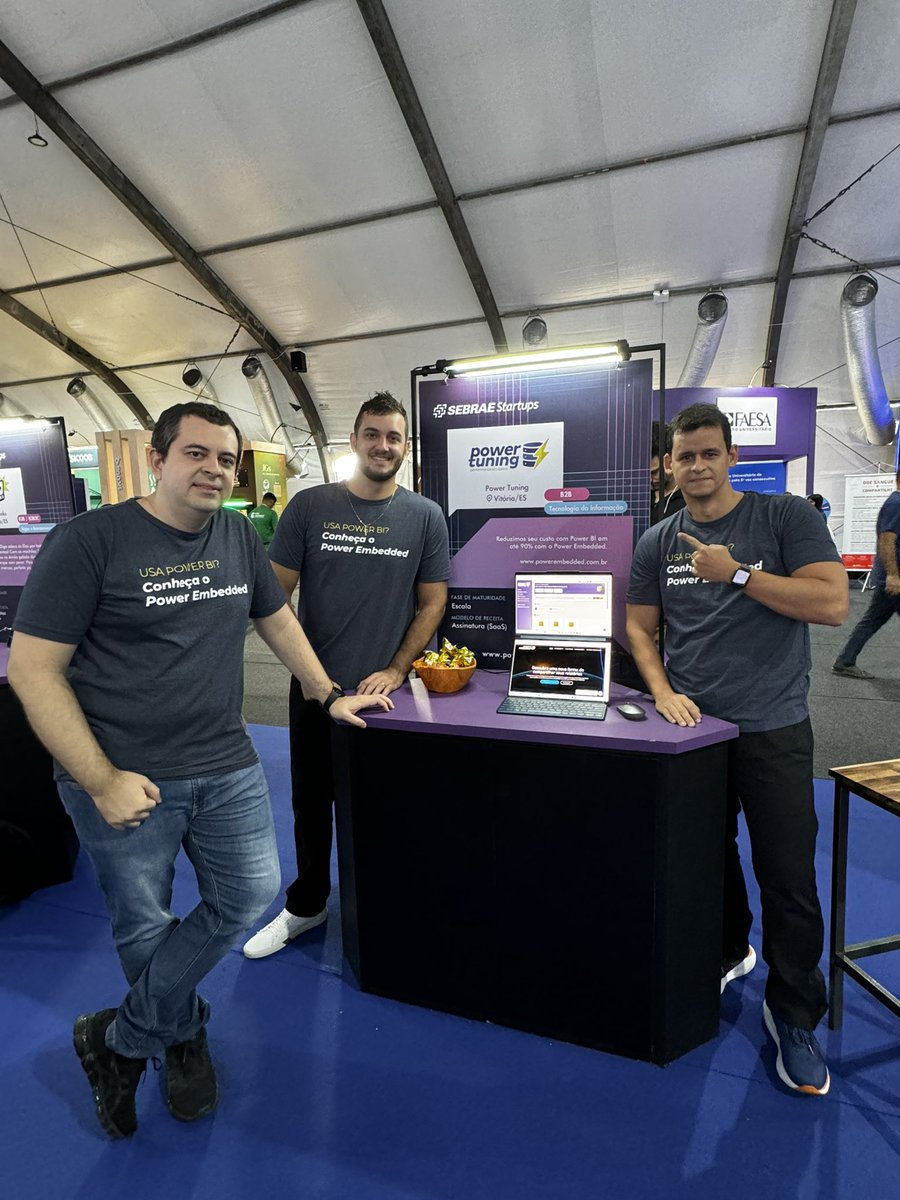
Já estamos por aqui na ESX 2024 na praça do papa em Vitória aguardando vocês!
Evento do Sebrae com uma estrutura top!
#sebrae #esx #esx24 #powerembedded #powertuning #microsoft #powerbi
1
107

24 Oct 2023
Escrevi em 2017-2021 os mais comuns aqui (tá no console da AWS também como Well-Architected Tool: Serverless Lens)
1. Logs (ingestão e Storage) são os mais altos; log level, o que logar, arquivamento automático etc
2. Lambda memória/dur; powertuning
wa.aws.amazon.com/serv.quest…
2
1
7
970
12 Jun 2023
O Rafael dos Santos agora é o novo Head of Cloud da Power Tuning.
Precisa de ajuda com Azure, chame a Power Tuning.
#azure #powertuning #azurebrasil #soupowertuning #cloud #rafaeldossantos
2
7
327

12 Jun 2023
Hoje recebemos nosso novo Head of Cloud!
Bem vindo @rsantosdev ⚡🚀
Obrigado por escolher vestir a camisa da empresa e fazer parte da família #PowerTuning!
Agora a Power Tuning vai atender Azure!

2
4
123
5 Jun 2023
O nosso time segue crescendo!
🚀🚀🚀
Hoje recebemos nosso novo Trainee!
Bem vindo Sérgio Franco ⚡🚀
Obrigado por escolher vestir a camisa da empresa e fazer parte da família #PowerTuning!

2
39
1 Jun 2023
O nosso time segue crescendo!
🚀🚀🚀
Hoje recebemos nosso novo Head of NoSQL!
Bem vindo Leandro Domingues ⚡🚀
Obrigado por escolher vestir a camisa da empresa e fazer parte da família #PowerTuning!

1
5
242
30 May 2023
Para ajudar na produtividade dos nossos DBAs no dia a dia, criei algumas procedures para ajudar na análise de problemas.
Chamei essas procedures de Power Reports.
youtube.com/watch?v=-49lQP0S…
#powertuning #poweralerts #monitoramento #dba #powerbi #microsoft #sqlserver
1
69
24 May 2023
Nosso time de BI criou um Dashboard no Power BI para ajudar no monitoramento do SQL Server dos nossos clientes.
youtube.com/watch?v=3-e-_mkK…
#powertuning #poweralerts #monitoramento #dba #powerbi #pbi #microsoft #sqlserver #soupowertuning
2
3
103
15 May 2023
Quem tem um SQL Server na empresa tem que assistir esse vídeo:
youtube.com/watch?v=hZ3TCH4d…
Marca aí o nome de quem tem um SQL Server na empresa.
Quem não usar o Power Alerts é louco!!!
#powertuning #poweralerts #monitoramento #dba #microsoft #sqlserver #soupowertuning
5
7
480
26 Apr 2023
Segue um post com mais informações da chegada do Portilho e dos próximos passos da Power Tuning.
powertuning.com.br/a-power-t…
#oracle #sqlserver #soupowertuning #dba #monitoramento #referencia #deepdive #powertuning #microsoft #goldpartner
1
3
162

25 Apr 2023
E aí agora da pra brincar com Power BI e Databricks? Eu te mostro como nesse vídeo hoje com todos os detalhes, dicas e limitações da atualização 3.0 da biblioteca "powerbiclient" para Jupyter Notebooks.
#planilheiros #powertuning #powerbi #databricks
youtube.com/watch?v=dNoFkPPY…
1
3
161
4 Apr 2023
O nosso time segue crescendo!
🚀🚀🚀
Hoje recebemos nosso novo Head Of Oracle!
Bem vindo Ricardo Portilho! ⚡🚀
Obrigado por escolher vestir a camisa da empresa e fazer parte da família #PowerTuning!

1
2
72
3 Apr 2023
O nosso time segue crescendo!
🚀🚀🚀
Hoje recebemos um novo Consultor DBA!
Bem-vindo Eric Porciuncula de Sousa ⚡
Obrigado por escolher vestir a camisa da empresa e fazer parte da família #PowerTuning!

1
3
79