
🚨 𝑹𝒆𝒄𝒐𝒏𝒄𝒆𝒑𝒕𝒖𝒂𝒍𝒊𝒔𝒊𝒏𝒈 𝑮𝒂𝒎𝒆 𝑴𝒐𝒅𝒆𝒍𝒔 𝒊𝒏 𝑭𝒐𝒐𝒕𝒃𝒂𝒍𝒍 - new publication
⚽️ 𝑮𝒂𝒎𝒆 𝑴𝒐𝒅𝒆𝒍𝒔 𝒊𝒏 𝑭𝒐𝒐𝒕𝒃𝒂𝒍𝒍 𝑪𝒐𝒂𝒄𝒉𝒊𝒏𝒈: 𝑨𝒏 𝑬𝒄𝒐𝒍𝒐𝒈𝒊𝒄𝒂𝒍 𝑫𝒚𝒏𝒂𝒎𝒊𝒄𝒔 𝑷𝒆𝒓𝒔𝒑𝒆𝒄𝒕𝒊𝒗𝒆
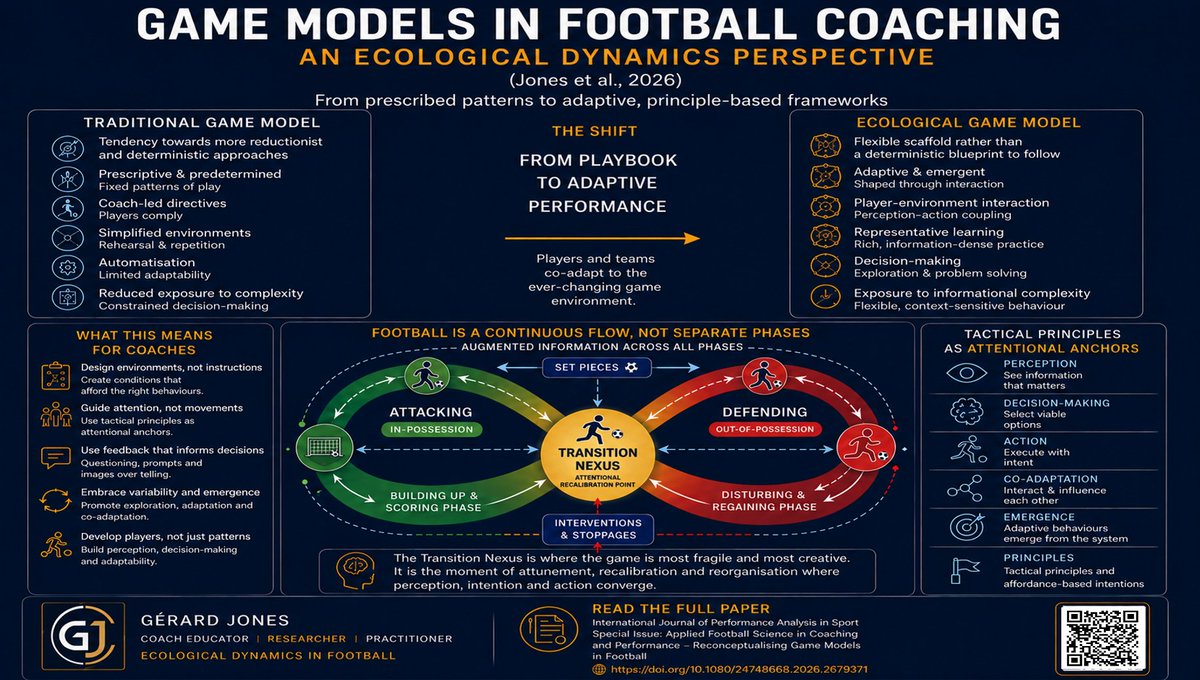
From rigid playbooks and prescribed patterns ➡️ to adaptive, principle-based frameworks shaped through player-environment interactions.
Excited to share our latest paper has now been published in the 𝐈𝐧𝐭𝐞𝐫𝐧𝐚𝐭𝐢𝐨𝐧𝐚𝐥 𝐉𝐨𝐮𝐫𝐧𝐚𝐥 𝐨𝐟 𝐏𝐞𝐫𝐟𝐨𝐫𝐦𝐚𝐧𝐜𝐞 𝐀𝐧𝐚𝐥𝐲𝐬𝐢𝐬 𝐢𝐧 𝐒𝐩𝐨𝐫𝐭 as part of the special issue: Applied Football Science in Coaching and Performance.
The paper explores how Game Models in football can be reconceptualised through an ecological dynamics perspective, moving beyond rigid systems and prescriptive structures toward adaptable frameworks that support perception, decision-making, problem-solving, and player-environment interaction.
A huge thank you to everyone who has contributed to the discussions, challenges, and ideas that have shaped this work, and what this could mean for future research in:
• Coach Education
• Practice Design
• Methodology Departments
• Feedback & Coach Behaviour
• Talent Development
• Performance Analysis
• Game Models
This paper positions its contribution as a conceptual framework intended to guide future research and applied practice.
What may be most original within this paper is the attempt to reconceptualise Game Models in football, not as a deterministic blueprint of pre-planned patterns and prescribed solutions, but as a flexible scaffold that supports adaptive player and team behaviours within the evolving constraints of competition.
The paper also introduces the idea of:
• 𝑻𝒂𝒄𝒕𝒊𝒄𝒂𝒍 𝒑𝒓𝒊𝒏𝒄𝒊𝒑𝒍𝒆𝒔 𝒂𝒔 𝒂𝒕𝒕𝒆𝒏𝒕𝒊𝒐𝒏𝒂𝒍 𝒂𝒏𝒄𝒉𝒐𝒓𝒔 that guide perception and action within game-specific situations.
• The Transition Nexus, where moments of transition become attentional recalibration points requiring adaptation, reorganisation, and co-ordination.
• Coach feedback as player challenges, where questions, prompts, and informational guidance are used to shape players’ visual search and affordance perception without prescribing ready-made answers.
From this perspective, Game Models become tools for designing representative learning environments that support perception-action coupling, player autonomy, adaptability, and co-adaptive team behaviours.
Read here:
tandfonline.com/doi/full/10.…
Jones, G., Kubayi, A., Stone, J. A., & Davids, K. (2026). Game models in football coaching: an ecological dynamics perspective. International Journal of Performance Analysis in Sport, 1–18. doi.org/10.1080/24748668.202…
#FootballCoaching #CoachEducation #SkillAcquisition #EcologicalDynamics #GameModel #FootballResearch #PerformanceAnalysis #TalentDevelopment #CoachingScience #Football #PrincipledGameModels #Affordances #PracticeDesigns #CoachingFeedback
2
27
109
9,484