
Thermodynamically consistent machine learning model for excess Gibbs energy
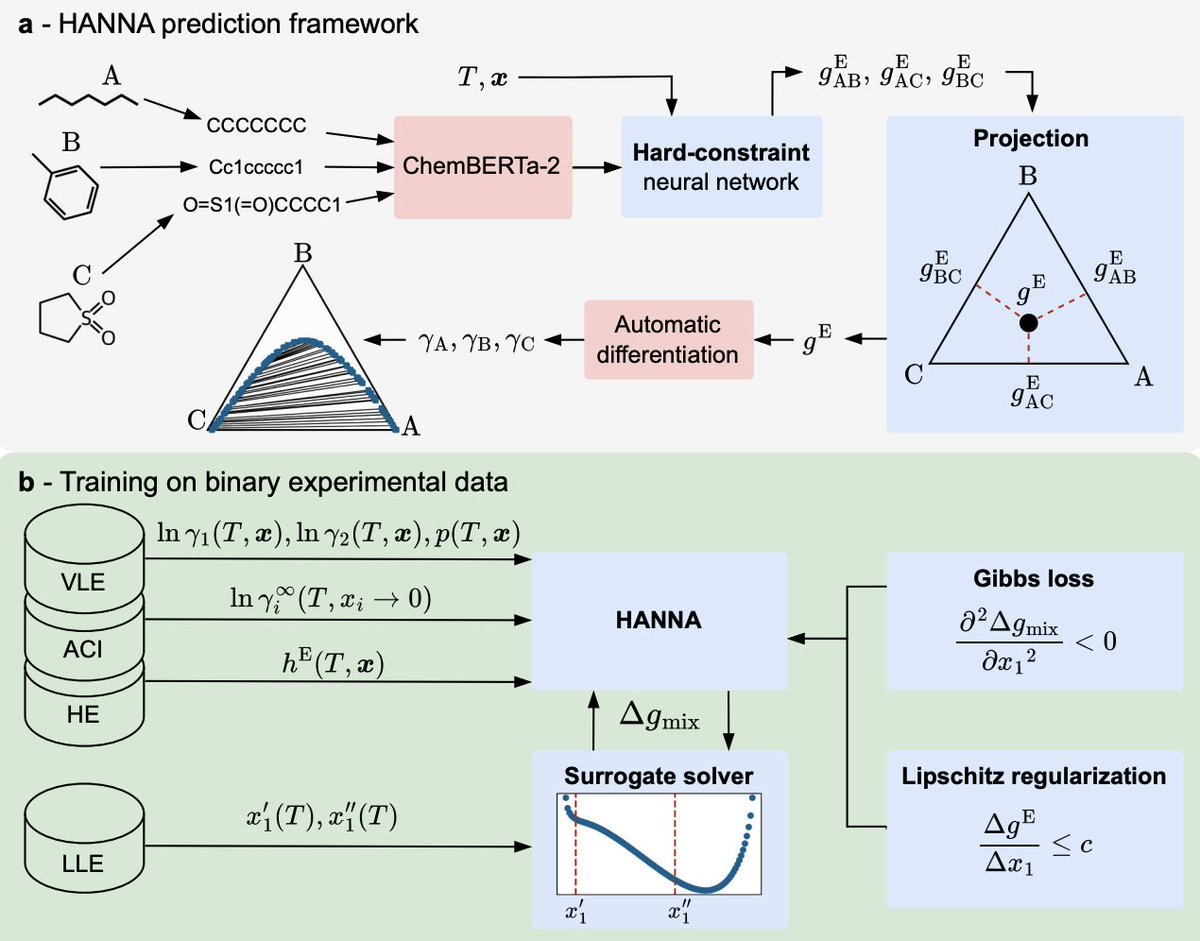
1. The paper presents HANNA, a hard-constraint neural network that predicts excess Gibbs energy (gE) and activity coefficients for liquid mixtures directly from molecular structure (SMILES), temperature, and composition—while guaranteeing thermodynamic consistency by construction.
2. The central idea is to embed physical laws as hard constraints inside the architecture (not as post-hoc penalties): exact Gibbs–Duhem consistency (via automatic differentiation of gE), permutation equivariance to component ordering, correct infinite-dilution and pure-component limits (γi → 1), and consistent behavior for pseudo-mixtures (identical components collapse to one).
3. HANNA is trained on a large experimental dataset from the Dortmund Data Bank spanning multiple measurement types in binary mixtures: VLE (TPXY), VLE without vapor composition (TPX, trained via pressure), infinite-dilution activity coefficients (ACI), liquid–liquid equilibrium compositions (LLE), and excess enthalpies (HE). In total: 824,481 data points, 46,543 systems, 4,114 unique components, including ionic liquids.
4. A key training innovation is end-to-end learning from experimental LLE phase compositions. Because iterative LLE solvers are hard to differentiate through, the authors introduce a differentiable surrogate solver that maps discretized Gibbs energy of mixing curves to coexisting-phase compositions, enabling gradient-based training on LLE data.
5. To improve LLE detection, they add a physically motivated “Gibbs loss” based on phase stability: it penalizes cases where the model fails to produce negative curvature (negative second derivative of Δgmix) required for a miscibility gap, complementing the supervised loss on phase compositions.
6. HANNA generalizes from binary training data to mixtures with any number of components using a parameter-free geometric projection (Muggianu projection) that combines learned binary interactions into multicomponent gE. The projection is designed to avoid singularities at infinite dilution and includes a similarity-based “lumping” mechanism so identical components yield gE = 0 and consistent reductions.
7. Molecular representation is handled via pretrained ChemBERTa-2 embeddings from SMILES, followed by feed-forward networks that output binary interaction terms; multi-component activity coefficients are then obtained by automatic differentiation of the projected gE, maintaining exact thermodynamic relations.
8. Against modified UNIFAC (Dortmund), HANNA shows higher accuracy on shared applicability domains for binary VLE, ACI, and LLE, and it also expands practical coverage beyond UNIFAC’s group-parameter horizon—especially for ionic-liquid-containing systems where UNIFAC often cannot be applied.
9. The work also benchmarks against recent ML activity-coefficient models (e.g., GE-GNN, GDI-GNN, SolvGNN, GNN-IAC). HANNA is positioned as broader in scope (temperature- and composition-dependent; extends to multicomponent mixtures) and more strictly consistent (hard constraints vs partial/soft constraints), while achieving better accuracy on common evaluation subsets.
10. Limitations discussed include: most training data lie between 273–428 K; liquid-phase pressure dependence is neglected; polymers are unsupported (also due to ChemBERTa token limits); strong electrolytes (beyond ionic liquids) are out of scope; and rare anomalous LLE artifacts appear in a small fraction of systems (often involving very small molecules like water/methanol), possibly linked to tokenizer/embedding issues.
📜Paper: doi.org/10.1038/s41467-026-7…
#MachineLearning #Thermodynamics #ChemicalEngineering #PhaseEquilibria #ActivityCoefficients #GibbsEnergy #PhysicsInformedML #ComputationalChemistry #ProcessSystemsEngineering
2
1
20
1,731

29 Feb 2024
by understanding that they can be modeled using conic inequalities 🎉 , enhancing the efficiency of their solution using solvers by conversion into Mixed-Integer Conic Programs.
This approach was applied to various examples in #ProcessSystemsEngineering and #MachineLearning.
1
1
151

10 initial endowments at @PurdueEngineers will support advanced chemical engineering, 4 of which will be introduced at #AIChEAnnual. Research areas include #SoftMaterials, #Separations, #MathematicalModeling and #ProcessSystemsEngineering. bit.ly/49j3vtb
@LifeAtPurdue
2
4
1,875

23 Oct 2023
1
2
269

18 Sep 2023
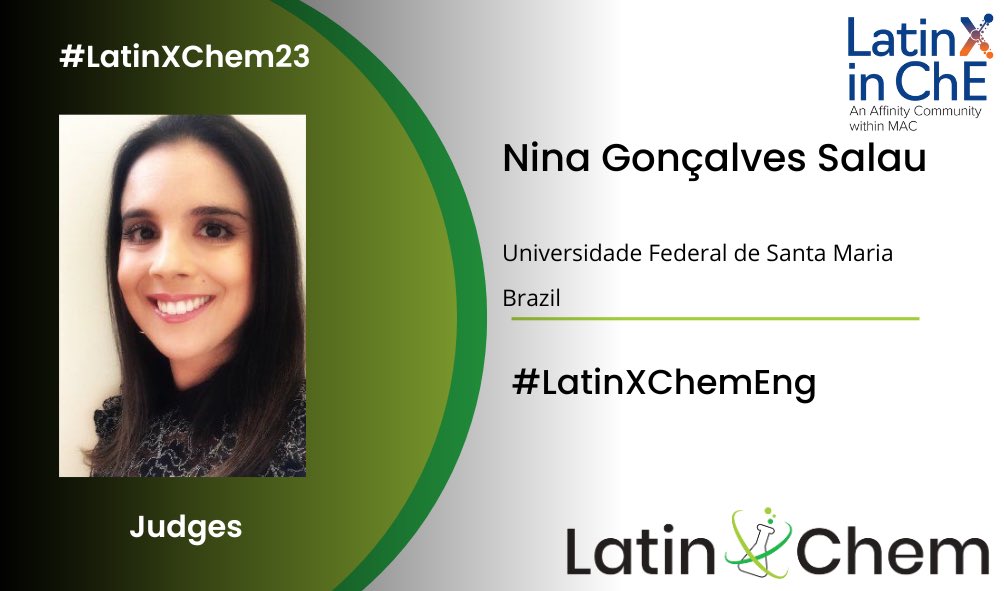
Hi everyone! I’m Nina Salau, an Associate Professor @UFSM_oficial, working with #ProcessSystemsEngineering . I’m honored to serve as a judge in #LatinXChem23 . Please register your work in the #LatinXChemEng category before September 30th. @LatinXChem @LatinXinChE
7
20
1,361

27 Jul 2023
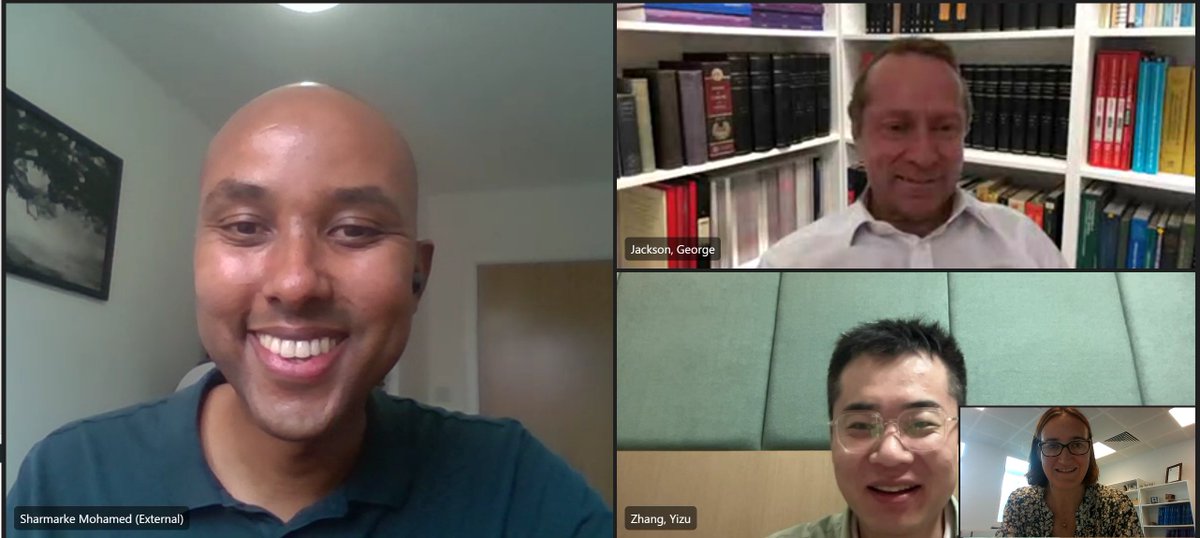
Congrats to Dr. @yizu_zhang on passing his PhD viva on the CSP of multicomponent crystals & 4 pushing the field forward with inclusion of induction effects. Best wishes for the future. @imperialcollege @ImperialChemEng @sargent_centre #ProcessSystemsEngineering @ClaireAdjiman
10
861

3 May 2023
Thanks to everyone involved
@Naush13 @jonRmcdonough @AntonioE89 @OptimlPse @MatarLab @OkMatar @PREMIERE_UKRI
#machinelearning #optimization #cfd #chemicalengineering #processsystemsengineering
2
4
524

7 Jul 2021
Please join us at: iitkharagpur.webex.com/iitkh…
#ExpertTalk
#SafetyEngineeringManagementAndAnalytics
#ProfDavideManca
#ProcessSystemsEngineering
4
5 May 2021
This is the right moment to thank the many collaborators, friends, and family that have been with me during these years. Especially to Ignacio Grossmann, whose mentorship has been invaluable.
The future will be full of #QuantumComputing #ProcessSystemsEngineering and fun!
1
11

Do your #PhD in #ProcessSystemsEngineering - Apply for this #PhD position at @TU_Muenchen (only in German) 👉ow.ly/cOBJ50E98rO #PhDGermany #ProcessEngineering #ChemicalEngineering #FoodTechnology #MaterialSciences
2
2
Want to do your #PhD in #ProcessSystemsEngineering ? Look at this open #PhD position at @TU_Muenchen (only in German) 👉ow.ly/GKT350E98og #PhDGermany #ProcessEngineering #ChemicalEngineering #FoodTechnology #MaterialSciences
9
12
The MPI for Dynamics of Complex Technical Systems @maxplanckpress is seeking a #PhD Student in #ProcessSystemsEngineering 👉ow.ly/P7sc50DXa4P #PhDGermany #ChemicalEngineering #ProcessEngineering #Physics #Chemistry
3
5
The MPI for Dynamics of Complex Technical Systems @maxplanckpress is looking for a #PhD Student in #ProcessSystemsEngineering 👉ow.ly/3roo50DXa3k #PhDGermany #ChemicalEngineering #ProcessEngineering #Physics #Chemistry
2
3

1 Mar 2021
I am coming to the realisation that my career and research interest can be summed up thus; #ProcessSystemsEngineering
I am deeply fascinated by design, modelling, optimization, AI concepts, Control of engineering systems and processes.
5
See this open #PhD position in #ProcessSystemsEngineering at @TU_Muenchen (only in German) 👉ow.ly/Uuy150DDutb #PhDGermany #FoodTechnology #ProcessEngineering #ChemicalEngineering #BioProcessEngineering
6
10
Interested in #ProcessSystemsEngineering ? See this open #PhD position at @TU_Muenchen (only in German) 👉ow.ly/jDzD50DDuql #PhDGermany #FoodTechnology #ProcessEngineering #ChemicalEngineering #BioProcessEngineering
3
7
See this #PhD position in #ProcessSystemsEngineering on alternatives for meat at @TU_Muenchen (only in German) 👉daad.de/deutschland/promotio… #PhDGermany #ProcessEngineering #ChemicalEngineering #FoodTechnology #MaterialSciences
5
16
Are you into alternatives for meat? See this open #PhD position in #ProcessSystemsEngineering at @TU_Muenchen (only in German) 👉ow.ly/y1bD50DxtIe #PhDGermany #ProcessEngineering #ChemicalEngineering #FoodTechnology #MaterialSciences
2
2

23 Dec 2020
#mdpiprocesses Review
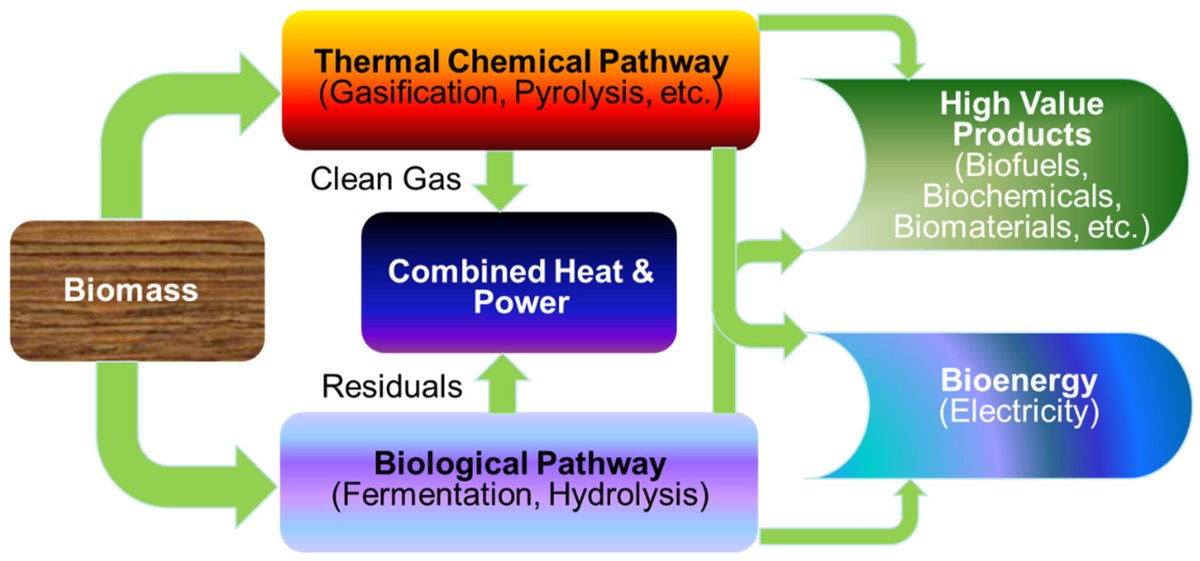
"A Review of #ProcessSystemsEngineering (PSE) Tools for the Design of #IonicLiquids and Integrated #Biorefineries" mdpi.com/2227-9717/8/12/1678, a high-quality review paper from Dr. Nishanth G. Chemmangattuvalappil, Dr. Denny K. S. NG, and their colleagues.
1
3
See this #PhD #Fellowship in #ProcessSystemsEngineering at @TU_Muenchen (only in German) 👉ow.ly/gPRB50BPNQl #PhDGermany #ProcessEngineering #ChemicalEngineering #FoodTechnology #BioProcessTechnology [image © Uli Benz / TU München]
2
3