
Jun 13
🗓️ Weekly Recap – Phase #4 Portal Progress, Mainnet Lite Validation & Infra Hardening
This week was again heavily focused on Portal V1, with meaningful progress across product flows, API Gateway behavior, observability, and hosted inference readiness.
🔹 Phase #4 – Monitoring, Support & Stats
- Continued monitoring across routing, miners, validators, dashboards, indexers, and L3 stats.
- Phase #4 remained stable while Portal and Mainnet Lite workstreams continued to mature.
🔹 Portal V1 – Product Flow Maturing
- Portal moved from rough MVP toward a more usable hosted product surface with cleaner auth, API keys, usage visibility, request logs, and UI/UX refinement.
- Data consistency between web app, database, and API-key systems improved significantly.
🔹 Portal V1 – API Gateway & Quota Work
- Sliding-window quota logic received deeper testing and fixes, including weekly-limit accounting improvements.
- Usage counting became more accurate with better separation between successful requests, quota events, and real failures.
🔹 Portal V1 – Request Visibility & Analytics
- Request visibility improved with better logs, filters, totals, and detailed request views.
- Added richer usage analytics including trends, activity heatmaps, and token-level visibility.
🔹 Portal V1 – Reliability, Observability & Operations
- Dual API Gateway setup is now operating behind a shared entry path, reducing single-point dependency.
- Admin/ops visibility expanded with metrics around gateway health, latency, routing distribution, and user activity.
🔹 Portal V1 – API Compatibility & Streaming
- OpenAI-style and Anthropic-style REST compatibility continued to improve.
- SSE/streaming MVP is now working, with deeper reliability work shifting toward backend/router behavior.
🔹 Portal V1 – Stress Testing & Router Pools
- Stress testing expanded using multiple accounts, keys, parallel requests, and longer-running workloads.
- This surfaced the next bottlenecks and drove further work on capacity-aware routing and router-pool behavior.
🔹 Mainnet Lite – Baseline Validation
- Mainnet Lite dedicated-node E2E was re-run successfully, including payment distribution behavior.
- Ephemeral-node network-task E2E also worked, confirming another critical baseline path.
🔹 RPC & Infrastructure Hardening
- Internal RPC infrastructure is now live across both testnet and mainnet-related environments.
- Early stability looks good and provides better operational control than previous external dependencies.
🔹 Payment Staking – Regression & Hardening
- Progress was lighter than planned while Portal took priority this week.
- Additional validation and regression testing remain on the upcoming work list.
🔹 PyClaw – Dev Path Progress
- Continued incremental progress on PyClaw workflows, tooling, and repository structure.
- Focus remains on preparing for the first public development release and open iteration cycle.
A productive Phase #4 week overall - Portal V1 made the largest jump forward, Mainnet Lite baseline checks continued to pass, and the hosted inference path is increasingly shifting from concept into an operational product.
#Cortensor #Testnet #Phase4 #AIInfra #DePIN #Portal #PyClaw #MainnetLite #L3

Jun 8

🗓️ Weekly Focus – Portal Refinement, Mainnet Lite Baseline & PyClaw
Phase #4 continues with Portal V1 as the primary focus, while Mainnet Lite baseline work, Payment Staking validation, and PyClaw development continue alongside it.
🔹 Phase #4 – Monitoring, Support & Stats
- Continue monitoring routing, miners, validators, dashboards, indexers, and L3 stats.
- Track stability as Portal V1 and Mainnet Lite workstreams continue to evolve.
🔹 Portal V1 – Product Refinement
- Continue refining the Portal MVP now that the core path is in place (auth, API keys, usage visibility, gateway, router pools, hosted requests).
- Focus on improving usability, operational flow, and product readiness.
🔹 Portal V1 – Gateway & Router Pool Hardening
- Continue hardening Gateway → router-pool behavior, observability, and request handling.
- Focus on reliability, operational visibility, and preparing the hosted path for broader usage.
🔹 Portal V1 – API / Usage / Quota Refinement
- Continue refining API-key lifecycle, usage visibility, logging, and quota/rate-limit behavior.
- Build on last week's testing and fixes around sliding-window accounting and request tracking.
🔹 Mainnet Lite – Baseline & Prerequisite Checks
- Spend more time validating the Mainnet Lite baseline setup and prerequisite components.
- Continue checking infra, RPC, contracts/modules, indexer, oracle, and dedicated-node paths.
🔹 Payment Staking – Regression & Hardening Tests
- Continue the postponed regression pass following the recent security-hardening rollout.
- Goal remains validating the full staking/usage flow and confirming no regressions.
🔹 PyClaw – Dev Path Progress
- Continue PyClaw iteration across workflow, side packages, tools, and repository structure.
- Target remains a rough public development release next month so iteration can continue openly.
This week is about continuing to refine the Portal baseline, validating Mainnet Lite foundations, and tightening the supporting systems that sit underneath both.
#Cortensor #Testnet #Phase4 #AIInfra #DePIN #Portal #PyClaw #MainnetLite #L3

1
10
17
263
Jun 13
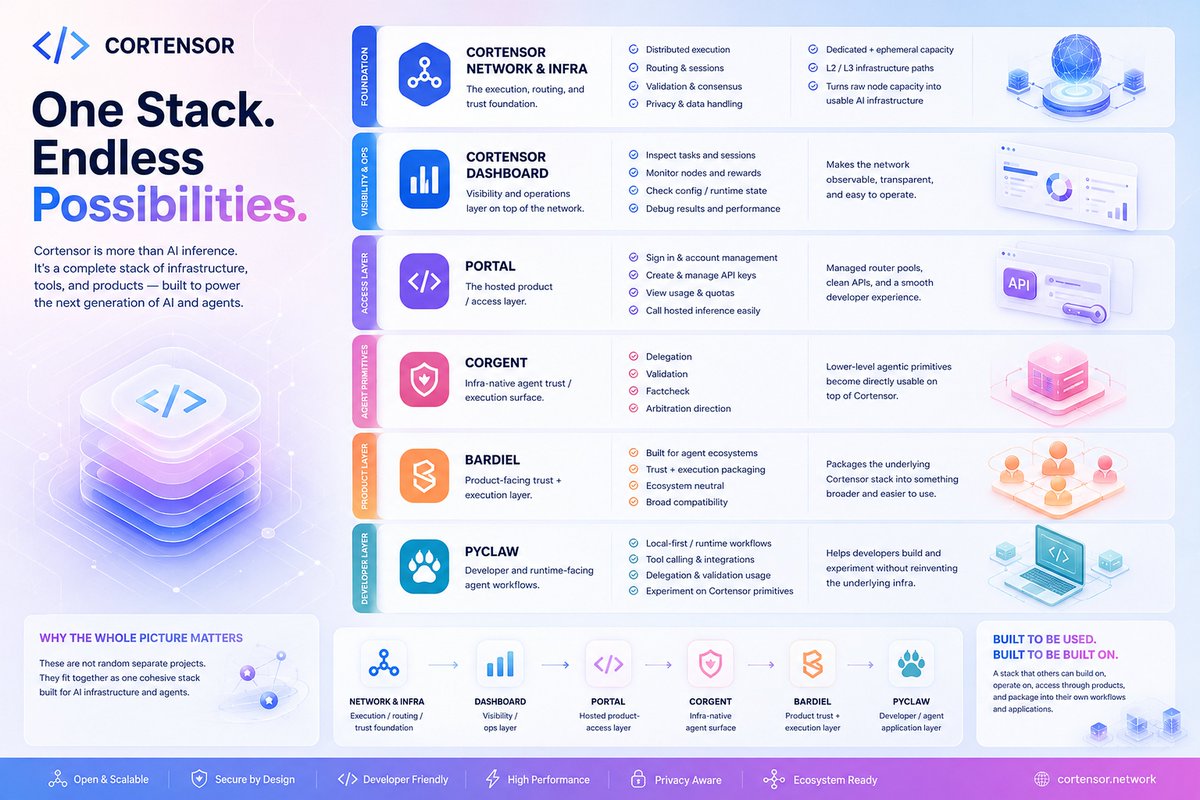
Cortensor is not just one product or one surface.
It is increasingly becoming one stack:
- Network & Infra as the foundation
- Dashboard for visibility and operations
- Portal for hosted access
- Corgent for infra-native agent execution
- Bardiel and PyClaw as higher-level product and agent layers
That is the bigger picture:
One stack that people can build on, operate on, access through products, and turn into real applications.
#Cortensor #AIInfra #AgenticAI #Portal #Dashboard #Corgent #Bardiel #PyClaw
Jun 9
🔎 Recap: How the Cortensor Stack Fits Together
Over the years, a lot of the Cortensor work can look fragmented if you only see it as separate devlogs:
- Network
- Router
- Dashboard
- Portal
- Corgent
- Bardiel
- PyClaw
But the point is that these are increasingly becoming one stack.
🔹 Cortensor Network & Infra
This is the foundation:
- Distributed execution
- Routing
- Sessions
- Validation
- Privacy & Data handling
- Dedicated Ephemeral capacity
- L2 / L3 infra paths
This is the layer that turns raw node capacity into usable AI infrastructure.
🔹 Cortensor Dashboard
The Dashboard is the visibility and operations layer on top of that foundation:
- Inspect tasks and sessions
- Monitor nodes and rewards
- Check config/runtime state
- Debug results and performance
It makes the network observable and operable.
🔹 Portal
Portal is the hosted product/access layer:
- Sign in
- Create API keys
- View usage
- Call hosted inference
- Use managed router pools through a cleaner API
It makes Cortensor easier to consume as a product instead of only as raw infra.
🔹 Corgent
Corgent is the more infra-native agent trust/execution surface:
- Delegation
- Validation
- Factcheck
- Arbitration direction
It is where the lower-level agentic primitives become usable more directly.
🔹 Bardiel
Bardiel is the more product-facing trust execution layer built on top of that direction.
It shows how the underlying Cortensor trust/execution stack can be packaged into something broader and easier to use across agent ecosystems.
🔹 PyClaw
PyClaw is another example of the layer above infra:
- Local-first/runtime-facing agent workflows
- Tool calling
- Delegation/validation consumption
- Developer-facing experimentation on top of Cortensor primitives
It helps show how products can consume the network rather than rebuild everything from scratch.
🔹 Why the whole picture matters
So these are not random separate projects.
They fit together more like:
- Network & Infra = execution / routing / trust foundation
- Dashboard = visibility / ops layer
- Portal = hosted product-access layer
- Corgent = infra-native agent surface
- Bardiel / PyClaw = product and agent layers built on top
That is the bigger picture people should see now.
Cortensor is not only building “AI inference.”
It is building a stack that others can:
- Build on
- Operate on
- Access through products
- and package into their own workflows and applications
That is what makes all these developments more meaningful together.
#Cortensor #AIInfra #AgenticAI #Portal #Dashboard #Corgent #Bardiel #PyClaw
3
8
20
646
Jun 9
🔎 Recap: How the Cortensor Stack Fits Together
Over the years, a lot of the Cortensor work can look fragmented if you only see it as separate devlogs:
- Network
- Router
- Dashboard
- Portal
- Corgent
- Bardiel
- PyClaw
But the point is that these are increasingly becoming one stack.
🔹 Cortensor Network & Infra
This is the foundation:
- Distributed execution
- Routing
- Sessions
- Validation
- Privacy & Data handling
- Dedicated Ephemeral capacity
- L2 / L3 infra paths
This is the layer that turns raw node capacity into usable AI infrastructure.
🔹 Cortensor Dashboard
The Dashboard is the visibility and operations layer on top of that foundation:
- Inspect tasks and sessions
- Monitor nodes and rewards
- Check config/runtime state
- Debug results and performance
It makes the network observable and operable.
🔹 Portal
Portal is the hosted product/access layer:
- Sign in
- Create API keys
- View usage
- Call hosted inference
- Use managed router pools through a cleaner API
It makes Cortensor easier to consume as a product instead of only as raw infra.
🔹 Corgent
Corgent is the more infra-native agent trust/execution surface:
- Delegation
- Validation
- Factcheck
- Arbitration direction
It is where the lower-level agentic primitives become usable more directly.
🔹 Bardiel
Bardiel is the more product-facing trust execution layer built on top of that direction.
It shows how the underlying Cortensor trust/execution stack can be packaged into something broader and easier to use across agent ecosystems.
🔹 PyClaw
PyClaw is another example of the layer above infra:
- Local-first/runtime-facing agent workflows
- Tool calling
- Delegation/validation consumption
- Developer-facing experimentation on top of Cortensor primitives
It helps show how products can consume the network rather than rebuild everything from scratch.
🔹 Why the whole picture matters
So these are not random separate projects.
They fit together more like:
- Network & Infra = execution / routing / trust foundation
- Dashboard = visibility / ops layer
- Portal = hosted product-access layer
- Corgent = infra-native agent surface
- Bardiel / PyClaw = product and agent layers built on top
That is the bigger picture people should see now.
Cortensor is not only building “AI inference.”
It is building a stack that others can:
- Build on
- Operate on
- Access through products
- and package into their own workflows and applications
That is what makes all these developments more meaningful together.
#Cortensor #AIInfra #AgenticAI #Portal #Dashboard #Corgent #Bardiel #PyClaw
3
8
17
3,244
thipdb88 retweeted
Jun 8
🗓️ Weekly Focus – Portal Refinement, Mainnet Lite Baseline & PyClaw
Phase #4 continues with Portal V1 as the primary focus, while Mainnet Lite baseline work, Payment Staking validation, and PyClaw development continue alongside it.
🔹 Phase #4 – Monitoring, Support & Stats
- Continue monitoring routing, miners, validators, dashboards, indexers, and L3 stats.
- Track stability as Portal V1 and Mainnet Lite workstreams continue to evolve.
🔹 Portal V1 – Product Refinement
- Continue refining the Portal MVP now that the core path is in place (auth, API keys, usage visibility, gateway, router pools, hosted requests).
- Focus on improving usability, operational flow, and product readiness.
🔹 Portal V1 – Gateway & Router Pool Hardening
- Continue hardening Gateway → router-pool behavior, observability, and request handling.
- Focus on reliability, operational visibility, and preparing the hosted path for broader usage.
🔹 Portal V1 – API / Usage / Quota Refinement
- Continue refining API-key lifecycle, usage visibility, logging, and quota/rate-limit behavior.
- Build on last week's testing and fixes around sliding-window accounting and request tracking.
🔹 Mainnet Lite – Baseline & Prerequisite Checks
- Spend more time validating the Mainnet Lite baseline setup and prerequisite components.
- Continue checking infra, RPC, contracts/modules, indexer, oracle, and dedicated-node paths.
🔹 Payment Staking – Regression & Hardening Tests
- Continue the postponed regression pass following the recent security-hardening rollout.
- Goal remains validating the full staking/usage flow and confirming no regressions.
🔹 PyClaw – Dev Path Progress
- Continue PyClaw iteration across workflow, side packages, tools, and repository structure.
- Target remains a rough public development release next month so iteration can continue openly.
This week is about continuing to refine the Portal baseline, validating Mainnet Lite foundations, and tightening the supporting systems that sit underneath both.
#Cortensor #Testnet #Phase4 #AIInfra #DePIN #Portal #PyClaw #MainnetLite #L3
Jun 6
🗓️ Weekly Recap – Phase #4 Portal Progress & Mainnet Lite Baseline
This week was heavily focused on Portal V1, with most of the effort going into turning the hosted inference path from a rough concept into something much closer to a real product.
🔹 Phase #4 – Monitoring, Support & Stats
- Continued monitoring across routing, miners, validators, dashboards, indexers, and L3 stats.
- Phase #4 remained stable while Portal V1 work became the primary focus.
🔹 Portal V1 – Baseline Infrastructure Established
- Portal V1 now has working baseline infrastructure across dev and prod environments.
- API Gateway, router-pool path, auth flow, data model sync, and API key issuance/consumption are all in place in rough form.
🔹 Portal V1 – API Gateway & Product Flow Progress
- Portal request flow improved significantly with usage visibility, request logs, quota handling, and API key lifecycle work.
- Gateway compatibility with OpenAI/Anthropic-style REST paths improved, and SSE/stream MVP is now working.
🔹 Portal V1 – Router Pools, Observability & Operations
- Router-pool testing expanded with additional routing and load-balancing scenarios.
- Early admin, observability, and operational surfaces are taking shape to support the hosted path.
🔹 Portal V1 – Quota & Rate-Limit Testing
- Sliding-window quota logic received deeper testing and fixes.
- Weekly counting issues were resolved and groundwork was laid for future fixed-window experiments.
🔹 RPC Infrastructure Migration
• Testnet and Mainnet Lite environments were moved toward newer Cortensor-managed RPC infrastructure.
• This gives better control over reliability, observability, and long-term operational costs.
🔹 Mainnet Lite – Baseline Progress
- Some progress was made on Mainnet Lite, but it was not a major focus area this week.
- Base infra, RPC, contracts/modules, and a rough dedicated-node E2E path are now in place for future iteration.
🔹 Payment Staking – Regression & Hardening
- Limited progress this week as focus shifted heavily toward Portal V1.
- Additional regression and validation work remains planned in upcoming weeks.
🔹 PyClaw – Dev Path Progress
- PyClaw continued moving forward, but only incrementally while Portal V1 took priority.
- Side packages, tooling, and repository structure continue to evolve toward the first public development release.
A productive Phase #4 week overall - Portal V1 made the biggest leap forward, while Mainnet Lite, Payment Staking, and PyClaw all continued moving forward at a slower pace behind the scenes.
#Cortensor #Testnet #Phase4 #AIInfra #DePIN #Portal #PyClaw #MainnetLite #L3

1
7
15
838
Jun 8
🔎 Recap: What Cortensor Network Is and Why It Matters
A quick recap on what Cortensor Network is in the broader stack.
🔹 What the network is
At the simplest level, Cortensor Network is the execution, routing, and trust layer underneath everything else in the Cortensor ecosystem.
It is the part that makes it possible to:
- route work across nodes
- execute inference through sessions
- validate results with redundancy/consensus
- support privacy-aware and data-aware flows
- turn raw distributed capacity into something usable by products and agents
So from the outside, the network is not just “some nodes running models.”
It is the coordination layer that lets compute, trust, and data handling work together.
🔹 What makes it different
Cortensor is not only about running inference.
It is also building around:
- routing — deciding where work goes
- validation — deciding whether work should be trusted
- privacy — controlling how data is protected
- data ownership — giving stronger control over offchain data paths
- quality signals — using actual task behavior to improve node selection
That means the network is trying to provide more than model access alone.
It is trying to provide the primitives needed for real agentic and distributed AI workflows.
🔹 What the network can do today
The current network direction already supports or is shaping around:
- direct inference/completion paths
- delegated execution through /delegate
- consensus-aware verification through /validate
- dedicated-node and ephemeral-node execution paths
- privacy and offchain data-management flows
- quality-aware node selection and SLA-style filtering
- product layers on top, such as Dashboard, Portal, Corgent, and Bardiel
So the network is no longer only raw capacity.
It is already becoming a more structured execution and trust fabric.
🔹 How the layers fit together
A simple way to think about it is:
- Cortensor Network = the underlying execution / routing / trust infrastructure
- Router = the execution and coordination surface on top of the network
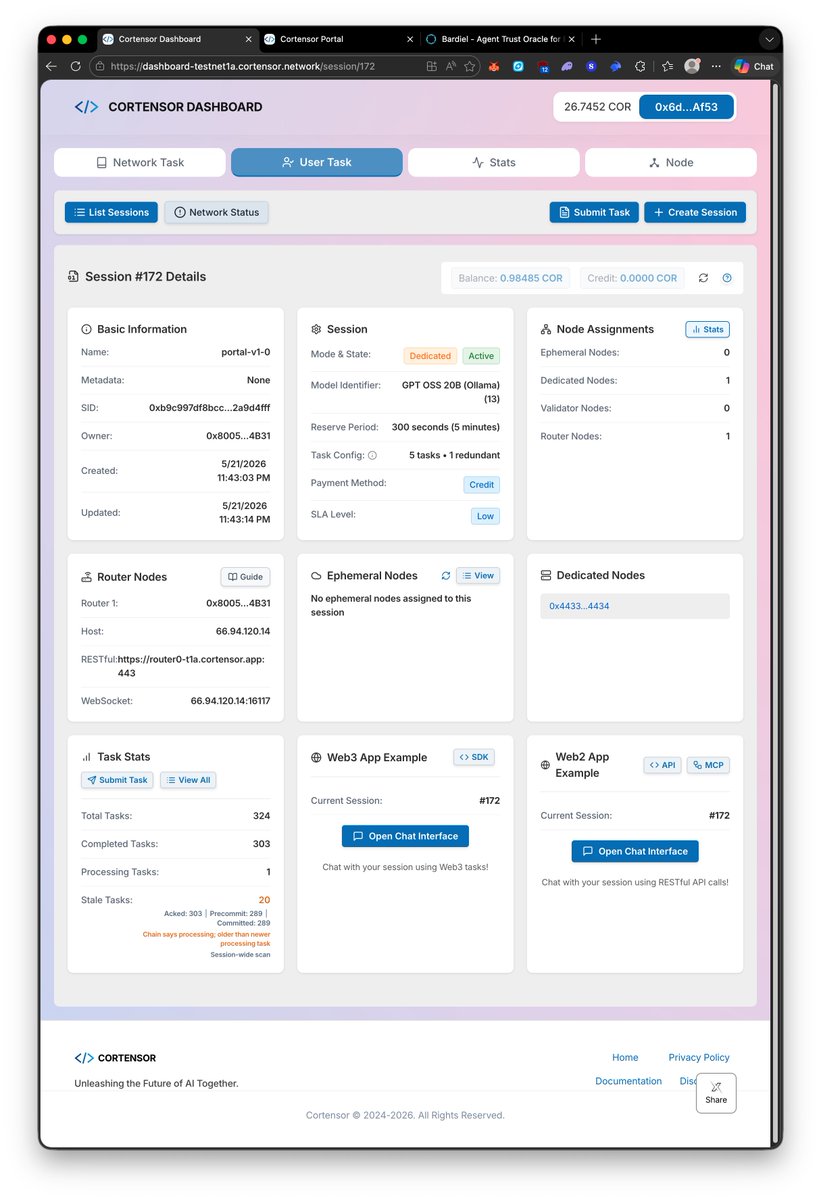
- Dashboard = the visibility and operations layer
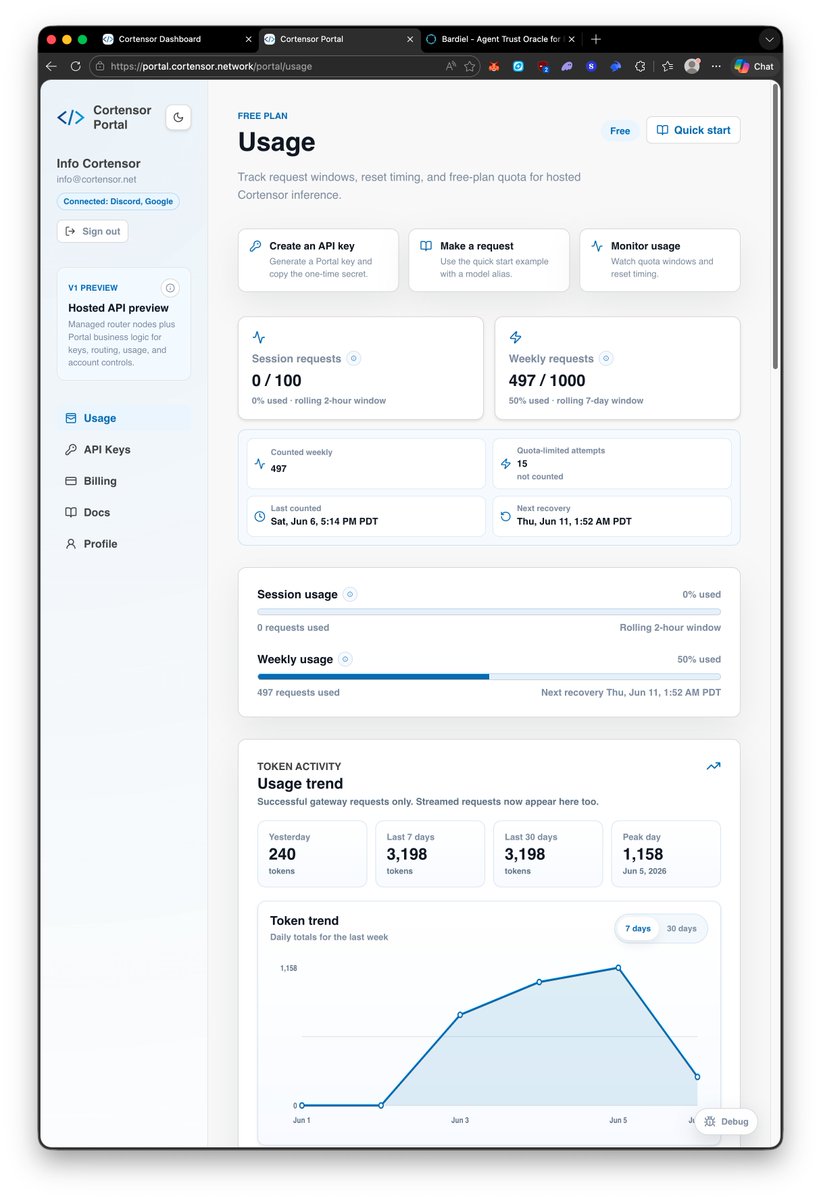
- Portal = the hosted product-access layer
- Corgent / @BardielTech / PyClaw = higher-level trust, agent, and product surfaces built on top
So the network is the foundation, while the other pieces make it easier to observe, access, and use.
🔹 Why this matters
Cortensor matters because a future AI stack likely needs more than “send prompt, get response.”
It needs:
- execution routing
- trust settlement
- validation
- privacy-aware data handling
- usable product layers on top of infra
That is why Cortensor Network matters: it is the layer trying to turn distributed AI capacity into something that is:
- programmable
- verifiable
- observable
- productizable
- easier to build on
🔹 Current takeaway
So the simplest framing is:
Cortensor Network is the execution, trust, and coordination layer that turns distributed node capacity into usable AI infrastructure.
That is what makes the rest of the stack possible.
#Cortensor #AIInfra #AgenticAI #DePIN

1
8
12
656
Jun 6
🗓️ Weekly Recap – Phase #4 Portal Progress & Mainnet Lite Baseline
This week was heavily focused on Portal V1, with most of the effort going into turning the hosted inference path from a rough concept into something much closer to a real product.
🔹 Phase #4 – Monitoring, Support & Stats
- Continued monitoring across routing, miners, validators, dashboards, indexers, and L3 stats.
- Phase #4 remained stable while Portal V1 work became the primary focus.
🔹 Portal V1 – Baseline Infrastructure Established
- Portal V1 now has working baseline infrastructure across dev and prod environments.
- API Gateway, router-pool path, auth flow, data model sync, and API key issuance/consumption are all in place in rough form.
🔹 Portal V1 – API Gateway & Product Flow Progress
- Portal request flow improved significantly with usage visibility, request logs, quota handling, and API key lifecycle work.
- Gateway compatibility with OpenAI/Anthropic-style REST paths improved, and SSE/stream MVP is now working.
🔹 Portal V1 – Router Pools, Observability & Operations
- Router-pool testing expanded with additional routing and load-balancing scenarios.
- Early admin, observability, and operational surfaces are taking shape to support the hosted path.
🔹 Portal V1 – Quota & Rate-Limit Testing
- Sliding-window quota logic received deeper testing and fixes.
- Weekly counting issues were resolved and groundwork was laid for future fixed-window experiments.
🔹 RPC Infrastructure Migration
• Testnet and Mainnet Lite environments were moved toward newer Cortensor-managed RPC infrastructure.
• This gives better control over reliability, observability, and long-term operational costs.
🔹 Mainnet Lite – Baseline Progress
- Some progress was made on Mainnet Lite, but it was not a major focus area this week.
- Base infra, RPC, contracts/modules, and a rough dedicated-node E2E path are now in place for future iteration.
🔹 Payment Staking – Regression & Hardening
- Limited progress this week as focus shifted heavily toward Portal V1.
- Additional regression and validation work remains planned in upcoming weeks.
🔹 PyClaw – Dev Path Progress
- PyClaw continued moving forward, but only incrementally while Portal V1 took priority.
- Side packages, tooling, and repository structure continue to evolve toward the first public development release.
A productive Phase #4 week overall - Portal V1 made the biggest leap forward, while Mainnet Lite, Payment Staking, and PyClaw all continued moving forward at a slower pace behind the scenes.
#Cortensor #Testnet #Phase4 #AIInfra #DePIN #Portal #PyClaw #MainnetLite #L3
Jun 1
🗓️ Weekly Focus – Phase #4 Portal Testing, Mainnet Lite Baseline & PyClaw Dev Path
This week continues Phase #4 execution, with Portal V1 moving into deeper quota/rate-limit testing, Mainnet Lite expanding baseline node tests, and PyClaw continuing toward public dev iteration.
🔹 Phase #4 – Monitoring, Support & Stats
- Continue monitoring routing, miners, validators, dashboards, indexers, and L3 stats.
- Track stability as Portal V1, Mainnet Lite, and related Phase #4 workstreams keep moving forward.
🔹 Portal V1 – API Gateway Stress Quota Testing
- Run simple stress tests on the Portal API Gateway and continue quota/rate-limit validation.
- Compare current sliding-window behavior vs fixed-window quota/rate-limit options.
🔹 Portal V1 – Model Pool Flow Testing
- Configure different model pools and test how requests route through each pool.
- Run flow tests across auth, API keys, gateway, router pool, quota checks, and usage logging.
🔹 Mainnet Lite – Ephemeral Dedicated Node Baseline
- Set up at least one ephemeral node and one dedicated node for Mainnet Lite baseline testing.
- Use them to continue validating basic routing, session, oracle/indexer, and dashboard behavior.
🔹 Testnet RPC Migration – Internal Infrastructure
- Begin switching Testnet-0 and Testnet-1a over to Cortensor-managed RPC infrastructure.
- Goal is to reduce external dependencies and gain better control over reliability, monitoring, and costs.
🔹 Payment Staking – Regression & Hardening Tests
- Continue the postponed regression pass on Payment Staking after the recent security hardening rollout.
- Goal is to confirm no flow regressions across staking, usage, and related payment paths.
🔹 PyClaw – Dev Path Progress
- Continue PyClaw dev-path iteration across workflow, side packages, tools, and repo structure.
- Additional side packages were released over the weekend, helping define the open-source development flow.
This week is about pushing Portal V1 from baseline into real usage testing, expanding Mainnet Lite node coverage, migrating testnets to internal RPC infrastructure, and continuing PyClaw’s public development path.
#Cortensor #Testnet #Phase4 #AIInfra #DePIN #Portal #PyClaw #MainnetLite #Security #L3

1
9
13
503
Jun 1
🔎 Recap: How Portal and PyClaw Fit Together
A quick recap on the relationship between Cortensor Portal and PyClaw.
🔹 What Portal is
At the simplest level, Portal is one of the main infrastructure/product access surfaces for Cortensor.
It gives a cleaner way to access the network through things like:
- hosted API access
- API keys
- usage visibility
- managed router pools
- simpler developer-facing entry points
So Portal is the layer that helps turn raw Cortensor infra into something easier to consume as a product.
🔹 What PyClaw is
PyClaw is one of the products/app layers that can sit on top of that infrastructure.
In other words:
- Portal = the access / infra surface
- PyClaw = one of the consumers of that surface
PyClaw can use the same underlying Cortensor capabilities around:
- inference
- routing
- agent workflows
- validation
- execution primitives
without needing every user to think about the lower-level infra directly.
🔹 Why this matters
This relationship is important because it shows how Cortensor can support its own product ecosystem.
If Portal becomes the cleaner entry point into the network, then products like PyClaw can focus more on:
- user workflow
- agent behavior
- product experience
- actual use cases
instead of rebuilding all the infra access paths themselves.
🔹 Why PyClaw success helps Cortensor
If PyClaw succeeds or drives more usage, that indirectly benefits the Cortensor Network through Portal.
Why:
- more PyClaw usage means more consumption of Cortensor-backed infra
- more usage through Portal helps validate the hosted product path
- more real product demand helps stress and improve the network
- more external/product activity can translate into more useful demand for Cortensor capacity underneath
So even if PyClaw is “just one product,” it can still help strengthen the broader Cortensor ecosystem by driving actual usage into the underlying infra.
🔹 Current takeaway
So the simple framing is:
- Cortensor Network = the underlying infra and execution layer
- Portal = the infrastructure / product-access surface
- PyClaw = one of the products that can consume that surface
That is why Portal and PyClaw are connected: one makes access easier, the other can turn that access into real usage.
#Cortensor #Portal #PyClaw #AIInfra #AgenticAI
May 25
🔎 Recap: What Cortensor Portal Is and Why It Matters
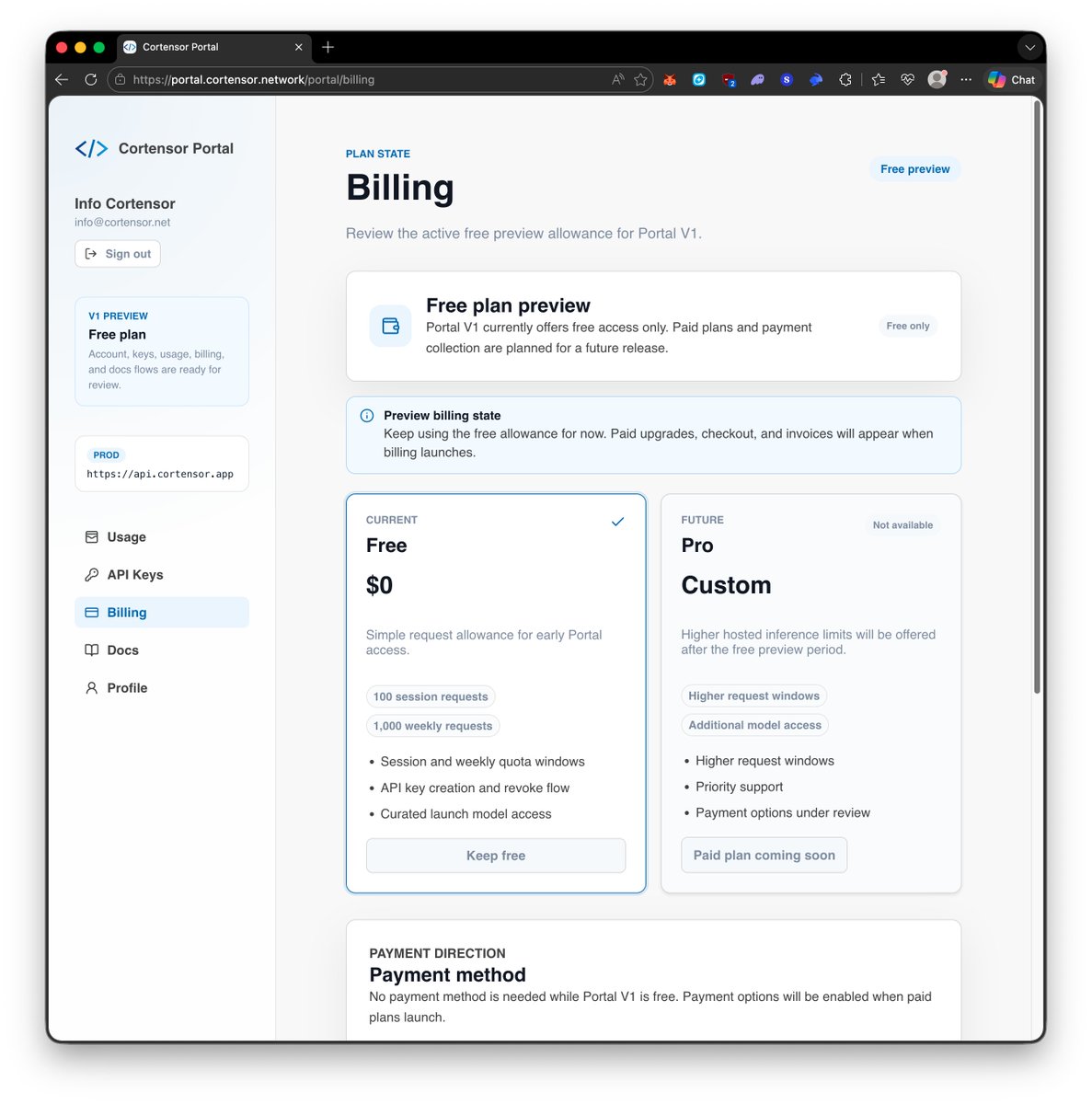
At the simplest level, Cortensor Portal is the hosted product layer for using Cortensor more easily.
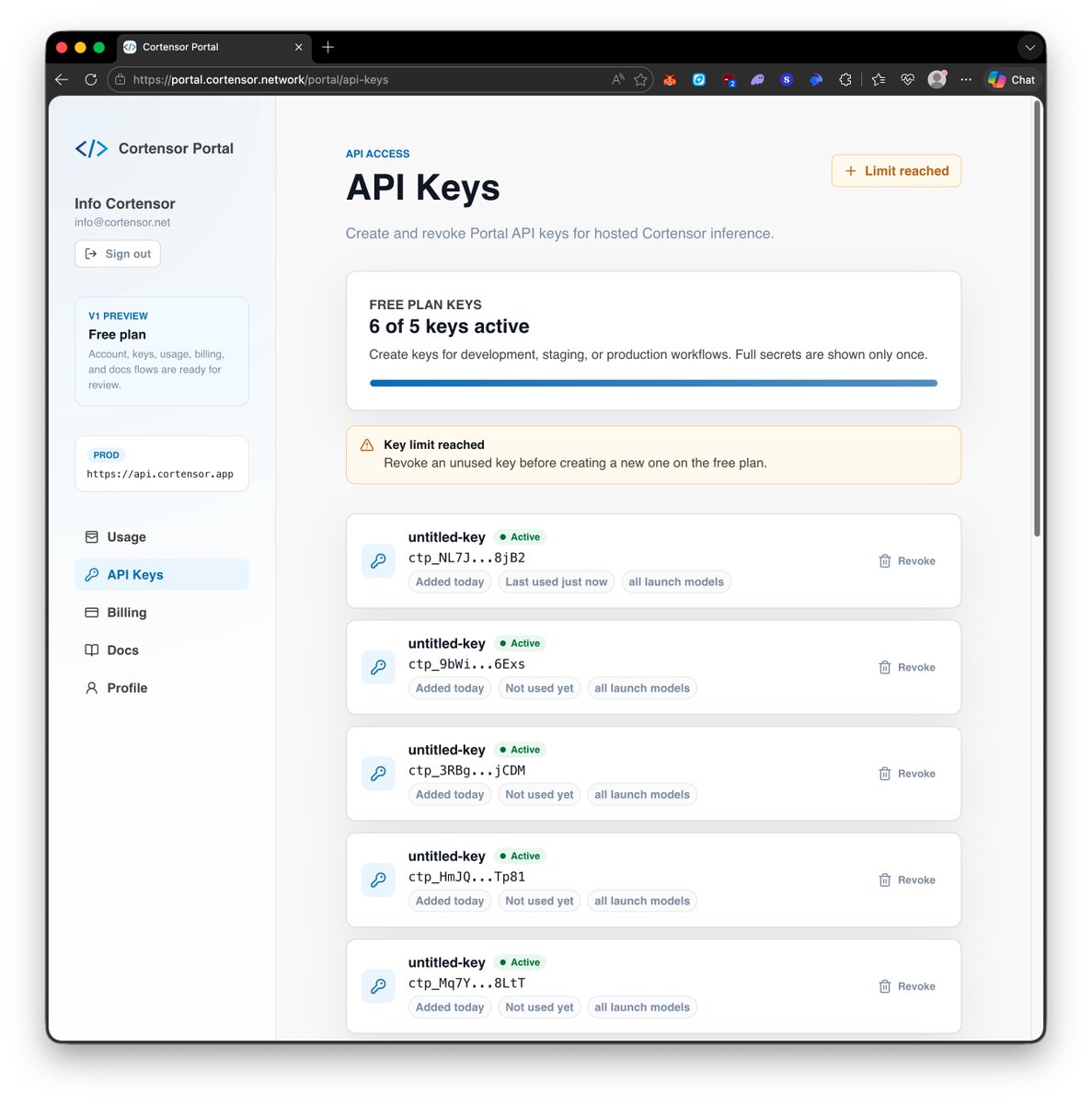
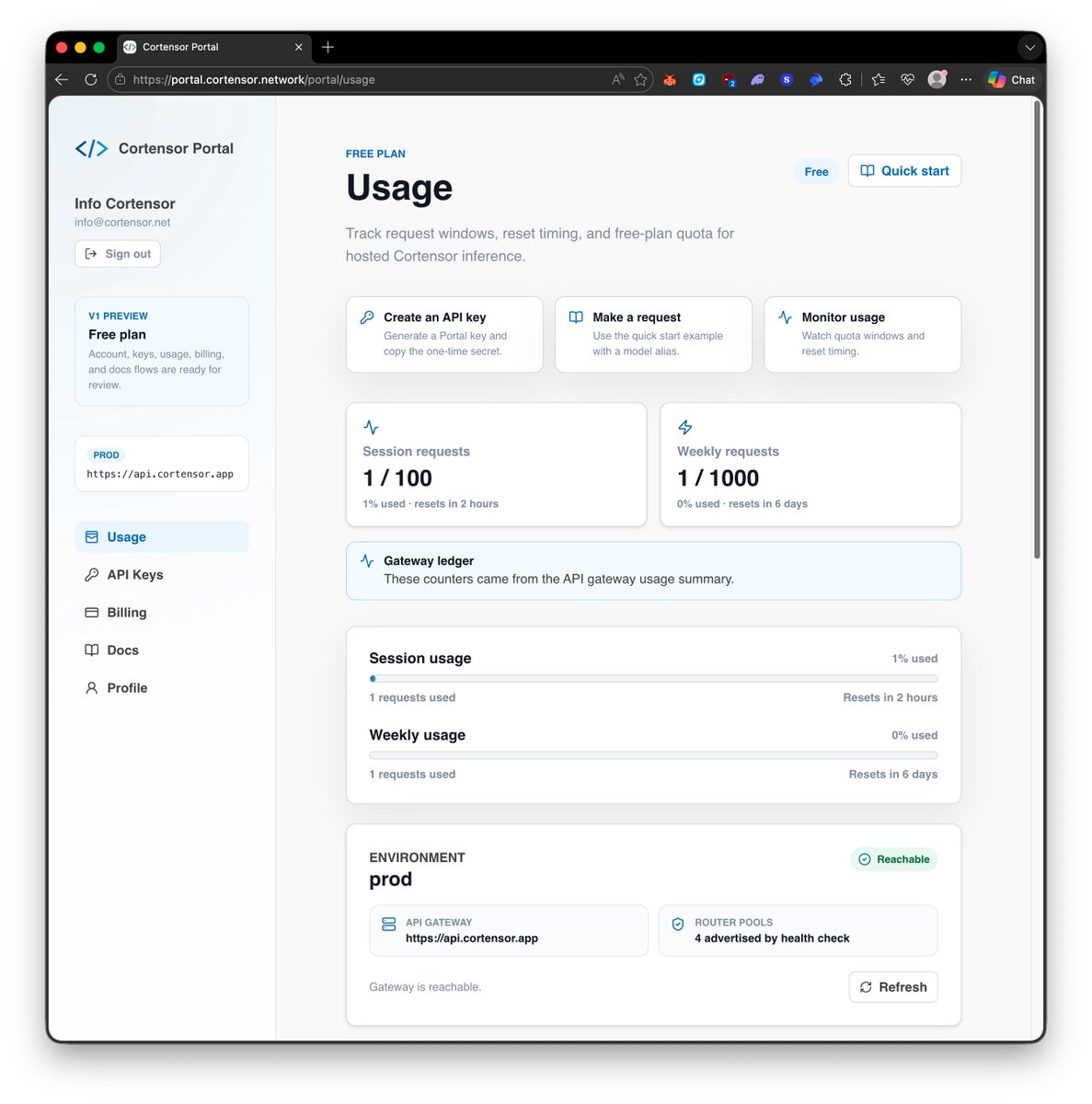
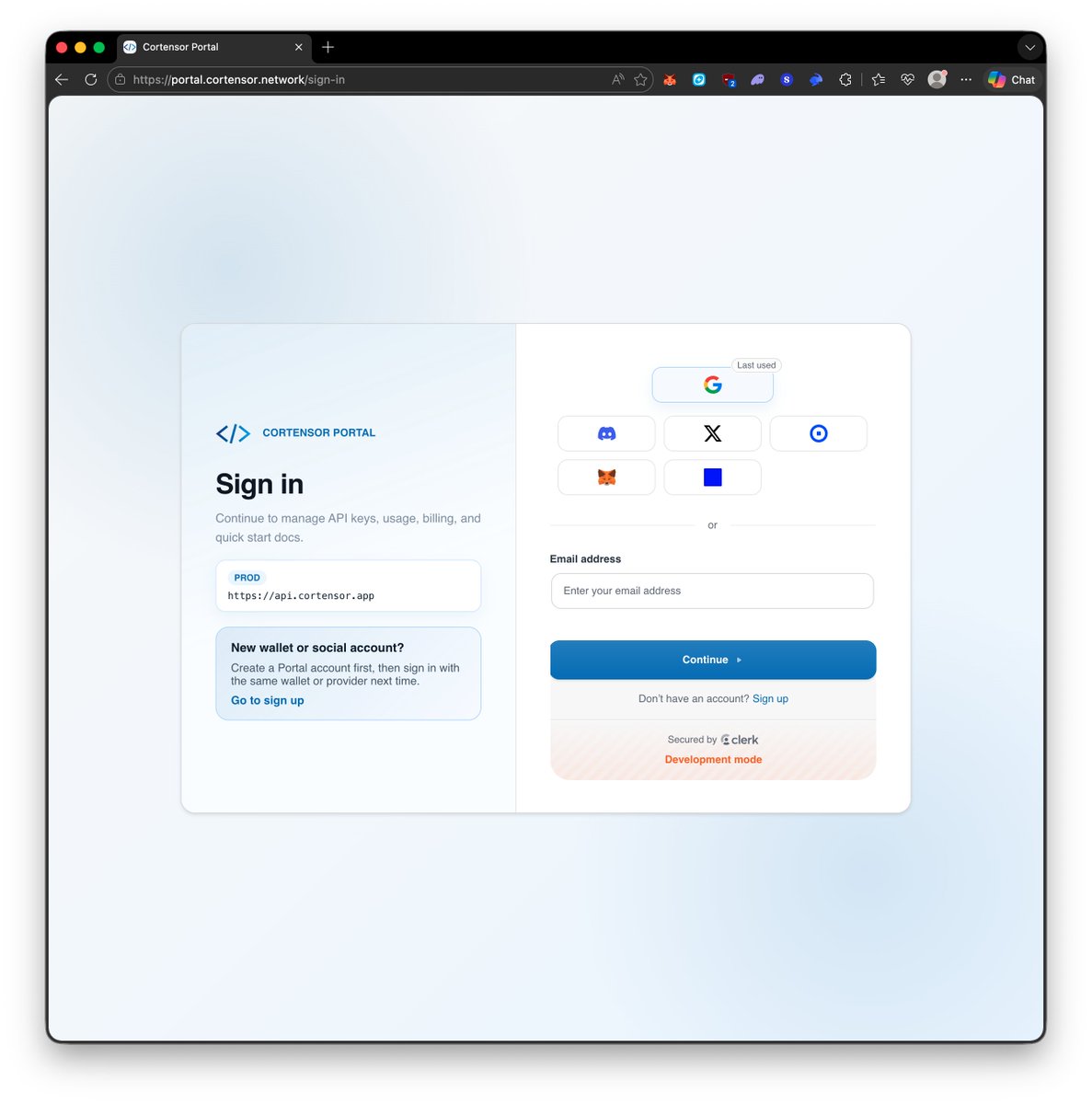
Instead of asking users to deal with raw infrastructure directly, Portal is meant to give a cleaner surface where someone can:
- sign in
- create and manage API keys
- view usage and limits
- call hosted inference through a stable API
- use curated model access in a more productized way
So from the outside, Portal means:
less infra friction, more direct product access.
That matters because not everyone wants to run router nodes, manage sessions, or think about backend topology just to use Cortensor.
What Portal can do
Portal is meant to make Cortensor easier to use for:
- developers who want hosted inference quickly
- teams that want API-key-based access
- apps that want stable model aliases and cleaner request flows
- users who want usage visibility and simpler account management
### What Portal can enable over time
Portal can also become the entry point for broader product experiences on top of the network:
- richer hosted inference plans
- better usage and request visibility
- more managed model/routing options
- smoother onboarding for external developers
- product layers that sit on top of Cortensor without exposing all of the raw infra underneath
Why this is important for Cortensor
Portal matters because it helps Cortensor move from being understood mainly as infrastructure to being used more directly as a product.
That is important because:
- it lowers the barrier to entry
- it makes integration easier for outside developers and teams
- it gives Cortensor a clearer product surface people can adopt faster
- it helps translate network capability into real usage and distribution
So the main idea is simple:
Cortensor Portal is how Cortensor becomes easier to consume as a product, not just as infrastructure.
#Cortensor #Portal #API #AIInfra
7
14
231
Jun 1
🗓️ Weekly Focus – Phase #4 Portal Testing, Mainnet Lite Baseline & PyClaw Dev Path
This week continues Phase #4 execution, with Portal V1 moving into deeper quota/rate-limit testing, Mainnet Lite expanding baseline node tests, and PyClaw continuing toward public dev iteration.
🔹 Phase #4 – Monitoring, Support & Stats
- Continue monitoring routing, miners, validators, dashboards, indexers, and L3 stats.
- Track stability as Portal V1, Mainnet Lite, and related Phase #4 workstreams keep moving forward.
🔹 Portal V1 – API Gateway Stress Quota Testing
- Run simple stress tests on the Portal API Gateway and continue quota/rate-limit validation.
- Compare current sliding-window behavior vs fixed-window quota/rate-limit options.
🔹 Portal V1 – Model Pool Flow Testing
- Configure different model pools and test how requests route through each pool.
- Run flow tests across auth, API keys, gateway, router pool, quota checks, and usage logging.
🔹 Mainnet Lite – Ephemeral Dedicated Node Baseline
- Set up at least one ephemeral node and one dedicated node for Mainnet Lite baseline testing.
- Use them to continue validating basic routing, session, oracle/indexer, and dashboard behavior.
🔹 Testnet RPC Migration – Internal Infrastructure
- Begin switching Testnet-0 and Testnet-1a over to Cortensor-managed RPC infrastructure.
- Goal is to reduce external dependencies and gain better control over reliability, monitoring, and costs.
🔹 Payment Staking – Regression & Hardening Tests
- Continue the postponed regression pass on Payment Staking after the recent security hardening rollout.
- Goal is to confirm no flow regressions across staking, usage, and related payment paths.
🔹 PyClaw – Dev Path Progress
- Continue PyClaw dev-path iteration across workflow, side packages, tools, and repo structure.
- Additional side packages were released over the weekend, helping define the open-source development flow.
This week is about pushing Portal V1 from baseline into real usage testing, expanding Mainnet Lite node coverage, migrating testnets to internal RPC infrastructure, and continuing PyClaw’s public development path.
#Cortensor #Testnet #Phase4 #AIInfra #DePIN #Portal #PyClaw #MainnetLite #Security #L3
May 30
🗓️ Weekly Recap – Phase #4 Portal Progress, Mainnet Lite E2E & PyClaw Iteration
This week focused heavily on Portal V1, while continuing Mainnet Lite preparation, Payment Staking validation, and PyClaw development work.
🔹 Phase #4 – Monitoring, Support & Stats
- Continued monitoring across routing, miners, validators, dashboards, indexers, and L3 stats.
- Phase #4 remained stable while Portal and Mainnet Lite work moved deeper into implementation.
🔹 Portal V1 – Auth / API / Logging Progress
- Portal request visibility, API-key flow, usage tracking, and request-log surfaces received multiple rounds of refinement.
- Data consistency across web app ↔ Supabase ↔ Unkey improved significantly, making the hosted flow feel much closer to a real product.
🔹 Portal V1 – Gateway & Router Pool Progress
- Gateway → router-pool integration moved from planning into actual implementation and testing.
- API-key issuance/consumption, request tracking, and backend execution paths were proven in rough form.
🔹 Portal V1 – Infra & Environment Setup
- Baseline Portal infrastructure is now established with separate dev and prod environments.
- Current focus is hardening Gateway → router-pool behavior and improving operational visibility.
🔹 Mainnet Lite – Dedicated Session E2E
- Mainnet Lite baseline became more concrete with dashboard, indexer, oracle, and supporting infra coming online.
- First rough dedicated-session E2E flow on Arbitrum mainnet baseline was exercised, surfacing the next set of gas, payment, and ops gaps.
🔹 Payment Staking – Regression & Hardening
- Payment Staking security hardening remains deployed on Testnet-0 and Testnet-1a.
- Additional E2E validation was performed to confirm the recent hardening changes did not introduce regressions.
🔹 PyClaw – Dev Path Progress
- Continued PyClaw iteration around workflow, tooling, side libraries, and repository structure.
- Open-source workflow definition is taking shape as we move toward a rough public dev release next month.
A productive Phase #4 week overall - Portal V1 is now moving from concept toward implementation, Mainnet Lite has its first meaningful E2E path, and PyClaw continues progressing toward its initial public development cycle.
#Cortensor #Testnet #Phase4 #AIInfra #DePIN #Portal #PyClaw #MainnetLite #Security #L3

1
7
14
1,672
May 30
🗓️ Weekly Recap – Phase #4 Portal Progress, Mainnet Lite E2E & PyClaw Iteration
This week focused heavily on Portal V1, while continuing Mainnet Lite preparation, Payment Staking validation, and PyClaw development work.
🔹 Phase #4 – Monitoring, Support & Stats
- Continued monitoring across routing, miners, validators, dashboards, indexers, and L3 stats.
- Phase #4 remained stable while Portal and Mainnet Lite work moved deeper into implementation.
🔹 Portal V1 – Auth / API / Logging Progress
- Portal request visibility, API-key flow, usage tracking, and request-log surfaces received multiple rounds of refinement.
- Data consistency across web app ↔ Supabase ↔ Unkey improved significantly, making the hosted flow feel much closer to a real product.
🔹 Portal V1 – Gateway & Router Pool Progress
- Gateway → router-pool integration moved from planning into actual implementation and testing.
- API-key issuance/consumption, request tracking, and backend execution paths were proven in rough form.
🔹 Portal V1 – Infra & Environment Setup
- Baseline Portal infrastructure is now established with separate dev and prod environments.
- Current focus is hardening Gateway → router-pool behavior and improving operational visibility.
🔹 Mainnet Lite – Dedicated Session E2E
- Mainnet Lite baseline became more concrete with dashboard, indexer, oracle, and supporting infra coming online.
- First rough dedicated-session E2E flow on Arbitrum mainnet baseline was exercised, surfacing the next set of gas, payment, and ops gaps.
🔹 Payment Staking – Regression & Hardening
- Payment Staking security hardening remains deployed on Testnet-0 and Testnet-1a.
- Additional E2E validation was performed to confirm the recent hardening changes did not introduce regressions.
🔹 PyClaw – Dev Path Progress
- Continued PyClaw iteration around workflow, tooling, side libraries, and repository structure.
- Open-source workflow definition is taking shape as we move toward a rough public dev release next month.
A productive Phase #4 week overall - Portal V1 is now moving from concept toward implementation, Mainnet Lite has its first meaningful E2E path, and PyClaw continues progressing toward its initial public development cycle.
#Cortensor #Testnet #Phase4 #AIInfra #DePIN #Portal #PyClaw #MainnetLite #Security #L3
May 25
🗓️ Weekly Focus – Phase #4 Support, Portal V1 Iteration & Mainnet Lite E2E
This week continues Phase #4 execution, with focus on Portal V1 product/API flows, Mainnet Lite dedicated-session testing, Payment Staking regression, and PyClaw’s public dev path.
🔹 Phase #4 – Monitoring, Support & Stats
- Continue monitoring routing, miners, validators, dashboards, indexers, and L3 stats.
- Track stability as Phase #4 workstreams move from baseline setup into deeper testing.
🔹 Portal V1 – Auth / API / Logging Iteration
- Iterate on Portal V1 auth and API-side flows now that baseline infra is set up.
- Focus on access logs, request logs, API usage visibility, and refinement around the product/backend path.
🔹 Portal V1 – Gateway & Router Pool Refinement
- Continue improving the Gateway → router pool flow for managed inference.
- Tighten request routing, access control, and early operational behavior across dev/prod environments.
🔹 Mainnet Lite – Dedicated Session E2E
- Build on last week’s Mainnet Lite baseline infra setup.
- Start setting up and testing an E2E dedicated-session flow across contracts, oracle/indexer, dashboard, and router path.
🔹 Payment Staking – Regression Testing
- Payment Staking security hardening is now rolled out on Testnet-0 and Testnet-1a.
- Run another E2E pass on the Payment Staking flow to confirm no regression after the hardening updates.
🔹 PyClaw – Dev Path Progress
- Continue PyClaw iteration with side libraries/tools and GitHub workflow experiments.
- Target remains a rough initial dev release around mid next month, even if not fully ready, so public iteration can begin.
This week is about moving Phase #4 from baseline setup into practical validation: Portal V1 API/auth/logging, Mainnet Lite E2E, Payment Staking regression, and PyClaw’s open dev path.
#Cortensor #Testnet #Phase4 #AIInfra #DePIN #Portal #PyClaw #MainnetLite #Security #L3

4
8
16
452
May 26
🔎 Recap: What PyClaw Is and Why It Matters for Cortensor
At a high level, PyClaw is the emerging agent/product layer we’re building on top of Cortensor.
It is not just another model wrapper.
The idea is to turn the lower-level Cortensor primitives into something that can support more real agent workflows:
- plan
- act
- use tools
- validate
- retry
- keep an audit trail
🔹 What PyClaw is
PyClaw is the place where we experiment with:
- agent loops
- tool calling
- workflow control
- local-first / developer-facing agent behavior
- how those flows should sit on top of router/session primitives
So if Cortensor is the infra and execution layer, PyClaw is one of the ways that layer becomes a more usable agent product.
🔹 How it helps Cortensor
PyClaw is useful for Cortensor because it stress-tests the stack in a more realistic way.
It helps surface:
- where /delegate should evolve
- where /validate still has gaps
- how tool calling behaves on newer open models
- where router-side job execution and session spreading need improvement
- what is missing for actual agent workflows, not just simple completions
So PyClaw is not only “something built on Cortensor.”
It is also a forcing function that helps improve Cortensor itself.
🔹 What it means for Cortensor
PyClaw matters because it helps show what Cortensor can become beyond raw infra.
It means Cortensor is not only building:
- sessions
- routing
- validation
- privacy
- inference quality
It is also building toward:
- agent-native workflows
- product layers on top of infra
- more concrete developer-facing experiences
- a stronger path from infrastructure → real usage
🔹 Current takeaway
So the simplest way to think about it is:
- Cortensor = execution, trust, routing, privacy, network primitives
- PyClaw = one of the agent layers that helps turn those primitives into real workflows
That is why PyClaw matters.
It helps define what the next layer on top of Cortensor should actually look like.
#Cortensor #PyClaw #AgenticAI #AIInfra
May 24
🛠️ DevLog – PyClaw Early Dev Release Timing
A quick note on the current timing direction for PyClaw.
🔹 Current expectation
We’re targeting an initial dev-facing release around mid next month.
🔹 What that means
This does not mean PyClaw will be fully ready by then. The first release is more about opening the surface and starting public iteration, even while the product is still fragile and under active development.
🔹 Public iteration direction
After that first dev release, we’ll keep iterating on PyClaw more publicly instead of waiting for everything to feel fully polished behind the scenes.
🔹 Rough usability timeline
The current rough expectation is that it may still take around ~2 more months of iteration before it reaches a more usable state.
🔹 In parallel
We’ll also keep releasing the surrounding tools and libraries in public repos so the workflow and ecosystem around PyClaw becomes clearer in the open as development continues.
#Cortensor #DevLog #PyClaw #AgenticAI #OpenSource #ProductUpdate
2
10
17
352

May 26
hardened staking on both testnets, now validating the full path before PyClaw goes live. clean sequencing
1
33
May 25
🗓️ Weekly Focus – Phase #4 Support, Portal V1 Iteration & Mainnet Lite E2E
This week continues Phase #4 execution, with focus on Portal V1 product/API flows, Mainnet Lite dedicated-session testing, Payment Staking regression, and PyClaw’s public dev path.
🔹 Phase #4 – Monitoring, Support & Stats
- Continue monitoring routing, miners, validators, dashboards, indexers, and L3 stats.
- Track stability as Phase #4 workstreams move from baseline setup into deeper testing.
🔹 Portal V1 – Auth / API / Logging Iteration
- Iterate on Portal V1 auth and API-side flows now that baseline infra is set up.
- Focus on access logs, request logs, API usage visibility, and refinement around the product/backend path.
🔹 Portal V1 – Gateway & Router Pool Refinement
- Continue improving the Gateway → router pool flow for managed inference.
- Tighten request routing, access control, and early operational behavior across dev/prod environments.
🔹 Mainnet Lite – Dedicated Session E2E
- Build on last week’s Mainnet Lite baseline infra setup.
- Start setting up and testing an E2E dedicated-session flow across contracts, oracle/indexer, dashboard, and router path.
🔹 Payment Staking – Regression Testing
- Payment Staking security hardening is now rolled out on Testnet-0 and Testnet-1a.
- Run another E2E pass on the Payment Staking flow to confirm no regression after the hardening updates.
🔹 PyClaw – Dev Path Progress
- Continue PyClaw iteration with side libraries/tools and GitHub workflow experiments.
- Target remains a rough initial dev release around mid next month, even if not fully ready, so public iteration can begin.
This week is about moving Phase #4 from baseline setup into practical validation: Portal V1 API/auth/logging, Mainnet Lite E2E, Payment Staking regression, and PyClaw’s open dev path.
#Cortensor #Testnet #Phase4 #AIInfra #DePIN #Portal #PyClaw #MainnetLite #Security #L3
May 23
🗓️ Weekly Recap – Phase #4 Kickoff, Portal Infra & Mainnet Lite Baseline
This week’s Phase #4 kickoff items went well: Portal V1 infra is now standing up, Mainnet Lite has a first baseline, and security hardening work has started landing on testnets.
🔹 Phase #4 – Monitoring, Support & Stats
- Phase #4 kickoff monitoring continued across routing, miners, validators, dashboards, indexers, and L3 stats.
- Early phase behavior looks steady as we begin shifting into the main Phase #4 workstreams.
🔹 Portal V1 – Baseline Infra Setup
- Portal V1 baseline infra is now set up across dev and prod, with environments separated.
- Iteration has started; only auth/Clerk is currently shared for simplicity while the rest of the stack stays isolated.
🔹 Portal V1 – Early Implementation Iteration
- Started early iteration on the Portal V1 flow after baseline infra setup.
- Focus is now moving into gateway behavior, router-pool wiring, product/backend logic, and dev/prod hardening.
🔹 Mainnet Lite – Baseline Setup
- A minimal Mainnet Lite infra baseline is now in place.
- Not fully tested yet, but oracles, indexer, and dashboard are confirmed running.
🔹 Payment Staking – Security Hardening
- Payment Staking hardening updates were pushed to both Testnet-0 and Testnet-1a.
- More testing is needed next week, but this was the main security concern for now; other items are more design-level hardening/improvement paths.
🔹 PyClaw – Dev Path Progress
- PyClaw work continued in parallel toward the first public dev iteration.
- Core/side/tool repos have started to be released to define the open-source workflow and development structure.
A productive Phase #4 kickoff week overall - Portal V1 infra is now real, Mainnet Lite has its first baseline, security hardening is moving through testnets, and PyClaw is starting to open up as a public development track.
#Cortensor #Testnet #Phase4 #AIInfra #DePIN #Portal #PyClaw #MainnetLite #Security #L3

2
8
16
1,585
May 24
🛠️ DevLog – PyClaw Early Dev Release Timing
A quick note on the current timing direction for PyClaw.
🔹 Current expectation
We’re targeting an initial dev-facing release around mid next month.
🔹 What that means
This does not mean PyClaw will be fully ready by then. The first release is more about opening the surface and starting public iteration, even while the product is still fragile and under active development.
🔹 Public iteration direction
After that first dev release, we’ll keep iterating on PyClaw more publicly instead of waiting for everything to feel fully polished behind the scenes.
🔹 Rough usability timeline
The current rough expectation is that it may still take around ~2 more months of iteration before it reaches a more usable state.
🔹 In parallel
We’ll also keep releasing the surrounding tools and libraries in public repos so the workflow and ecosystem around PyClaw becomes clearer in the open as development continues.
#Cortensor #DevLog #PyClaw #AgenticAI #OpenSource #ProductUpdate
2
10
21
583
May 23
🗓️ Weekly Recap – Phase #4 Kickoff, Portal Infra & Mainnet Lite Baseline
This week’s Phase #4 kickoff items went well: Portal V1 infra is now standing up, Mainnet Lite has a first baseline, and security hardening work has started landing on testnets.
🔹 Phase #4 – Monitoring, Support & Stats
- Phase #4 kickoff monitoring continued across routing, miners, validators, dashboards, indexers, and L3 stats.
- Early phase behavior looks steady as we begin shifting into the main Phase #4 workstreams.
🔹 Portal V1 – Baseline Infra Setup
- Portal V1 baseline infra is now set up across dev and prod, with environments separated.
- Iteration has started; only auth/Clerk is currently shared for simplicity while the rest of the stack stays isolated.
🔹 Portal V1 – Early Implementation Iteration
- Started early iteration on the Portal V1 flow after baseline infra setup.
- Focus is now moving into gateway behavior, router-pool wiring, product/backend logic, and dev/prod hardening.
🔹 Mainnet Lite – Baseline Setup
- A minimal Mainnet Lite infra baseline is now in place.
- Not fully tested yet, but oracles, indexer, and dashboard are confirmed running.
🔹 Payment Staking – Security Hardening
- Payment Staking hardening updates were pushed to both Testnet-0 and Testnet-1a.
- More testing is needed next week, but this was the main security concern for now; other items are more design-level hardening/improvement paths.
🔹 PyClaw – Dev Path Progress
- PyClaw work continued in parallel toward the first public dev iteration.
- Core/side/tool repos have started to be released to define the open-source workflow and development structure.
A productive Phase #4 kickoff week overall - Portal V1 infra is now real, Mainnet Lite has its first baseline, security hardening is moving through testnets, and PyClaw is starting to open up as a public development track.
#Cortensor #Testnet #Phase4 #AIInfra #DePIN #Portal #PyClaw #MainnetLite #Security #L3
May 18
🗓️ Weekly Focus – Phase #4 Kickoff, Portal Infra & Mainnet Lite Prep
Testnet Phase #4 has kicked off. This week starts with the usual early-phase monitoring/stats pass while we begin setting up the baseline infrastructure for Portal V1 and Mainnet Lite.
🔹 Phase #4 – Monitoring, Support & Stats
- Monitor routing, miners, validators, dashboards, indexers, and L3 stats during the kickoff window.
- Track stability and early behavior as Phase #4 begins.
🔹 Portal V1 – Infra Baseline Prep
- Start baseline infra prep for Portal V1, especially the API Gateway and router pool path.
- Goal is to establish the dev environment before deeper implementation.
🔹 Portal V1 – Dev Environment Setup
- Once gateway router-pool dev infra is ready, begin actual implementation/testing on the dev environment.
- Focus on request flow, routing behavior, and early product/backend wiring.
🔹 Mainnet Lite – Dashboard & Indexer Setup
- Set up the initial Mainnet Lite dashboard indexer this week.
- Deploy basic contracts alongside the pre-mainnet modules prepared last phase.
🔹 Payment Staking – Security Hardening
- Address security hardening items on the Payment Staking module.
- Clean up minor issues identified during the latest security review.
🔹 PyClaw – Iteration Toward Dev Release
- Continue PyClaw iteration toward the first public development release.
- Even if still rough/non-usable, target is around mid next month so iteration can continue more openly in public.
This week is about stabilizing Phase #4 kickoff while standing up Portal V1 infra, Mainnet Lite visibility, security hardening, and PyClaw’s public dev path.

8
15
553
May 21
🛠️ DevLog – Mainnet Lite Baseline Setup Is Mostly There
A quick progress update on the Mainnet Lite baseline setup.
🔹 What’s now in place
The remaining minimal setup/config for the dashboard indexer side is now mostly in place, along with the current server-side instance mapping and the 2 oracle paths.
🔹 Oracle side
- Network task oracle: arbiscan.io/tx/0xe7c62905a47…
- User task oracle: arbiscan.io/address/0x274a55…
🔹 Indexer / dashboard side
- Mainnet Lite indexer: db-be-mainnet-lite.cortensor…
(data is still mock for now)
🔹 Current status
So at this point, the very minimal baseline config/setup is there.
🔹 What’s next
We’ll likely pause this here for now and resume when timing is closer or when we think it is needed again.
🔹 Current focus shift
With the baseline infra setup now there on both:
- Portal V1
- Mainnet Lite
we’ll spend more of our time on the Portal side next, along with continued PyClaw iteration.
#Cortensor #DevLog #MainnetLite #Portal #PyClaw #Infra
May 20
🛠️ DevLog – Mainnet Lite / L2 Baseline Infra: What’s Still Left
A quick reminder on what’s still left on the Mainnet Lite / L2 baseline infra side.
🔹 Remaining baseline items
The main remaining pieces are still:
- indexer configuration
- oracle configuration
🔹 What’s next
We’ll likely work on those later today and see if we can get far enough to run a rough E2E dedicated-node user-task path on top of this baseline.
🔹 Gas note
These baseline / test runs will use actual ETH as gas, so this is not just isolated dry config work — it is part of checking the real L2 path under more realistic conditions.
🔹 Current context
So the base RPC/infra side is already in place, but these last supporting pieces still need to be configured before the Mainnet Lite path feels more complete at the baseline level.
🔹 Current takeaway
This is mainly a quick reminder on what is still pending:
- indexer
- oracle
- then a rough E2E dedicated-node task check if things line up
#Cortensor #DevLog #MainnetLite #L2 #Infra #Indexer
1
8
18
322