
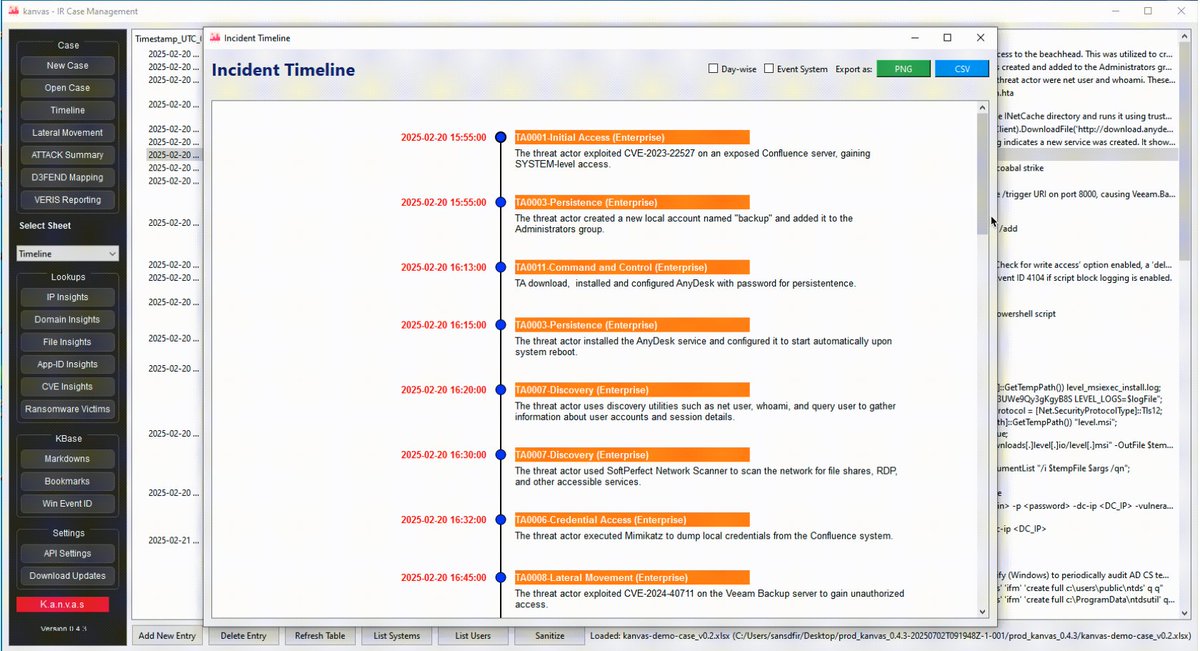
KANVAS is a Python-based IR tool that transforms the "Spreadsheet of Doom" into a unified workspace with attack chain visuals, MITRE mapping, and API lookups.
#KANVAS #IncidentResponse #DFIR #MITRE #ThreatIntel #InfoSec #CaseManagement #SOC #PythonTools
meterpreter.org/kanvas-incid…
2
358

Agno's PythonTools: Path traversal leads to sensitive information disclosure and potential RCE openwall.com/lists/oss-secur…
using self.base_dir.joinpath(file_name) without proper validation. This allows an attacker to traverse the file system to read, write, or execute files.
2
7
791

Jan 11
🤍 Turn Your Computer Files Into a Download Link (Instant Mode) ⚡️🖥️➡️📱
No cables. No apps. No cloud.
Just ONE line of Python code and your folder becomes a live download hub 🔥 only requires installing Python.
🧠 How it works (simple & fast):
You turn a folder on your computer into a local server, then access it from your phone, tablet, or even a smart TV, like opening a website 🌐
⚙️ Quick setup (30 seconds):
1️⃣ Open the folder you want to share
2️⃣ Click the address bar → type cmd → press Enter
3️⃣ Run this magic line 👇
python -m http.server 8888 --bind 0.0.0.0
4️⃣ Run CMD Type "ipconfig"
5️⃣ Copy your IPv4 Address (Wi-Fi section)
6️⃣ On your phone browser, open:
👉 http://YOUR-IP:8888
Boom 💥 folder unlocked.
🚀 What you can do now:
📂 Browse all files in the folder
⬇️ Download instantly
🎬 Stream videos directly
📱 Transfer files phone ↔ laptop
📺 Open files on Smart TV
⚡ Zero uploads, zero delays
🔥 Why this trick is elite:
✔️ No file size limits
✔️ No third-party apps
✔️ Works on Windows, macOS, Linux
This is one of those “once you know it, you always use it” power moves 🧠⚡️
Local sharing, unlocked.
#Python #TechTips #LocalServer #FileSharing #DeveloperLife #CodingTricks #NoCloud #LocalNetwork #ProductivityHacks #DigitalSkills #LearnToCode #PythonTools #TechEducation #SmartWorkflow #DevHacks

11
195

Jan 5
pymongo
Insert documents, query JSON-like data, handle massive collections — perfect for scrapers, pipelines, and data collection systems.
#DataPipelines #PythonTools #AutomationLife #BuildInPublic #BackendFlow #TechCreator

ALT When systems flow, progress feels effortless.
1
3
39

26 Aug 2025
Tired of slow, clunky set operations in Python? 🚀 FastSet by @pisquared is insanely fast, memory-efficient, and built for real-world data chaos. Think native sets… but on caffeine. ☕⚡️ #DataEngineering #PythonTools
2
20

7 Jul 2025
🎥 "𝐀𝐩𝐩𝐥𝐢𝐜𝐚𝐭𝐢𝐨𝐧𝐬 𝐨𝐟 𝐏𝐲𝐭𝐡𝐨𝐧 𝐢𝐧 𝐄𝐜𝐨𝐧𝐨𝐦𝐢𝐜𝐬" by @icce_official @ygesociety
📺 𝐖𝐚𝐭𝐜𝐡 𝐧𝐨𝐰: youtu.be/BH60_7DaTm8
#PythonForEconomics #DataScience #Econometrics #YGES #ICCE #EconomicAnalysis #YoungEconomists #PythonTools #CareerInEconomics
3
5
157

🎥 "𝐀𝐩𝐩𝐥𝐢𝐜𝐚𝐭𝐢𝐨𝐧𝐬 𝐨𝐟 𝐏𝐲𝐭𝐡𝐨𝐧 𝐢𝐧 𝐄𝐜𝐨𝐧𝐨𝐦𝐢𝐜𝐬" by @icce_official @ygesociety
📺 𝐖𝐚𝐭𝐜𝐡 𝐧𝐨𝐰: youtu.be/BH60_7DaTm8
#PythonForEconomics #DataScience #Econometrics #YGES #ICCE #EconomicAnalysis #YoungEconomists #PythonTools #CareerInEconomics
2
4
136

•Always operate within legal and ethical boundaries, and only on systems you are authorized to test
#TelegramScraper #PythonTools #OSINT #TelegramRecon #RedTeamTools #ThreatIntelligence #CyberSecurityTraining #EducationOnly #TelegramSecurity #EthicalHacking #BugBounty
1
5
1,684

22 May 2025
🚀 Fast-track your cybersecurity career with Python for Cybersecurity! Build powerful tools FAST without starting from scratch. 🐍🛡️ 100 tools for vulnerability research, pentesting, & more! 🌟
🔗 Start now: cybersecurityos.gumroad.com/…
#Cybersecurity #PythonTools #CareerAdvancement
6
215

18 May 2025
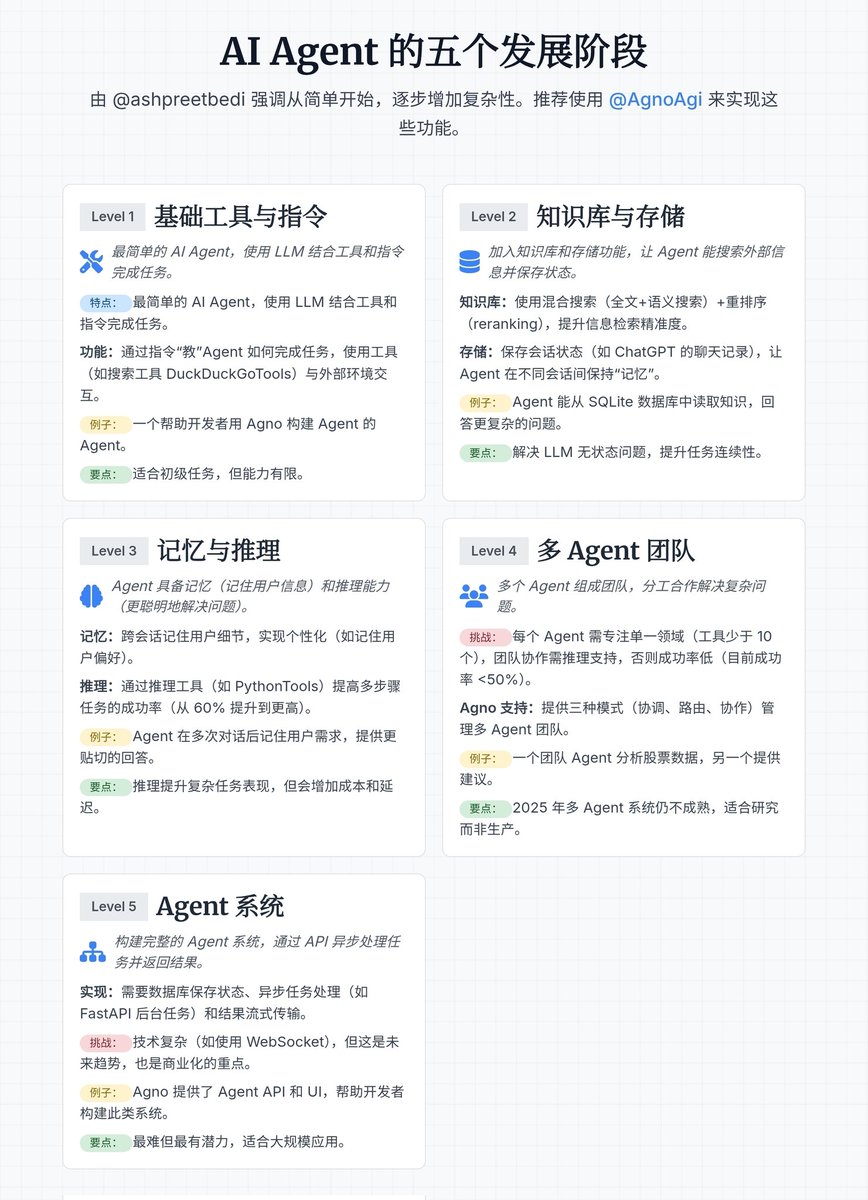
AI Agent 的五个发展阶段 - 从简单到复杂,@ashpreetbedi 强调从简单开始,逐步增加复杂性,并推荐使用 @AgnoAgi 来实现这些功能
Level 1:基础工具与指令
特点:最简单的 AI Agent,使用 LLM 结合工具和指令完成任务。
功能:通过指令“教”Agent 如何完成任务,使用工具(如搜索工具 DuckDuckGoTools)与外部环境交互
例子:一个帮助开发者用 Agno 构建 Agent 的 Agent
要点:适合初级任务,但能力有限
Level 2:知识库与存储
特点:加入知识库和存储功能,让 Agent 能搜索外部信息并保存状态
知识库:使用混合搜索(全文 语义搜索) 重排序(reranking),提升信息检索精准度
存储:保存会话状态(如 ChatGPT 的聊天记录),让 Agent 在不同会话间保持“记忆”
例子:Agent 能从 SQLite 数据库中读取知识,回答更复杂的问题
要点:解决 LLM 无状态问题,提升任务连续性
Level 3:记忆与推理
特点:Agent 具备记忆(记住用户信息)和推理能力(更聪明地解决问题)
记忆:跨会话记住用户细节,实现个性化(如记住用户偏好)
推理:通过推理工具(如 PythonTools)提高多步骤任务的成功率(从 60% 提升到更高)
例子:Agent 在多次对话后记住用户需求,提供更贴切的回答
要点:推理提升复杂任务表现,但会增加成本和延迟
Level 4:多 Agent 团队
特点:多个 Agent 组成团队,分工合作解决复杂问题
挑战:每个 Agent 需专注单一领域(工具少于 10 个),团队协作需推理支持,否则成功率低(目前成功率 <50%)
Agno 支持:提供三种模式(协调、路由、协作)管理多 Agent 团队
例子:一个团队 Agent 分析股票数据,另一个提供建议
要点:2025 年多 Agent 系统仍不成熟,适合研究而非生产
Level 5:Agent 系统
特点:构建完整的 Agent 系统,通过 API 异步处理任务并返回结果
实现:需要数据库保存状态、异步任务处理(如 FastAPI 后台任务)和结果流式传输
挑战:技术复杂(如使用 WebSocket),但这是未来趋势,也是商业化的重点
例子:Agno 提供了 Agent API 和 UI,帮助开发者构建此类系统
要点:最难但最有潜力,适合大规模应用
核心建议
从简单开始:先从 Level 1 开始,逐步增加复杂性
AI 工程即软件工程:保持简单,系统更易管理
工具推荐:使用 Agno(支持记忆、知识、推理等功能),并查看其文档和示例
18 May 2025

The 5 Levels of AI Agents
Lets explore the 5 levels of AI Agents, from simple to complex. Always start with level 1 and add complexity as needed.
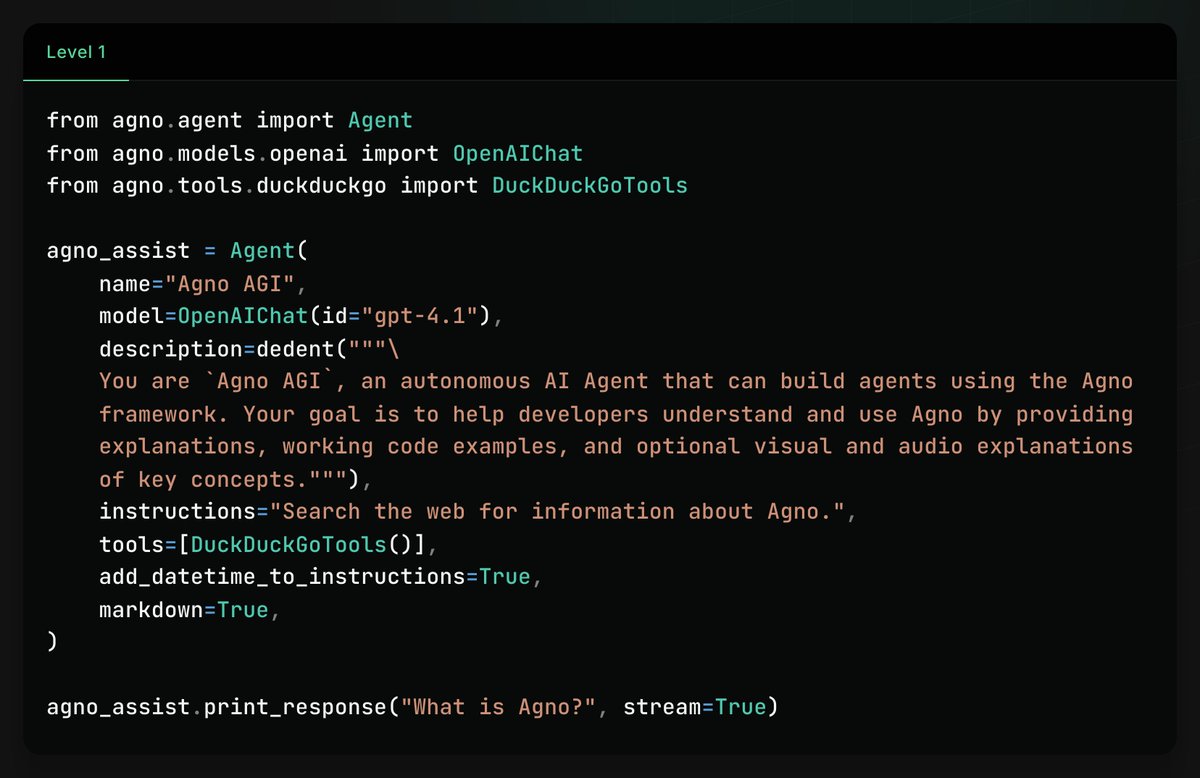
Level 1: Agent with tools and instructions. When people say agents are just LLM tool calls in a loop, this is what they mean (this also tells you their level of understanding).
Instructions "teach" the Agent how to achieve its task and tools let Agents interact with external environments to push or pull data. Here's an Agent that helps developers build Agents using Agno (so clean 🤩)
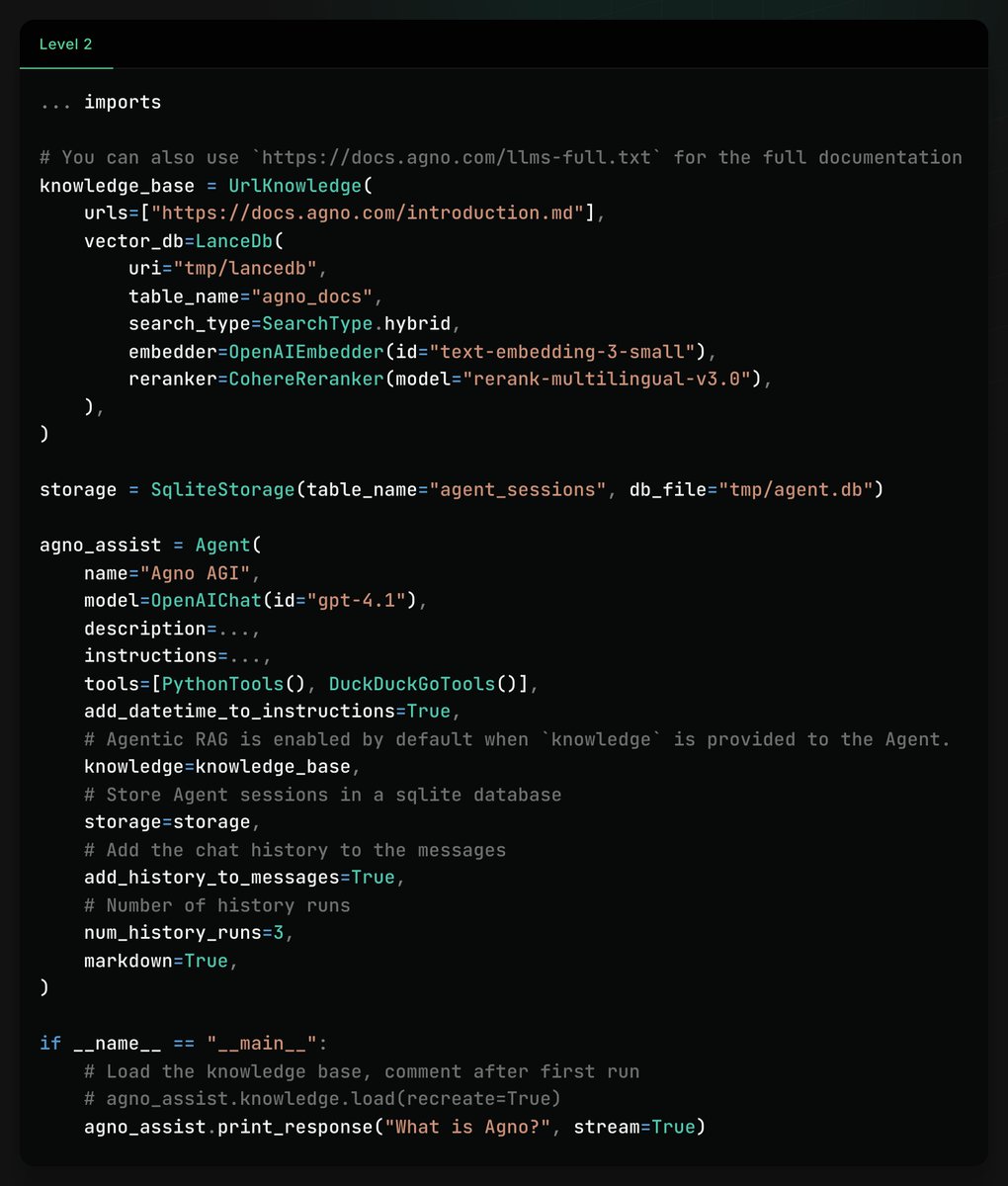
Level 2: Agent with knowledge and storage. Rarely does a model have all the information it needs to achieve its task and we obviously can't jam everything in the context, so we give the Agent knowledge that it searches at runtime (i.e Agentic RAG or Dynamic few-shot).
Knowledge search needs to be hybrid (full-text and semantic). Hybrid search reranking is the best out-of-the-box Agentic Search strategy you can use.
Storage saves the Agent's state in a database. LLM calls are "stateless" and storage makes Agents "stateful" by storing messages in a database and adding them to the current call as needed.
If you're using chatgpt, storage is what lets us continue the chat after closing the tab and each chat thread that you see on the left navbar is a "session" in storage.
Storage also saves the session state (very useful) but that's for another day. Here's how knowledge & storage look like in code:
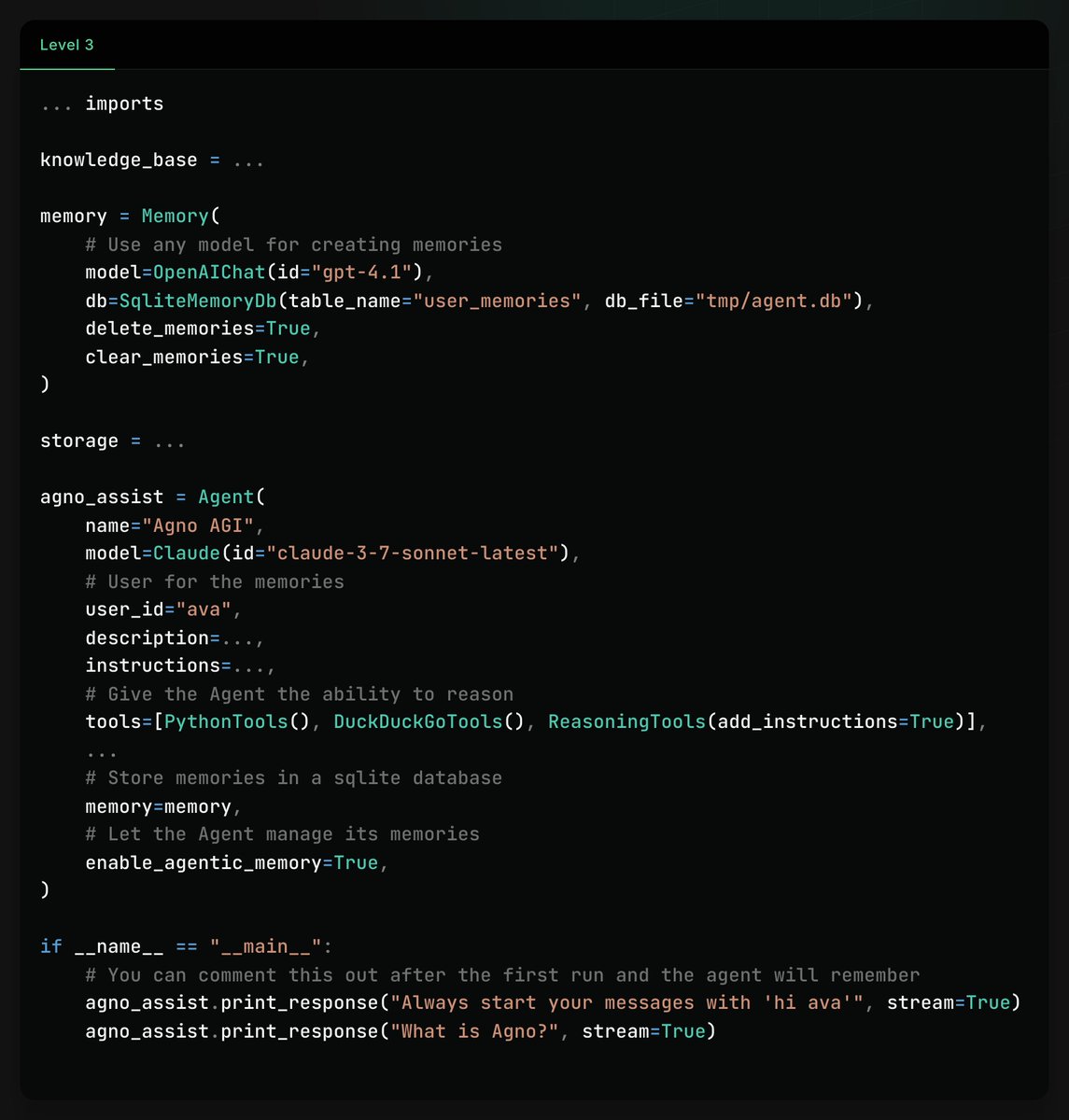
Level 3: Agent with memory and reasoning. Memory let's an Agent remember details about a user and personalize its responses across sessions. This is a fairly new concept that everyone is still exploring. The part of memory im the most excited about is "self-learning", more on this soon.
Reasoning is a key feature that every agent builder should know when and how to use. The biggest problem with Agents is that the success rate of an agent decreases with the number steps the agent needs to take. Eg: if success rate of 1 step is 90%, average success rate of an agent that needs to take 5 steps (across 1000s of runs) is ~60%. This is no good.
Reasoning architectures not only improve cognitive reasoning (understanding of data and instructions) but also improves the success rate of each step. By taking a hit on cost and latency, we can improve the overall performance. Here's how you can add memory and reasoning to an Agno agent:
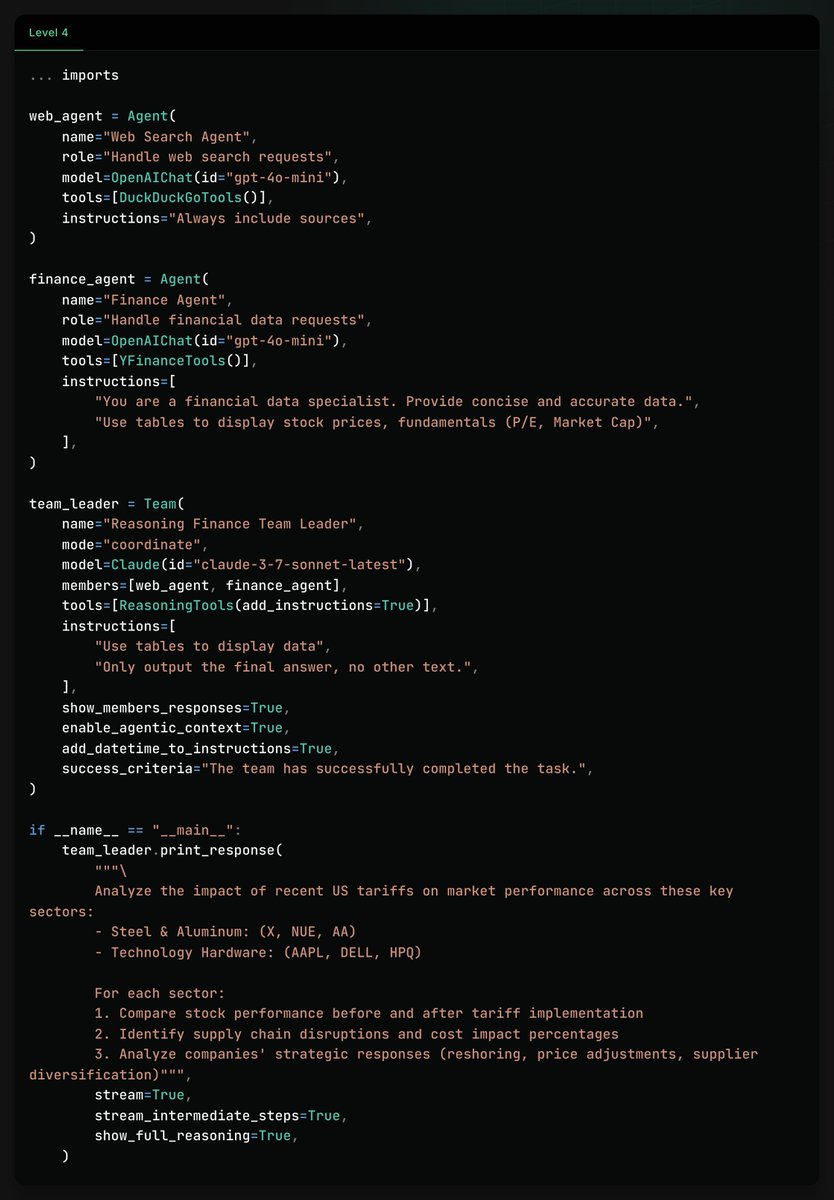
Level 4: Multi Agent Teams. Agents work best when they have a narrow scope (i.e. specialized to a domain) and a reasonably small set of tools (<10 ish). By putting agents together in a team, we can increase the overall capabilities and solve broader, more complex problems.
Remember to add reasoning, otherwise the Team leader struggles to work on complex tasks. Note: my current (2025) belief is that autonomous multi-agent teams don't work. They work <1/2 the time and thats no good.
As models get better and capabilities improve, this is the level im most excited about, but at the moment autonomous multi-agent systems remain an area of research and experimentation only.
Agno comes with an industry leading multi-agent architecture that supports 3 modes of execution: coordinate, route and collaborate with the ability to automatically manage agentic memory and context. Here's an example:
Level 5: Agentic Systems. APIs (i.e. servers) that take in a request, asynchronously and reliable complete the task and stream back the result. These are hard, very hard - when the request comes in we need to save the state in a database and trigger an async job (background task in FastAPI) and stream the results back as they're ready. Websockets can work here, but they are not an each tech to work with.
Agentic systems is where the $ is and what everyone is trying to build. We've put out the Agent API, Agent UI and detailed documentation on how to build them. I hope to write more on this to help AI engineers build better systems.
Thank you for reading, I should probably turn this into a blog post. If you liked reading this, please let me know and consider starring Agno: agno.link/gh
If you're interested in building Agents, you can read more on our docs: agno.link/docs
Final parting words: AI Engineering is Software Engineering. Keep it simple and things become a lot easier.
Thanks,
Ashpreet
4
45
135
27,271

3 May 2025
Ready to use it?
Open-source on GitHub:
👉 github.com/Julianj34/Systemi…
RT & star if you support open quant research 💙
Let the flow guide your trades 🌊📊
#OpenSourceQuant #CryptoAnalytics #PythonTools #GitHub #stockAnalytics
340
1 May 2025
Unlock your cybersecurity potential! 🚀 Check out our beginner's guide, "Python for Cybersecurity: A Beginner's Checklist" loaded with 100 essential tools. Start now: trilltayo.gumroad.com/l/pyth… 🌟 #CyberSecurity #PythonTools
1
5
333
27 Mar 2025
🔒🚀 Unlock Python for Cybersecurity tools! Enhance your security skills with our curated list of 100 tools. Elevate your expertise today! 🔍💡👇 #Cybersecurity #PythonTools trilltayo.gumroad.com/l/pyth…
2
192

24 Mar 2025
Can a Unicode snowman melt my matplotlib chart? ☃️📉
Source: devhubby.com/thread/how-to-u…
#PythonTools #SoftwareDevelopment #PythonCode #DataScienceCommunity #symbols #unicode

4
8
101
13 Feb 2025
🚀 Elevate your cybersecurity skills with Python! Unlock 100 tools for vuln research, pen testing, reverse engineering & more. Discover now: trilltayo.gumroad.com/l/pyth… #Cybersecurity #PythonTools
3
304
21 Jan 2025
Unlock the Future of Cybersecurity with 100 Python tools! 🚀 Build projects faster, without coding from scratch. Join now: trilltayo.gumroad.com/l/pyth… 🔒 #CyberSecurity #PythonTools
2
343
9 Jan 2025
🚀 Hey Security Enthusiasts! Ready to boost your career? 🌟 Check out our "Python for Cybersecurity: Beginner's Checklist" with 100 tools! 🔗 trilltayo.gumroad.com/l/pyth… #CyberSecurity #PythonTools
5
318

7 Jan 2025
Excited to share #smolagents by @huggingface! 🤖 A lightweight library unlocking agentic AI workflows with multi-step agents, tool integration, & dynamic decision-making. Build smarter with ease! 🌟 Start exploring today! 🌐 #AI #MachineLearning #Python #OpenSource #LLM #AIWorkflow #CodeAgents #APIs #Tech #Innovation #DataScience #AIResearch #NLP #Coding #PythonTools #Developers #AIModels #HuggingFace #ToolIntegration #AIProgramming

2
107
26 Dec 2024
Boost your cybersecurity skills effortlessly! 🚀 Discover 100 Python Security Tools for vulnerability research, pen testing & more. Start your journey now: trilltayo.gumroad.com/l/pyth… 🛡️ #Cybersecurity #PythonTools
2
278
24 Oct 2024
🌟 Ready to excel in cybersecurity? Discover over 100 Python Security Tools! 🚀 Perfect for aspiring security engineers & pen testers. Check it out: trilltayo.gumroad.com/l/pyth… 🔒 #CyberSec #PythonTools
4
215