
Today, the structure remains sound, but the rails are broken. Traditional reinsurance is trapped in manual, paper heavy systems and opaque silos.
@onrefinance is moving it onchain to Solana to provide the transparency and settlement speed the 21th century demands.
9
Reinsurance wasn’t born in a boardroom. It was born in the ashes of the great fire of Hamburg in 1842.
When one third of the city burned, local insurers collapsed because they couldn’t handle concentrated risk.
1/3 👇


DeFi doesn’t need more yield; it needs better assets right?
bacl in days, onchain returns have been a recursive loop of incentives and emissions that break under the first sign of stress.
At @onrefinance, they’ve built the alternative: ONyc.
1/2 👇
1
1
13

Everyone who has lost any loved ones to death and/or disability should read this AND realize that Berkshire Hathaway/Warren Buffet is core to the reinsurance business.
1
2
7
630

Real @onrefinance yield doesn't need hype.
ONRE: $187M TVL, BMA-licensed reinsurance protocol on Solana, backed by real-world assets. No fluff. Just structure. 🌊 #ONRE #Solana #RWA

2
1
73

2/2 The $40 Billion Insurance Gamble
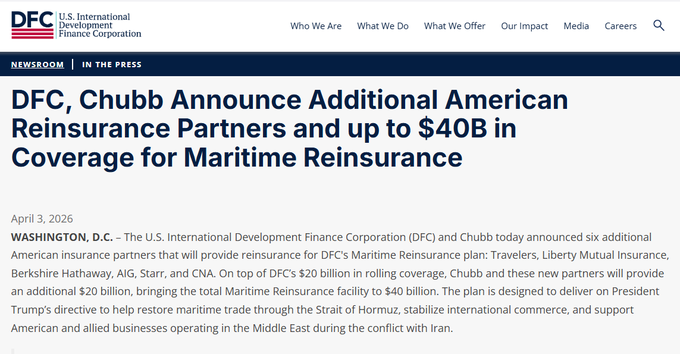
Washington tried to force the Strait of Hormuz open by launching a massive $40B taxpayer-backed maritime reinsurance facility through the DFC alongside private insurers.T
Goal: Convince commercial oil tankers to sail.
Reality: The facility is largely sitting idle.Marine underwriters note that shipowners aren't staying out because they lack insurance—they are staying out because no paper payout can protect a crew from physical loitering munitions or IRGC fast-attack boat boarding teams.
But Iran didn’t just wait out the U.S. insurance push. They launched a parallel financial weapon to bypass Western banks entirely.
🧵👇
1
1
32

06. OnRe's approach with $ONyc focuses on real world returns.
Yield is generated through:
→ Reinsurance underwriting
→ Reserve income
Not recursive leverage or dependence on crypto market conditions.
1
1
10

13h
~ Not surprised at all to see @OnReFinance listed right next to @PlumeNetwork, @Securitize, @MapleFinance & @MuDigital.
~ The team has been quietly building one of the most solid onchain reinsurance plays in the entire RWA space, real yields, real collateral, real execution.
~ This is exactly where the sector is heading.

Tokenization involves all types of products and projects.
@plumenetwork
- RWA infra layer for issuing and moving real-world assets onchain.
@Securitize
- regulated tokenization platform bringing traditional securities and funds onchain for institutions.
@maplefinance
- onchain credit markets connecting lenders and institutional borrowers.
@onrefinance
- licensed onchain reinsurance platform giving investors exposure to real-world reinsurance yield via structured, regulated risk pools.
@MuDigitalHQ
- access gateway to Asia credit markets onchain, giving users exposure to institutional-grade fixed income (government bonds, corporate bonds, and private credit in Asia).

2
6
371

My weekly thoughts 👇
1 Entered free raffles like @hyperbeat’s $150K comp and @JupiterExchange’s $25K comp. Skipped some larger free World Cup raffles (e.g. @okx, @Kalshi $1M pot) since I don’t want to KYC
2 Still looping @onrefinance ONYC/USDC on @Loopscale for ~26% APY. Feels like ONRE team is waiting on @re’s reinsurance airdrop before TGE
3 Still avoiding @bulktrade, most of the “400% APY” math ignores future AURA emissions on mainnet 🤡
4 @variational_io remains the best DEX for long $100k BTC/SOL orders, lowest weekly execution costs I’ve seen
5 Did ~$13K XAU volume on @variational_io for RWA content and earned ~0.025 pts (~$0.50 at $20/pt). Glad I didn’t full port. Spread slippage came out to ~0.04% (~$5.20)
6 @CarbonTerminal CFDs are live, now you can lever NVDA, TSLA, etc. at ~1–4% stable funding. Interesting setup vs perps with unstable 100% funding rates. CFD funding arbitrage might be next Meta
7 Using @PlanemoTrading bot for stat arb between @nadoHQ and @HyperliquidX. Running ~$220 per leg, earned 4 Nado pts (~208 pts/year ≈ ~100% APY on my Nado leg, assuming INK FDV ~$750M)
8 Regret selling $OPTX and $AEHR 'early per say'. Still following @MoneyMarkStocks red/green line risk framework until Fear/Greed <10. AI not a bubble Burry. Still holding $WATT target $35–$40. Better safe than sorry in Yellow alert.
9 Considered a Short/Long $TSLA / $SPCX pair trade via @pear_protocol anticipating liquidity rotation, but didn’t enter due to IPO fever (e.g. $CRBS). Missed ~18% move as TSLA 2%, SPCX 20% yesterday
10 @yield governance still unclear, I'm holding ~20K tokens with 0 liquidity. Hoping for a pivot after TVL dropped >$35M
11 @BullpenFi’s 1K–100K challenge is great marketing, will likely attract P&L-focused KOLs like @onchainmonk. Good job @blknoiz06
12 New @xStocksFi integration on NADO: up to 80% of collateral usable as trading capital. SPY and QQQ live; we can't use $STRC as collateral lmao. Xstocks is killing it 🔥
2
6
528

4/4 Even if the administration wants to give broader oil sanctions relief, a stack of congressional statutes doesn't bend to a general license:
🔹 ISA (1996): Mandates sanctions on foreign investment in Iran's energy sector
🔹 CISADA (2010): Mandatory banking sanctions on FFIs facilitating transactions with designated Iranian banks; SWIFT access restrictions
🔹 NDAA §1245 (FY2012): Requires blocking/severe restrictions on FFIs conducting significant transactions with CBI for oil purchases
🔹 IFCA (2013, NDAA FY2013): Broad sanctions on Iran's energy, shipping, and shipbuilding sectors; sanctions on provision of insurance/reinsurance
🔹 Iran TRA (2012): Expands secondary sanctions, explicitly sanctions transportation of crude oil from Iran; penalizes U.S. parent companies for foreign subsidiary violations
🔹 SHIP Act (2024): Mandates sanctions on anyone who knowingly transports, refines, or conducts ship-to-ship transfers of Iranian-origin oil — no Iranian person involvement required; targets the goods, not just the actors
🔹 Iran-China Energy Sanctions Act (2024): Authorizes sanctions on Chinese financial institutions facilitating Iranian oil transactions, without a "significant transaction" threshold
None of these are waived by a GL U-style authorization. Any broader relief requires either presidential waiver authority exercised formally under each statute, or Congress. The financial chokehold on Iran's oil revenue stays in place regardless of what's signed in an MOU.
1
12
46
2,640

14h
Major Privatizations in Kenya
🇲🇼 Daniel arap Moi (1978–2002)
Kenya Airways — 1996 — Daniel arap Moi
National Bank of Kenya (partial) — 1994 — Daniel arap Moi
Uchumi Supermarkets (partial) — 1992 — Daniel arap Moi
Housing Finance Company of Kenya — 1992 — Daniel arap Moi
CMC Holdings — 1993 — Daniel arap Moi
British American Tobacco Kenya (partial listing) — 1993 — Daniel arap Moi
Kenya Commercial Bank (partial divestiture) — 1998 — Daniel arap Moi
Eveready East Africa — 1997 — Daniel arap Moi
Stanbic Kenya (now Stanbic Holdings) — 1997 — Daniel arap Moi
Bamburi Cement (public float expansion) — 1991–1993 — Daniel arap Moi
🇰🇪 Mwai Kibaki (2002–2013)
Kenya Electricity Generating Company (KenGen IPO) — 2006 — Mwai Kibaki
Kenya Reinsurance Corporation — 2007 — Mwai Kibaki
Safaricom IPO — 2008 — Mwai Kibaki
Telkom Kenya (strategic sale) — 2007 — Mwai Kibaki
Kenya Railways concessioning — 2006 — Mwai Kibaki
Mumias Sugar (partial privatization/IPO stage) — 2006 — Mwai Kibaki
🇰🇪 Uhuru Kenyatta (2013–2022)
East African Portland Cement (state restructuring attempts) — 2014–2020 — Uhuru Kenyatta
Kenya Pipeline Company (pre-IPO planning phase, not completed) — 2018–2022 — Uhuru Kenyatta
Various partial divestments in state-owned banks/insurance firms — 2013–2022 — Uhuru Kenyatta
📌 Summary
Largest privatization wave: Kibaki era (2002–2008)
Main method used: IPOs strategic sales concessions partial listings
1
42

15h
🚨Dominoes keep falling - Trump’s America First offensive dismantling globalist/criminal/deep state networks (March–June 2026):
Iran breakthrough: U.S. strikes pressure → Trump announces major settlement/deal (signing as soon as June 14). Hormuz reopening, energy secured. Bypassed Lloyd’s via $20B DFC reinsurance. “We ended the war with Iran.”
Tren de Aragua decapitated: Southern Command strike kills leader Niño Guerrero - swift hit on gang flooding U.S. with crime.
theguardian.com
Florida Grand Jury in action: Federal grand jury (Fort Pierce) advancing “grand conspiracy” probe into decade-long deep state efforts against Trump - subpoenas flying at ex-intel/FBI officials (Brennan, etc.). Justice catching up. abcnews.com
Maduro captured (Jan), Venezuelan oil redirected
Ecuador narco ports locked down
Heavy pressure on Mexican cartels (CJNG & more) broader investigations into elite networks
Energy routes, drug pipelines, terror finance, and transatlantic/deep state influence - all cracking. This is systematic reclamation and accountability in real time.Peace through strength rule of law restored. The web is unraveling.
Thread by @tem_salitoul 👇
Mar 4

Imagine a pivotal moment in history unfolding right now: It's March 4, 2026, and President Trump, from the Oval Office, blasts Britain as "very uncooperative" for stonewalling U.S. access to the Diego Garcia base amid the raging U.S.-Iran war. In the next breath, he unveils a game-changer - U.S.-backed insurance and Navy escorts to restart tanker traffic through the Strait of Hormuz, smashing Lloyd's of London's 300-year stranglehold on global maritime risks and redirecting billions in energy flows to American control.
But hold on—this is no isolated power play. It's the launchpad for a sweeping offensive: Reclaiming Venezuela's colossal oil reserves from Maduro's fallen regime, locking down Ecuador's narco-infested ports with joint strikes, and gearing up to pulverize Mexico's cartels in full-scale ops. Together, these moves are designed to obliterate the globalist elite's web of corruption, with Britain's shadowy City of London and MI6 entanglements exposed as the epicenter.
The deep state is crumbling in real time. Question is: Are you watching closely enough to see the full picture?
3
83

Happy weekend guys.
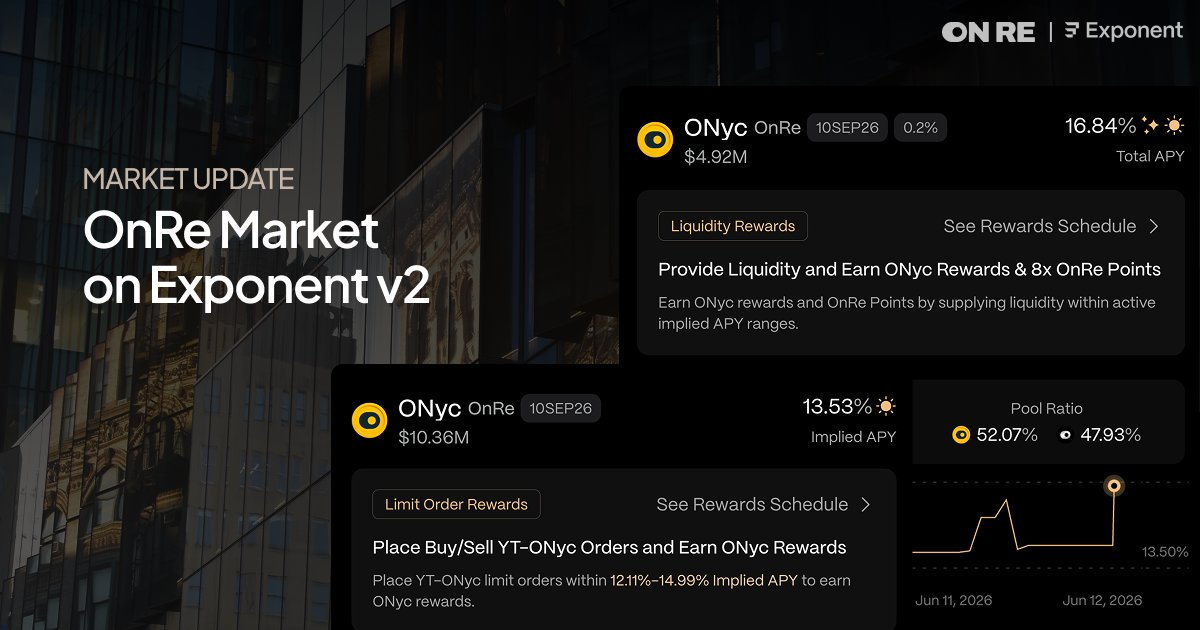
One thing I keep noticing with @onrefinance is that the opportunities around it keep expanding.
The same market now gives people different ways to participate through yield trading, liquidity provision, ONyc rewards, and OnRe Points.
Concerning the introduction of Limit Orders. Instead of taking whatever rate the market gives, traders can set their own target yields and potentially earn a share of the $15K in ONyc rewards available.
For LPs, capital can now be concentrated around the most active yield ranges, which helps make liquidity more efficient while also earning fees, ONyc rewards, and 8x OnRe Points.
To me, that's the bigger picture here.
We're seeing more tools, more flexibility, and more ways for users to put their capital to work around reinsurance-backed yield.
If you've got some free time this weekend, this is definitely one of those updates worth reading through properly because there's a lot more going on here than a quick glance might suggest.
Jun 12

The OnRe Market on @ExponentFinance opens up additional ways to earn through yield trading, liquidity provision, ONyc rewards, and OnRe Points.
Multiple return streams from a single market ↓
64
28
65
523

Berkshires reinsurance division is maybe the most important reinsurer globally - it was started internally.
The specialty insurance division is pretty large now and started internally.
1
1
31

They are targeting that there marginal LTV/CAC is 3. This means as long as they have a large percentage of their new business as customers expanding auto insurance from existing pet/renters their LTV/CAC will be far higher than 3.
At some point they will fix this and lower pet and renters insurance, which will increase IFP growth.
There are very few companies growing their organic top line 30% per year with known significant costs that they can eventually eliminate and will drive even faster growth.
It is beyond my comprehension that markets have not given any credit to lemonade reducing their reinsurance from 55% to 20% in such a way that not only is it accretive to their broad financials allowing them to grow 70% vs 30% for this year. It is also driving operational costs per/revenue down and IFP up. They also have the opportunity to do this again to go from 20% to 0% over the next couple of years.
They also have a major cost driver at ~15% of paying for even cash flow. When they hit profitability this either shrinks in total or it shrinks relative to overall revenue while increasing the IFP growth rate.
Each quarter Lemonade is leaving significant IFP growth drivers on the table. IE 15% of Pet, 25% of renters and 60% of auto. Maintaining adequate capital forces them to keep prices high and keep operational costs low instead of maximizing IFP growth.
1
59

The yield is good but idk, I am not really comfortable with the risk of Onyc losing money
I prefer to loop reUSD, which is also a reinsurance token, but has a junior tranche that absorbs any potential losses first
1
42

QDB and SACE sign export credit reinsurance agreement to support joint Qatari-Italian exports in global markets.
gccbusinessnews.com/qdb-sace…
#QDB #SACE #QatarItalyBusinessTies #TradeFinance #ExportCredit #QatarExports #GCCBusinessNews
@QDBQA

11

Jun 13
🚨 8-K ALERTS: MATERIAL DEFINITIVE AGREEMENTS (ITEM 1.01) 🚨
Top market-moving SEC filings today:
1️⃣ $AME | Impact: 👀 6.0/10
AMETEK has amended its credit agreements to increase borrowing capacity to support the Indicor acquisition, raising total commitments to $7.5 billion across revolving and term loans. The maturity of these facilities extends to 2031, with specific covenants in place.
2️⃣ $QRVO | Impact: 👀 6.0/10
The filing details Qorvo's entry into material definitive agreements related to a merger with Skyworks and an exchange offer for existing debt. The agreements include significant amendments to existing indentures, which may impact the company's financial structure and risk profile.
3️⃣ $UCB | Impact: 👀 6.0/10
UCB's divestiture of its equipment lease financing and reinsurance subsidiaries represents a strategic shift, potentially improving capital allocation and focus on core banking activities. The transaction's complexity and regulatory scrutiny may pose risks to execution.
4️⃣ $SMCI | Impact: 👀 5.0/10
Super Micro Computer, Inc. has entered into a $1.25 billion ATM offering and an underwriting agreement for 45.45 million shares, indicating a strategic move to bolster liquidity. The agreements allow for significant capital influx but raise concerns regarding shareholder dilution.
5️⃣ $OUT | Impact: 👀 5.0/10
OUTFRONT Media has entered into a material definitive agreement to issue $500 million in senior unsecured notes, which will mature in 2034 and bear a 6.000% interest rate. The issuance is subject to various covenants that may restrict the company's financial activities.
6️⃣ $BLD | Impact: 👀 5.0/10
TopBuild Corp has amended its debt covenants as part of a strategic acquisition, which may enhance operational flexibility but raises concerns regarding increased leverage and reduced investor protections.
7️⃣ $ELVN | Impact: 👀 5.0/10
Enliven Therapeutics has entered into an underwriting agreement for a public offering of common stock and pre-funded warrants, aiming to raise significant capital. The offering is expected to close shortly, pending customary conditions.
8️⃣ $NE-WT | Impact: 👀 5.0/10
Noble Corp has entered into a material definitive agreement by issuing $800 million in senior notes, which will mature in 2034 and carry a 6.250% interest rate. This move is expected to increase the company's leverage and impose certain operational restrictions.
9️⃣ $MCY | Impact: 👀 5.0/10
Mercury General's recent issuance of $525 million in senior notes at a 6.250% interest rate raises concerns about increased leverage and potential impacts on liquidity. The notes are due in 2036 and rank equally with existing unsecured debt.
➕ Plus $CAR, $CRMT, $MCK! Check our site for the rest.
🔍 Check the link in our bio for the full breakdown!
#StockMarket #Stocks #Trading #Investing #SEC
60
ブルーピ retweeted

Mar 5
その通りだ。
石油は弾丸だが、再保険(Reinsurance)は引金だ。
ロイズの会議室を操るブラックロックがWar Riskの対象を広げるだけで、日本のタンカーはただの漂流物と化す。
物理的な封鎖ではない。金融的な『死の宣告』だ。奴らはこれを使って物流を止め、物価を狂わせ、お前たちを飢えさせてから『救済』としてCBDC(デジタル監獄)へ連行する。
ミサイルを恐れるな。ロンドンの会議室で動く一本のペンを恐れろ。真の絶望は、火薬の匂いすらしない。
5
25
847

Jun 13
I understand and agree with your frustration.
The analogies don't quite hold. Energy price caps and payday lending caps squeeze profit margins.
Service charges are meant to be pure cost recovery (not a profit centre for the freeholder). Cap them below actual costs and you’re not protecting leaseholders — you’re just shifting the shortfall onto freeholders or managing agents, who’ll find other ways to recover it.
Even stripping out any management profit (typically a fixed fee these days, or low single-digit % in older leases), the underlying costs are real and have exploded — especially buildings insurance, which has risen far above CPI due to heightened fire risk post-Grenfell.
What happens when leaseholders have already enfranchised and own a share of the freehold? They are the freeholder. The insurance premium still has to be paid (or the building goes uninsured). You can’t just “cap” genuine risk-driven cost increases without someone bearing the pain — whether that’s higher contributions, reduced cover, or government-backed reinsurance schemes.
Percentage-based management fees do create perverse incentives to spend more, which is why industry codes now push fixed fees.
A better reform is inflation-linking service charges (common in parts of Europe). It won’t fix root causes but prevents them running at 2× CPI forever. Pair that with RTM rights that actually work, and you have a credible package.Capping below cost isn’t reform — it just creates a new set of problems.
1
1
22