Joint Modeling of Transcriptomic and Morphological Phenotypes for Generative Molecular Design
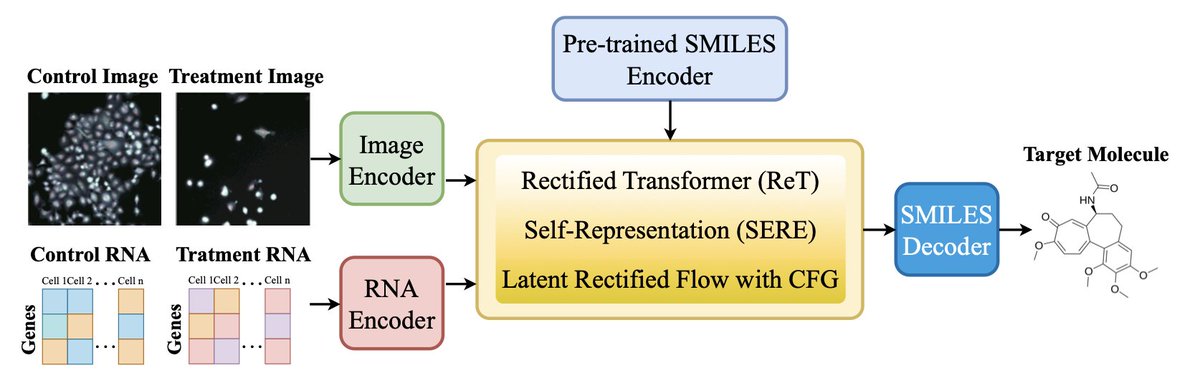
1 Introducing Pert2Mol, the first framework for multi-modal phenotype-to-structure generation that integrates both transcriptomic and morphological features from paired control-treatment experiments to enable generative molecular design.
2 The core innovation lies in using rectified flow instead of diffusion models, achieving 12.4x faster generation with deterministic sampling while maintaining superior quality, as evidenced by a Fréchet ChemNet Distance of 4.996 compared to 7.343 for diffusion baselines.
3 Pert2Mol employs bidirectional cross-attention mechanisms between control and treatment states to capture perturbation dynamics beyond simple differential expression, allowing the model to learn gene-to-gene relationships and morphological changes simultaneously.
4 The framework introduces Student-Teacher Self-Representation (SERE) learning to stabilize training in high-dimensional multi-modal spaces, with ablation studies showing FCD degrades from 4.996 to 6.809 when SERE is removed.
5 The model maintains perfect molecular validity (100%) while achieving 84.7% scaffold diversity, demonstrating appropriate exploration of chemical space without mode collapse that plagued transcriptomics-only methods like TransGEM.
6 Interestingly, the analysis reveals a task-dependent modality preference: RNA-only variants excel at compound identification (highest Tanimoto similarity), but full multi-modal integration is essential for maximizing generative fidelity.
7 Pert2Mol operates in the latent space of molecular autoencoders, conditioning a transformer architecture with adaptive layer normalization and SwiGLU activations on fused multi-modal embeddings from ResNet image encoders and cross-attention RNA encoders.
8 The framework addresses a critical gap in phenotypic drug discovery by enabling systematic translation of high-content screening data into molecular hypotheses, supporting reproducible hypothesis-driven validation through its deterministic generation process.
📜Paper: biorxiv.org/content/10.64898…
#Pert2Mol #GenerativeAI #DrugDiscovery #Chemoinformatics #MultiModalLearning #PhenotypicScreening #Transcriptomics #CellPainting #RectifiedFlow #MolecularDesign
1
1
8
1,285



21 Dec 2025
SDXL x Flux2VAEという試み|NoobAI-Flux2VAE-RectifiedFlow|shiba*2 note.com/gentle_murre488/n/n…
4
35
4,735

8 Jun 2025
この論文でRectifiedFlowに適したODE数値解法として提案されてるRF-Solver、読み進めてなんか雲行き怪しいな?と思ったら結局ただの中点法だった(書かれてる変数を代入するとそうなるが、論文ではそれに気づいておらずむしろ不要にちょっと重い計算をしてる)arxiv.org/abs/2411.04746
15
1,388

3 Dec 2024
Rectified Flow for Structure-Based Drug Design
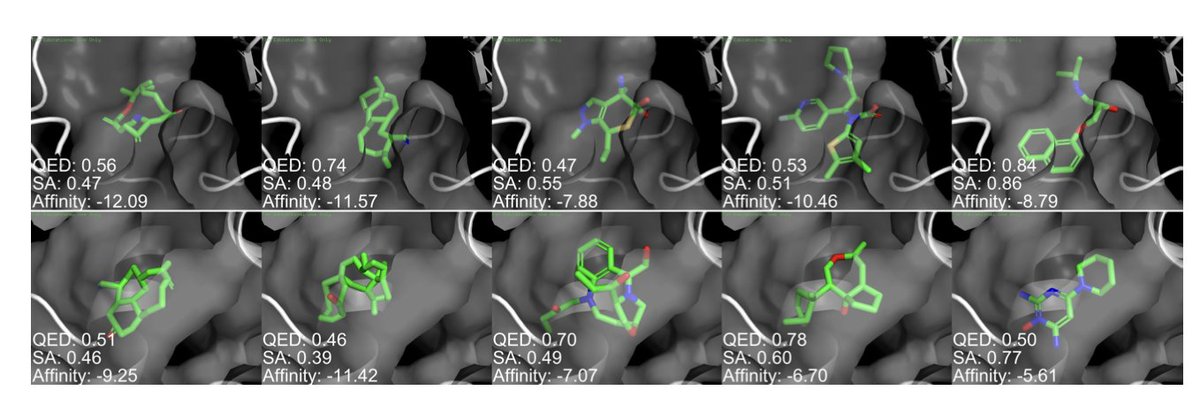
• This study introduces FlowSBDD, a generative framework based on rectified flow models, for structure-based drug design (SBDD). The approach integrates innovative loss functions and flexible prior distributions to improve ligand design for protein pockets.
• A key highlight: FlowSBDD achieves state-of-the-art performance on the CrossDocked2020 benchmark, with an average Vina Dock score of -8.50 and a 75% diversity score, surpassing leading diffusion-based methods like TargetDiff and DecompDiff.
• The framework incorporates a bond distance loss function, which enhances structural accuracy and molecular property prediction. This leads to a 17.6% improvement in QED scores and a 29.4% enhancement in Vina Dock metrics.
• FlowSBDD introduces flexible priors, allowing initialization with non-standard or pre-generated distributions. This capability refines starting conditions for ligand generation, further improving sampling efficiency and binding affinities.
• Compared to autoregressive and diffusion models, FlowSBDD offers faster molecule generation (144 seconds for 100 molecules), reducing computational costs while maintaining high-quality outputs.
• Limitations include underperformance in some binding affinity metrics (e.g., Vina Score). Future work will refine the model’s handling of generated structures and explore theoretical frameworks for prior distribution impacts.
@dz2266
📜Paper: arxiv.org/abs/2412.01174
#DrugDesign #RectifiedFlow #MolecularGeneration #AIinMedicine #ProteinLigandInteraction
1
8
1,026

17 Nov 2024
What a brilliant week for Open Source AI!
Qwen 2.5 Coder by @Alibaba_Qwen - 0.5B / 1.5B / 3B / 7B / 14B/ 32B (Base Instruct) Code generation LLMs, with 32B tackling giants like Gemnini 1.5 Pro, Claude Sonnet
LLM2CLIP from @MSFTResearch - Leverage LLMs to train ultra-powerful CLIP models! Boosts performance over the previous SOTA by ~17%
Athene v2 Chat & Agent by @NexusflowX - SoTA general LLM fine-tuned from Qwen 2.5 72B excels at Chat Function Calling/ JSON/ Agents
Orca Agent Instruct by @MSFTResearch - 1 million instruct pairs covering text editing, creative writing, coding, reading comprehension, etc - permissively licensed
Ultravox by @FixieAI - 70B/ 8B model approaching GPT4o level, pick any LLM, train an adapter with Whisper as Audio Encoder
JanusFlow 1.3 by @deepseek_ai - Next iteration of their Unified MultiModal LLM Janus with RectifiedFlow
Common Corpus by @pleiasfr - 2,003,039,184,047 multilingual, commercially permissive and high quality tokens!
I'm sure I missed a lot, can't wait for the next week!
Put down in comments what I missed! 🤗
10
60
401
55,849

14 Apr 2024
そんな最新手法をガッツリ配合したDeepの怪物ことStable Diffusion、3はもはやDiffusionですらない(RectifiedFlow)のでなんかもうアレ
#Diffusionとは
3
564