
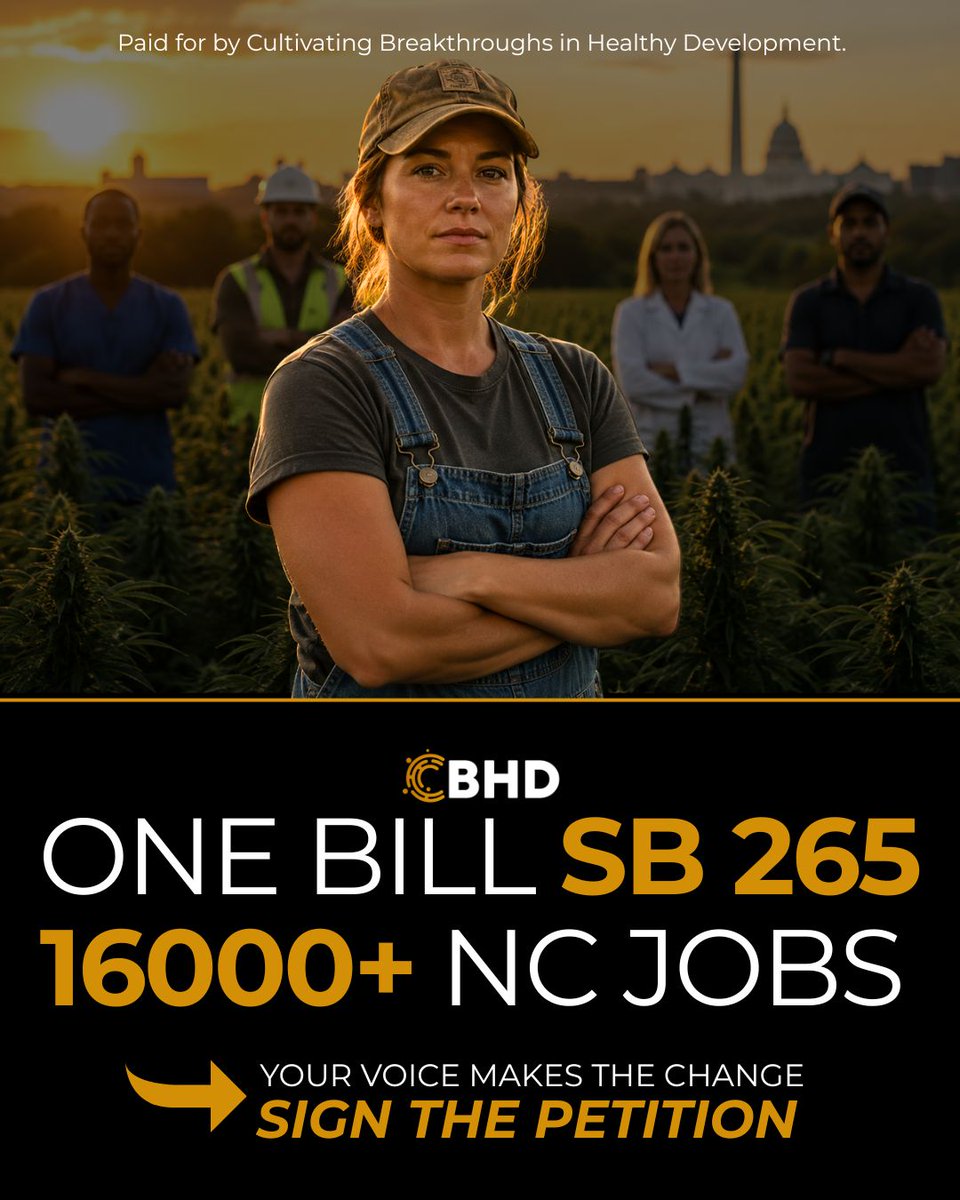
A regulated North Carolina hemp industry means structure, oversight, and accountability. It means treating hemp like a real industry instead of a political talking point.
SB 265 gives North Carolina the chance to build something responsible before uncertainty tears it apart.
The future of this industry should be decided in North Carolina, not just taken away.
Sign the petition at cbhd.news/pages/cbhd-petitio…
#SB265 #NCHemp #RegulateNotBan #FreedomOfChoice #CBHD
10

Mar 20
Be respectful. Be personal. Your story matters.
RT this — every Nassau County consumer needs to see it.
#NewYork #ConsumerProtection #RegulateNotBan #kratum
2
26

Feb 24
Skill-Based Games ≠ Gambling: Law, Policy & the PROGA Fallout
Calling skill-based games:
“gambling” is factually incorrect, legally unsustainable, and economically self-defeating.
What Skill-Based Games Actually Are(Using fantasy sports as illustration):
- Users apply skill and judgment before the event — player analysis, pitch conditions, role selection, and statistical evaluation
- Teams are selected from confirmed players only
- Once the event begins:
Teams are locked
No substitutions, stake changes, or live intervention
This is pre-event application of skill, not wagering on chance.
Platforms are also transparent and auditable:
- All teams become downloadable after contest lock
- KYC-verified users, tax-compliant transactions, audit trails
Illegal betting is the opposite — no KYC, no taxes, no safeguards.
The Law Is Settled:
Indian courts apply one consistent test:
"Where skill predominates over chance, the activity is not gambling."
For over six decades:
- Skill-based games are protected under Article 19(1)(g)
- Courts have repeatedly held rummy, poker, horse racing and fantasy sports to be games of skill
- No Supreme Court judgment has ever classified fantasy sports or legitimate skill-based games as gambling
PROGA 2025 and Constitutional Scrutiny:
PROGA 2025 is under challenge before the Supreme Court.
Serious constitutional concerns arise:
- Article 19(1)(g): Blanket bans destroy lawful trade
- Article 14: Arbitrary treatment — skill games restricted while state lotteries (pure chance) continue
- Article 21: Excessive paternalism without evidence-based harm analysis
- Federalism: Betting and gambling fall under the State List
Under settled law, regulation is preferred over prohibition.
Economic Contradiction:
The Government values India’s online gaming market at:
₹23,200 crore (2024) with
₹31,600 crore projected (2027)
Yet industry data shows:
~85% of revenue historically came from Real Money Gaming (RMG).
After choking RMG:
- Legal platforms shut down
- Payment gateways blocked
- Tax-paying, compliant operators exited
- Legitimate revenue collapsed
This raises a simple question:
- If RMG was the backbone, what exactly is being counted in future growth projections?
The Predictable Outcome
Users did not stop playing — they migrated to:
◆ Offshore platforms
◆ Illegal betting sites
◆ Unregulated operators
Consequences:
◆ No Indian taxes
◆ No consumer protection
◆ Increased fraud and financial harm
◆ Massive underground betting economy
Eliminating regulated RMG did not eliminate gambling.
It only pushed users and money into illegal markets.
Bottom Line:
✔ Skill-based games are not gambling
✔ They are pre-event, skill-driven, transparent, and auditable
✔ Courts consistently protect them
✔ Blanket bans strengthen illegal betting and weaken the State
So, Regulate skill. Punish illegality.
Do not mislabel lawful skill-based games as gambling.
@AshwiniVaishnaw
@GoI_MeitY
#SkillBasedGames #RealMoneyGaming
#RMG
#PROGA
#RegulateNotBan #GamingPolicy
#DigitalEconomy #ConstitutionalLaw
#OnlineGamingAct2025 #DigitalIndia #OnlineGamingRegulation #CyberSecurity
#SafeGaming #ResponsibleGaming
Feb 24

#WATCH | The government has taken a considered decision regarding online gaming regulation.
However, will this Act blur the long-debated distinction between chance-based games and skill-based games?
S. Krishnan, Secretary,@GoI_MeitY, explains.
Watch the full program: youtu.be/Pcy_xQ3rw2k?si=ocRa…
@SecretaryMEITY @MamtaDdnews
#OnlineGamingAct2025 #DigitalIndia #OnlineGamingRegulation #CyberSecurity #SafeGaming #ResponsibleGaming
8
16
1,866

Jan 26
A Utah veteran shares how kratom helps him manage pain—as lawmakers consider new restrictions.
Real people. Real stories.
This is why smart regulation, not bans, matters.
Listen to those impacted. Protect access. 🌿
👉 fox13now.com/good-day-utah/u…
#Kratom #Veterans #RegulateNotBan
1
3
4
569
Jan 22
Why PROGA 2025 raises serious constitutional concerns.
'Thread 1/4'
PROGA 2025 is under challenge before the Supreme Court for violating fundamental rights.
Hearing held on 21 Jan 2026; matter deferred to February.
Key constitutional issues:
• Article 19(1)(g) – Blanket ban on skill-based Real Money Games (RMG) destroys legitimate trade. Games like rummy, poker & fantasy sports are protected where skill predominates.
• Article 14 – Arbitrary classification: skill games banned, while state lotteries (pure chance) continue.
• Article 21 – Excessive paternalism; no evidence-based harm analysis or least-restrictive regulatory measures.
• Federalism – Betting & gambling fall under State List (Entry 34); a nationwide central prohibition raises legislative competence concerns.
Pending adjudication, PROGA presents serious constitutional doubts under settled law.
#PROGAUnconstitutional #RMGBan
'Thread 2/4'
Indian constitutional jurisprudence is clear and consistent:
Here are few cases in which judiciary has passed an order on skill based games.
1. R.M.D. Chamarbaugwala v. Union of India
* AIR 1957 SC 628 *
Held: Competitions where success depends on a substantial degree of skill are not gambling and are protected under Article 19(1)(g).
→ Introduced the “predominance of skill over chance” doctrine.
2. State of A.P. v. K. Satyanarayana
* AIR 1968 SC 825 *
Held: Rummy is mainly a game of skill, involving memory, strategy & judgment.
→ Gambling laws do not apply.
This doctrine has governed the field for over 60 years.
#SkillGames #ConstitutionalLaw
3. Later SC & High Court precedents reinforce the rule
K.R. Lakshmanan v. State of Tamil Nadu
* (1996) 2 SCC 226 | AIR 1996 SC 1153 *
Held: Horse racing is a game of skill; blanket bans are unconstitutional.
4. Varun Gumber v. U.T. of Chandigarh
* 2017 SCC OnLine P&H 5372 | Cri LJ 3827 *
Held: Fantasy sports involve skill, judgment & statistical analysis.
→ Dream11 declared a game of skill; prohibition rejected.
5. Gurdeep Singh Sachar v. Union of India
* 2019 SCC OnLine Bom 13059 *
Held: Fantasy sports are not gambling; protected commercial activity.
6. All India Gaming Federation v. State of Tamil Nadu
* 2023 SCC OnLine Mad 4530 *
Held: Online rummy & poker are skill-based games.
→ Absolute ban struck down as violative of Articles 14, 19(1)(g) & 301.
No judgment till date overrules these principles.
#LegalPrecedents #FantasySports
'Thread 3/4'
Post-PROGA outcomes show regulatory failure:
• As per CUTS International survey data, offshore platform usage rose from 68% to 82%
• User spending increased: 26% now spend ₹5k–10k/month (earlier ~8%)
• Underground betting economy estimated at ₹8.2 lakh crore annually
• 7,800 sites blocked, yet mirror sites reappear within hours
• Influencer-driven promotion via Telegram & Instagram continues unchecked
Meanwhile, state lotteries (pure chance) remain legal.
Result: higher addiction risk, no KYC, no consumer safeguards — harm pushed underground.
#IllegalBetting #BlackMarket
'Thread 4/4'
Economic & employment fallout
Impact so far:
• ₹15,000–20,000 crore annual loss in GST & income tax
• Pre-ban RMG ecosystem contributed ₹20,000 crore in revenue
• 200,000 jobs supported earlier
• 7,000 layoffs, 400 firms shut, 2,000 startups at risk
• $840M investor write-downs
The constitutional answer is regulation, not prohibition:
KYC, spending limits, consumer protection & strict action against illegal operators.
Constitutional scrutiny must favour regulate over ban.
#RegulateNotBan #SaveRMGIndia
#PROGA
#OnlineGamingBill2025
Views expressed are legal-policy analysis. Matter pending adjudication before the Hon’ble Supreme Court.
19 Aug 2025

The online gaming bill deals a knockout punch to the booming real money gaming industry in India
Impact of real money gaming ban in numbers per industry sources ⏬
Loss of Rs 20,000 Crore in annual tax revenues
Rs 25,000 Crore in FDI write off
Loss of Rs 10,000 Crore in annual spends (Ads/Marketing/Services/Consulting)
400 companies may shut down
Loss of 2,00,000 high skilled jobs
50 Crore Indians may be pushed to illegal offshore gambling with 0 tax.
1
9
21
1,639
Jan 22
Why PROGA 2025 raises serious constitutional concerns.
'Thread 1/4'
PROGA 2025 is under challenge before the Supreme Court for violating fundamental rights.
Hearing held on 21 Jan 2026; matter deferred to February.
Key constitutional issues:
• Article 19(1)(g) – Blanket ban on skill-based Real Money Games (RMG) destroys legitimate trade. Games like rummy, poker & fantasy sports are protected where skill predominates.
• Article 14 – Arbitrary classification: skill games banned, while state lotteries (pure chance) continue.
• Article 21 – Excessive paternalism; no evidence-based harm analysis or least-restrictive regulatory measures.
• Federalism – Betting & gambling fall under State List (Entry 34); a nationwide central prohibition raises legislative competence concerns.
Pending adjudication, PROGA presents serious constitutional doubts under settled law.
#PROGAUnconstitutional #RMGBan
'Thread 2/4'
Indian constitutional jurisprudence is clear and consistent:
Here are few cases in which judiciary has passed an order on skill based games.
1. R.M.D. Chamarbaugwala v. Union of India
* AIR 1957 SC 628 *
Held: Competitions where success depends on a substantial degree of skill are not gambling and are protected under Article 19(1)(g).
→ Introduced the “predominance of skill over chance” doctrine.
2. State of A.P. v. K. Satyanarayana
* AIR 1968 SC 825 *
Held: Rummy is mainly a game of skill, involving memory, strategy & judgment.
→ Gambling laws do not apply.
This doctrine has governed the field for over 60 years.
#SkillGames #ConstitutionalLaw
3. Later SC & High Court precedents reinforce the rule
K.R. Lakshmanan v. State of Tamil Nadu
* (1996) 2 SCC 226 | AIR 1996 SC 1153 *
Held: Horse racing is a game of skill; blanket bans are unconstitutional.
4. Varun Gumber v. U.T. of Chandigarh
* 2017 SCC OnLine P&H 5372 | Cri LJ 3827 *
Held: Fantasy sports involve skill, judgment & statistical analysis.
→ Dream11 declared a game of skill; prohibition rejected.
5. Gurdeep Singh Sachar v. Union of India
* 2019 SCC OnLine Bom 13059 *
Held: Fantasy sports are not gambling; protected commercial activity.
6. All India Gaming Federation v. State of Tamil Nadu
* 2023 SCC OnLine Mad 4530 *
Held: Online rummy & poker are skill-based games.
→ Absolute ban struck down as violative of Articles 14, 19(1)(g) & 301.
No judgment till date overrules these principles.
#LegalPrecedents #FantasySports
'Thread 3/4'
Post-PROGA outcomes show regulatory failure:
• As per CUTS International survey data, offshore platform usage rose from 68% to 82%
• User spending increased: 26% now spend ₹5k–10k/month (earlier ~8%)
• Underground betting economy estimated at ₹8.2 lakh crore annually
• 7,800 sites blocked, yet mirror sites reappear within hours
• Influencer-driven promotion via Telegram & Instagram continues unchecked
Meanwhile, state lotteries (pure chance) remain legal.
Result: higher addiction risk, no KYC, no consumer safeguards — harm pushed underground.
#IllegalBetting #BlackMarket
'Thread 4/4'
Economic & employment fallout
Impact so far:
• ₹15,000–20,000 crore annual loss in GST & income tax
• Pre-ban RMG ecosystem contributed ₹20,000 crore in revenue
• 200,000 jobs supported earlier
• 7,000 layoffs, 400 firms shut, 2,000 startups at risk
• $840M investor write-downs
The constitutional answer is regulation, not prohibition:
KYC, spending limits, consumer protection & strict action against illegal operators.
Constitutional scrutiny must favour regulate over ban.
#RegulateNotBan #SaveRMGIndia
#PROGA
#OnlineGamingBill2025
Views expressed are legal-policy analysis. Matter pending adjudication before the Hon’ble Supreme Court.
19 Aug 2025

Knee jerk blanket ban on Online Real Money Gaming without consulting stakeholders or states is another masterstroke by Modi Sarkar in bad policy making.
Here’s why:
Revenue hit: India earns ₹20,000 Cr annually from GST & income tax via online RMG. The ban means states lose this a revenue stream.
Jobs & Startups at risk: 2,000 gaming startups | 2 lakh jobs in IT, AI, design.
A ban kills India’s gaming talent pool & pushes entrepreneurs abroad.
Investments dry up: ₹23,000 Cr FDI in last 5 years. Global investors will pull back if India shuts its own digital industry.
Ecosystem collapse: ₹7,000 Cr spent annually on ads, data centres, sponsorships, cyber security will all be gone overnight.
Unintended consequences:
Bans don’t stop addiction or suicides
Instead, they push users to unregulated offshore platforms worth ₹8.2 lakh Cr annually where Government has no control at all.
Security risks: Unregulated sites ensures money laundering, terror financing, data theft. Even FATF & Rashtriya Raksha University warn against such risks.
Legal mess: The Supreme Court is still deciding whether Centre or States have the power. Why the rush to ban now?
The solution isn’t prohibition.
Probable way forward:
- Regulating skill-based platforms
- Enforcing IT Rules, 2021
- Whitelisting legitimate operators
A well balanced regulation will ensure:
- Jobs Revenue
- Safer users
- National security
- Global innovation
A blanket ban will not only lead to evenue loss, but will give rise to Illegal markets that might threaten national security and of course, there will be a huge innovation setback.
Regulation is the way forward.
11
20
1,225
Jan 21
Why PROGA 2025 raises serious constitutional concerns.
'Thread 1/4'
PROGA 2025 is under challenge before the Supreme Court for violating fundamental rights.
Hearing held on 21 Jan 2026; matter deferred to February.
Key constitutional issues:
• Article 19(1)(g) – Blanket ban on skill-based Real Money Games (RMG) destroys legitimate trade. Games like rummy, poker & fantasy sports are protected where skill predominates.
• Article 14 – Arbitrary classification: skill games banned, while state lotteries (pure chance) continue.
• Article 21 – Excessive paternalism; no evidence-based harm analysis or least-restrictive regulatory measures.
• Federalism – Betting & gambling fall under State List (Entry 34); a nationwide central prohibition raises legislative competence concerns.
Pending adjudication, PROGA presents serious constitutional doubts under settled law.
#PROGAUnconstitutional #RMGBan
'Thread 2/4'
Indian constitutional jurisprudence is clear and consistent:
Here are few cases in which judiciary has passed an order on skill based games.
1. R.M.D. Chamarbaugwala v. Union of India
* AIR 1957 SC 628 *
Held: Competitions where success depends on a substantial degree of skill are not gambling and are protected under Article 19(1)(g).
→ Introduced the “predominance of skill over chance” doctrine.
2. State of A.P. v. K. Satyanarayana
* AIR 1968 SC 825 *
Held: Rummy is mainly a game of skill, involving memory, strategy & judgment.
→ Gambling laws do not apply.
This doctrine has governed the field for over 60 years.
#SkillGames #ConstitutionalLaw
3. Later SC & High Court precedents reinforce the rule
K.R. Lakshmanan v. State of Tamil Nadu
* (1996) 2 SCC 226 | AIR 1996 SC 1153 *
Held: Horse racing is a game of skill; blanket bans are unconstitutional.
4. Varun Gumber v. U.T. of Chandigarh
* 2017 SCC OnLine P&H 5372 | Cri LJ 3827 *
Held: Fantasy sports involve skill, judgment & statistical analysis.
→ Dream11 declared a game of skill; prohibition rejected.
5. Gurdeep Singh Sachar v. Union of India
* 2019 SCC OnLine Bom 13059 *
Held: Fantasy sports are not gambling; protected commercial activity.
6. All India Gaming Federation v. State of Tamil Nadu
* 2023 SCC OnLine Mad 4530 *
Held: Online rummy & poker are skill-based games.
→ Absolute ban struck down as violative of Articles 14, 19(1)(g) & 301.
No judgment till date overrules these principles.
#LegalPrecedents #FantasySports
'Thread 3/4'
Post-PROGA outcomes show regulatory failure:
• As per CUTS International survey data, offshore platform usage rose from 68% to 82%
• User spending increased: 26% now spend ₹5k–10k/month (earlier ~8%)
• Underground betting economy estimated at ₹8.2 lakh crore annually
• 7,800 sites blocked, yet mirror sites reappear within hours
• Influencer-driven promotion via Telegram & Instagram continues unchecked
Meanwhile, state lotteries (pure chance) remain legal.
Result: higher addiction risk, no KYC, no consumer safeguards — harm pushed underground.
#IllegalBetting #BlackMarket
'Thread 4/4'
Economic & employment fallout
Impact so far:
• ₹15,000–20,000 crore annual loss in GST & income tax
• Pre-ban RMG ecosystem contributed ₹20,000 crore in revenue
• 200,000 jobs supported earlier
• 7,000 layoffs, 400 firms shut, 2,000 startups at risk
• $840M investor write-downs
The constitutional answer is regulation, not prohibition:
KYC, spending limits, consumer protection & strict action against illegal operators.
Constitutional scrutiny must favour regulate over ban.
#RegulateNotBan #SaveRMGIndia
#PROGA
#OnlineGamingBill2025
Views expressed are legal-policy analysis. Matter pending adjudication before the Hon’ble Supreme Court.
2
41
66
4,265

Jan 16
Save innocent Indian users! Choose regulation over ban – or IPL/T20 season will bring big troubles. Please reconsider and act now!🇮🇳🙏🏻
#RegulateNotBan #SaveIndianGaming #CyberSafety
3
2
83
Jan 15
Ban pushes everything underground. Better: Regulate legit RMG platforms strictly to protect users, generate revenue & block real crooks.
@MeitYIndia
@cybercrimeindia
@HMOIndia
Time for regulation🙏🏻, not prohibition! #RegulateNotBan #FakeGamingScams #ProtectIndianYouth"
1
1
3
328

Jan 11
We wish the govt applied the same logic to reduced-risk substitutes with risk-proportionate tax instead of prohibition. That would be real welfare maximization. #RegulateNotBan
@PMOIndia @FinMinIndia @MoHFW_INDIA @INCIndia
deccanherald.com/opinion/ind…
4
93

As such, in Bangladesh, where an estimated 35% of adults smoke, banning alternative nicotine products such as e-cigarettes #vapes, could be doing more harm than good for the nation. #RegulateNotBan dhakatribune.com/opinion/edi…
1
5
320

18 Dec 2025
Than why did he JUST say from the oval office on live tv that the polls show 82% in favor? (Of the American people, not his core supporters... I'll give you that.) He also stated he has never been inundated by so many people on an issue like he has with this. And this is for RESEARCH.
You've got bad info. Fake News.
The American Legion, Doctors, Scientists, Senior advocates and many others were with him to sign the direction for rescheduling to #Schedule3.
#SaveAmericanHemp #EducateNOTBan #VeteransforHemp #RegulateNOTBan #SaveHemp #Cannabis #ZARWellness
2
69
16 Dec 2025
Congratulations @CornbreadHemp! And thank you @RandPaul for fighting for the future of American Hemp!
(We appreciate @tedcruz standing with you to try and keep the language out of the funding bill, too! As a veteran owned Texas Hemp company, we fought hard for Hemp in Tx- and now we are back at it nationally!)
#SaveAmericanHemp #EducateNOTBan #VeteransforHemp #RegulateNOTBan #SaveHemp
1
3
63
15 Dec 2025
Why don't more candidates run with this as a BIG part of their platform? Front and Center. Major issue.
It's Time.
#SaveAmericanHemp #Deschedule #Reschedule #EducateNOTBan #VeteransforHemp #RegulateNOTBan #Cannabis #CannabisforAmerica #ZARWellness @hifa_health @TexasHempBiz @txcannaco @HempRoundtable
12 Dec 2025

I'm urging President Trump to listen to the American people & loosen restrictions on marijuana. It’s an economic, medical, & public safety issue.
Reclassifying marijuana is progress, & I'll continue my fight to legalize marijuana & expunge prior marijuana possession convictions.

3
115
15 Dec 2025
On behalf of millions of veterans, seniors. farmers, manufacturers, distributors, retailers, patients, medical professionals, and adult Americans across the country, thank you!! (just to name a few)
#SaveAmericanHemp #Deschedule #Reschedule #EducateNOTBan #VeteransforHemp #RegulateNOTBan #Cannabis #CannabisforAmerica #ZARWellness @hifa_health @TexasHempBiz @txcannaco @HempRoundtable
1
8
153
12 Dec 2025
We are seeing Reefer Maddness 2.0 right now. #MakeItMakeSense Cannabis has been the subject of continual propaganda for almost 90 years!
#ProhibitionDoesntWork #SaveAmericanHemp #ReeferMaddness #EducateNOTBan #VeteransforHemp #RegulateNOTBan
1
3
139
11 Dec 2025
We've got our bid-boy pants on and everything! #WereReady #Deschedule #ProhibitionDoesntWork #SaveAmericanHemp #EducateNOTBan #VeteransforHemp #RegulateNOTBan #SaveHemp
2
14

9 Dec 2025
Side effects of Banning Real Money Gaming started with Teams Jersey branding now reached to Streaming Rights. Next it will affect the viewership of IPL. What do you say?
#fantasy #regulatenotban #proga
1
3
708
4 Dec 2025
We believe that the best way to break the stigma is with education.
#SaveAmericanHemp #EducateNOTBan #VeteransforHemp #SaveHemp #RegulateNOTBan
2
6
4 Dec 2025
If the test for THC was verification of someone being high at the moment of testing, I'd agree with you. But instead it only shows that you've utilized thc in the past MONTH!
Plus, there are non-psychoactive tinctures with THC at levels that CAN'T activate psychoactivity, only the medicinal properties of THC- and edibles that have things like THC-V (doesn't get you high) that provide a calm, clear-headed focus and energy boost people use without psychoactive properties (the high) at all!
Our bodies have a master regulatory system called an Endocannabinoid system. Our bodies are built and have receptors specifically for the Phyto cannabinoids in cannabis. ("Phyto" cannabinoids mean from a plant... your body produces it's own called anandamide which is what you feel during a runner's high or when mothers are nursing- it works in conjunction with oxytocin for bonding.) So it holds onto those beneficial compounds as long as it can.
Develop an "actively high" test for work, and I'm with you!
#SaveAmericanHemp #EducateNOTBan #VeteransforHemp #RegulateNOTBan #SaveHemp #ProhibitionDoesntWork #EndProhibition
1
6
139