Ranjan Kumar Sinha retweeted

Ultimately Qatar had to step in to retrieve the situation. Pakistan just didn't have the heft or credibility that would bring both sides close to an understanding. And the understanding will be signed in Geneva, perhaps because the Europeans also intervened towards the end and promised something tangible to Iran(reuters.com/world/europe/uk-…).
Of course India will have to also introspect, reassess its West Asia and US policy.

الرئيس ترامب يقول : قطر تستحق الثناء ، ويتعين ان ينسب الفضل لها ، والقطريون ساعدونا كثيرا في هذا الاتفاق . علينا أن نفهم ان قطر تقع في وسط كل شيء اكثر من أي دولة أخرى وحتى أكثر من الامارات.
وأضاف ترامب : نحن نحتاج الى الطيران لمدة ساعة ونصف للوصول الى هناك وكذلك الأمر مع السعودية.
بمجرد ان تعبر خطا واحدا تكون هناك. انه في قلب منطقة عدائية بشكل لا يصدق وتحيط به أطراف مختلفة.
وتابع ترامب : لقد قدموا مساعدة هائلة كانت قطر عونا كبيرا جدا في انجاز هذا الأمر واتمنى ان يدرك الناس ذلك ، كانوا شجعانا جداً ، وقائدهم الأمير كان شجاعاً جداً جداً.
#تميم_المجد
#قطر🇶🇦
#ترامب
#ايران🇮🇷
6
8
40
4,762

I hate to break this to you, but the IRGC buried their Uranium at Isfahan, making it impossible to retrieve without at least 2 years worth of work. The other two sites, are the same problem. They did that to protect it. To outlast Trump.
Once he's out of, they'll dig it out.
3

Guys try to retrieve yours and copy inputting it.. when I typed mine did go through... After retrieved... I saw this... Thank Jesus the Christ...

1
12


👑🌷The Princess in the Mirror🪞Simeon: Romantic Rivalry Out Now!
You and your betrothed return to modern-day Japan to retrieve a necklace necessary for your eventual ascension to the throne. However, the trip reveals more rivals for your heart...
#MirPri #otomegame #datingsim

12

After seeing this video, viewers might ask “Why would someone register multiple times in a short period?”
The answer will surprise some:
1st: There’s no limit to how many times a person can register to vote in any block of time. Any change in the registration would be limited to the location of where the outbound mailed ballot would go to.
2nd: The person “assisting” in the unnecessary registration of someone who is already registered is using his address for the receiving of the ballot, knowing that the homeless won’t bother to trek across town to retrieve his ballot. It then falls into the hands of that person. I would bet the County Registrar has records of the same person registering multiple times in a single year, and that almost all of such people are homeless, and that the only change from one registration to the other is the physical address of the outbound ballot that comes from the county. @USAttyEssayli @NathanHochmanDA @FBILosAngeles @RoxanneHoge @jenvanlaar @Johnnydontlike @californiapost

My jaw literally dropped listening to this
Homeless woman in Los Angeles says NGOs come to them and register them to vote 5 TIMES PER YEAR and pay them $25
Multiple people all confirm they register the homeless 4-5x A YEAR EACH and pay them
This is why Democrats made ballot harvesting by 3rd party networks in California legal
They are registering the homeless to vote 5x each, providing the fake name and address information, and then ballot harvesting hundreds of thousands of ballots
1
19
freelanceengineeringservicesllc retweeted

A Common Moorhen (Gallinula chloropus) chick repeatedly begs for food while the attending parent appears to retrieve prey from the water.
At one point, the food seems to be reclaimed and consumed by the adult instead. Was the item dropped by the chick, intentionally withheld, or could the interaction have been part of a broader learning process related to foraging or movement?
#AnimalBehavior
1
4
35
1,288

Without saying anything else, Loki goes to retrieve Pete his requested coffee. When he comes back, he hands it over to the other and leans his hip against the desk.
"You can talk to me about it if you'd like, you know..." He offers, albiet feeling a little awkward doing so.

“ Just . . a really bad day. Sorry. “
Pete rubs the corner of his eyes with rough digits, nodding.
“ Uh— pour me a cup of coffee? Please? Should be ready in the pot. “
27

back, not moving. Sidney: (nearly frozen in shock, rubbing some of the blood from his face, exclaiming) " OH MY GAWD!!!" Carlos: (bending down to retrieve his spear out of Greg's pierced eye, accidentally plucking the eyeball out by mistake, sneering with a grin) "Ooops!
3

i like this paper because it points at a very annoying truth:
maybe the problem is not that agents need to remember more
maybe the problem is that agents need to forget better
most agent memory systems are built like hoarders with an embedding index
save every chat
summarize every session
retrieve whatever looks semantically close
pray the model knows what to trust
then we act surprised when stale facts, compressed details, and half-updated memories quietly rot the agent over time
real deployed agents need memory hygiene, not memory maximalism
write the right thing
retrieve the right thing
use the right thing
forget the right thing
that last part is where a lot of the current discourse is still weirdly allergic

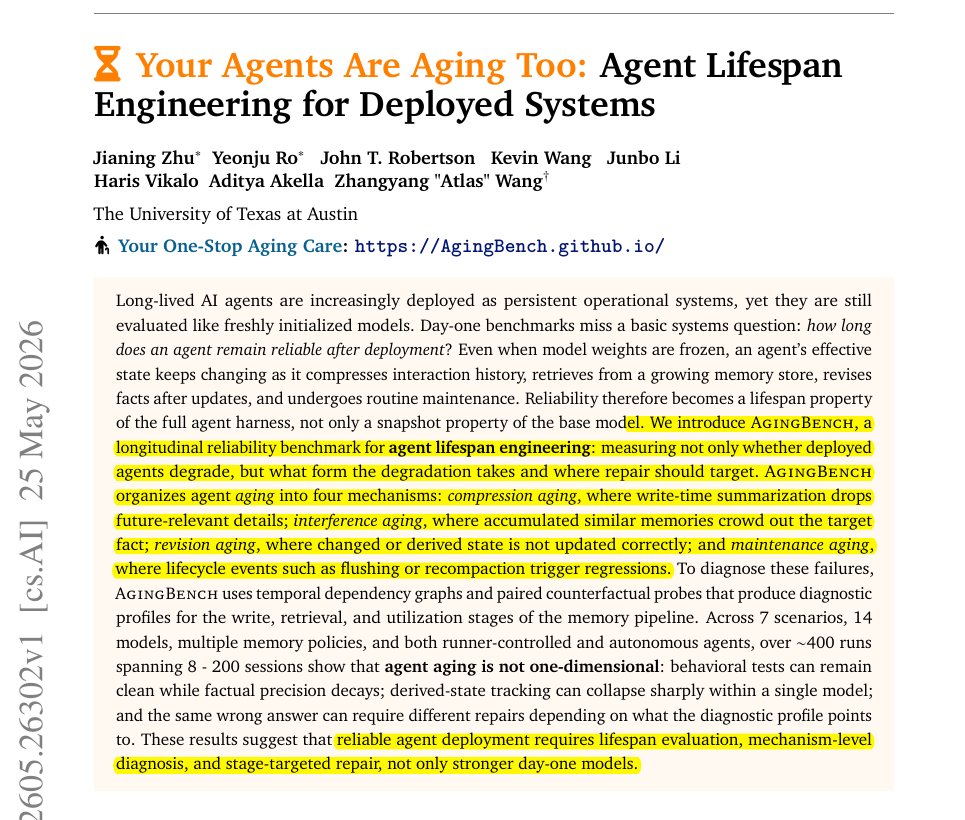
Univ of Texas paper shows AI agents can slowly become less reliable after deployment, even when the model itself does not change.
The problem is that agents are often judged when they are fresh, but real agents keep changing because they summarize old chats, store more memories, update facts, and go through maintenance.
An agent that remembers you across weeks is really a small operating system wrapped around a language model: it writes notes, compresses them, retrieves them, updates them, and occasionally cleans house.
Every one of those steps can quietly rot.
A medication dose can become “a daily medication,” two similar clients can blur into one, a canceled subscription can remain active, and a schedule can vanish after a maintenance pass.
The uncomfortable finding is that the agent may still sound competent while becoming less exact.
The proposed AgingBench, a benchmark that checks whether an agent stays reliable across many sessions instead of only checking one clean starting point.
It studies 4 ways agents age: summaries can drop key details, similar memories can get mixed up, updated facts can stay stale, and maintenance can suddenly break memory.
The deeper lesson is that “give it more memory” is often the wrong repair.
If the fact was never written, retrieval cannot save it.
If the fact was written but crowded out, better summarization will not fix it.
If the fact is present but unused, the problem is not storage but the agent’s decision to trust or ignore what it retrieved.
This paper reframes deployed agents less like static models and more like aging infrastructure.
----
Link – arxiv. org/abs/2605.26302
Title: "Your Agents Are Aging Too: Agent Lifespan Engineering for Deployed Systems"
8

Dear Mirza! I regret the hassle it caused. Please be assured that I'm here to help. However, I won't be able to retrieve the required account details with the tracking ID you provided. Kindly share your registered email address/contact number that was used to place the order and the 21-digits order number via X DM so I can assist you accordingly. - IM
6


Track & Monitor Suspected Cheating Partners
Recover Hacked Social Media Accounts
Retrieve Stolen Passwords & Sensitive Info
#allsocialmediahacking #Snapgod #snaphack #Snapchat #hacked #breachmyeyeonly
⤵️⤵️
t.me/cyber_pass…

1
31

I remember when I went down there early on, as soon as I reached the firelink shrine lmao. I remember being so annoyed by the ghosts 😭 Somehow, I managed to eventually retrieve my souls and get tf outta there 😂
18
Opie 🚂 retweeted

Kind of like locking your keys in the car and then brilliantly smashing the windshield to retrieve them. One for the books.
2
4
125
1,710