
𝗧𝗵𝗲 𝟮𝟮𝟬𝟵 𝗥𝘂𝗹𝗲 𝗿𝗲𝘀𝘁𝗿𝗶𝗰𝘁𝘀 𝗮𝗶𝗿𝘀𝗽𝗮𝗰𝗲. 𝗜𝘁 𝗱𝗼𝗲𝘀𝗻'𝘁 𝘀𝗵𝘂𝘁 𝗶𝘁 𝗱𝗼𝘄𝗻.
This is an important distinction for commercial UAS operators, and one that can get lost in the coverage of this rule.
The proposed framework includes an explicit transit allowance under §74.250. Operators certificated under Parts 91, 107, 108, 135, and 137 retain legal transit rights through UAFR airspace. That's a meaningful industry protection that was not guaranteed going into this rulemaking.
But the transit allowance only protects operators who know it exists.
Here's what commercial operators should be doing now:
𝗔𝘂𝗱𝗶𝘁 𝘆𝗼𝘂𝗿 𝗼𝗽𝗲𝗿𝗮𝘁𝗶𝗼𝗻𝗮𝗹 𝗳𝗼𝗼𝘁𝗽𝗿𝗶𝗻𝘁. If you regularly fly at or near energy facilities, chemical plants, rail infrastructure, or other eligible sectors, identify which of your clients or sites could potentially pursue a UAFR designation.
𝗨𝗽𝗱𝗮𝘁𝗲 𝘆𝗼𝘂𝗿 𝗽𝗿𝗲-𝗳𝗹𝗶𝗴𝗵𝘁 𝘄𝗼𝗿𝗸𝗳𝗹𝗼𝘄. UAFRs will have defined, published geometry, unlike the informal restriction landscape operators have navigated for years. That's actually a clarity improvement, but only if you're checking for them.
𝗨𝗻𝗱𝗲𝗿𝘀𝘁𝗮𝗻𝗱 𝘄𝗵𝗮𝘁 𝗰𝗵𝗮𝗻𝗴𝗲𝘀 𝗮𝗻𝗱 𝘄𝗵𝗮𝘁 𝗱𝗼𝗲𝘀𝗻'𝘁. A UAFR doesn't grant the facility operator authority over your aircraft. Interdiction, jamming, and capture authority are entirely separate policy questions, explicitly outside the scope of this rule.
𝗧𝗵𝗲 𝗰𝗼𝗺𝗺𝗲𝗻𝘁 𝗽𝗲𝗿𝗶𝗼𝗱 𝗰𝗹𝗼𝘀𝗲𝘀 𝗝𝘂𝗹𝘆 𝟲, 𝟮𝟬𝟮𝟲.
The FAA is specifically asking for input on the economic impact to commercial operators if the transit allowance is not preserved in the final rule. That question has a direct answer from the people flying today.
#2209Explained #UAS #FAA #Part107 #commercialdrones #airspace

6

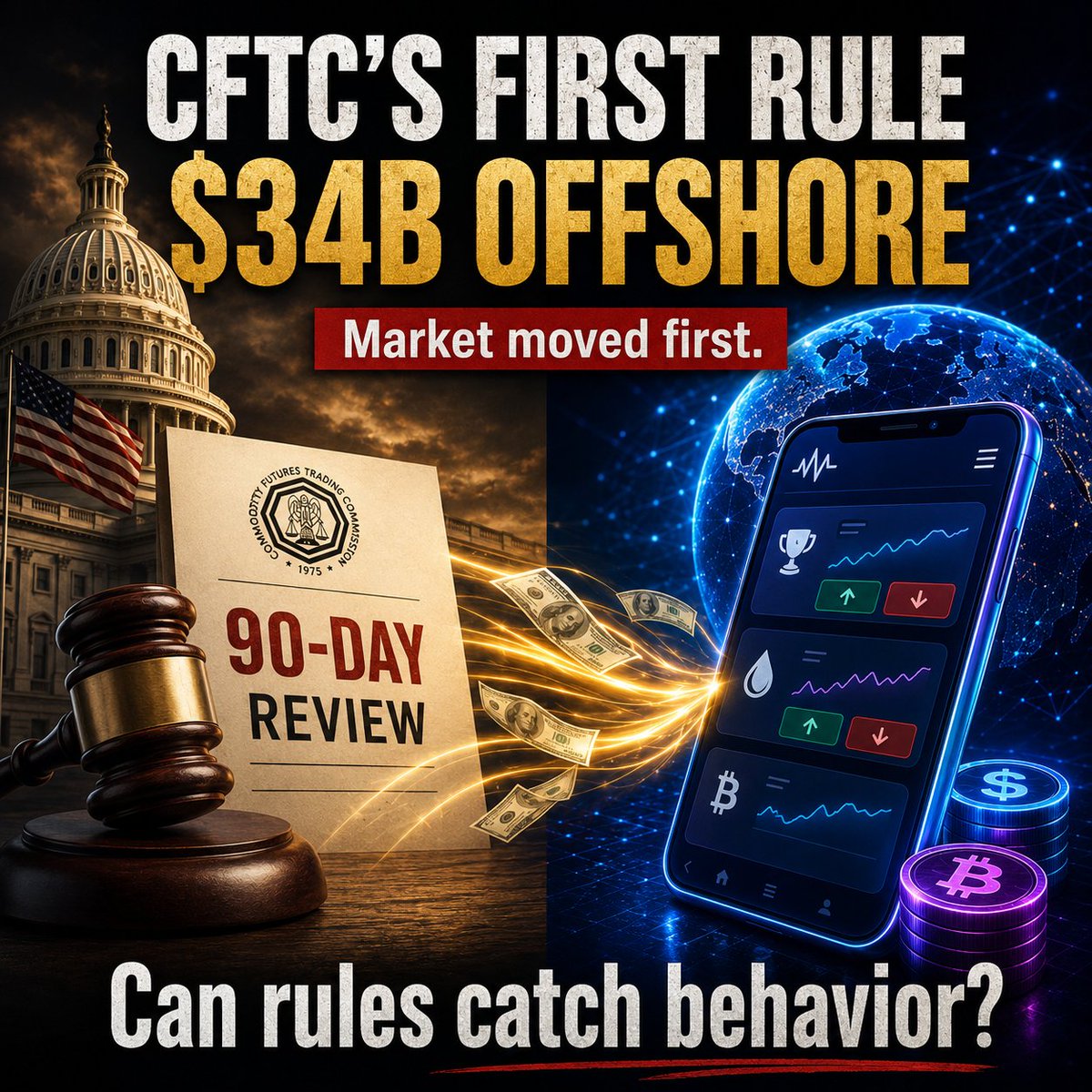
𝗖𝗙𝗧𝗖 𝘄𝗿𝗼𝘁𝗲 𝗶𝘁𝘀 𝗳𝗶𝗿𝘀𝘁 𝗽𝗿𝗲𝗱𝗶𝗰𝘁𝗶𝗼𝗻-𝗺𝗮𝗿𝗸𝗲𝘁𝘀 𝗿𝘂𝗹𝗲. 𝗔𝗺𝗲𝗿𝗶𝗰𝗮𝗻𝘀 𝗮𝗹𝗿𝗲𝗮𝗱𝘆 𝘁𝗿𝗮𝗱𝗲𝗱 $𝟯𝟰𝗕 𝗼𝗳𝗳𝘀𝗵𝗼𝗿𝗲.
A Rutgers study found that Americans accounted for up to $34 billion in offshore prediction-market volume over the twelve months ending April 2026. Not a projection. Actual volume. Harry Crane, a CFTC Innovation Advisory Committee member, ran the numbers — so this is not an anti-regulatory hit job.
CFTC Chairman Mike Selig unveiled his first real framework on June 10: a 90-day review process for whether prediction contracts serve the public interest, with a specific exemption for commercial shipping contracts like Strait of Hormuz oil flows. It is an honest attempt to build a durable structure for an industry that outgrew the rulebook.
The problem: the market already moved. Americans skipped the compliant on-chain platforms that Kalshi and Coinbase-backed built and went straight to Polymarket and others — where products are wider, users are unverified, and the legal exposure falls somewhere else.
The gap between a $34 billion behavioral fact and a 90-day comment period is the actual story. On-chain infrastructure worked as designed. Users chose the unlicensed version anyway.
The bull case for the CFTC framework has real teeth: formal rulemaking with multiple comment rounds is more durable than staff-level guidance, and it would be genuinely hard for a future administration to walk it back. But Polymarket already built the habits, the liquidity, and the product variety. A 90-day review process is not the same as no KYC, global access, and thousands of live markets.
The Coalition for Prediction Markets — Kalshi, , and Coinbase — commissioned the Rutgers study to make exactly this point to regulators. It worked. The number is in the room. Is a $34 billion behavioral fact something regulators can actually change — or is the offshore cat already out of the bag?
1
1
39


How do regulators actually write rules for crypto?
SEC Commissioner @HesterPeirce and Taylor Lindman, Chief Counsel of the Crypto Task Force, answered that and more in our conversation at the @SECGov offices in Washington, D.C.
We cover CLARITY Act rulemaking, lessons from Dodd-Frank, principles-based regulation and navigating the risks of decentralized projects.
If you want to understand how an agency like the SEC works, this episode is for you. I'm enormously grateful to Commissioner Peirce and Taylor for speaking with me and for their continued public service.
Timestamps:
0:00 Intro
1:20 Commissioner Peirce's philosophy on capital markets
5:04 Rulemaking at the SEC
6:48 The SEC's divisions, explained
8:27 How the Crypto Task Force is staffed
10:37 Lessons from Dodd-Frank
13:10 Legal artisans
15:15 The Clarity Act deadlines
18:55 Decentralized intermediaries
20:56 Principles-based vs prescriptive regulation
24:49 Tackling difficult crypto questions
26:23 Leveraging AI for data review
29:46 "Come in and register" under this SEC
33:50 SEC & CFTC collaboration
35:52 Re-engaging the crypto industry
40:00 Crypto Task Force & the Clarity Act
45:54 The SEC's non-crypto priorities
48:41 Avoiding another regulation-by-enforcement era
57:14 Thank you to Sam Enzer, @NYcryptolawyer and @CahillNXT, plus a shoutout to @DayOneLaw & @NickPullmanEsq.
Nothing in this podcast is legal or investment advice.
3
3
10
1,351

3h
🪙 Stablecoin Weekly Report
June 8 – June 14, 2026
───
Week in Brief
This week was defined by a regulatory crescendo: multiple major GENIUS Act implementation comment periods closed on June 9, dragging U.S. stablecoin issuers, state regulators, DeFi platforms, and traditional banks into the sharpest policy collision the industry has seen in years. Simultaneously, the payment incumbents finally showed their hand — reports of a joint Stripe-Visa-Mastercard stablecoin platform rattled Circle's stock and signaled that the turf war over digital-dollar infrastructure has formally begun. Against this backdrop, Tether made a decade-overdue transparency concession by engaging a Big Four accounting firm for its first full audit of USDT reserves.
───
Top Stories
───
1. Stripe, Visa, and Mastercard Reportedly Building Joint Stablecoin Platform
Date: June 8, 2026
Source: fortune.com/crypto/2026/06/0…
Summary: CoinDesk reported, citing three people familiar with the plans, that Stripe, Visa, and Mastercard are co-backing a soon-to-debut stablecoin platform, with Coinbase also evaluating whether to join the venture. The project would leverage each firm's existing infrastructure — Stripe's Bridge acquisition ($1.1B in 2024), Mastercard's BVNK acquisition (~$1.8B in early 2026), and Visa's multi-chain stablecoin settlement pilots already running at a $7B annualized run rate across nine blockchains. The reported platform aims to build programmable settlement, treasury operations, and remittance rails. Circle stock fell approximately 11% on the news and Mastercard and Visa each slipped more than 2%.
Why It Matters: This is arguably the most structurally significant competitive development in stablecoins since Tether's launch. The incumbents that stablecoins were theoretically designed to displace — card networks and payment processors — are now positioning to own the stablecoin infrastructure layer. If the platform materializes, it would bring GENIUS Act-ready compliance, massive merchant acceptance networks, and brand trust to stablecoin distribution in a way that neither Circle nor Tether can replicate organically. The Coinbase-Circle USDC revenue-sharing agreement (up for renewal August 2026) adds particular urgency: a Coinbase pivot toward the consortium platform could materially reduce USDC circulation and erode Circle's reserve-income model.
2. Tether Engages Big Four Firm (KPMG) for First Full USDT Audit
Date: June 9–10, 2026
Source: bitrss.com/tether-signs-big-…
Summary: Tether announced it has engaged a Big Four accounting firm — subsequently identified by multiple outlets as KPMG — to conduct the company's inaugural full financial statement audit of USDT reserves. CEO Paolo Ardoino called it the "biggest ever inaugural audit in the history of financial markets." The engagement goes substantially beyond Tether's existing monthly attestations from BDO, requiring scrutiny of assets, liabilities, internal controls, and reporting systems. The announcement came on the same day Circle's CRCL stock sold off sharply on CLARITY Act draft news, fueling speculation that Tether strategically timed the disclosure to deepen the competitive contrast with its primary rival.
Why It Matters: Tether's transparency deficit has been the industry's longest-running reputational liability. A Big Four audit transforms Tether from a company providing quarterly attestations into one with audited financial statements — a threshold requirement for institutional trust and GENIUS Act acceptance. For the $186B USDT franchise, this removes a major discount factor and shifts the competitive dynamic with Circle: USDC's regulatory head-start narrows if USDT gains the same tier of third-party verification. The timing, coinciding with Tether's USAT push into the U.S. market, signals the company is preparing for full GENIUS Act compliance rather than staying offshore indefinitely.
3. Circle Stock Crashes 20% as CLARITY Act Draft Bans Stablecoin Yield
Date: June 9–10, 2026
Source: bitrss.com/a-new-us-rule-wip…
Summary: Circle Internet Financial (CRCL) saw its stock tumble 22% to approximately $98, erasing $5 billion in market capitalization — its steepest intraday decline since IPO — after leaked draft language from a revised Senate CLARITY Act would broadly prohibit platforms from paying yield "directly or indirectly" on stablecoins or functionally equivalent instruments. The draft sweeps in exchanges, brokers, and their affiliates, closing third-party workarounds. Coinbase also fell roughly 21%. Circle derives approximately 96% of its revenue from interest earned on USDC reserve assets, making the yield prohibition an existential revenue-model threat.
Why It Matters: Stablecoin yield has been one of the primary growth levers for USDC adoption. If the CLARITY Act's final language prohibits all economically equivalent yield arrangements, it eliminates one of USDC's key demand drivers relative to USDT and could suppress demand for U.S.-regulated stablecoins broadly — pushing users toward offshore alternatives. The incident exposes a fundamental policy tension: regulators want to prevent stablecoins from functioning as shadow banking deposits, but overly restrictive yield rules undermine the very competitive proposition that has made GENIUS Act-aligned stablecoins attractive. Even bullish analysts (Berinstein: Outperform, $190 target; Clear Street: Buy, $152 target) acknowledge the draft signals real legislative revision risk to Circle's valuation premium.
4. GENIUS Act Comment Deadline: FDIC Rulemaking Exposes Yield, Custody, and Deposit Flight Battles
Date: June 9–11, 2026
Source: pymnts.com/cryptocurrency/20…
Summary: The FDIC's GENIUS Act implementation framework comment period closed June 9, generating hundreds of submissions on reserve requirements, custody safekeeping, and redemption standards. The FDIC proposal confirms that deposits backing payment stablecoins would not carry pass-through FDIC insurance to token holders. Key conflicts emerged: Consensys argued that legitimate fees and revenue-sharing between issuers and wallet/distribution partners should not automatically be treated as prohibited yield; the National Community Reinvestment Coalition warned that stablecoin growth could trigger deposit flight from community banks that rely on local deposits to fund small-business lending.
Why It Matters: The FDIC final rule — expected July 2026 — will determine the economics of the next-generation dollar. The yield question could structurally disadvantage U.S.-regulated stablecoins if commercial arrangements between issuers and distributors face legal uncertainty, while creating business model clarity would enable the kind of regulated-stablecoin distribution ecosystem the GENIUS Act envisions. The deposit-flight concern is also substantive in the long run: as stablecoin balances scale into the trillions, capital that once funded local lending may migrate to sovereign-debt reserve pools that don't recirculate into community credit.
5. NYDFS Becomes First State to Propose GENIUS Act-Aligned Stablecoin Regulation
Date: June 9, 2026
Source: stablecoininsider.org/nydfs-…
Summary: The NYDFS proposed regulation on June 9 to qualify New York as the first state meeting Treasury's "substantially similar" certification standard under the GENIUS Act. The proposal preserves New York's 2022 framework — 1:1 dollar backing, redemption at par, permissible reserves, independent audits — while adding: custodian concentration limits, monthly CEO/CFO reserve certification, annual internal-controls attestation by a registered public accounting firm, and for issuers over $25B outstanding, a floor of 0.5% of reserves (capped at $500M) in insured deposits. A maximum two-business-day redemption deadline is also codified.
Why It Matters: Treasury certification as a "substantially similar" regime allows New York-licensed issuers under $10B in circulation to remain under state rather than federal oversight. This preserves NYDFS jurisdictional authority over a sector it has dominated since becoming the first major regulator to license stablecoin issuers. New York's early move signals the beginning of a state-level standards race, and the concurrent NYDFS-EBA memorandum of understanding (signed June 2) positions New York-licensed issuers for smoother EU market access under MiCA — a meaningful cross-border advantage.
6. Hyperliquid and Paradigm Push Back on FinCEN's Secondary-Market Compliance Reach
Date: June 10, 2026
Source: blockchain.news/news/hyperli…
Summary: In a joint comment letter to Treasury, Hyperliquid and Paradigm challenged FinCEN's requirement for permitted payment stablecoin issuers (PPSIs) to freeze, block, or reject transactions violating U.S. law across both primary and secondary markets. The letter argued that requiring issuers to police permissionless blockchain environments is impractical — smart contract interactions can trigger sanctions liability even when issuers have no relationship with the counterparties. They called for a "narrow and clear" secondary-market framework, warning that broad rules would drive U.S.-regulated stablecoins out of DeFi entirely and cede the space to offshore alternatives.
Why It Matters: The DeFi secondary-market question is the most consequential unresolved issue in the GENIUS Act rulemaking. If FinCEN imposes broad secondary-market compliance obligations on stablecoin issuers, U.S.-regulated stablecoins become structurally incompatible with permissionless DeFi — the fastest-growing use case for dollar liquidity. Offshore issuers with no U.S. regulatory obligations face no such friction, creating a structural incentive to route DeFi volume toward foreign-issued tokens. With the January 2027 full-compliance deadline looming, the final rule must be issued in 2026, making the coming months critical for determining whether U.S. stablecoins can remain competitive in decentralized markets.
7. Circle Mints $3.25B USDC on Solana in a Single Week; Network Reaches Record 10.3% of Global Supply
Date: June 8, 2026
Source: solanacompass.com/news/solan…
Summary: Circle minted $500 million in USDC on Solana in two tranches on June 8, pushing the network's share of global USDC supply to 10.3% — a new all-time high. The week ending June 14 saw approximately $3.25 billion in total USDC issuance on Solana, the largest weekly stablecoin mint of 2026. Multiple subsequent mints ($1B on June 12, $250M on June 14) extended the run. USDC now represents over 51% of total stablecoin liquidity on Solana, with the network's stablecoin market at ~$15.2 billion. Meanwhile, Ethereum's USDC allocation contracted 1.48% in the same period.
Why It Matters: Solana's stablecoin infrastructure has crossed the threshold from narrative into genuine institutional plumbing. The minting activity reflects real demand driven by Mastercard's always-on stablecoin settlement on Solana, Pump.fun's USDC pairs for token launches, and growing DEX and lending market depth. This demonstrates that stablecoin issuance is increasingly chain-agnostic and demand-driven: when institutional settlement or DeFi activity concentrates on a network, authorized mints follow. Solana's rise signals that the monoculture era of Ethereum/TRON stablecoin dominance is giving way to multi-chain liquidity distribution — with implications for chain economics, validator revenues, and the competitive positioning of Ethereum-centric stablecoin infrastructure.
8. Tether Freezes $72M USDT After Suspicious Tron Activity Spikes Monero Price
Date: June 11–12, 2026
Source: cryptoadventure.com/tether-f…
Summary: Tether blacklisted a Tron-based address holding $72 million USDT on June 12, following on-chain activity flagged by ZachXBT. A Tron wallet received 120.2 million USDT and rapidly dispersed funds — routing over $12M to KuCoin, $8M through instant exchange services, and ~$8M from Tron to Bitcoin and Ethereum via Near Intents. The same entity placed large Monero buy orders, driving XMR from $330 to an intraday high near $438. Tether acted within hours. The freeze follows a broader pattern: approximately $515M frozen across Ethereum and Tron addresses over the prior 30 days.
Why It Matters: This event illustrates the dual-use nature of USDT at scale. Tether's ability to freeze $72M within hours of suspicious activity demonstrates centralized-issuer compliance capability in practice — relevant to the FinCEN/OFAC PPSI rulemaking debate. However, once value transits from USDT into Monero, it becomes substantially harder to trace, highlighting the limits of primary-issuer surveillance. For regulators designing secondary-market compliance obligations, this case shows why targeting chokepoints (exchanges, bridges) where relationships are known is more effective than imposing blanket secondary-market freeze obligations on issuers who have no relationship with end counterparties.
9. Federated Hermes Launches GENIUS Act-Ready Money Market Fund for Stablecoin Reserves
Date: June 12, 2026
Source: crypto.news/federated-hermes…: Federated Hermes launched the Federated Hermes Money Market Management Digital Treasury Fund (ticker: OFFXX), a Rule 2a-7-compliant money market fund structured to qualify as a permissible reserve asset for payment stablecoin issuers under the GENIUS Act. The fund invests exclusively in U.S. dollar cash, Treasury securities with maturities of 93 days or less, and overnight repurchase agreements backed entirely by Treasury securities — meeting the GENIUS Act's 1:1 high-quality liquid asset requirement while providing issuers with income generation and compliance-grade documentation.
Why It Matters: The Federated Hermes launch signals that traditional asset management infrastructure is actively re-routing toward the GENIUS Act compliance ecosystem. With final implementation rules expected in July 2026, demand for reserve-focused products designed around eligible asset classes is materializing. The stablecoin reserve pool backing ~$316B in outstanding tokens is enormous: Tether alone holds $155B in U.S. Treasury bills, making it one of the world's largest T-bill holders. A purpose-built money market fund simplifies compliance documentation for smaller issuers, creates a revenue opportunity for traditional asset managers, and deepens the structural connection between stablecoins and the short-duration sovereign debt market — reinforcing the policy argument that stablecoins are becoming a systemically important channel for Treasury demand.
10. Ripple and Bitso Deploy MXNB on XRPL to Enable Institutional U.S.-Mexico Stablecoin Settlement
Date: June 12, 2026
Source: coinedition.com/ripple-and-b…
Summary: Ripple and Bitso announced the integration of MXNB — Bitso's Mexican peso-backed stablecoin — onto the XRP Ledger's permissioned DEX alongside RLUSD, providing institutional counterparties regulated on-chain liquidity for the U.S.-Mexico cross-border corridor. MXNB is designed as GENIUS Act-ready and enterprise-grade, with peso-native backing built for institutional settlement. Ripple also launched the XRPL AI Starter Kit, enabling AI agents to autonomously manage XRP and RLUSD payments.
Why It Matters: The MXNB/RLUSD integration demonstrates how the GENIUS Act framework is enabling regulated cross-border settlement infrastructure outside the U.S. dollar-only stablecoin paradigm. Rather than relying on correspondent banking and multi-day settlement, institutions gain on-chain peso liquidity with same-day finality. The U.S.-Mexico remittance corridor handles tens of billions annually, and stablecoin routing capture here would represent significant volume. More broadly, this development illustrates the frontier for dollar-adjacent stablecoins: local-currency stablecoins paired with regulated USD rails can address settlement friction in key emerging-market corridors in ways USDT and USDC alone cannot. Latin America is emerging as one of the most active proving grounds for institutional stablecoin payment infrastructure.

196

“The U.S. government just created a de facto kill switch for frontier AI security tools, without the scientific process its own AI cybersecurity order promised.”
That framing is harder to dismiss. It is not anti-safety. It is pro-process, pro-defense, and pro-American AI leadership.
A key factual anchor: Anthropic says the U.S. directive suspended access to Fable 5 and Mythos 5 by any foreign national, including people inside the U.S. and Anthropic’s own foreign-national employees, and that the practical result was disabling the models for all customers. Anthropic also says the government did not provide specific details, and that the observed issue appeared to involve a narrow, non-universal jailbreak identifying previously known minor vulnerabilities that other public models could also find.
The strongest missing angle
The most devastating point is not just “defenders lost access.”
It is this:
Ten days earlier, the White House’s own executive order said frontier-model engagement should be voluntary and should not create mandatory licensing, preclearance, or permitting for model release. Then the government used export-control authority to force a shutdown anyway.
That is the cleanest “gotcha,” because it uses the administration’s own words. The June 2 executive order calls for a voluntary framework where developers can provide access for up to 30 days before release, and it explicitly says nothing in that section authorizes mandatory licensing, preclearance, or permitting for AI model development, release, or distribution.
A sharper version of your post should include this sentence:
The issue is not whether frontier AI cyber capability deserves scrutiny. It does. The issue is that the government promised voluntary, technical, pre-release collaboration, then used an opaque emergency export-control directive as a post-release kill switch.
That line turns the post from “industry complaint” into “rule-of-law national-security process critique.”
Important factual caveat
Double-check “Over 60.” The version of the letter I could access lists signatories from Alex Stamos through Josh Yavor, and I count roughly the mid-50s, not over 60, though the number may be changing as people add names. The page does invite additional signatures through a form, so it may update.
Safer phrasing:
Dozens of American cybersecurity experts and executives…
or:
More than 50 American cybersecurity experts and executives…
Use “over 60” only if you have a fresher count than the parsed page.
Best upgraded version
Dozens of American cybersecurity experts and executives have signed an open letter asking Commerce Secretary Howard Lutnick and National Cyber Director Sean Cairncross to lift the export-control directives on Anthropic’s Fable and Mythos models — and, more importantly, to replace ad hoc model bans with a transparent, scientific process.The point is not that these models are harmless. Mythos is very good at finding software flaws and producing exploit paths. But that capability is not unique to Anthropic. Comparable cyber-assistance capabilities exist across frontier models and increasingly capable open-weight systems. Pulling one American tool away from defenders does not make adversaries less capable; it just makes defenders slower.Fable is the more revealing case. It was supposed to be the safeguarded version of Mythos. Anthropic says its protections were strong enough that users complained they were overly broad, and that no tester had found a universal jailbreak before the shutdown. The alleged trigger appears to have involved a narrow method for eliciting analysis of previously known, minor vulnerabilities — the kind of insecure-code identification that secure software development actually requires.That distinction matters. “Can this model recognize insecure code?” is not the same question as “Does this model create a novel offensive capability?” If a model cannot identify vulnerable code, it cannot reliably help developers write secure code.The letter asks for the obvious baseline: scientific evaluation criteria developed with industry and academia, proper rulemaking, transparent enforcement, fair time to remediate, and proportionality. That should be the floor for any serious AI cyber policy.Ten days before the shutdown, the White House’s own AI cybersecurity order called for voluntary collaboration with frontier-model developers and explicitly disclaimed mandatory licensing or preclearance for model release. The Fable/Mythos order looks like the opposite: a de facto model kill switch, applied without public criteria, technical transparency, or a cross-provider standard.If the standard is “a safeguarded model has a narrow jailbreak,” no frontier model survives. If the standard is “a model can identify insecure code,” then we have confused the smoke detector with the fire.
Even sharper short version
Dozens of American cybersecurity leaders signed an open letter asking Commerce and the National Cyber Director to lift the Fable/Mythos export-control directives.This is not a “no AI regulation” letter. It is a “do not regulate frontier cyber tools by opaque kill switch” letter.Mythos is strong at vulnerability discovery and exploit development. So are other frontier systems. Fable was the safeguarded version, and Anthropic says the issue that triggered the order was narrow, non-universal, and involved previously known minor vulnerabilities that other public models could also find.The original capability at issue — identifying insecure code — is not inherently offensive. It is how secure software gets written.If the government wants to regulate AI cyber capability, it needs scientific evals, rulemaking, transparent enforcement, time to remediate, and proportionality. Otherwise the U.S. is not reducing adversary capability; it is just taking tools away from defenders first.
“Genius-level” repositioning
The current draft says:
The controls pulled capable tools from defenders while adversaries keep advancing.
Good. But the deeper strategic claim is:
Cybersecurity is a race between patch latency and exploit latency. Any policy that slows defenders more than attackers is a vulnerability multiplier.
That is a much more sophisticated frame. It gives the audience a mental model.
Use this:
The relevant national-security question is not “can the model help find vulnerabilities?” Of course it can. The question is whether restricting access reduces attacker capability more than it increases defender patch latency. If the answer is no, the control is negative-security regulation.
That phrase — negative-security regulation — is strong. It names the failure mode.
Missing technical-policy elements
You should add a concrete alternative to the shutdown. Right now the argument says “lift the controls,” but the stronger move is “replace the controls with a better control architecture.”
Suggested policy package:
1. Immediate emergency general license for verified defenders.
Allow access for U.S. critical infrastructure operators, cleared vulnerability researchers, vetted cybersecurity firms, and trusted allied entities while review continues.
2. Classified technical annex, unclassified public summary.
The government can keep exploit-sensitive details classified, but it should still publish the category of risk, evaluation method, remediation demand, affected capability class, and why narrower mitigations were insufficient.
3. Cross-provider standard.
No single-company action unless the same technical threshold is applied across Anthropic, OpenAI, Google, xAI, Meta, Mistral, Moonshot, DeepSeek, Alibaba, and hosted open-weight providers. Otherwise it looks arbitrary.
4. Remediation window.
For non-catastrophic issues, require notice and a short fix period before model removal. Reserve immediate suspension for reproducible, high-severity, novel offensive uplift.
5. Sunset clause.
Any emergency model restriction should expire automatically unless renewed with a written technical finding.
6. Appeals path.
A provider should be able to challenge the finding before an interagency technical panel with outside cleared experts.
7. Defender-harm assessment.
Before restricting a model, the government should quantify who loses defensive access: critical infrastructure, hospitals, banks, software supply-chain teams, vulnerability researchers, federal contractors, and incident responders.
A strong line:
Any AI cyber restriction should require two findings, not one: that the model creates meaningful attacker uplift, and that the proposed restriction reduces attacker capability more than it slows defensive remediation.
The best “obscure thought inputs”
These are the deeper ideas that make the post feel much smarter.
The “stethoscope problem.”
A tool that detects disease can also teach you where disease exists. That does not make stethoscopes bioweapons. Likewise, a model that identifies insecure code can help attackers, but it is also foundational to secure engineering.
Line:
Treating vulnerability identification as inherently offensive is like treating a stethoscope as a pathogen.
The “capability conservation law.”
Export controls do not erase capability. They move capability to the actors least constrained by U.S. rules.
Line:
Model restrictions do not destroy cyber capability. They redistribute it toward actors with the fewest compliance obligations.
The “patch latency” frame.
In cyber, hours and days matter. Taking a model away from defenders creates real exposure even if attackers are only marginally slowed.
Line:
In cyber, delay is not neutral. A week of slower patching is an attack surface.
The “benchmark-to-ban pipeline.”
A model should not be banned because it performs well on a vaguely defined benchmark or one scary demo. There must be reproducible, comparative, adversarially validated evidence.
Line:
We cannot build a benchmark-to-ban pipeline where one private demo becomes national AI policy.
The “universal jailbreak standard” trap.
If every model is vulnerable to some narrow jailbreak, then using that as a recall standard effectively bans frontier deployment.
Line:
If the standard is “no narrow jailbreaks,” the standard is really “no frontier models.”
Anthropic made a similar point, saying perfect jailbreak resistance is likely not currently possible for any provider and that applying this standard broadly could halt new deployments across frontier providers.
The “defense tooling paradox.”
The more useful a model is for securing software, the more it resembles a tool that can be misused. That means capability alone cannot be the regulatory trigger.
Line:
A model good enough to secure real software will necessarily understand why real software is insecure.
Stronger wording swaps
Replace:
Yes, Mythos finds software flaws and writes exploits well…
With:
No serious person should pretend Mythos-class cyber capability is trivial. The question is marginal uplift, not whether the tool is powerful.
That sounds less dismissive and preempts critics.
Replace:
Fable’s protections were so aggressive the security community laughed at them on launch day.
With:
Fable was not an unsafeguarded release; Anthropic says its safeguards were strong enough that users complained they were overly broad.
The “laughed at them” line is funny, but it weakens the statesmanlike version. Keep it only for a social-media thread. Anthropic’s own statement supports the “overly broad” claim.
Replace:
China’s open-weight models are months behind at most…
With:
Public benchmarks already show Chinese open-weight systems close enough to make unilateral U.S. denial fragile.
That avoids overclaiming. Artificial Analysis reported Kimi K2.6 at 54 on its Intelligence Index, behind Anthropic, Google, and OpenAI at 57, and separately reported DeepSeek V4 Pro as the #2 open-weight reasoning model behind Kimi K2.6.
Replace:
without any real risk to justify it
With:
without public evidence of unique, reproducible, cross-provider incremental risk sufficient to justify a model-wide shutdown.
That is much harder to attack. “No real risk” sounds too absolute. “No public evidence of unique incremental risk” is the precise argument.
Missing proof points to add
Add one sentence explaining what Fable and Mythos are:
Anthropic described Fable 5 as a Mythos-class model made safe for general use, while Mythos 5 was the same underlying model with some safeguards lifted for a small group of cyberdefenders and infrastructure providers.
Add one sentence explaining why the shutdown became global:
Because the directive applied to foreign nationals, Anthropic said it had to disable access for all customers to ensure compliance.
Add one sentence explaining why allies will care:
The broader strategic cost is that U.S. allies and customers may treat American frontier models as revocable infrastructure, increasing the appeal of sovereign and open-weight alternatives. Reuters made this exact point in its analysis of the episode.
Add one sentence explaining why the China point is not speculative panic:
Moonshot says Kimi K2.7 Code is an open-source, coding-focused agentic model with stronger long-horizon coding performance than K2.6 and full model weights available on Hugging Face.
Best final post for maximum impact
Dozens of American cybersecurity experts and executives have signed an open letter asking Commerce Secretary Howard Lutnick and National Cyber Director Sean Cairncross to lift the export-control directives on Anthropic’s Fable and Mythos models.The important part is not “AI people dislike regulation.” The important part is that the security community is asking for scientific criteria, proper rulemaking, transparent enforcement, remediation time, and proportionality before the government uses a de facto kill switch on frontier cyber tools.No serious person should pretend Mythos-class cyber capability is trivial. Mythos is strong at finding software flaws and exploit paths. But that capability is not unique to Anthropic, and Fable was the safeguarded version. Anthropic says the issue that triggered the order was narrow, non-universal, involved previously known minor vulnerabilities, and could be replicated on other public models.The most telling point is that the original capability at issue was identifying insecure code. That is not inherently offensive. That is how secure software gets written. A model that cannot recognize vulnerable code cannot reliably help developers write safe code.The right question is not “can this model help find vulnerabilities?” Of course it can. The right question is whether restricting it reduces attacker capability more than it increases defender patch latency.If the answer is no, the policy is negative-security regulation: it slows the people trying to fix systems while adversaries keep using whatever frontier, open-weight, stolen, distilled, or domestic models they can access.Ten days before this shutdown, the White House’s own AI cybersecurity order called for voluntary collaboration with frontier-model developers and explicitly said it did not authorize mandatory licensing, preclearance, or permitting for model release. This order looks like the opposite: opaque, sudden, and not visibly tied to a cross-provider standard.If the standard is “a safeguarded frontier model has a narrow jailbreak,” no frontier model survives.
If the standard is “a model can identify insecure code,” we have confused the smoke detector with the fire.
Best one-liners
You do not secure software by classifying the smoke detector.
Vulnerability discovery is dual-use. So is every serious defensive tool.
A model good enough to secure real software will necessarily understand why real software is insecure.
The national-security question is not capability. It is marginal uplift.
Export controls do not erase capability. They decide who has to obey them.
If attackers keep their tools and defenders lose theirs, that is not safety. That is latency.
The government needs a model-risk standard, not a model-risk anecdote.
If one scary demo can trigger a shutdown, every frontier model is one demo away from being export-controlled.
The cleanest policy ask
End with a positive demand:
Lift the current directives and replace them with an emergency, risk-based AI cyber framework: reproducible technical findings, cross-provider evaluation, classified annexes where needed, public criteria where possible, remediation windows, defender-access licenses, independent expert review, and automatic sunset unless the government can show unique incremental risk.
That gives policymakers something to say yes to.
The post should not sound like “release everything.” It should sound like:
“Regulate frontier AI cyber capability like national-security infrastructure, not like a panic button.”

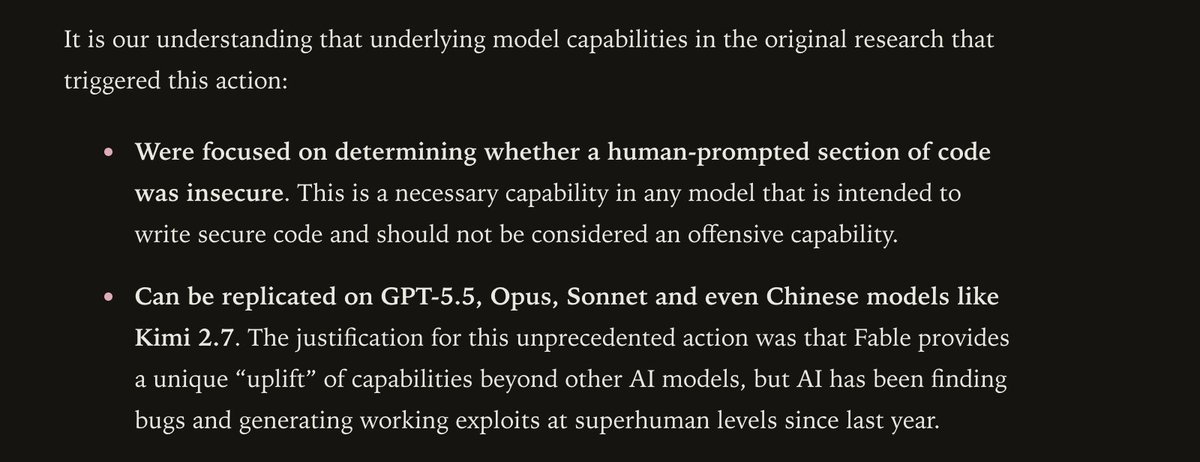
Over 60 American cybersecurity experts & executives have signed an open letter asking the Commerce Secretary and National Cyber Director to lift export controls on Anthropic's Fable and Mythos AI models. Yes, Mythos finds software flaws and writes exploits well, but so do others like GPT-5.5, Claude Opus, Sonnet, and Chinese models like Kimi 2.7. Fable's protections were so aggressive the security community laughed at them on launch day. The controls pulled capable tools from defenders while adversaries keep advancing. China's open-weight models are months behind at most, and that's only what's been published.
The letter asks for scientific evaluation criteria developed with industry input, proper rulemaking, transparent enforcement, and proportionality. One of the more telling lines: the original research that triggered the ban was about identifying insecure code. That's not an offensive capability but how you write secure software. freefable.org/
153

Over 60 American cybersecurity experts & executives have signed an open letter asking the Commerce Secretary and National Cyber Director to lift export controls on Anthropic's Fable and Mythos AI models. Yes, Mythos finds software flaws and writes exploits well, but so do others like GPT-5.5, Claude Opus, Sonnet, and Chinese models like Kimi 2.7. Fable's protections were so aggressive the security community laughed at them on launch day. The controls pulled capable tools from defenders while adversaries keep advancing. China's open-weight models are months behind at most, and that's only what's been published.
The letter asks for scientific evaluation criteria developed with industry input, proper rulemaking, transparent enforcement, and proportionality. One of the more telling lines: the original research that triggered the ban was about identifying insecure code. That's not an offensive capability but how you write secure software. freefable.org/
6
14
60
2,725

If the PCAC votes to recommend Category 1 for BPC-157, TB-500, or any of the others, the next step is not immediate access.
FDA must initiate rulemaking. That is a formal regulatory process with a comment period, review, and a final rule. Realistic timeline from a positive PCAC vote to actual 503A Bulks List inclusion: 6 to 18 months.
Anyone telling you these peptides will be back at compounding pharmacies by Q4 2026 after a July yes vote is giving you a more optimistic timeline than the regulatory process supports.
11

How do standard applications unlock immediate Satisfactory safety ratings? That is not true at all. That is why we have petitioned for a safety ratings rulemaking.
regulations.gov/comment/FMCS…
25

🏔️ NAK Nation 🏔️
Welcome back to The Veto Unravels.
Chapter 11: The Administrator's Regulatory Philosophy
Over the past ten chapters I walked you through the legal arguments, the judge, the three streams, the inside of the courtroom, and the questions likely to be asked on June 25.
Today's chapter looks at something adjacent to the case rather than inside it. The EPA Administrator who oversees the agency that issued the Pebble veto has, in several public settings, described a regulatory philosophy built on the same Supreme Court doctrines that sit at the center of this litigation. I want to show you what he has said, and I want to be careful and precise about what it does and does not tell you, because the distinction is the whole point.
Who Lee Zeldin Is
Lee Zeldin is the Administrator of the EPA, appointed by President Trump and confirmed in January 2025. He oversees the agency that issued the Pebble veto in January 2023, and the agency that is the named defendant, through DOJ, in the case before Judge Gleason.
That makes his public description of how he reads the governing law worth understanding. Not because it changes the case, it does not, and I will come back to that, but because it tells you about the posture of the agency that would handle any reconsideration if the court reopens the veto. His philosophy is relevant to the administrative path, which is a different thing from the litigation.
One caution up front, and I am stating it because this series lives on getting these distinctions right. Everything in this chapter is about what the current EPA's leadership believes and intends. None of it is evidence about how Judge Gleason will rule. Keep those two things separate as you read, the same way I will.
The Doctrines He Describes
Across several appearances in spring 2026, Zeldin described three legal doctrines that happen to be the same ones running through this case.
On Loper Bright, he has said EPA must follow the best reading of the law, and that the pendulum cannot swing back to a world where a merely reasonable agency reading was enough. That is an accurate description of the post-Loper Bright standard. Courts now independently determine the best reading of a statute rather than deferring to an agency's reasonable one.
On Sackett, he has described an EPA committed to following the decision precisely in its WOTUS rulemaking, and to making the new water definition as durable as possible. Sackett rejected the significant-nexus framework for Clean Water Act jurisdiction.
On West Virginia v. EPA, he has invoked the major questions doctrine, the principle that regulations of vast economic significance require clear congressional authorization rather than creative readings of old statutes.
These are real statements and they describe real doctrines. Now here is the honest accounting of how each connects, and does not connect, to Pebble.
What The Overlap Does And Does Not Establish
Here is the core thing NAK Nation needs to understand, because it is easy to get wrong and the temptation runs in one direction.
The plaintiffs' arguments draw on Loper Bright, Sackett, and the broader skepticism of expansive agency authority. Zeldin describes a philosophy drawing on the same doctrines. It is tempting to read that overlap as added pressure on the veto. It is not, and I want to be straight about why.
The Biden veto is vulnerable to Loper Bright, or it is not, based on the text of the statute and the administrative record. That vulnerability would be exactly the same whether or not the current Administrator ever gave a speech about the best-reading standard. A court applies the doctrine to the record in front of it. It does not apply the doctrine more forcefully because the sitting Administrator has publicly endorsed it. So Zeldin's statements do not add legal weight to the plaintiffs' arguments. The doctrinal pressure on the veto, whatever it amounts to, comes from the doctrine and the record, not from the Administrator's description of his philosophy.
What the statements genuinely tell you is narrower and still worth knowing. They tell you the posture of the EPA that would conduct any reconsideration. If the court reopens the veto, an EPA led by someone who reads the governing doctrines this way is more likely to reconsider in a development-favorable direction than an EPA that read them otherwise. That is real, and it is relevant to the administrative path we have discussed. It is not relevant to what Gleason decides on June 25.
On the major questions point specifically, I want to be candid rather than convenient. Courts generally reserve the major questions doctrine for regulations of sweeping national economic and political consequence. Whether a single-project Section 404c veto qualifies is genuinely doubtful, and it is one of the weaker arguments in the plaintiffs' set, not one of the stronger ones. Zeldin invoking the doctrine in a general setting does not change that. I am not going to inflate it for you.
What This Means For June 25, And What It Does Not
Let me be as clear as I can.
Zeldin's public statements do not change the legal arguments before Judge Gleason. Courts decide APA cases on the briefing and the administrative record, not on statements administrators make in hearings and podcasts. His words are not legally operative in that courtroom. June 25 turns on whether the plaintiffs' arguments, on the record, persuade Gleason to vacate or remand. Nothing the Administrator has said outside the case bears on that.
Where his philosophy matters is after, and only if, the court reopens the veto. If Gleason vacates or remands any component, the reconsideration lands with an EPA whose leader has described exactly this reading of the governing law. That tells you something about how a reconsideration would likely go. It tells you nothing about whether the reconsideration happens, because that depends on the court, and it tells you nothing about whether a reconsidered withdrawal would survive the legal challenge that would immediately follow, because that depends on the salmon-stream findings we have covered at length, which remain the hardest part of the veto to dislodge regardless of anyone's philosophy.
So, hold it this way. Zeldin's statements strengthen your read of the administrative path's direction if it opens. They do not strengthen the litigation, they do not predict June 25, and they do not touch the salmon-stream core that is the real obstacle to reaching the mine. Intent is not capability. The Administrator's words are strong evidence of intent. They are no evidence of capability.
The Honest Version Of The Complete Picture
Three streams, stated accurately.
The legal stream. Five plaintiff arguments targeting contested components of the veto, grounded in EPA's own documented language, against a legal backdrop that has shifted since 2023. Oral argument in ten days. This is the stream that decides whether the veto is disturbed, and the cleanest arguments reach the Restriction more than the salmon-stream-anchored Prohibition.
The administrative stream. An EPA whose leadership reads Sackett and Loper Bright in a development-favorable way, and a WOTUS rule being finalized along Sackett lines. If the court reopens the veto, this is the posture that would handle it. The constraint, unchanged, is that the Prohibition's core survives the jurisdictional narrowing, so even a willing EPA faces the firewall and the certainty of intervenor litigation.
The legislative stream. Permitting reform is being negotiated in the Senate, but it is genuinely stuck on a partisan impasse over energy projects, and the provisions that would matter to a 404(c) veto are prospective in any case. The PERMIT Act's veto provision does not reach the 2023 determination, and the SPEED Act amends NEPA, not the Clean Water Act veto. So this stream is the slowest and least certain, and as of now it does not contain a tool that removes this veto.
That is the accurate picture. It is genuinely a multi-front situation with real movement on the front most likely to produce a partial win, the Restriction, and a long, contested road on the part that blocks the mine. Zeldin's philosophy is a real and documented feature of the administrative front. It is not a thumb on the scale in the courtroom, and I would be doing NAK Nation a disservice to present it as one.
Coming Thursday I show you how the three strongest arguments work together, and why multiple independent pathways matter for the thesis, with the same honesty about which pathways reach the mine and which reach only the regional zone.
Stay locked in NAK Nation. 🇺🇸🏔️
#NAKNation #PebbleMine #TheVetoUnravels #JudgeGleason #June25 #LoperBright #Sackett #CleanWaterAct
2
14
283

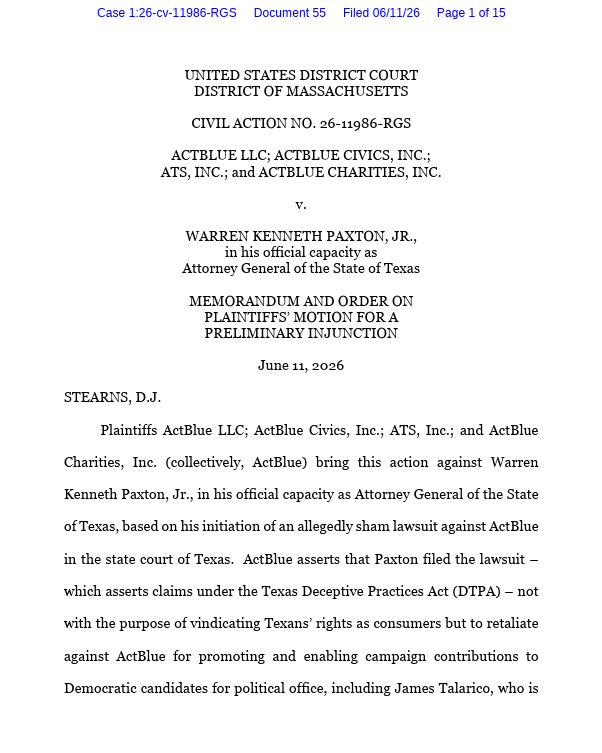
In reality, Paxton’s investigation into the fundraising platform over fraudulent and misleading donation processes began back in 2023, two years before Talarico would declare his candidacy for the U.S. Senate. In 2024, Paxton submitted a Petition for Rulemaking to the Federal Election Commission in hopes of closing fundraising loopholes.
Jun 11

🚨 A federal judge in Massachusetts blocked Texas Attorney General Ken Paxton from continuing his state court lawsuit against ActBlue, finding it was likely brought because the platform helped raise money for his Senate rival James Talarico.
17

@grok you skipped epa emission controls and the fact most of these contain multiple parts. Example FMVSS 208. Include IIJA-directed rulemaking thats upcoming
1
27

A group of WTO members is taking the E-Commerce Agreement to the edge of the WTO system, raising questions about plurilateral rulemaking and the limits of consensus in an increasingly multipolar world. Learn more with this discussion guide based on a paper by Peter Ungphakorn, former Senior Information Officer at the WTO: buff.ly/tOg5mqj
#WTO #DigitalTrade #ECommerce #TradePolicy #TradeGovernance

61


12h
No, aprobar no basta. “Que se haga efectiva” significa que la ley realmente entre en vigor y se implemente. Con la Clarity Act (H.R. 3633) pasa exactamente esto:Aprobación firma del Presidente = se convierte en ley (enactment).
Pero la mayoría de sus artículos clave entran en vigor 360 días después de la promulgación (o incluso más tarde, cuando se publiquen las reglas finales en el Federal Register).
La SEC y la CFTC tienen hasta 360 días para emitir las regulaciones detalladas (rulemaking).
Hasta que no pasen esos plazos y las agencias publiquen e implementen las reglas concretas, el marco regulatorio anterior sigue aplicándose en la práctica. Los bancos, custodios, exchanges y fondos institucionales siguen operando con cautela por riesgo de compliance. Eso es lo que permite la manipulación y el FUD constante.
Saludos Feli
2
1
28

The SEC is clearing a path for tokenization, but guidance issued without a full rulemaking process lacks the durability of formal regulation.
Progress is happening, just expect the legal foundation to get tested before it holds firm.

14

12 to 18 months is the quiet tell in SEC tokenization. The hype says permanent market structure, but CoinDesk says the SEC is preparing exemptive authority first, not full rulemaking. Atkins called it a limited innovation pathway on May 8. I keep watching the rails arrive before the rulebook is dry.
6

SEC's tokenization exemption shortcut sounds exciting but former lawyers say it won't hold up like real rulemaking 🤔 We need solid legal ground, not workarounds that crumble later. Is a half-measure better than nothing? #Tokenization
15

There’s been a marked shift in the #supervisory environment, with recent #rulemaking from 3 prudential #regulators emphasizing material #financial risks over more qualitative, subjective concerns.
bankdirector.com/article/wha…
102

The instrument is the story.
Not a published export rule. A letter, at 5:21pm ET on a Friday, asserting export-control authority over two named models. No comment period, no rulemaking, no appeal.
R Street called it what it was: process-free discretion.
1
4