
AMO QND COLONIZADOEES PERDER DE SWUS PAIS COLONIZADOS


73


Jun 16
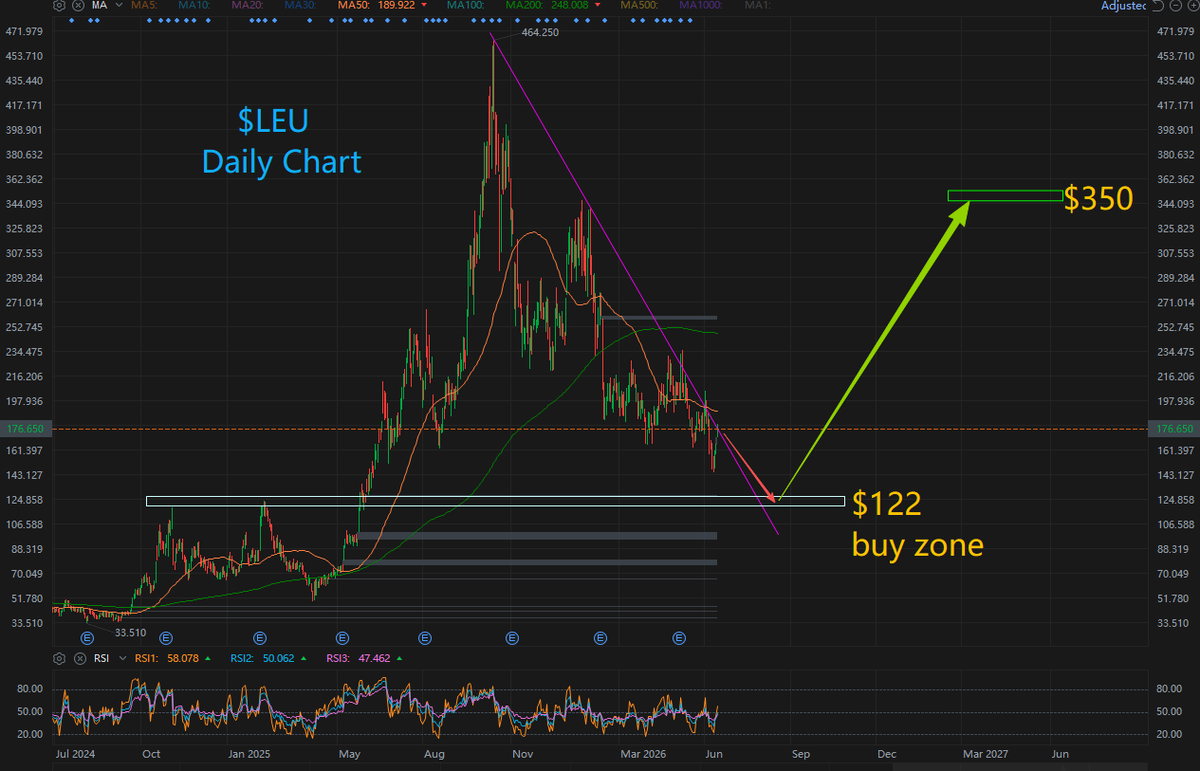
$LEU --- $LEU: America’s Sole Licensed Domestic Commercial Uranium Enrichment Producer
Centrus Energy ($LEU) remains the only U.S.-based firm holding full commercial licensing to operate domestic uranium enrichment capacity. The U.S. Department of Energy (DOE) recently awarded Centrus an additional $900 million special-task contract for HALEU (High-Assay Low-Enriched Uranium). HALEU, enriched between 5% and 20% U-235, is the mandatory core fuel for next-generation advanced Small Modular Reactors (SMRs).
Russia’s TENEX was formerly the world’s only commercial HALEU supplier. After federal legislation banned all imports of Russian nuclear fuel, Centrus emerged as the United States’ sole domestic HALEU supplier. The National Nuclear Security Administration (NNSA) has formally signaled plans to execute sole-source procurement exclusively from the company.
During the Q1 2026 earnings call, CEO Amir Vexler announced the firm had shifted to full execution mode to accelerate capacity expansion at its Piketon, Ohio enrichment facility. Centrus also revealed a deep technical partnership with AI leader Palantir ($PLTR), delivering approximately $300 million in targeted cost reductions across its supply chain, engineering scheduling, and plant design workflows. This cost relief eases capital strain for facility buildouts and directly lifts long-term gross margin profiles.
1. Unbreachable Geopolitical Moat as Domestic Replacement Supplier
U.S. nuclear fleets were long heavily reliant on Russian enrichment services (measured in Separative Work Units, SWUs). Amid sweeping U.S.-Russia decoupling and passage of federal nuclear energy legislation, Washington’s domestic supply chain subsidies create forced structural demand for onshore enrichment capacity. As America’s only domestic commercial enrichment pure-play, Centrus stands poised to capture billions of dollars in market share previously controlled by Russian state nuclear enterprises.
2. Nuclear Power: The Ultimate Energy Backbone for AI Data Centers
Hyperscalers including Microsoft, Amazon, and Meta are locked in an arms race to scale AI compute infrastructure, triggering crippling nationwide power shortages. Big tech firms are rushing to sign long-term power purchase agreements for nuclear generation—especially SMRs, highlighted by Microsoft’s landmark deal for the Three Mile Island nuclear complex. Every operational SMR requires HALEU fuel sourced exclusively from Centrus, cementing $LEU as the deeply hidden pick-and-shovel play powering the entire AI infrastructure boom.
3. Multi-Decade Contract Backlog Delivers Unmatched Long-Term Visibility
As of the end of Q1 2026, Centrus’ total contracted backlog reached $3.9 billion, with committed order volumes fully booked out through 2040. Hard fixed contracts for pure uranium feedstock and SWU enrichment services alone account for $3.1 billion of that total. This multi-decade locked-in revenue stream insulates the company’s core fundamentals against broad macroeconomic volatility, delivering exceptional downside resilience and predictable long-term cash flow.
2
19
949

Jun 15
World Nuclear Fuel Market Conference - 2026 (Scottsdale, AZ)
Part 1
I attended this excellent conference for the first time this year, where uranium producers and utilities met to negotiate prices and deliveries. The attendance was large with the entire nuclear fuel supply chain being well represented.
The economics for utilities have improved so much that they are installing up-rated equipment as fast as possible, even beyond what is disclosed publicly, including moving to higher fuel enrichments (6.25% and up). This is the next logical step, after conventional up-rates are done. Analysts agree the supply chain is not ready for this, let alone new builds.
New builds are now competing for many of the same components required for the up-rate projects.
The term "super up-rates" is also being used some, informally. One example is retrofitting to move to metal fuel (something like Lightbridge) for the existing LWR fleet.
Most of the growth in mining is currently ISR, but uranium milling is still seen as a weak spot. However, Energy Fuels is still running their White Mesa mill intermittently.
New investment really needs to ramp very quickly, but it's mostly private start-ups stepping into the fray at present, particularly for conversion.
The field of SMR and fuel cycle start-ups is now about 150 companies and many are expecting a major shake-out, soon.
We have 2 new start-ups that will do uranium conversion in Texas, FluxPoint Energy and Raven-Flint. This is in addition to UEC's plan and Solstice's (Converdyn) announcement they are up-sizing their expansion plans for the Metropolis plant and even considering a "Metropolis 2.0", in some central Southern state.
If this new conversion capacity gets built, the pressure will focus on the enrichment bottleneck even more.
It really makes me wonder what Cameco has been waiting for at Port Hope and Springfields? I'm also concerned about the Cameco/Silex GLE partnership, but I'm writing a separate report on that (Stay tuned).
General Matter, a very private enrichment start-up that recently won a $900 million contract from the DoE, was a hot topic.
GM claims to be ahead of their competition and will have the lowest cost SWUs. Of course, that's only really possible if their technology is somehow more efficient than centrifuges and/or lasers.
Their arrogance is amazing. While their laser enrichment peers have spent years explaining the merits of SILEX, CRISLA and QLE, GM refuses to disclose anything about their tech. "Just trust us, you don't need to know". It really does not land well with utilities, coming from a Silicon Valley start-up with no experience in this industry. But, they have a website now and "EXIM-backed financing".
GM has said their prospective customers are in the loop on their technology. But, some large fuel buyers told me they somehow missed those meetings. They seem to know less about GM than I do.
As I have written, I think GM's tech is either an updated version of gaseous diffusion or Calutrons, but that would not be more efficient. But, why would this be a secret? Why insult the intelligence of your prospects in the room? My theory is their tech was granted to them from a DoE lab, with never-to-be-disclosed requirements attached, because of nuclear proliferation concerns.
More on GM's tech:
x.com/ClayDMontgomery/status…
It's uncomfortable, but GM represents a larger trend, most of the desperately needed new investment in the US fuel supply chain is coming from private start-ups that tend to be really opaque and short on commercial scale production experience.
I also got confirmation that the secret waivers from the Canadian government for Atlantic Ro-Ro carriers that transport the Russian uranium (EUP) to the US are continuing to at least 2028. There is an annual meeting in Canada where DoE officials renegotiate this. It's still one of the best cards Canada has in trade negotiations with the US and the details of these meetings are still secret, including the waiver documents themselves.
Imported EUP Schedule:
arrcm.com/schedule.html
The lack of discussion on spent fuel reprocessing and plutonium was disappointing. There is actually a lot of this work going on behind the scenes now. This industry still does not want to talk about it. This is for the next generation of reactors that need HALEU.
The Trump Administration is currently negotiating the sale of 34 metric tons of weapons-grade plutonium to 5 SMR start-ups to substitute for HALEU.
Doing the math, that could produce about 136 metric tons of MOX to substitute for HALEU (or about 680 tons of MOX to substitute for LEU). That is over 150 years of Centrus' current production from their 16 centrifuge cascade (which produces 900 kg/year from LEU feedstock). Seems important.
How could this affect uranium miners? That 34 tons of plutonium is energy-equivalent to approximately 17 million lbs of mined U3O8. Remember when we got into the uranium sector because "there is no substitute"? Well, a lot of uranium (for HALEU at least), IS being substituted, because of the looming enrichment supply crisis.
French start-up Nuward is even using MOX substitution as a selling point for their SMRs, in Europe.
#Uranium #nuclear #SMR $CCJ $LEU $SOLS
Jan 20

What is the uranium enrichment technology currently being developed by General Matter?
Some of their recent statements and a big award from the DOE forced me to rethink this and I found something that changes my opinion on their viability.
GM says their technology is novel but has a high TRL (technology readiness level). "Novel" rules out centrifuges and "high TRL" rules out laser enrichment. So what else could it be? I thought it was an electrochemical process, such as Ubaryon, but there is a better candidate - Gaseous Diffusion updated with modern technology.
The old GD machines at Paducah used 50x more power per SWU than centrifuges. But, what if they were redesigned using modern tech? That 50x gap could be reduced considerably with higher quality porous membranes. Perfect membranes would require billions of precision 10 to 20 nm holes per inch. That was really hard to do in 1945. But, today it is routine in the semiconductor industry.
Modern chip fabs can make nearly perfect membranes for higher efficiency Gaseous Diffusion of UF6.
But, can silicon withstand corrosive UF6 gas? Not directly. However, aluminum metalization layers are commonly used on most chips today and Al does handle UF6 very well. It was used in the old GD machines.
General Matter has its origins in silicon valley where they know what can be made in chip fabs. I worked in the semiconductor industry for 25 years.
Remember inkjet printers? They work by squirting ink through an array of precision microscopic holes in a silicon chip.
The biggest technical obstacle for GM would probably be demonstrating that they can handle the UF6 corrosion with aluminum metalization. The remainder of GD machines are basically just gas compressors and cooling equipment. That's the sort of conservative tech that fits DOE's mandate for supplier diversity to reduce risk.
It's hard to know how far a perfect membrane could go to closing the power efficiency gap with centrifuges and laser enrichment. But, I now think General Matter could quickly become a serious competitor to GLE and Centrus Energy.
If I'm right about this, it means that new GD machines will eventually populate the same building that used to house the old GD machines (and next door to GLE) in Paducah, KY.
#Uranium #nuclear #silex $ccj $leu
10
7
47
6,140

threads.com/@cristinaceliade…
ATÉ EU DANCAVA COM 30 MILHÕES DE PIX NA MINHA CONTA, MAIS NAO DE FORMA SUJA. FICA PASMEM, DE VER UMA PF, UMA JUSTIÇA, NAO COLOCAR TODOS ESTES SAGADOS NA PRISÃO, TENDO TANTAS PROVAS.O QUE TÃO ESPERANDO? SERÁ QUE TERÁ QUE TRUMP ENTRE ,COM SWUS MARINERS
3

Refresher on Iran nukes.
1/ In 2009, using their IR-1 cascades, Iran created enough 3.5% enriched UF6 that further enrichment to weapons grade (95%) could yield one bomb.
2/ Getting to 3.5% takes about 80% of the SWUs needed to reach 95% (SWU=seperative work unit, loosley
1
11


Jun 13
Milhares de pais lamentam não poder assistir o jogo com swus filhos prisioneiros.
2
28

Jun 13
Parabéns pro bts, swus argumentos é diferença de estádio e arenas? Tem que ter demanda amor e a olivia teve
2
41

Jun 12
Iran’s Nuclear Breakout Timeline Mechanics (Simplified)
Breakout time = Estimated time for Iran to produce enough weapons-grade uranium (WGU, ~90% enriched U-235) for one nuclear weapon (~25 kg of WGU) if it decides to “break out” and sprint for it. It measures fissile material production only — not weaponization, warhead assembly, or delivery (those add months/years).
How It’s Calculated
1. Feedstock Enrichment Stages: Start with low-enriched uranium (LEU, e.g., 3.67% or higher like 20%/60%). Cascade centrifuges to progressively increase U-235 purity. Higher starting enrichment = much faster.
2. Centrifuge Capacity: Measured in SWU (Separative Work Units) — efficiency × number of centrifuges. Advanced centrifuges (IR-6, etc.) multiply speed dramatically.
3. Stockpile Size: Pre-existing enriched material shortens the path.
4. Assumptions: Parallel operations at sites like Natanz/Fordow; detection risk ignored in pure calc.
Formula basics: Time = (Required SWUs for target enrichment) / (Total SWU capacity per month). Tools like SWU spreadsheets model exact cascades.
JCPOA Impact & Sunset Mechanics
• Pre-JCPOA: ~2-3 months (large stockpile thousands of centrifuges).
• Under JCPOA (2015-2025-ish): Limited to ~5,000 first-gen centrifuges, 300 kg LEU stockpile (3.67% max), no high enrichment → ~12 months for first decade.
• Sunset Clauses (key flaw):
• ~Year 8-10 (2023-2025): Centrifuge limits ease; advanced models allowed → industrial-scale capacity ramps.
• Year 15 (~2030): Enrichment level/stockpile caps end.
• Result: Breakout shrinks from years (early deal) → months → weeks/days by late 2020s, while fully compliant. Iran could legally amass near-weapons
1
58

Jun 11
Cant Believe i was elegible..
Fr gonna rack up hours now while i wait for SWUs new set to drop.
#Destiny2

30


May 28
Ahh, we’re sorry you’ve run into a bit of a roadblock with your SWUs, they really are a fantastic perk all around. However, the upgrade magic all depends on availability, so if there isn’t space at the moment you try to apply it, what we can do is waitlist for it and keep our fingers crossed that a spot opens up. Our DMs are open should you need more info!
1
25

May 20
qnd vc quer remover o cara com foto de perfil de uma piroca dos swus seguidores mas vc ta no meio da academka
1
2
359

May 11
Hantavirus is a hemorrhagic disease primarily or exclusively transmitted by rodents, mainly in the SWUS. Mortality for untreated persons is about 30%. It's unclear whether it can be transmitted between people, but I looked and could find no definitive proof.
...
3
4
1,071


May 4
Hem de obrir la veda de tots els fills de puta que ens han portat tota aquesra merda a casa nostra,i tambe la dels inutils dels swus votants.
2
47

Hopefully this same SWUS troughing won't delay the onset of Monsoon Season here in Arizona again, like what's happened over the last 3 years.
2
3
108

Vai acontecer nada a extrema ja tem swus proprios travestis pra fazer demagogia eleitoral.
Essa merda ai que inventaram é pra reprimir outro setor da sociedade é os trabalhadores que vão se foder ainda mais por causa desse pessoal ai as leis que eles defendem cpmprova isso.
2
2
20

May 3
Não tem nenhuma pessoa nas areias de Copacabana agora que não tenha desenvolvido um profundo ÓDIO de todos os patrocinadores e swus anuncios em infinito loop nos telöes #shakiracabana
3
4
77
5,937