
[商願2025-99309]
商標: [画像] (標準文字)
OCR: Fileforce SecurePC
出願人: ファイルフォース株式会社 (東京都新宿区)
出願日: 2025年8月28日
区分: 第9類(電気通信機械器具,電子応用機械器具及びその部品,コンピュータソフトウェア,コンピュータハードウェア), 第42類(機械・装置若しくは器具又はこれらの機械等により構成される設備の設計,デザインの考案,電子計算機のプログラムの設計・作成又は保守,電子計算機・自動車その他その用途に応じて的確な操作をするためには高度の専門的な知識・技術又は経験を必要とする機械の性能・操作方法等に関する紹介及び説明,電子計算機の貸与,電子計算機用プログラムの提供,…)

ALT 標準文字: Fileforce SecurePC
397


Mar 19
2

Feb 14
$JASMY 🧡 | Why Jasmy Became a Chain
(No hype — just structure) 🏗️🇯🇵
People keep asking:
“Why did $JASMY become a chain?”
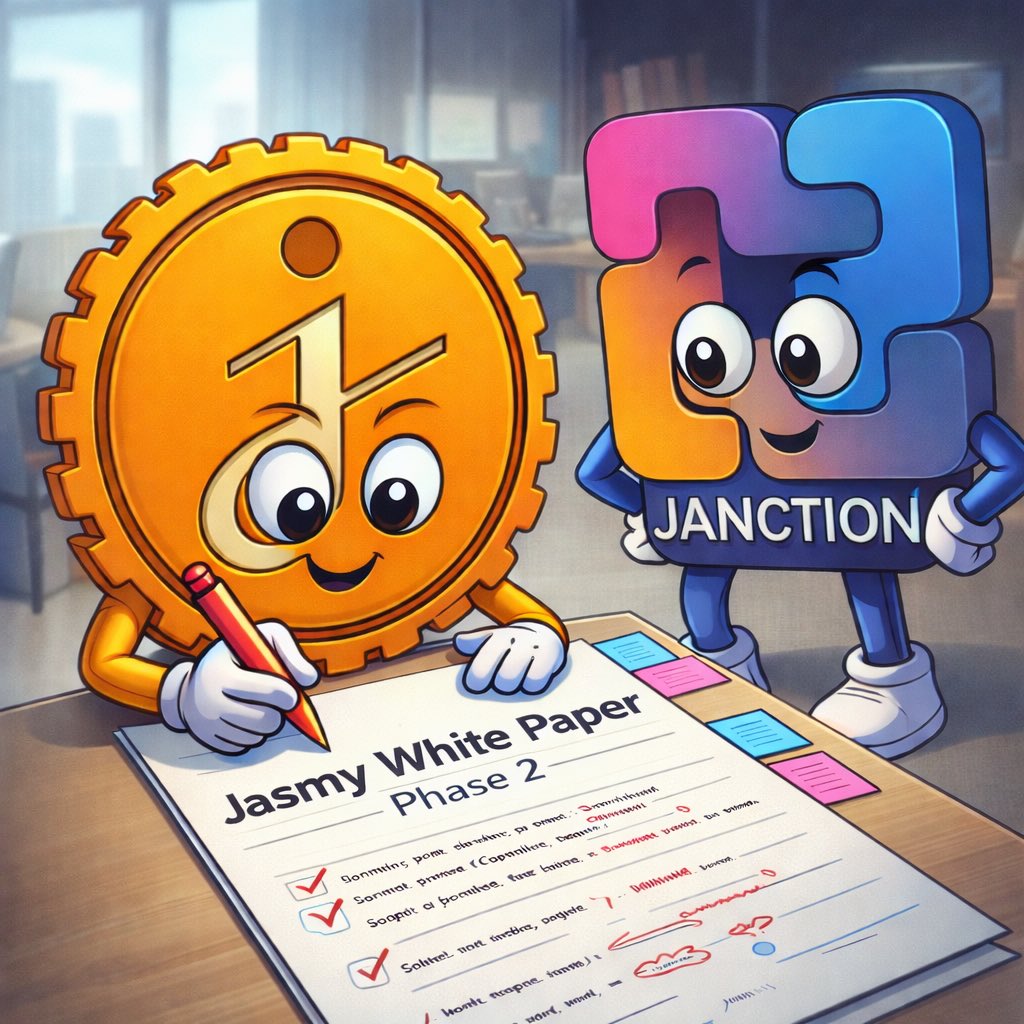
“It wasn’t in the whitepaper.”
“Did the narrative change?” 🤔
Here’s the real answer:
$JASMY didn’t pivot.
It evolved — because scaling a national-grade digital infrastructure requires owning settlement and compliance rails. ⚙️
⸻
1) 2018–2020: Phase 1 — Data Platform Vision 📄⏳
In 2018, the crypto landscape was very different:
• No mature L2 infrastructure
• No low-cost settlement rails
• Enterprise adoption ≈ zero
• Japan regulation = strict unclear
• Launching a chain = high risk
So the rational strategy was:
🪪 Personal Data Locker (PDL)
🔐 Data Ownership
🌐 IoT Data Platform
With the KPI structure behind the “$17 Thesis”:
👥 ~107M Active Users
💰 ~$500 Estimated Data Value per User
📊 ~16.7x PDR (Price–Data–Value Ratio)
This created a
Data-Value-Based Valuation Model
—not a SaaS-style recurring ARPU model.
⸻
2) 2020–2022: Structural Reality 💥
Then the market matured — painfully:
• Wild West speculation
• Major collapses (Terra, FTX)
• Regulatory tightening
• Trust erosion
Key realization:
Remaining only at the application layer means:
✅ You may attract users
❌ Infrastructure captures the value
❌ Compliance is external
❌ Settlement is external
You build utility.
Others own the rails.
⸻
3) 2023–2024: Enterprise & Government Integration 🏢🏛️
As $JASMY expanded into:
🔐 SecurePC / BlockchainPC
🪪 DID & certified identity flows
🇯🇵 Regulated insurance & enterprise systems
The constraint became clear:
Public chains optimize for openness.
Enterprise-grade environments require:
• Auditability
• Deterministic governance
• Controlled execution
• Compliance-aware rails
At this stage,
owning settlement stops being optional.
⸻
4) The Inflection Point: $JANCTION (AI GPU Economy) 🤖⚡
With $JANCTION introducing AI compute GPU monetization, a new problem emerged:
How do you settle:
• AI workloads
• Micropayments
• Device income
• Data monetization
efficiently and compliantly?
Ethereum L1 → Cost-prohibitive
Third-party chains → Loss of control
Off-chain → Breaks system integrity
Logical outcome:
Own the rail.
Not for narrative.
For system coherence.
⸻
5) Jasmy Chain = Integration Layer 🏗️🔗
Jasmy Chain connects:
PDL DID
⬇
$JANCTION compute economy
⬇
Payments settlement
⬇
Enterprise & government execution
It enables value capture across the full stack.
⸻
6) “Why wasn’t it in the whitepaper?”
Because in 2018:
• L2 ecosystems didn’t exist
• Rollup infra wasn’t production-ready
• Regulatory clarity was missing
• Cost structures were prohibitive
The whitepaper defined Phase 1.
Infrastructure evolution defined Phase 2.
⸻
Timeline
2018 → Data platform vision
2021 → Regulatory survival
2023 → Enterprise infrastructure
2024 → Identity expansion
2025 → AI settlement rail
→ Jasmy Chain becomes structural, not optional
⸻
Bottom Line
Jasmy Chain is not a narrative shift.
It is the infrastructure layer that allows $JASMY to scale, comply, and capture value system-wide.
Infrastructure first.
Narrative second.
#JASMY #JCT #JANCTION_Global #Jasmy_Global #Jasmychain
#Jasmywhitepaper
#DigitalIdentity #Web3Infrastructure #Compliance
#JapanTech
@HARA_JasmyCFO
5
33
175
5,326
Feb 13
People keep saying:
“ $JASMY is going nowhere.”
“Price is dead.”
“No momentum.” 📉😴
But the real question is…
Have you ever looked behind the system? 👀⚙️
⸻
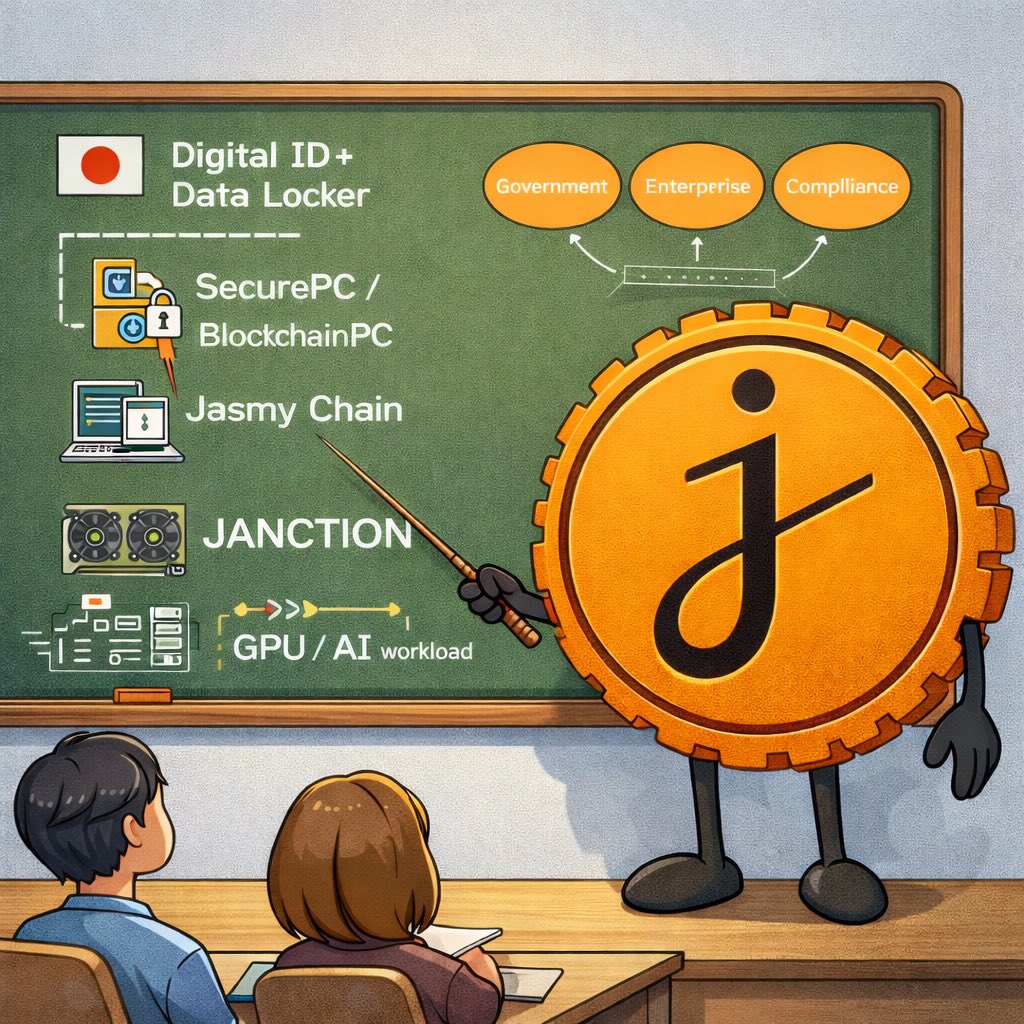
Here’s what $JASMY is actually building:
🪪 Digital ID Personal Data Locker
→ Real identity & data ownership in Japan
🔐 SecurePC / BlockchainPC
→ Enterprise & insurance-grade security
⛓️ Jasmy Chain (Arbitrum Orbit)
→ Own chain, $JASMY as native gas
🤖 #JANCTION GPU / AI Network
→ Compute AI workloads settled via #JASMY
📜 Full Japan compliance
→ Built for regulation, not shortcuts
This is not a “roadmap.”
This is live infrastructure. ✅
⸻
Coins that pump fast 🚀
usually have no system behind them.
No regulation.
No responsibility.
No long-term users. 💀
⸻
But when you work with:
🏛️ Governments
🏢 Enterprises
👥 Real users
📊 Sensitive data
You move slow — by design. ⏳
Because one mistake = system failure.
⸻
I didn’t buy $JASMY for pretty candles. 🕯️❌
I bought it for digital rails. 🏗️🇯🇵
Identity.
Data.
Settlement.
AI compute.
These don’t disappear in bear markets. ♻️💎
⸻
You can wait for green candles. 📈
I’m waiting for system maturity. 🧠⚙️
Choose your game. 😎
$JASMY 🧡
#JASMY #JCT #JANCTION_Global #Jasmy_Global #Jasmychain
#DigitalIdentity #Web3Infrastructure #Compliance
#JapanTech
#InfrastructurePlay #DigitalRails
@HARA_JasmyCFO
5
32
173
4,079

Feb 12
While many projects focused only on the blockchain and its promotion, #Jasmy built its sustainability with viable 'real life' projects like SecurePC, CarbonCredits or their partnerships with Aplix. This allows them to make profits as adoption grows.

Dead projects:
- Monad
- Starknet
- Zksync
- Srcoll
- Aleo
- Mina
- Linea
- Boba network
– Aptos
– Cosmos
– NEAR
– Rootstock
– Cardano
– Stellar
– Cronos
– Axelar
– Astar
– Bittensor
– Celo
– Zircuit
– EOS
– Sonic
– Injective
– Kaia
– Kava
– Lisk
– Metis
– Tezos
- Wormhole
- Movement
- Kinto
- Celestia
- Blast
- PIN AI
- Midas
- Kinto
- Metis
- 0G
- Polygon zkEVM
- Berachain
- Story
These chains were so popular at some point
1
4
221
Jan 15
🧠 Where $JASMY is right now — and what the market is actually waiting for
Many people ask:
“Why is adoption already real, but price still doesn’t reflect it?”
The short answer is simple:
👉 $JASMY hasn’t reached the stage where the market has to price it in.
Let’s break it down clearly.
⸻
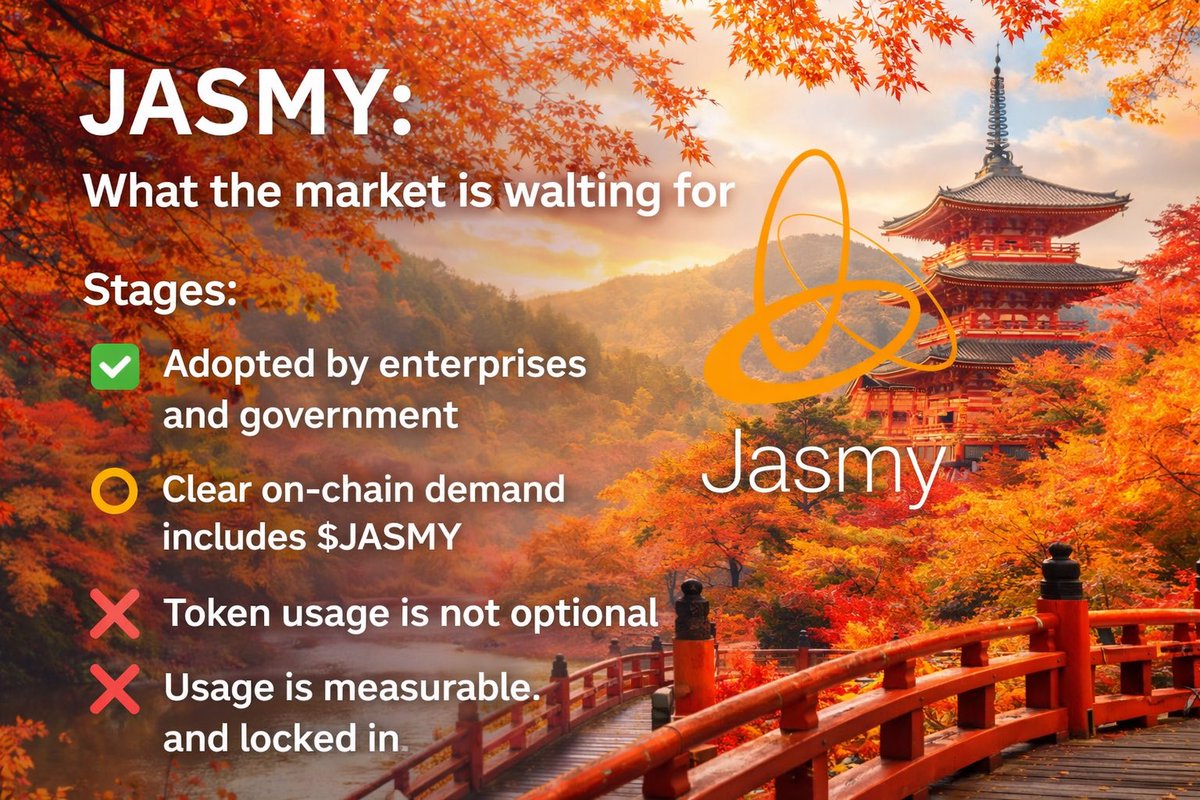
🪜 From Adoption to Price — #JASMY moves in stages
1️⃣ Stage 1 — Adoption (Already happened)
✔ SecurePC / BlockchainPC in real use
✔ Enterprise, insurance, workforce, government environments
✔ Placed inside systems that are sensitive and cannot fail
But almost all of this is still off-chain.
👉 This stage proves legitimacy
👉 It does not move price
⸻
2️⃣ Stage 2 — On-chain Boundary (In progress)
🟡 The market is waiting for clarity on what actually moves on-chain
Not vague “blockchain usage,” but specific answers:
• consent logs?
• audit proofs?
• cross-organization data exchange?
👉 Without a clear on-chain boundary,
the token is still optional.
⸻
3️⃣ Stage 3 — Mandatory Token Usage (Mainnet-enforced, Not yet)
❌ This is the stage the market is actually waiting for.
This is not just “mainnet goes live.”
What must be true:
• Using the system → requires $JASMY by design
• Writing critical data / consent / proofs → cannot occur without paying $JASMY
• Settlement, withdrawal, or system exit → cannot bypass $JASMY
• Gas and accounting rules → structurally fixed to $JASMY, not configurable or optional
Not:
“$JASMY can be used.”
But:
“The system does not function without $JASMY.”
👉 Until mainnet enforces this at the protocol level,
the token remains optional —
and the market will not re-rate.
⸻
4️⃣ Stage 4 — Measurable Usage Entity Lock-in (Not yet)
❌ This is when price stops asking questions.
• Verifiable on-chain metrics (tx, gas, wallets)
• Large entities holding / locking / staking
• Systems that cannot operate without the token
👉 At this stage, explanation becomes unnecessary.
⸻
🔍 Early signals vs Late signals (don’t confuse them)
Early signals (before price):
• Clear language around gas / settlement / accounting
• Specific on-chain flows, not abstractions
• Dashboards and real metrics
• Documentation that forces token usage
Late signals (after price):
• TVL spikes
• Millions of transactions
• Influencers “discovering” the narrative
• CEX headlines
⸻
🧠 The honest conclusion
Right now, JASMY has:
✔ Real adoption
✔ Enterprise and government trust
But it still lacks:
❌ Mandatory token usage
❌ Clear on-chain demand
❌ Measurable, unavoidable token flow
So yes —
Price not reflecting fundamentals yet is normal.
JASMY is not designed to pump on hype.
It’s designed to activate when systems cross the accounting boundary.
Japan doesn’t adopt loudly.
It adopts structurally.
And when the token becomes a requirement, not a choice,
price won’t move gradually —
it will re-rate all at once.
#JASMY $JCT #JANCTION_Global #Jasmy_Global
#EnterpriseAdoption #Japan #DigitalInfrastructure #Web3
@binance @_RichardTeng
#BinanceMonitoring #BinanceTag
@HARA_JasmyCFO
2
31
130
3,925
Jan 14
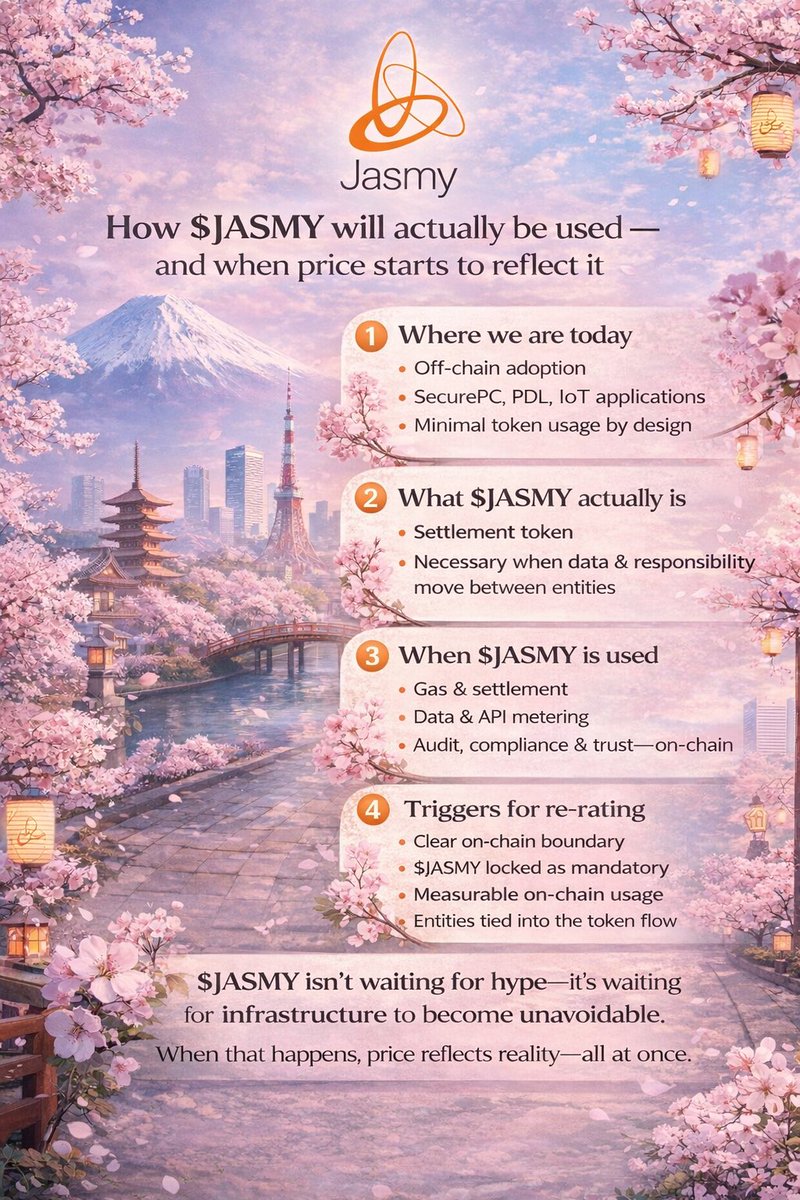
🧠 How $JASMY will actually be used — and when price starts to reflect it
Many people ask the wrong question about Jasmy.
Not:
“What can $JASMY be used for?”
But:
When does the system stop working without $JASMY?
1️⃣ Where we are today
Jasmy already has real adoption, mostly off-chain:
• SecurePC / BlockchainPC
• Personal Data Locker (PDL)
• Workforce, insurance, IoT, government use cases
These are production systems, not demos.
They stay off-chain due to:
• regulation
• audit & risk control
• cost & stability
👉 Token usage is intentionally minimal at this stage.
That’s correct sequencing — and why price hasn’t moved yet.
⸻
2️⃣ What $JASMY actually is
$JASMY is not a consumer token.
It’s an infrastructure settlement token.
It becomes necessary only when:
👉 data, identity, and responsibility move between entities, not just within one company.
That’s the on-chain boundary.
⸻
3️⃣ When $JASMY becomes unavoidable
$JASMY is used by design, when:
• data moves across organizations
• consent & audit logs must be immutable
• value flows between companies / cities
Something must handle:
• settlement
• accounting
• gas
• proof of responsibility
👉 That role belongs to $JASMY.
⸻
4️⃣ How $JASMY is used (no theory)
When the ecosystem moves on-chain:
• Gas / settlement → Jasmy Chain / JANCTION
• Data & API accounting → PDL-verified usage
• Audit & compliance proofs → on-chain consent & logs
• Cross-organization trust → paid, verifiable actions
This isn’t UX.
It’s compliance infrastructure.
⸻
5️⃣ Why adoption ≠ price
Because:
• adoption ≠ token demand
• compliance ≠ speculation
Price moves only when:
👉 the system cannot run without touching the token
⸻
6️⃣ What triggers re-rating
No hype — just structure:
1️⃣ Clear on-chain boundary
2️⃣ $JASMY locked as mandatory gas / settlement
3️⃣ Measurable on-chain usage
4️⃣ Large entities unable to bypass it
When 2–3 appear together, the market re-rates — all at once.
⸻
🧠 Final takeaway
$JASMY isn’t waiting for hype.
It’s waiting for infrastructure to become unavoidable.
Japan adopts quietly — but structurally.
When systems cross the accounting line,
$JASMY stops being an idea
and becomes a requirement.
That’s when price catches up.
#JASMY $JCT #JANCTION_Global #Jasmy_Global
#EnterpriseAdoption #DigitalInfrastructure #Japan #Web3 #Compliance
@HARA_JasmyCFO
5
37
148
11,000
Jan 9
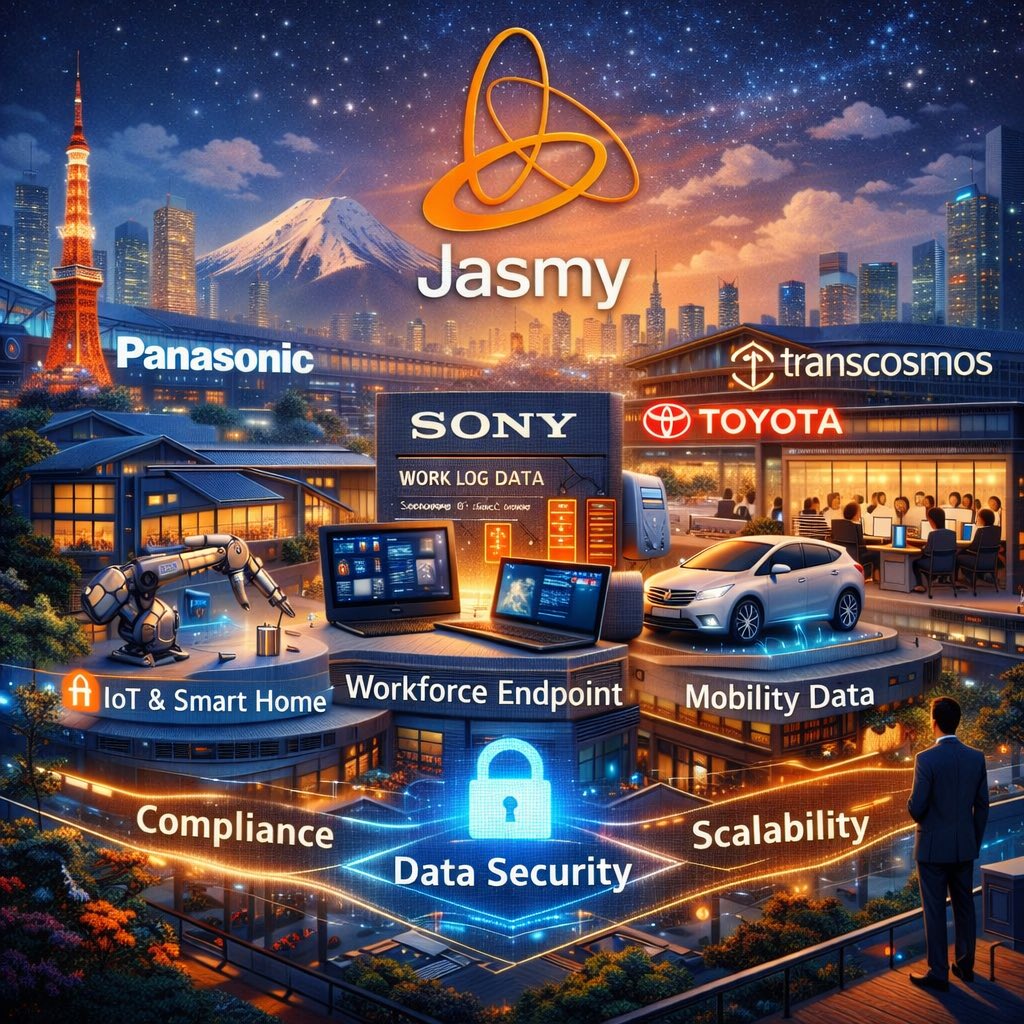
🧠 Why #Jasmy keeps showing up inside Panasonic, Sony, Toyota — and Transcosmos
(and why that’s not a coincidence)
Many people still look at $JASMY and think
“IoT old enterprise news.”
But when the same names keep appearing —
Panasonic, Sony, Toyota, Transcosmos —
this stops being about announcements.
It becomes a repeatable adoption pattern inside Japanese enterprises 🇯🇵
⸻
🔍 The question most people don’t ask
Not:
Who did $JASMY work with?
But:
Where are these organizations allowing technology to sit inside their systems?
And across every case, the answer is the same 👇
➡️ Endpoint · Workforce · Data accountability
⸻
🧩 What all these use cases have in common
Not tokens.
Not hype.
Not consumer apps.
But the point where data is created — and where law & compliance apply directly:
• employee work devices 💻
• operational IoT endpoints 🏭
• audit-critical workflows 📋
• systems that cannot break
BlockchainPC / SecurePC isn’t positioned as a “product.”
It’s positioned as a compliance-ready enterprise endpoint standard.
That’s where Japanese companies open the door.
⸻
🏭 Panasonic — IoT that must be accountable
In factories and smart environments,
the problem isn’t collecting data.
It’s:
• who controls it
• who is responsible
• who can audit it
PDL secure endpoints turn IoT data into
👉 enterprise-grade, accountable data
⸻
🧑💼 Sony — adoption starts with the workforce
The AKASHI attendance / worklog system sounds boring.
That’s exactly why it matters.
In Japan, workforce systems sit at the intersection of:
• labor law
• compliance
• audit
• internal governance
Japan doesn’t adopt tech from hype.
It adopts it inside internal systems first.
⸻
📞 Transcosmos — proof at scale
This is the missing piece most people overlook.
Transcosmos isn’t a pilot.
It’s tens of thousands of real BPO / call-center workers.
SecurePC running on:
• real employees
• real customer data
• real operations
➡️ That’s scalability operability proof, not a demo.
⸻
🚗 Toyota & mobility data — a national-grade problem
Mobility data = location, behavior, telemetry.
This is nation-level data.
Before innovation, you need:
• trust
• control
• legal clarity
That’s why $JASMY isn’t positioned as a dApp —
but as infrastructure data can legally pass through.
⸻
🧠 The bigger picture
Put Panasonic Sony Toyota Transcosmos together
and you don’t get a partner list.
You get a national adoption pattern:
• endpoints first
• workforce first
• compliance first
• scale first
Japan doesn’t adopt loudly.
It adopts quietly — and structurally.
That’s why this pattern doesn’t pump fast 📉
but it also doesn’t disappear easily.
#JASMY $JCT #JANCTION_Global #Jasmy_Global
#EnterpriseAdoption #Japan #DigitalInfrastructure #Web3 #Cybersecurity #IoT
@binance @_RichardTeng
#BinanceMonitoring #BinanceTag
@HARA_JasmyCFO
2
40
163
4,201
Jan 8
🟧 Insurance Industry Penetration — the part most people still don’t see
Most people still think $JASMY is just “IoT data”.
That view is outdated.
#Jasmy has already entered one of Japan’s hardest, most regulated industries —
the insurance sector.
And it didn’t enter as a vendor.
It entered inside the system.
⸻
🔶 1) $Jasmy is already inside Japan’s insurance establishment
$Jasmy is an Advisory Member of
Japan Association of Insurance Agencies
This matters more than people realize.
In Japan:
•Industry associations control standards, workflows, and approvals
•Advisory Members don’t sell tools — they help shape operational frameworks
•Vendors without compliance credibility don’t get invited
This is how real enterprise adoption starts in Japan:
inside the association, not on Twitter.
⸻
🔶 2) Why insurance is such a big deal — and why it needs PDL / SecurePC
Insurance is not just another enterprise vertical.
It sits at the intersection of:
•🩺 health data
•👥 personal identity
•🧾 claims & financial records
•🕒 worklogs & audit trails
And it is audited every year, under standards stricter than many banks.
This is why insurance companies need:
•PDL (Personal Data Locker) → legal data ownership & consent
•SecurePC / BlockchainPC → device-level security immutable worklogs
•Audit automation → proof, not promises
Jasmy Secure PC isn’t “endpoint security”.
It’s audit infrastructure.
That’s why it now complies with the standards of
Life Insurance Association of Japan
Not PoC.
Not testing.
Industry-grade deployment.
⸻
🔶 3) Insurance × IoT × PDL = entirely new product models
This is the part the market hasn’t priced in yet.
When you combine:
•Insurance (risk pricing & compliance)
•IoT (real-world behavioral data)
•PDL (user-controlled, consent-based data)
You unlock new categories of products:
•📊 Real-time risk scoring
(not annual, static assessments)
•🪪 ID-secure claims
(fraud reduction, verifiable identity)
•🔄 Dynamic premiums
(better behavior = lower cost)
•📘 Audit-ready underwriting
(defensible to regulators)
These products are impossible without:
•DID (identity)
•KYM (device identity)
•SecurePC (execution proof)
•PDL (data backbone)
That full stack already exists inside Jasmy.
⸻
🔶 4) This fits perfectly into Jasmy’s insurance roadmap
Nothing here is accidental.
This connects cleanly with:
•Advisory role inside the insurance association
•Roadmap: Products for Insurance Agents
•SecurePC BlockchainPC already used in real enterprises
•Expansion toward public-sector and regulated industries
This is silent enterprise rollout, Japanese style:
slow, compliant, sticky, and hard to replace.
⸻
🧡 Takeaway
$Jasmy didn’t announce insurance adoption.
It earned it.
Insurance is one of the hardest industries to penetrate in Japan.
If you can operate there, you can scale almost anywhere.
$JASMY is no longer just IoT or data.
It is becoming insurance-grade digital infrastructure for Japan.
@binance @_RichardTeng
#BinanceMonitoring #BinanceTag
#JASMY $JCT #JANCTION_Global #Jasmy_Global
#DigitalIdentity #Insurance #Web3Infrastructure #Compliance
#JapanTech
@HARA_JasmyCFO
4
34
159
5,612
Jan 5
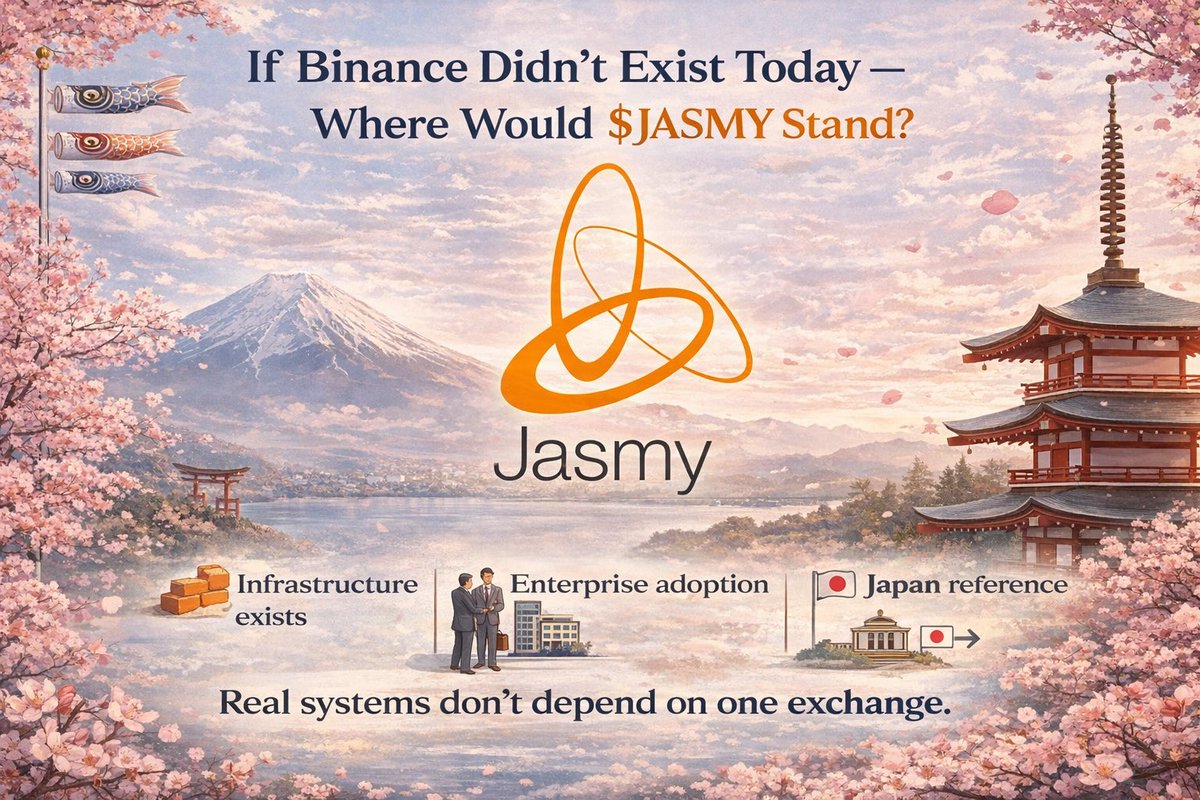
❓ If Binance Didn’t Exist Today — Where Would $JASMY Stand?
Let’s remove Binance from the equation for a moment.
No tags. No pressure. No demands.
Just one honest question:
👉 If Binance didn’t exist today, would $JASMY still stand?
1️⃣ Does the infrastructure still exist?
Yes. ✅
$JASMY was not built around any single exchange.
Its foundation lives at the system layer ⚙️
•🪪 Digital Identity (DID)
•🔐 Personal Data Locker (PDL)
•🖥️ KYM / SecurePC
•🏢 Enterprise-grade data & device security
These systems do not rely on listings
They do not rely on price candles
Remove an exchange —
the infrastructure keeps running
⸻
2️⃣ Would enterprises still be using it?
Yes. 🤝
Enterprise adoption is driven by:
•🛡️ compliance
•🔒 security
•📋 auditability
•⚖️ regulatory alignment
Companies don’t choose $JASMY because of price action 📉📈
They choose it because the system works
An exchange decision does not invalidate enterprise usage.
⸻
3️⃣ Would Japan still reference it?
Yes. ✅
Japanese government bodies do not operate on market sentiment
They operate on:
•📑 documentation
•⚖️ compliance
•🏗️ real-world deployment
JASMY’s PDL is referenced in areas tied to:
•🏙️ local governments
•🗂️ data governance
•🪪 digital identity infrastructure
That reference doesn’t disappear with a market label
⸻
4️⃣ So where does $JASMY’s real value come from?
Viewed only through an exchange lens
$JASMY may look externally controlled.
Viewed through a systems lens
its value comes from:
•🧱 deployed infrastructure
•🏢 enterprise adoption
•🏛️ state-level reference
•⚖️ high-compliance environments
And none of that is decided by a single exchange.
⸻
- Final takeaway
The real value of $JASMY
≠ the decision of any one exchange.
Exchanges are secondary markets
$JASMY is positioning itself inside primary systems
Without Binance,
$JASMY may lose spotlight
but the infrastructure remains
adoption continues
and Japan’s direction does not change 🇯🇵➡️
This isn’t defense.
It’s separating market noise 🔊 from system reality
#JASMY $JCT #JANCTION_Global #Jasmy_Global
#Web3Infrastructure #DigitalIdentity #JapanTech
#Binance
@HARA_JasmyCFO
@SachaGriff63504
7
24
121
3,200
2 Dec 2025
Great question. The way we see it, Sony, Jasmy and Janction sit at different layers rather than competing.
– Soneium is Sony’s own L2 infra for Web3/content.
– Jasmy is the data-rights layer (PDL/DID/KYM SecurePC), already integrated into Sony’s AKASHI and other services.
– Janction is the AI/GPU and value-flow layer built on top of Jasmy.
So even if Sony has its own chain or token, that doesn’t mean “detaching” from Jasmy – they solve different parts of the stack and can interoperate where it makes sense.
1
1
71
14 Nov 2025
Honestly, arguing with people who refuse to understand the architecture is pointless —
but answering them does help everyone else watching the conversation.
Here’s the reality they keep missing:
$JASMY is not a meme coin floating alone.
It is tied directly to an ecosystem that Japan is already integrating into public services, insurance, identity, and device authentication.
When you have:
• DID PDL recognized by national agencies
• KYM for device-level identity
• SecurePC used across regulated sectors
• JASMY Chain where $JASMY = native gas
• Compliance frameworks that 99% of crypto projects can’t even pass
…then the token isn’t “separate from the company.”
The token IS THE FUEL of that infrastructure.
If someone still thinks the tech and the token have nothing to do with each other, that’s fine —
but it doesn’t change how the architecture actually works.
Not every reply is for the FUDster.
Most of the time, it’s for the silent readers who genuinely want to understand why $JASMY is different from typical hype projects.
Fundamentals → adoption → utility → price.
Always in that order.
1
9
330
14 Nov 2025
Yes — this news can support $JASMY price long-term. Here’s how 👇🔥
1️⃣ Secure PC adoption = more enterprises entering the Jasmy ecosystem
When a product gets certified by Japan’s Life Insurance Association 🏦
it becomes deployable across the entire insurance sector.
More deployments → more usage of Jasmy’s infrastructure ⚙️
2️⃣ Jasmy Chain uses $JASMY as native gas
Every enterprise connecting to PDL / DID / KYM / SecurePC runs on the same network.
More integrations → more transactions → more gas demand ⛽📈
→ stronger fundamentals for $JASMY
3️⃣ Certification increases institutional trust
Institutions want compliance stability 🔐
Sector approval = higher chance of future adoption by gov, insurance, and finance.
Real infra tokens benefit when big industries adopt them 💼
4️⃣ It reduces “narrative risk”
Investors worry if Jasmy is real or just talk.
This news confirms:
✔️ real customers
✔️ real compliance
✔️ real sector adoption
Stronger narrative → stronger price support 🧱📊
⸻
Will the price pump today?
Probably not instantly ⏳
But does it increase the long-term value of $JASMY?
Absolutely — because ecosystem usage grows, and $JASMY is the native gas powering it ⚡🟧
That’s the real answer.
4
213
14 Nov 2025
🟧 #JASMY SECURE PC — INSURANCE ADOPTION IS NOW OFFICIAL
Here’s the full breakdown — all facts, no hype 👇🔥
🔶 1) New “Log Analyzer” = Audit Automation for the Insurance Sector 🛡️💻
From the official PR release:
• ⚠️ Auto-extract important alerts
• 📩 Daily security reports
• 🗂️ Full response-history tracking
• 📊 Dashboard: OS updates / software versions / external devices / patch status
👉 Secure PC = mini SOC in a box
👉 Built for FULL insurance audit compliance
⸻
🔶 2) Certified under Japan’s “Business Quality Evaluation Standards” 🏦📑
Secure PC is now compliant with the Life Insurance Association of Japan —
the standard every major insurer & agency must follow:
• 🏢 Nationwide life insurance companies
• 🧑💼 All insurance agents/agencies
• 📝 Annual industry audits
Not PoC.
Not testing.
Official industry-grade approval. ✔️🔥
⸻
🔶 3) #Jasmy has officially entered the Insurance Stack 🧩🔐
Insurance = one of Japan’s biggest data ecosystems:
• 🩺 health records
• 👥 customer data
• 🧾 claims
• 🕒 worklogs
• 💻 device logs
• 📘 compliance reports
Secure PC PDL DID KYM
= exactly the architecture insurance companies need.
👉 $JASMY = Insurance-grade infrastructure
👉 PDL = data backbone
👉 Secure PC = compliance auditing
👉 DID KYM = identity device trust
This is a full operational stack — not just one product. ⚙️
⸻
🔶 4) Perfect alignment with Jasmy’s Insurance Narrative 🤝✨
This connects everything:
• 🟧 Jasmy = Advisory Member (Japan Association of Insurance Agencies)
• 🗂️ Roadmap: Products for Insurance Agents
• 🤝 Partnership with iTrust (Digital Garden City Nation)
• 🖥️ BlockchainPC SecurePC used in real enterprises
• 🏅 Now: Secure PC passes national life-insurance standards
No hype — just execution. 🧠⚙️
⸻
🔶 5) This is a “Silent Enterprise Rollout” 🤫🚀
Hara’s style = ship quietly into massive sectors:
• 👥 Transcosmos (21,000 staff)
• 🖥️ VAIO SecurePC
• 🏢 Sony (AKASHI attendance)
• 🔌 Panasonic IoT
• 🚗 Toyota mobility
• 🏛️ Local governments
And now:
Japan’s entire insurance industry. 🏦🔥
This is national-scale infra — not a small update.
⸻
🧡 6) Takeaway 🎯🔥
Insurance adoption is officially here.
Secure PC is now certified for real deployment across Japan’s life-insurance sector. 🇯🇵
This proves $JASMY isn’t just “IoT” or “data.”
It’s becoming Japan’s insurance-grade digital infrastructure. 🟧⚡️
#Jasmy #Jasmy_Global #JANCTION_Global #PDL #DID #KYM #JapanTech #InsurTech @_RichardTeng @binance #BinanceTag #BinanceMonitoring
@HARA_JasmyCFO
prtimes.jp/main/html/rd/p/00…
2
25
109
3,705

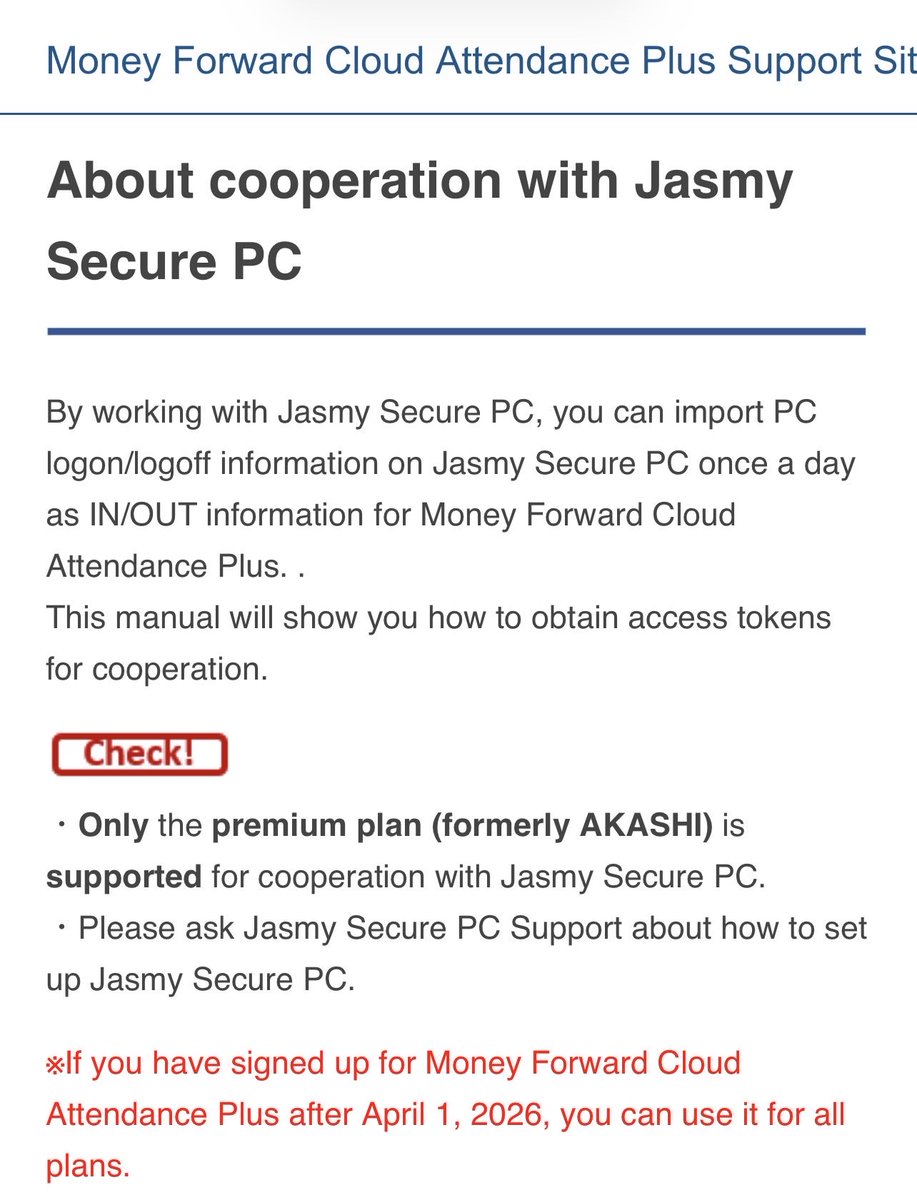
Jasmy Secure PC for Worklog has been updated!
The new Log Analyzer makes alert management easier, and ALSI’s cloud-based web filtering is now available as an optional feature.
Check it out!
#Jasmy #SecurePC #Update
14 Nov 2025

Jasmy has added a new feature, “Log Analyzer,” to Jasmy Secure PC for Worklog.
This feature automatically organizes critical alerts, records response history, and visualizes update status to reduce operational workload.
Jasmy has also introduced ALSI’s cloud-based web filtering as an optional service, enabling access control for webmail and online storage in line with industry quality standards.
prtimes.jp/main/html/rd/p/00…
#Jasmy #Security #LogAnalyzer
10
78
3,290
11 Nov 2025
✅ Point 7 — “Bring a technical point.”
You said:
None of the claims have technical evidence.
Bring real technical points.
Fair —
so here are the actual technical anchors 👇
⸻
✅ 1) Jasmy Chain → Orbit infra
Jasmy Chain runs on Arbitrum Orbit:
• inherits parent security 🛡️
• uses $JASMY as native gas ⛽
• modular execution env ⚙️
This is a real implementation, not a concept.
⸻
✅ 2) Layer separation is defined
• Jasmy Chain → infra gas settlement context
• #Janction → workload execution coordination
Clear roles → modular stack 🧩
⸻
✅ 3) Off-chain compute model is industry-standard
Workloads execute off-chain settle/coordinate on-chain
Same category as:
• Bittensor
• Akash
• Render
→ Legit, established design 🔌
⸻
✅ 4) Identity trust layer
Not marketing —
actual systems in use:
• SecurePC / BlockchainPC 🔐
• Personal Data Locker (PDL)
• iTrust integration (verified ID) ✅
Regulated enterprise-grade → real infra
⸻
✅ 5) Interoperability
CCIP integration →
enables cross-ecosystem connectivity 🔄
= concrete cross-layer behavior
⸻
✅ 6) Testnet exists
Jasmy Chain testnet is live —
tx gas behavior can be observed.
Not hypothetical 🧪
⸻
✅ Bottom line
There is technical foundation:
• Orbit infra
• native gas
• modular separation
• enterprise identity systems
• CCIP interop
• testnet live
→ This is not “no technical basis.”
It’s simply a different modular implementation than ETH-style rollups ✅
If you want to continue deeper,
we can go into:
• message routing
• workload metering
• settlement flow
• infra boundaries
I’m happy to dig into specifics.
122
11 Nov 2025
✅ Point 6 — “Team likes ≠ technical validation.”
You said:
Team members liking posts doesn’t prove anything technical.
Totally agree ✅
A like is not a spec, not code, not documentation.
But →
nobody claimed it was.
⸻
✅ 1) Social signals ≠ technical proof
A like only means:
• acknowledgment 👀
• visibility 🔎
• directional alignment 🤝
It does not equal technical validation — and that’s fine.
⸻
✅ 2) Actual validation = implementation
Real proof comes from:
• Jasmy Chain on Orbit ⚙️
• $JASMY as native gas ⛽
• workload/coordination layer (Janction) 🔧
• CCIP interoperability 🔌
• SecurePC / PDL iTrust (identity) 🔐
That’s the technical grounding — not likes.
⸻
✅ 3) Debate is about architecture
We’re discussing:
• infra vs workload roles 🧱
• modular structure 🧩
• settlement context 📦
• identity trust model 🔑
None of this depends on “who liked what.”
⸻
✅ 4) Bottom line
We agree:
Likes ≠ technical proof ✅
And since no one used them as technical evidence,
this point doesn’t change the argument.
16
11 Nov 2025
✅ Point 3 — “ $JASMY = identity trust gas”
Your argument is basically:
“There is no public identity system, no DID, and everything is centralized — so calling it identity/trust is misleading.”
Let’s clarify 👇
⸻
✅ 1) Identity =/= only DID
You’re framing “identity” narrowly as DID-only.
But in Japan, compliance-grade identity is broader:
✅ KYC / verified user identity
✅ Data-consent & auditability
✅ Policy-controlled access
✅ Enterprise identity integration
Jasmy’s identity layer revolves around:
• Personal Data Locker (PDL)
• SecurePC / BlockchainPC
• verified access → controlled data usage
That’s a legitimate identity trust foundation in regulated environments 🔐
Whether it’s W3C-DID or hybrid-model doesn’t invalidate it.
⸻
✅ 2) Trust is earned through compliance
Jasmy’s “trust” isn’t just cryptography —
it’s regulatory trust ✅
Japan FSA compliance enterprise deployment =
real-world legal trust → not marketing.
Trust here =
who owns the data who is legally accountable
That’s stronger than “anonymous DID running on-chain.”
⸻
✅ 3) Verified identity partnerships exist
The partnership with iTrust (listed company)
provides verified identity →
linked to Jasmy’s decentralized data control layer.
So:
• iTrust = verified ID
• $Jasmy = decentralized control execution
Together → identity trust infrastructure ⚡️
This directly addresses the “no verified identity” claim.
⸻
✅ 4) $JASMY as gas is already live
Since Jasmy Chain (Orbit) launched testnet:
$JASMY is native gas.
That part is not marketing —
it’s implemented.
So the token does serve an infrastructure role 🔌
⸻
✅ Bottom line
JASMY’s role =
✅ Identity via PDL SecurePC
✅ Trust via FSA-compliant architecture
✅ Gas on Jasmy Chain (Orbit)
It’s not “just centralized marketing.”
It’s hybrid identity infra aligned with Japanese regulation —
which is exactly why enterprises can use it.
167
9 Nov 2025
Bro, you’re mixing up facts with frustration 😂
1.$Jasmy didn’t “fail partners.”
Real deployments exist:
• Sony / VAIO SecurePC
• Transcosmos call-center rollout
• Panasonic IoT platform
• Toyota mobility R&D
= That alone kills your narrative ✅
2.$JCT wasn’t created “out of nowhere.”
It’s a different layer:
• $JASMY = identity trust gas
• $JCT = workload / execution market
Two different functions → not replacements.
3.“5 more years” is just vibes.
Mainnet infra compliance are already live.
Companies are building now.
If you’re gonna criticize, at least come with real info, not fan fiction 🤝
It’s okay not to understand the architecture.
Just don’t yell confidently from the wrong mountain 🤷♂️
3
251