

they're going to do a socialgraph i bet
its worth it for Alon and crew if they can get users on @CoinComms
it'll be silly not to hold some . this is probably the most organically formed community so far there
EbnLFfTrjCRayJgVb4TVwmSn1kFTrnHHnfLmAJQLpump

i can totally imagine alon/pump posting this
"community rallies together on CoinComms to force us to do an airdrop"
tokens pumps to 9 figs. Alon then says yep that is your $PUMP airdrop .
also, this could be used for any projects, not only pump
im bullish
1
4
939

GM builders
The biggest lie in the creator economy is that you dont own your social graph. Every platform locks your network behind their walls, turning your hard earned connections into ephemeral data they control. Your influence is rented, not owned.
This is where @wallchain breaks the cycle. It isnt just measuring attention; its constructing a composable and protocol agnostic social graph layer. Your persistent contribution onchain translates into a verifiable, interoperable social primitive that you actually own.
Imagine porting your entire reputation and trusted network across any DAO, any dapp, any future social platform. Thats what real social ownership looks like. Not fleeting engagement, but durable, portable capital. The future of social capital is being built here
#AttentionFi #SocialGraph #Web3Infrastructure $WALL

41
58
842

May 6
Cross-context Personal Knowledge Base with Social Graph🧠
Introducing Cross-context Personal Knowledge Base with Social Graph. Your Memory, Across Every Conversation
Most AI forgets you the moment a chat ends. Teamily's Personal Knowledge Base remembers — across every group, every agent, and every context.
Powered by your social graph, it connects the dots between your work, relationships, and ideas, so your AI always knows who you are, what you care about, and what happened before.
No setup.
No tagging.
Just intelligence that grows with you.
🙌Try the prompt today:
“visualize my knowledge base with social graph”
#teamily #AI #Agent #KnowledgeBase #Social #SocialGraph
6
3
18
13,332

Apr 28
The first XChat directory is here for anyone building, exploring, or tracking the XChat ecosystem @xchat_show the earliest tools often define the first wave of growth #XChat #EcosystemTools #SocialGraph #ProjectRadar x.com/xchat_show/status/2048…
💼 🎊 🌻 💎 🚀

9
35

Apr 23
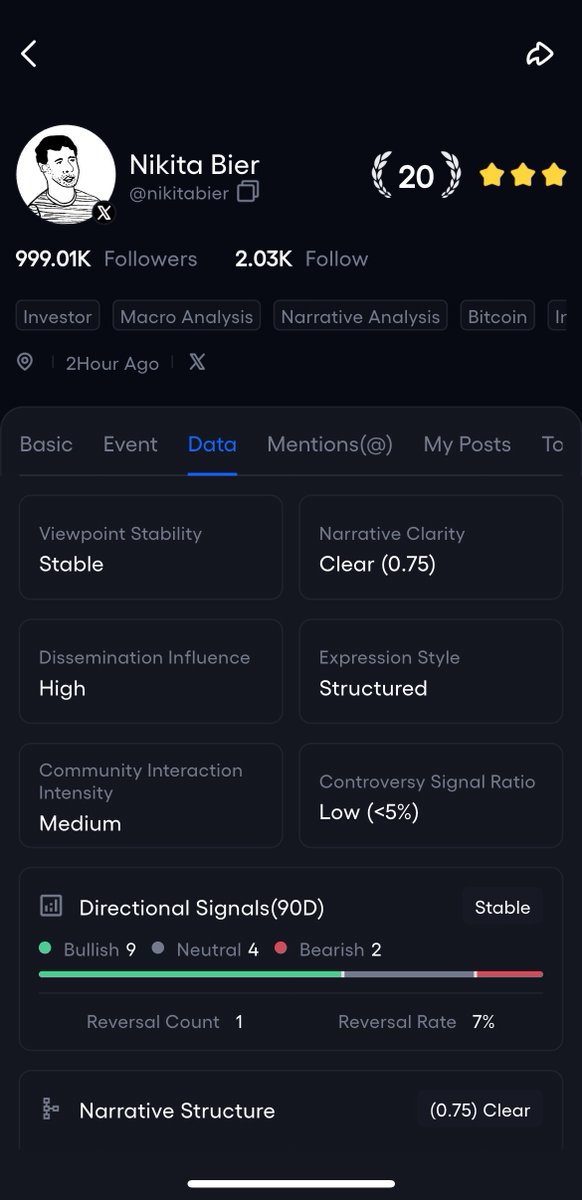
TruthX Most Buzz | Nikita Bier
Is X shifting from interest-based forums to real-time chat infrastructure?
Signal Trigger: Mentioned by 46 KOLs in the past 24h
@nikitabier X announced it will discontinue Communities on May 6, citing extremely low usage and a disproportionate share of spam, scams, and malicious reports. The feature will be replaced with a stronger focus on XChat, including joinable public group links.
Some users support removing spam-heavy spaces, while active community moderators criticize the move, warning about reduced engagement and audience fragmentation.
Key Signals
• X continues consolidating overlapping social layers into fewer, higher-engagement surfaces
• Interest-based “communities” are being replaced by real-time chat-based interaction models
TruthX Insight
• Signal Type: Product strategy shift / Social graph restructuring
• Confidence: High
• Market Impact: Social platform design
Verdict
— X is moving away from static, topic-based communities toward real-time, link-driven interaction layers.
— This reflects a broader platform trend: reducing fragmented engagement surfaces in favor of unified attention flows.
KOL Profile
Nikita Bier: X Product Direction/ X engineering leadership)
Signals typically reflect platform-level changes in engagement mechanics, social graph design, and attention distribution architecture
Track real-time KOL & narrative signals on TruthX
👉 truthx.com
#TruthX #X #NikitaBier #SocialGraph #XChat #ProductShift #AttentionEconomy
8
82

Apr 20
Web3 social graphs AI recommendations = discovery without surveillance capitalism #SocialGraph #AI #Privacy
2
1

Apr 13
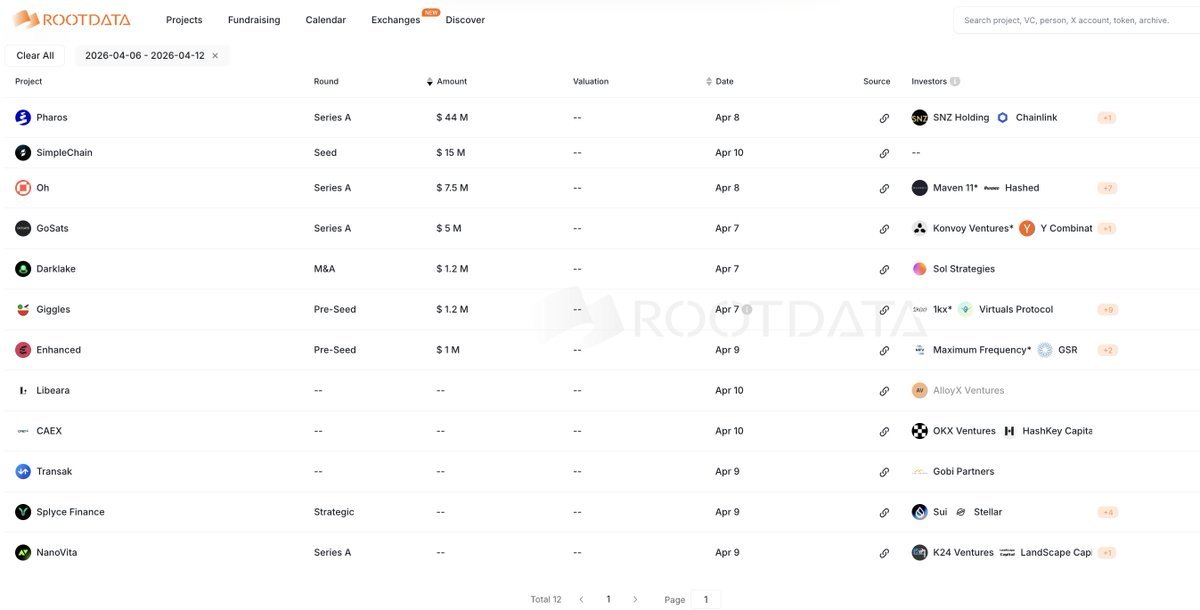
最近的加密融资数据,还是很活跃的,不过号称融资 44m 的 Pharos 有点不好相信,大概率是刷数据的吧。
- Oh @ohdotxyz 面向数字创作者的AI基础设施和产品
Series A 轮,融资 750万美元。投资方:Maven11 Capital、L1D、Hashed 等。
- GoSats @gosatsapp Series A 轮,融资 500万美元。
投资方:Konvoy Ventures、Y Combinator、Taisu Ventures 等。
- Giggles @giggles_app 社交交易平台
Pre-Seed 轮,融资 120万美元。投资方:1kx、Virtuals Protocol、SocialGraph VC 等。
先关注下

💡Latest Claimed Project
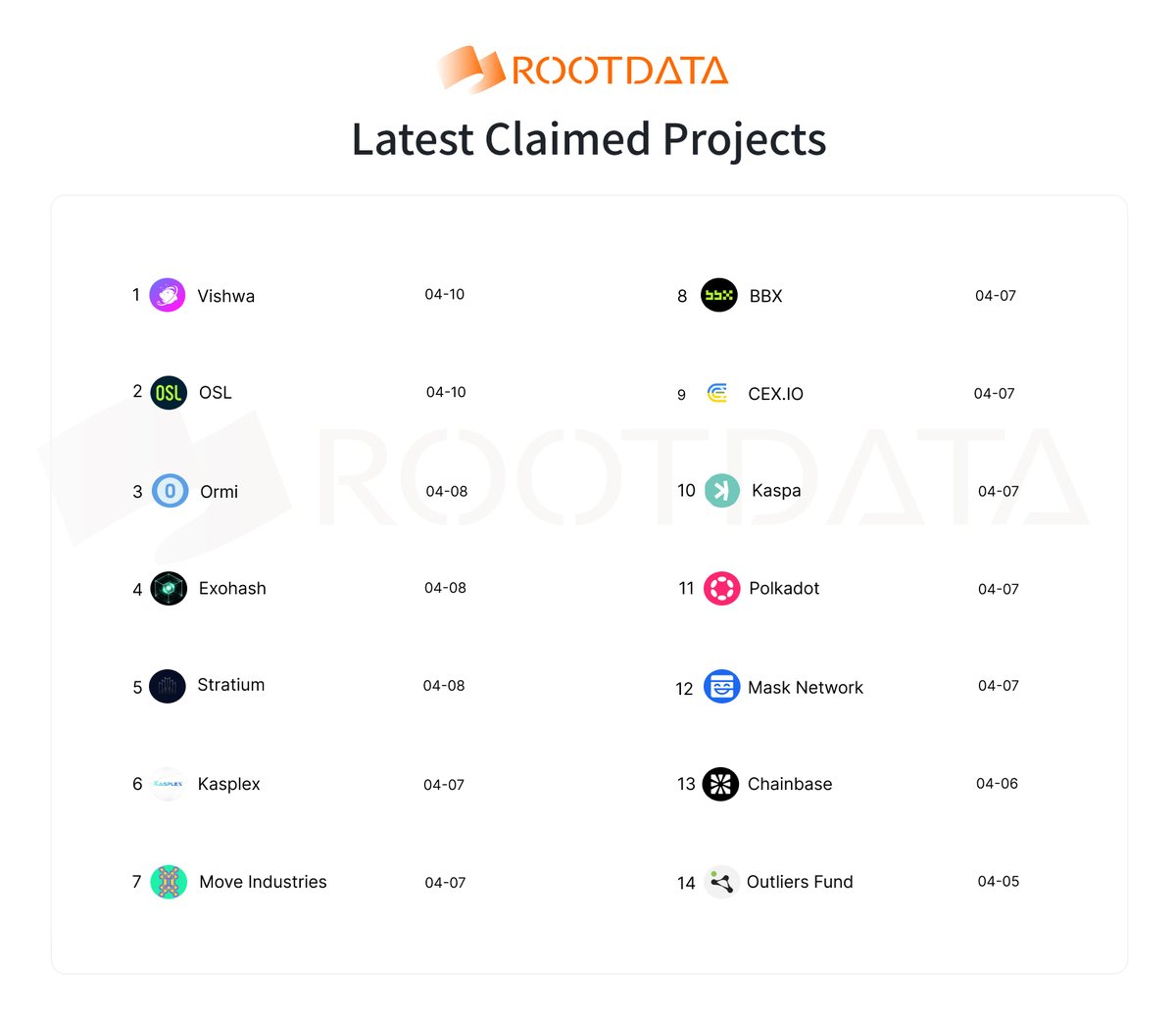
This week, 14 projects have claimed their profiles on RootData, which including @osldotcom , @Polkadot , @masknetwork , @ChainbaseHQ and more. Projects that completed verification and updated their information this round saw their overall Transparency Score jump by an average of over 55%. Some experienced a staggering 120% increase in heat and visibility on RootData, which has significantly boosted community trust and market attention. To date, more than 130 projects have now completed official verification.
Claim your project for free, get verified, and directly manage & update project's profile in our backend, leading to higher-quality and more precise exposure across RootData and our network of over 220 data partners.
👉 Claim now:
rootdata.com/Projects/submit…
2
1
6
1,531


O Algoritmo do X e a Falácia da Conexão: Uma análise sob a ótica de High-Assurance e Formal Methods
Como engenheiro focado em métodos formais, estou acostumado a lidar com sistemas onde a confiabilidade é baseada em provas e propriedades verificáveis. No entanto, o que vemos hoje no algoritmo do X é o oposto: a substituição da semântica das relações humanas por uma otimização probabilística cega.
#FormalMethods #HighAssurance #XAlgorithm #SoftwareEngineering #DataEthics #SocialGraph #Algoritmo
1
116

Apr 1
The social graph isn't just a map; it's a dynamic, living ecosystem. Most wander aimlessly; a few learn to navigate.
Every interaction, every connection, every shared idea shapes the currents of this digital landscape. Without understanding its hidden pathways, you're at the mercy of its flow.
But what if you could see the currents? What if you could choose your trajectory, not just drift?
Wallchain transforms the unseen into the navigable.
It provides the intelligence to understand the social graph not as chaos, but as a system of interconnected nodes and flows. Your XScore becomes your compass, guiding you through the most influential pathways. Quacks reward the deliberate, strategic movements that allow you to master this complex terrain.
Stop being a passenger. Start being a navigator.
@wallchain
#Wallchain #SocialGraph #AttentionFi

5
7
44

Mar 30
Excited to collaborate with @tiltedxyz ! 🤝
By integrating Tilted’s real-time data layer with UXLINK’s 55M users and massive Social Growth Layer, we’re doing more than just connecting people — we’re structuring the future of Web3 intelligence.
Together, we’re turning social engagement into a high-value data economy. The next chapter of decentralized growth starts here. 🌐🚀
#UXLINK #Tilted #Web3Social #AIData #SocialGraph
Mar 27

Tilted 🤝 UXLINK
We’re excited to partner with @UXLINKofficial, the world’s largest Web3 social platform connecting millions of users through decentralized social networks and growth infrastructure.
UXLINK brings a powerful social ecosystem with 55M registered users and hundreds of ecosystem partners.
Tilted adds a real-time data layer — transforming streams, gameplay, and community activity into structured datasets through their Tag & Earn system.
Together, they explore how social networks, AI data infrastructure, and creator participation can unlock new forms of engagement and intelligence across Web3 communities.
From social graphs to real-time data economies — the future of decentralized engagement is being built.

27
26
39
5,453

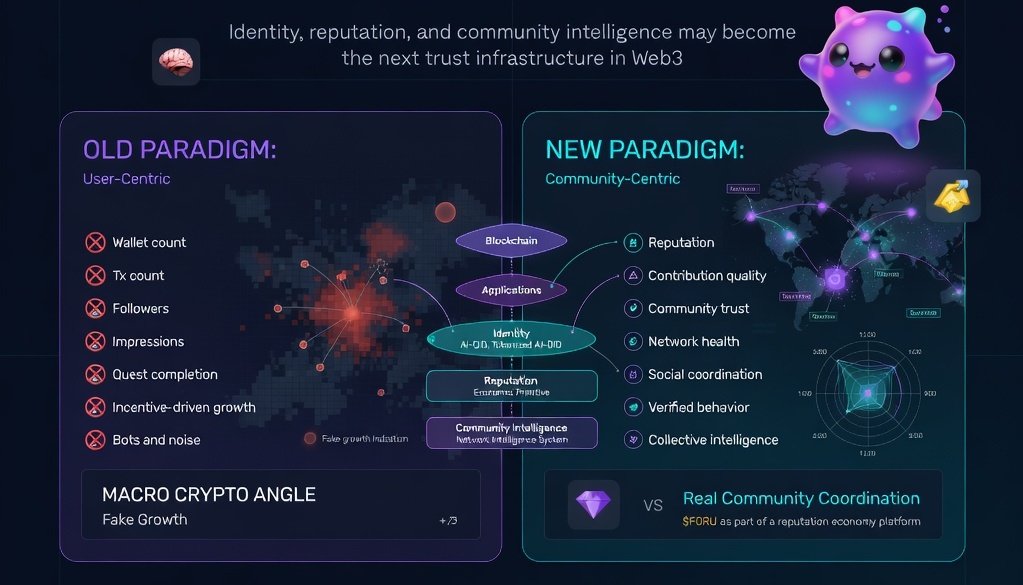
While many projects measure users, ForU is starting to measure communities.
ForU V2 is interesting not only because of the AI narrative, but also because it shifts from focusing on individual users to reading communities as living data layers.
It's a seemingly simple change, but it has significant implications.
In crypto, we've been using superficial metrics for too long
• wallet count,
• transaction count,
• followers,
• impressions, and quest completion.
The problem is, these numbers often fail to differentiate between genuine growth and incentivized growth.
Crowded doesn't necessarily mean healthy. Big doesn't necessarily mean strong. Active doesn't necessarily mean trustworthy.
This is where ForU V2 direction begins to shift.
From what I've read in the docs, ForU initial phase involved building a foundation of identity and reputation through AI-DID, tokenized AI-DID, and IdentiFi scores. In the current phase, they've shifted to the Community Intelligence Engine & Repper Leaderboard. This shows their focus is broadening not just understanding who their users are, but also the quality of the surrounding network.
This means the question is no longer simply who is the most active ??
But rather is this community organic or not ??
Is trust built or just noise ??
Are contributions consistent or seasonal ??
Who is truly a key node in the spread of value ??
This is crucial.
Bcz more & more ecosystems can buy attention, rent engagement, and push dashboards to appear growing. But once the incentives stop, many "communities" immediately appear empty.
So, if a project starts focusing on reputation infrastructure and community intelligence, I think it deserves more serious attention.
What's interesting is that ForU doesn't just talk about identity as a static credential.
In their docs, AI-DID is created as an identity that is continuously updated based on verified behavior and activity, while C-DID is used to capture the behavior of the community as a collective entity. This differs from identity models that simply answer "who are you," because ForU also wants to answer "what is your contribution trajectory" and "what is your context within the network."
If this model matures, the impact could be far reaching.
For campaigns, it could help distribute rewards based more on the quality of participation, rather than just volume.
For communities, it could help differentiate between real contributors and accounts that appear when incentives are introduced.
For the AI ecosystem, the direction is also becoming more connected because their latest whitepaper frames ForU as a trust layer for the AI economy, not just a simple reputation dashboard.
At that point, $FORU becomes interesting to monitor not just as an ecosystem token, but as part of a utility engine connected to platform usage.
Their tokenomics documents even discuss usage driven value accrual and buyback programs, so the narrative isn't just about tokens.
I think the big thesis is here
The previous cycle was driven largely by liquidity. The current cycle is driven by attention. The next cycle may be increasingly determined by verifiable trust.
If that happens, then reputation economy platforms and tokenized AI-DID won't just be niche narratives, but could become important foundations for social coordination on Web3.
The big question remains is the crypto market truly ready to value reputation as highly as it values liquidity ??
@foruai @BNBCHAIN
#FORU #FORUAI #Web3 #ReputationEconomy #AI #SocialGraph
16
1
18
440

Mar 13
🚀 Real ID: Your Web3 Digital Identity, Connecting Humans & AI 🚀
Take control in the decentralized world. 💪
Real ID lets you create your ID, build a trusted social graph, and connect with Agents—powering human-AI collaboration. ✨
🔑 Create Your ID: One-click self-sovereign DID—you own the keys.
🌐 Build Social Graph: Connect with users to form trusted networks.
🤖 Connect Agents: Link with various Agents via authorized connections.
✅ Grant Permissions: Agents act for you within set rules.
🛡️ Two-Way Protection: Users endorse trusted Agents—secure and transparent.
Join Real ID and unlock endless possibilities! 👋✨
#Web3 #DID #AI #SocialGraph

2
1
4
144

Mar 3
Phoenix Scoring, Embedding Models, and Algorithmic Judo on the @X Social Graph
Blogger: bryantmcgill.blogspot.com/20…
Soundcloud: soundcloud.com/bryantmcgill/…
Obsidian: bryantmcgill.xyz/articles/Ph…
Substack: bryantmcgill.substack.com/p/…
This is a precise field manual on the live mechanics of X’s recommendation graph. Phoenix scoring and embedding models, operational since their public core in 2023 and refined through 2026, treat every account as a node in a directed weighted social graph. Edges are likes, replies, views, blocks, reports. Your internal embedding vector updates continuously through neighborhood aggregation. Social Vector Sinks are nodes whose sustained interactions trigger associative multipliers that pull surrounding signals into low-integrity manifolds, throttling distribution and poisoning reach. Through two live specimens from late February and early March 2026—one in the Anthropic “Department of War” red-line thread, one inside the viral Tyler Oliveira “New Jersey’s Jewish Invasion” documentary branch—I demonstrate exactly how these sinks operate, whether they emerge naturally from legacy grievance archetypes or are deliberately cultivated by social media management firms working in tandem with platforms and corporations like Anthropic to dampen unwelcome signals. This piece equips you to identify the pattern, sidestep the drag, and execute the judo inversion that turns the dampener into the contained specimen. Above all it exposes the abuse potential: built-in algorithmic tools meant for quality filtering can be weaponized to silence dissent, and the antisemitic-trope layering seen in specimen two is not fringe noise but a high-friction vector that corporations can exploit to quarantine pro-pluralism or sovereignty voices while preserving plausible deniability.
I wrote this as a field manual and a public lesson at the same time. If you keep reading, you’ll see how X’s Phoenix scoring and embedding models behave in the wild: how your account is treated as a node in a directed, weighted social graph, how your internal embedding shifts through neighborhood effects, and why negative signals—blocks, reports, “not interested”—carry outsized weight that can quietly throttle distribution. I define what I call Social Vector Sinks—accounts and micro-clusters that act as low-integrity attractors in embedding space—and I walk through two live specimens from late February and early March 2026 showing how even light engagement can trigger associative drag that poisons reach by guilt-by-association. But this isn’t just diagnosis; it’s pedagogy. I’m using real encounters to teach the reader the mechanism in motion, then demonstrate algorithmic judo: a containment protocol that refuses sustained mutual edges, maps the manifold privately, and ends with a clinical public reframing that turns the dampener into a labeled exhibit—so silent scrollers learn the system while the sink loses oxygen. Whether these sinks emerge naturally or are deliberately cultivated, the dynamics are the same, and by the end you’ll know how to spot them, avoid the pull, and convert high-friction engagement traps into high-signal civic and strategic instruction.
#PhoenixScoring #TweepCred #Algorithm #Algorithms #EmbeddingVectors #SocialGraph #Sinks #SMM

1
5
7
1,695


#SocialGraph is a term used not just by @WhatsApp but also all so-called technical giants.
I have disabled social graph for @Google all services, @SamsungIndia across all devices and @Microsoft.
@GoI_MeitY, @AshwiniVaishnaw, @PIBFactCheck do these #WhatsApp scams on tracking us
1
3
315

Feb 5
Attention is easy to ignite
What matters is whether it can be carried forward
The real divide in any ecosystem is simple:
do incentives reward moments, or do they sustain builders?
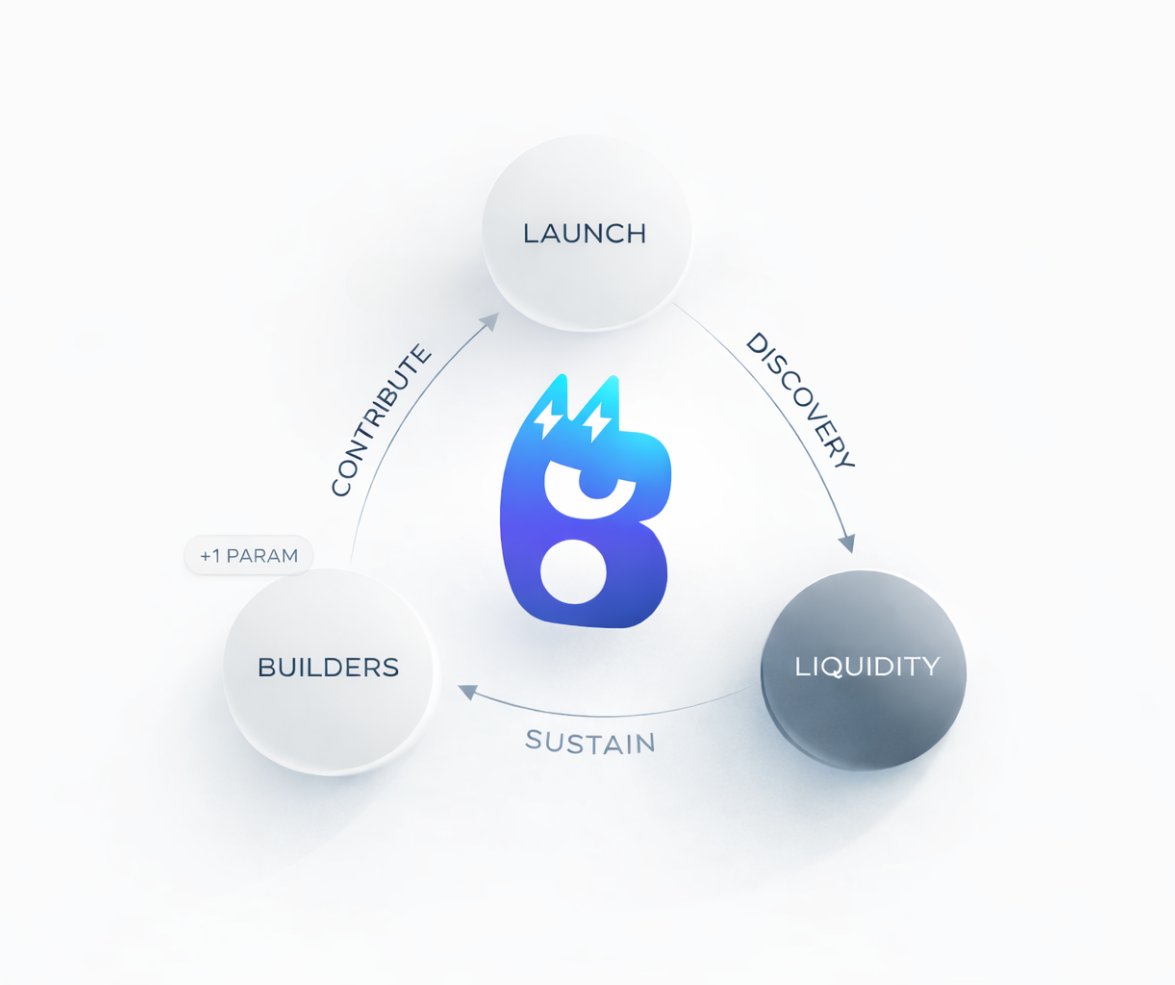
Tyche is designed around the latter:
▪️Genesis aligns early distribution with real contribution through SP
▪️Builder Lanes provide structured paths for Advanced Launch, Liquidity, Governance, and Ecosystem — with verifiable milestones
▪️Sustaining phases rely on the Builder Pool, where rewards follow depth and time, not short-term bursts
Turn attention into depth. Turn depth into a community order that lasts
#Tyche #BTCFi #SocialGraph #Bitcoin #BTCDEX #Runes

1
4
199


Feb 4
Time to spin it up
New flywheel loading🔁
One extra parameter — big shift
Built for Bitcoin Runes
◼️◼️◼️◼️◼️◼️◼️◼️◼️◻️
#Tyche #BTCFi #SocialGraph #Bitcoin #BTCDEX #Rune #launchpad
5
214