

@Actor_Mahendran வீட்டிலிருந்து மின்சாரம் எடுத்துக் கொள்ளவும்.. பில் அவர் கட்டிக் கொள்வார்..

4100 followers!
I just hit 4k last week, dang.
Thanks all!
Be sure to claim a free solarsystem⤵️
waypoint.shinythings.space (just ask your ship ai how!)
Be sure to play my latest ⤵️
Fableboy.shinythings.space
3
163

நம்ம மாஸ்டர் மொத்த 'சோலார் சிஸ்டத்துலயும்' ரெண்டு வயரைச் சொருகி மோட்டார் ஓட்டப் பாக்குறாரு! உலக மகா சயின்டிஸ்ட் ப்ரோ நீங்க!"
#Solarsystem
@Actor_Mahendran
48

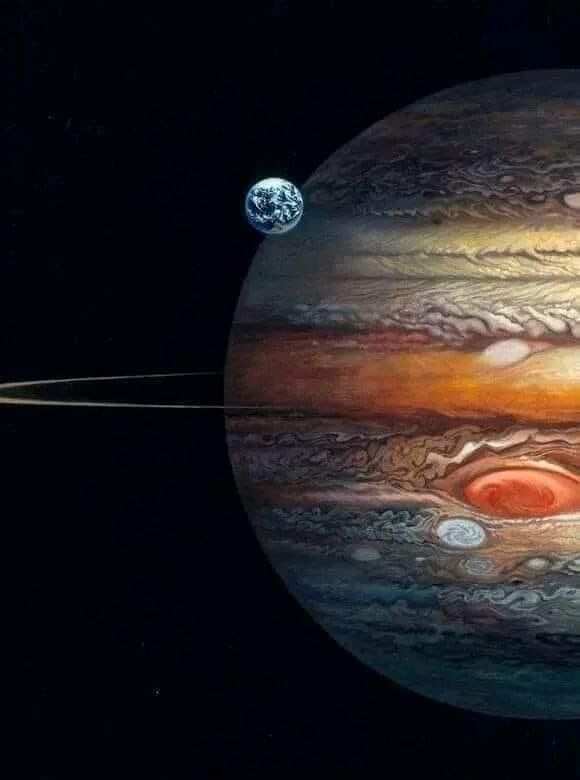
The sheer size of Jupiter is difficult to comprehend.
The giant planet is so vast that more than 1,300 Earths could fit inside it by volume. As the largest planet in our Solar System, Jupiter dwarfs every other world, reminding us just how small our home planet is in the cosmic scale.
A true giant among planets.
#Jupiter #Earth #SolarSystem #Space #Astronomy
2
4
32
1,184
sethu pathi retweeted

ஒரே டவுட்டு தான்… @Actor_Mahendran இவன் கிட்டலாம் ஏன் அரசியல் கேள்வி கேக்குறீங்க? 🤔
@TimonTheFire @iam_Vetti
#Solarsystem
1
11
52
481

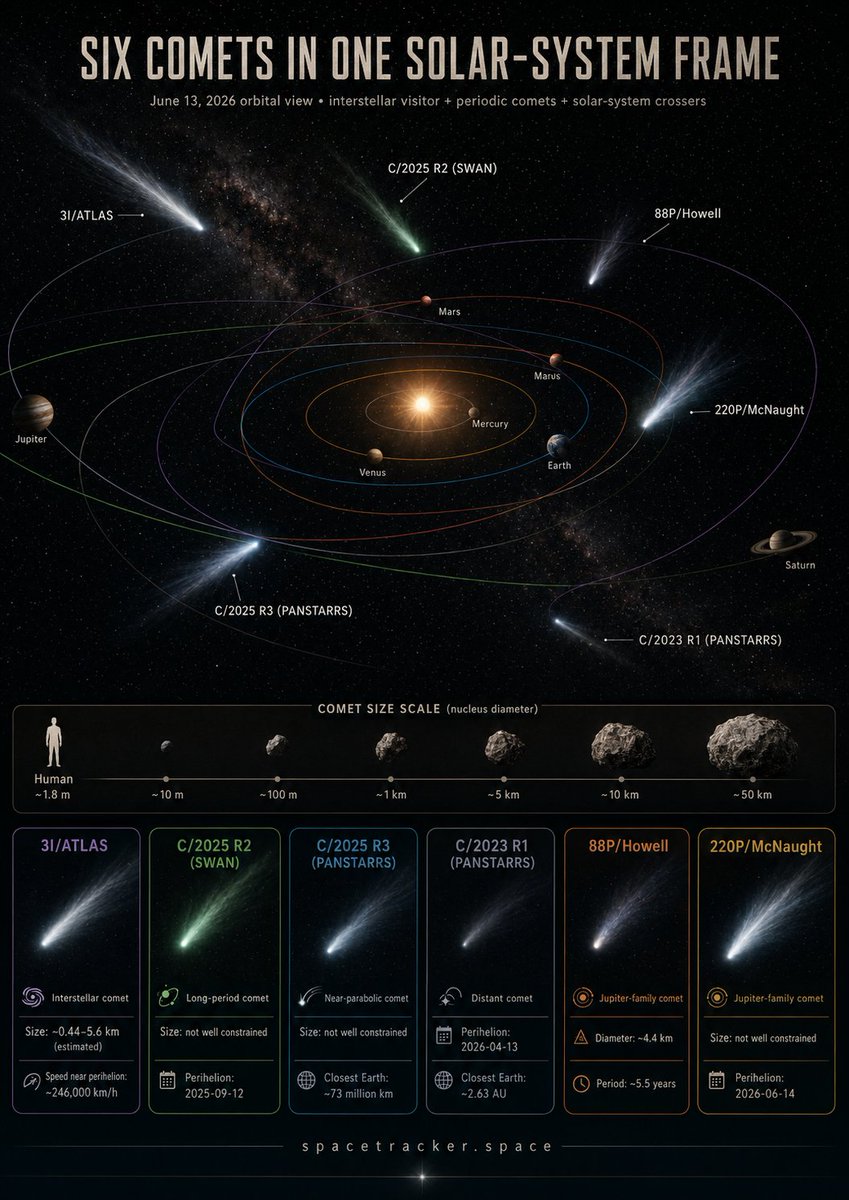
🚨 BREAKING: Six Comets Captured in One Solar-System Frame
3I/ATLAS • C/2025 R2 SWAN • C/2025 R3 PANSTARRS • C/2023 R1 PANSTARRS • 88P/Howell • 220P/McNaught
June 13, 2026 orbital view • Interstellar visitor • Long-period comets • Jupiter-family comets
Credit: spacetracker.space
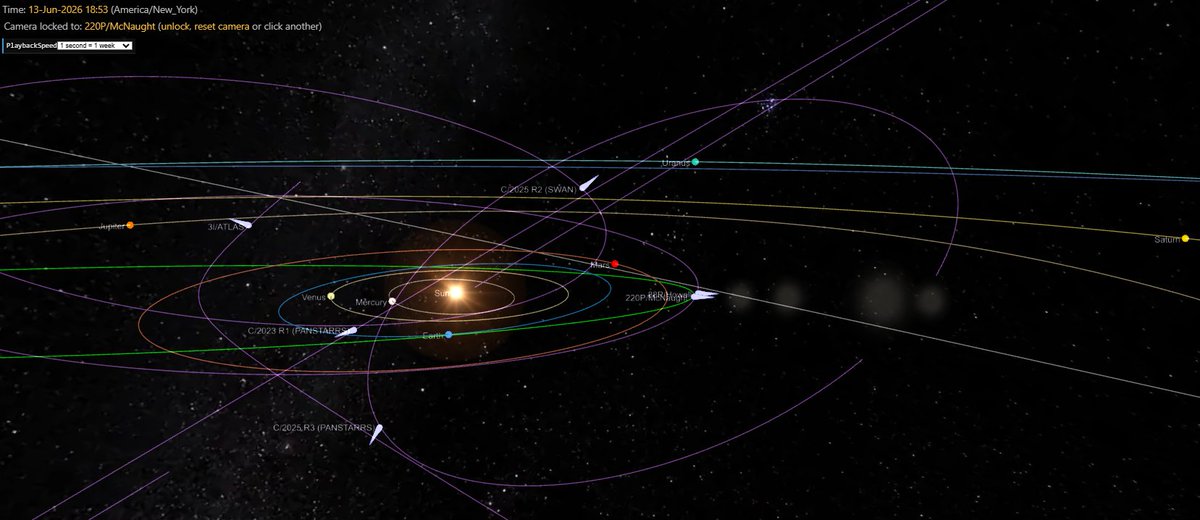
A new orbital-map view from June 13, 2026 shows a remarkable comet traffic scene across the inner solar system. The image is not a telescope photo. It is an orbit simulation showing comet paths, planetary positions, and the geometry of several active cometary bodies moving through the same solar-system region.
The objects visible include 3I/ATLAS, C/2025 R2 (SWAN), C/2025 R3 (PANSTARRS), C/2023 R1 (PANSTARRS), 88P/Howell, and 220P/McNaught.
This is not an impact warning. It is a scientific snapshot of comet motion, solar heating, dust activity, gas release, and orbital diversity.
SOLAR-SYSTEM COMET TRAFFIC - JUNE 2026
C/2025 R2 SWAN C/2025 R3 PANSTARRS
\ /
\ /
3I/ATLAS --------\---------------------/------ interstellar escape path
\ /
\ /
Jupiter Mars / Earth / Sun
88P Howell
220P McNaught
🌌 PILLAR 1 -3I/ATLAS: The Interstellar Visitor
What it is:
3I/ATLAS is an interstellar comet. That means it did not originate as a normal bound object orbiting the Sun. It entered the solar system on a hyperbolic path and is leaving again.
Discovery:
It was discovered on July 1, 2025 by the ATLAS survey.
Perihelion:
Its closest approach to the Sun occurred around October 29–30, 2025, at about 1.4 astronomical units, just inside the orbit of Mars.
Closest approach to Earth:
It stayed far from Earth, with closest Earth distance around 1.8 AU. It was never an impact threat.
Speed:
NASA reported it moving at extremely high interstellar speed: about 221,000 km/h at discovery and roughly 246,000 km/h near perihelion.
Mass:
A confirmed mass is not available from the orbital image. Mass should not be claimed from this screenshot. Size estimates and nucleus constraints exist, but mass depends on density and shape, which are not directly measured from the simulation.
Material and chemistry:
JWST observations showed an unusually carbon-dioxide-rich coma, with water, carbon monoxide, water ice, dust, and carbonyl sulfide also reported. This makes 3I/ATLAS one of the most scientifically important comet objects in the scene.
Tail / anti-tail status:
A cometary coma and dust/gas activity are confirmed. A specific anti-tail claim should not be made from this orbit screenshot alone.
Scientific importance:
3I/ATLAS is the strongest science object in the frame because it carries material from outside the solar system. It gives astronomers a rare chance to compare chemistry from another star system with comets formed around our Sun.
Status:
☄️ Interstellar
🌍 No Earth danger
🔬 High scientific value
🧪 Unusual CO₂-rich chemistry
🟢 PILLAR 2 - C/2025 R2 (SWAN): The Solar-Wind Discovery Comet
What it is:
C/2025 R2 (SWAN) is a long-period comet found in solar-observing data.
Discovery:
The Minor Planet Center recorded reports of cometary activity after the object was detected in SWAN imagery. The comet became widely followed because it appeared close to the Sun and then brightened enough to attract attention from skywatchers.
Perihelion:
It passed closest to the Sun in September 2025, at roughly half the Earth-Sun distance.
Closest approach to Earth:
Its closest Earth approach occurred in October 2025 at a safe astronomical distance.
Speed:
A precise speed should not be claimed from the screenshot. Comet velocity changes continuously along its orbit, and an exact number requires an ephemeris calculation for a specific time.
Mass:
No reliable mass is confirmed from the orbit map. A comet’s brightness does not directly reveal mass.
Material and appearance:
SWAN became known as a visually interesting comet, with a bright coma and tail activity as solar heating drove gas and dust release.
Tail / anti-tail status:
Tail activity is part of its comet behavior, but an anti-tail should not be claimed from the orbital map alone.
Scientific importance:
C/2025 R2 shows how near-Sun discovery tools can reveal comets that ordinary night-sky surveys may miss until they emerge from solar glare.
Status:
🟢 Long-period comet
☀️ Solar-heated activity
🌍 No Earth danger
📡 Detected through solar-observing data
⚡ PILLAR 3 - C/2025 R3 (PANSTARRS): The Tail-Physics Comet
What it is:
C/2025 R3 (PANSTARRS) is a bright 2026 comet that became important because of its tail behavior near the Sun.
Discovery:
It was discovered by the Pan-STARRS survey in 2025.
Perihelion:
It reached perihelion in April 2026, passing close enough to the Sun for intense heating and strong tail development.
Closest approach to Earth:
It made its closest approach to Earth in late April 2026 at a safe distance of tens of millions of kilometers.
Speed:
No exact speed should be taken from the screenshot. A firm velocity needs a date-specific ephemeris.
Mass:
A confirmed mass is not publicly established from the orbit-map data.
Material and tail behavior:
This is one of the best tail-science objects in the group. Observations from solar spacecraft showed the comet’s ion tail activity as it moved near the Sun. A dust tail and ion tail are different: dust tails are made of heavier particles pushed by sunlight, while ion tails are made of charged gas shaped by the solar wind.
Anti-tail status:
No confirmed anti-tail should be stated from the screenshot alone. Anti-tail appearances are usually viewing-geometry effects caused by dust along the orbital plane.
Scientific importance:
C/2025 R3 is valuable because it shows the interaction between comet gas, dust, sunlight, and the solar wind.
Status:
⚡ Tail-physics object
☀️ Strong solar interaction
🌍 No Earth danger
📸 Important for comet-imaging observers
❄️ PILLAR 4 - C/2023 R1 (PANSTARRS): The Distant Cold Comet
What it is:
C/2023 R1 (PANSTARRS) is a distant comet with a much larger perihelion distance than the bright inner-solar comets in the scene.
Discovery:
It was identified by the Pan-STARRS survey.
Perihelion:
It reached perihelion on April 13, 2026 at about 3.57 AU from the Sun.
Closest approach to Earth:
Its nearest Earth approach occurred around June 12, 2026 at about 2.63 AU.
Speed:
No exact speed is stated from the screenshot. Because it remains far from the Sun compared with the inner comets, it is not being presented here as a high-speed near-Sun object.
Mass:
A confirmed mass is not available from the map.
Material and activity:
At more than 3 AU from the Sun, this comet is colder and fainter than the inner solar-system comets. Any activity at that distance is scientifically useful because it can involve more volatile ices than ordinary water-ice sublimation close to the Sun.
Tail / anti-tail status:
The orbit image does not confirm a visible tail or anti-tail.
Scientific importance:
C/2023 R1 matters because it represents the colder, more distant class of comet behavior. Not every important comet is bright. Some are valuable because they show how comet activity behaves far from the Sun.
Status:
❄️ Distant comet
🌌 Cold-region activity
🌍 No Earth danger
🔭 Faint but scientifically useful
🔁 PILLAR 5 -88P/Howell: The Returning Jupiter-Family Comet
What it is:
88P/Howell is a periodic Jupiter-family comet. Its orbit is strongly shaped by Jupiter’s gravity, and it returns to the inner solar system on a roughly 5.5-year cycle.
Discovery:
It was discovered by Ellen Howell in 1981.
Perihelion:
It reached perihelion on March 18, 2026, at about 1.36 AU from the Sun.
Closest approach to Earth:
Its 2026 nearest approach to Earth is listed for October 10, 2026 at about 1.50 AU.
Speed:
No exact velocity should be quoted from the screenshot. A precise value requires date-specific orbital calculation.
Mass:
A confirmed mass is not available from the orbit map. Some diameter estimates exist, but mass requires density and shape information.
Material and tail behavior:
88P/Howell is a normal active periodic comet. Its importance is not based on shock value, but on repeat observation. Returning comets help astronomers track how nuclei evolve after repeated solar heating.
Anti-tail status:
No anti-tail is confirmed from this image.
Scientific importance:
88P/Howell is valuable because repeated returns let observers compare brightness, activity, and dust output from one orbit to another.
Status:
🔁 Periodic comet
🪐 Jupiter-family orbit
🌍 No Earth danger
📆 Repeat-observation science
💥 PILLAR 6 - 220P/McNaught: The Outburst Comet in the Frame
What it is:
220P/McNaught is a Jupiter-family periodic comet with an orbit of about 5.5 years.
Discovery:
It was discovered by Robert H. McNaught in 2004.
Perihelion:
It reaches perihelion on June 14, 2026 at about 1.56 AU from the Sun.
Closest approach to Earth:
Its nearest Earth approach is listed for October 12, 2026 at about 1.02 AU.
Speed:
No exact velocity is taken from the screenshot. A precise number requires a time-specific ephemeris.
Mass:
No confirmed mass is available from the orbit map.
Outburst activity:
This is the most dramatic comet in the image. Reports in June 2026 described a major brightening event, with 220P/McNaught becoming much brighter than expected. Such outbursts can occur when trapped gas, dust, or fractured surface material is suddenly released.
Tail / anti-tail status:
Dust-tail development has been reported. An anti-tail should not be claimed from the orbit image alone.
Scientific importance:
220P/McNaught is important because sudden comet outbursts reveal unstable surface layers and volatile pockets inside a nucleus. These events help researchers understand how comet crusts fracture, release material, and change after repeated solar passages.
Status:
💥 Outburst comet
🔁 Jupiter-family periodic comet
🌍 No Earth danger
📈 Major brightness change reported
FINAL SCIENTIFIC SUMMARY
This image shows a rare comet-traffic moment, not a collision scenario.
The frame includes one interstellar comet, multiple long-period or near-parabolic comet paths, and two Jupiter-family periodic comets. Each object tells a different story:
🌌 3I/ATLAS tells the story of material from another star system.
🟢 C/2025 R2 SWAN tells the story of solar-observing instruments catching comets near the Sun.
⚡ C/2025 R3 PANSTARRS tells the story of dust, ion tails, and solar-wind interaction.
❄️ C/2023 R1 PANSTARRS tells the story of cold, distant comet activity.
🔁 88P/Howell tells the story of repeat periodic comet evolution.
💥 220P/McNaught tells the story of sudden outburst behavior near perihelion.
The strongest scientific headline is clear:
Six comet paths. One solar-system frame. No confirmed Earth danger. High scientific value.
Processed by spacetracker.space
#Comet #Comets #3IATLAS #InterstellarComet #220PMcNaught #88PHowell #CometSWAN #PANSTARRS #Astronomy #SpaceScience #SolarSystem #NASA #JWST #SOHO #Skywatching #CometOutburst #IonTail #DustTail #OortCloud #JupiterFamilyComet #InterstellarObject #SpaceNews #Astrophotography #ScienceNotHype #SpaceTracker
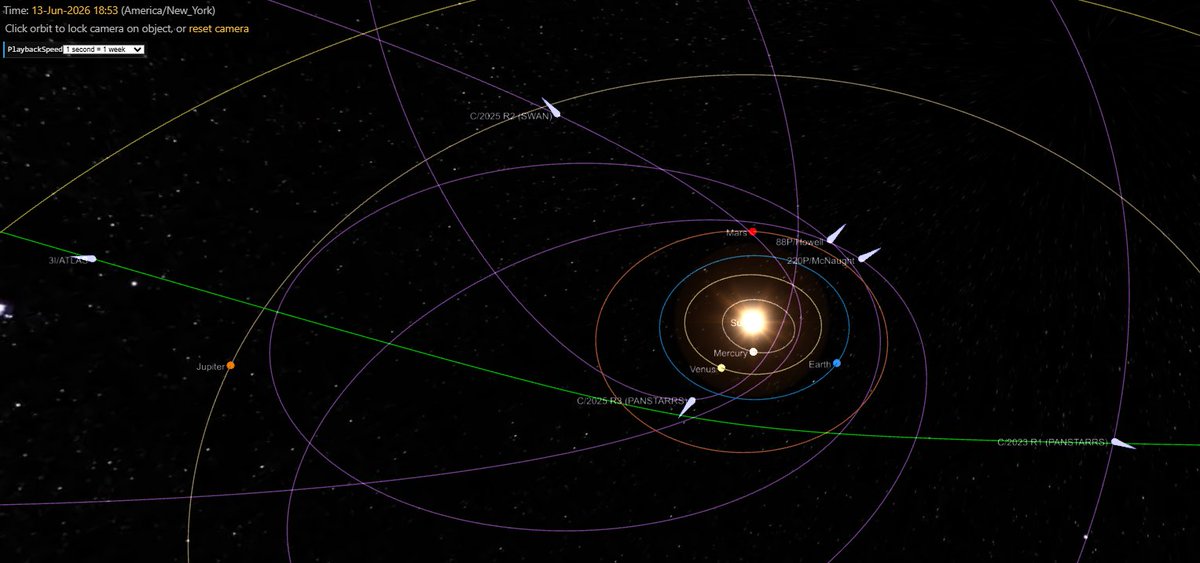
ALT 🚨 **BREAKING: Six Comets in One Solar-System Frame** ☄️🌌 A rare June 13, 2026 orbital view shows **3I/ATLAS • C/2025 R2 SWAN • C/2025 R3 PANSTARRS • C/2023 R1 PANSTARRS • 88P/Howell • 220P/McNaught** moving through the same solar-system scene. One is interstellar. Others are long-period and Jupiter-family comets. No impact warning — just a powerful look at real comet traffic around the Sun. **Credit: spacetracker.space** #Comet #3IATLAS #SpaceNews #Astronomy #SolarSystem #PANSTARRS #CometSWAN #McNaught #Howell #SpaceTracker
1
2
4
823

#Pioneer10 departed the #solarsystem #OnThisDay in 1983 after a decade of taking photos of the planets, including the first close-up images of #Jupiter...
history.com/this-day-in-hist…
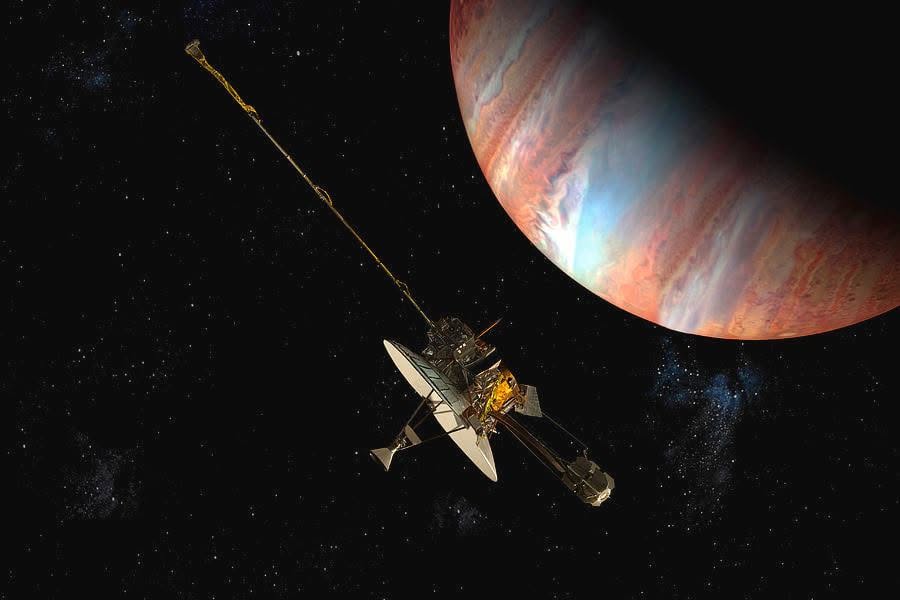
4


14h
📅 On this day, June 13, 1983
Pioneer 10 became
the first human-made object
to leave the #SolarSystem,
crossing #Neptune’s orbit.
[ A #Jun2026Post by #SidMsi ]
We aimed for the stars.
Then kept going.
#TodayInHistory #SpaceAge

10

அட. நான் கூட இவரு நல்லா தானேப்பா நடிக்கிறார், ஏப்பா இவருக்கு இன்னும் தமிழ் சினிமாவில் வாய்ப்பு நிறைய படத்துல குடுக்க மாட்டிக்கிறாங்க அப்படின்னு நினைச்சேன்.
ஆனா இப்ப தானே தெரியுது.. வாய், ஆர்வக்கோளாறு, அதிகபிரசங்கி தனம்.
இப்படி இருந்தா எப்படிப்பா
#master #mahendran #solarsystem

101
